Birdie writes "Yep. Inflation stinks. Government economic interference stinks. Got a good solution?"
Inflation does stink. No doubt about it. And you ask a very good question. Just what can be done about it. There is really only one answer and it is quite simple. It is also highly improbable that the Government would implement it.
The simple answer is to return to a Gold Standard. Now there are several ways of implementing a gold standard. One way is the 100% gold backed currency which would mean that every dollar is backed by gold. A gold standard can also be implemented on a scale less than 100% so that not every dollar is backed, say at a rate of 25%. This would give the government latitude to print more bills than they have gold for but it would still be limited so that inflation could not occur.
But like I said, that isn't likely. I give it lesser odds than Frosty surviving a vacation in Hades.
What else can be done? Largely only personal decisions and lifestyle changes. Cutting back on current spending and making that a way of life is perhaps the first step.
Living debt free is the next step which is much easier said than done of course. Some recommendations that I have seen include holding a garage sale and using that money on a bill. Everyone has things they don't need or even want anymore. EBay and Amazon are great places to sell things while getting a higher price than can be obtained via garage sales but the principle is the same, namely make money by getting rid of junk.
If moving is an option, move into a cheaper place. It is one of your biggest expenses and shaving off $200 or more a month can really make a difference. Also consider utilities and how much more it costs to heat and cool a large house compared to a smaller one. And even in that big house utilities can be cut by some simple measures.
One of my own ideas is to start a cottage industry. Make and sell crafts at the local craft shows, flea & farmers markets. Make candles or soap. Sew/crochet those handles onto kitchen towels. Make jewelry or little figurines. Make quilts, they go for a ton of money and I have even seen homemade ones in downtown shops going for $350+. Make burritos and sell them at construction sites. There are many things that you and your children can do from home to assist with the budget, all while learning useful skills.
As Triton said, it is quite possible to turn a profit in stocks. I would caution to be careful as most people lose money. That's just the way it works. I would also say never put all your money into it (or any one thing!) as one should always remember their 5 most important metals. Gold, Silver, Steel, Brass and Lead. Stay diversified in those five and it will get you through any downturn.
Showing posts with label Economics. Show all posts
Showing posts with label Economics. Show all posts
Wednesday, May 16, 2007
Economics: Deception
Just the other day it occurred to me how it is that people don't really notice how inflation eats away at their earnings. Now, everyone is vaguely aware of the problem but they don't understand just how it affects them. And I believe I have found the primary reason they don't see it.
In the course of a person's life they work various jobs and in for the majority of people those jobs are more advanced or technical or specialized. This naturally increases their worth to a company, or society if you will, and so their pay increases. So during their life, say from 16 to maybe 45 their pay continually increases because they are a more valuable asset as time goes on, and tho all the while inflation is eating away at their income it is hidden to them due to their naturally increasing worth. So what should be a time of getting ahead and building up a retirement and an inheritance for one's children instead becomes a time of barely increasing income in real terms.
To illustrate:
A man starts work flipping burgers at age 16 in 1978, working at minimum wage. We'll say he worked 40 hours a week. His gross income would have been $5,512
That same man, in his prime at 45 today would make about $40-45,000 (this is about 5-10K higher than the national average) For the following comparison I have used the more generous 45K figure.
From a dollar perspective he makes a tremendous amount more than he did as a youth, but when adds in inflation the change is not so dramatic as one might think. When the 1978 amount is adjusted for inflation it becomes $17,707. Or, looked at another way (holding everything to 1978 dollars), his income went from $5,512 to $14,007.
In terms of dollars his income increased by ~8, but in real purchasing power it increased by less than 3. The man has hardly gotten ahead, but he was able to successfully hide from himself the constant theft by inflation.
In the course of a person's life they work various jobs and in for the majority of people those jobs are more advanced or technical or specialized. This naturally increases their worth to a company, or society if you will, and so their pay increases. So during their life, say from 16 to maybe 45 their pay continually increases because they are a more valuable asset as time goes on, and tho all the while inflation is eating away at their income it is hidden to them due to their naturally increasing worth. So what should be a time of getting ahead and building up a retirement and an inheritance for one's children instead becomes a time of barely increasing income in real terms.
To illustrate:
A man starts work flipping burgers at age 16 in 1978, working at minimum wage. We'll say he worked 40 hours a week. His gross income would have been $5,512
That same man, in his prime at 45 today would make about $40-45,000 (this is about 5-10K higher than the national average) For the following comparison I have used the more generous 45K figure.
From a dollar perspective he makes a tremendous amount more than he did as a youth, but when adds in inflation the change is not so dramatic as one might think. When the 1978 amount is adjusted for inflation it becomes $17,707. Or, looked at another way (holding everything to 1978 dollars), his income went from $5,512 to $14,007.
In terms of dollars his income increased by ~8, but in real purchasing power it increased by less than 3. The man has hardly gotten ahead, but he was able to successfully hide from himself the constant theft by inflation.
Monday, January 08, 2007
Minimum Wage And Inflation
Colorado recently joined the ranks of the few States with a higher minimum wage than the Federal minimum. Colorado passed a Constitutional Amendment that grants an immediate increase and ties a yearly increase to the official rate of inflation.
Much has been said on both sides of this issue. One side says that the poor cannot live on $5.15 an hour. The other says that it will cause a loss of jobs and that those jobs are largely entry level, also that it will cause inflation. In reality, both have some truth to them. I thought I would add some sense of the economic to this issue.
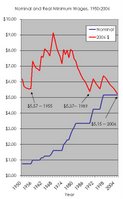 In real terms, the minimum wage has never been lower. That is, in purchasing power, when indexed for inflation at 2006 levels, the minimum wage is lower than it was in the late 1950's when it was a nominal rate of only $1/hr. This is illustrated by the accompanying chart (taken from Irregular Times)
Also, minimum wage workers are certainly not the majority and so the effects of raising the minimum would be lower due to this. The question is, just how much would that effect be? To look at that we need to determine how many people would be effected. Currently that number is about 7.3 million. Those workers are generally part time workers so I feel it is safe to work with an average 30 hour work week. That then puts those workers at making a combined total of approx $1.13 Billion a week. If we were then to add a 50% raise to those workers it would increase $564 million a week, or a total of $29.3 Billion a year. **
Now to put this in comparison we need to take note of the largest cause of inflation. The Federal Reserve. The Fed (NOT a part of the Federal Government) creates excess money at a varying rate on a weekly basis, but rarely is that number anywhere less that $10 Billion. Last week, as reported by the Mogambo Guru, "Total Fed Credit exploded by another $6.8 billion, another $8 billion of actual cash was released... Enough money was created to allow Total Commercial Paper to jump by $23.7 billion! All in one week!"
So in one week, nearly the entire inflationary effect of a years worth of raise for the minimum wage worker was created by the Fed. What this tells me is that the entire economic downside to an increase in the federal minimum wage could be offset by simply stopping the Fed from increasing the money supply for two weeks, three weeks tops.
** I realize that raising the wage for the minimum wage worker would also sweep up others who are slightly above the minimum and so the numbers would need to be reworked but I simply do not have the numbers or the time available to quantify that. If anyone has more info on that please let me know as I would gladly take a further look at this issue.
Much has been said on both sides of this issue. One side says that the poor cannot live on $5.15 an hour. The other says that it will cause a loss of jobs and that those jobs are largely entry level, also that it will cause inflation. In reality, both have some truth to them. I thought I would add some sense of the economic to this issue.
 In real terms, the minimum wage has never been lower. That is, in purchasing power, when indexed for inflation at 2006 levels, the minimum wage is lower than it was in the late 1950's when it was a nominal rate of only $1/hr. This is illustrated by the accompanying chart (taken from Irregular Times)
Also, minimum wage workers are certainly not the majority and so the effects of raising the minimum would be lower due to this. The question is, just how much would that effect be? To look at that we need to determine how many people would be effected. Currently that number is about 7.3 million. Those workers are generally part time workers so I feel it is safe to work with an average 30 hour work week. That then puts those workers at making a combined total of approx $1.13 Billion a week. If we were then to add a 50% raise to those workers it would increase $564 million a week, or a total of $29.3 Billion a year. **
Now to put this in comparison we need to take note of the largest cause of inflation. The Federal Reserve. The Fed (NOT a part of the Federal Government) creates excess money at a varying rate on a weekly basis, but rarely is that number anywhere less that $10 Billion. Last week, as reported by the Mogambo Guru, "Total Fed Credit exploded by another $6.8 billion, another $8 billion of actual cash was released... Enough money was created to allow Total Commercial Paper to jump by $23.7 billion! All in one week!"
So in one week, nearly the entire inflationary effect of a years worth of raise for the minimum wage worker was created by the Fed. What this tells me is that the entire economic downside to an increase in the federal minimum wage could be offset by simply stopping the Fed from increasing the money supply for two weeks, three weeks tops.
** I realize that raising the wage for the minimum wage worker would also sweep up others who are slightly above the minimum and so the numbers would need to be reworked but I simply do not have the numbers or the time available to quantify that. If anyone has more info on that please let me know as I would gladly take a further look at this issue.
Thursday, December 14, 2006
Econ 103 a.k.a The Inflation Monopoly Game
I touched upon inflation and it really needs more explanation as people dont really understand it or what it does.
Dictionary.com defines inflation as "a persistent, substantial rise in the general level of prices related to an increase in the volume of money and resulting in the loss of value of currency." And since I cannot improve upon that this lesson is concluded! (haha, you wish!)
So it is a rise in the general level or prices because there is more dollars in circulation, which causes each dollar to be worth less. Essentially you have an actual wealth pool of, say 100 million dollars. Now if there are 100M worth of bills floating around then the price of everything will stay the same (subject to the decreases indicated in Econ 102.) But if you add $1,000 to that 100M then what you get is a dollar that is worth just a little bit less and as a result will buy just a little less than it did before.
Inflation is a process of continually adding that $1,000 to the money supply. Each little bit isn't really noticed but together they add up to steal away the money that you have and that which you have saved. But it isn't just a piddly $1,000 being added here and there. It is usually several BILLION added. Every week. Last week it was $9.7 billion. In one week. ONE FREAKING WEEK!
If you need a mental picture or some sort of hands on activity try this. Pull out the monopoly board game. Actually, pull out two as you will need it. Have everyone start out with the regular amount of money and begin play. But everytime it is your turn, add $100 to your bank (this would grow over the course of the game). Not everyones, just yours, and watch what happens. First off you are going to have complaints, but secondly you are going to notice that as the first person to have that money you are going to benefit from it to the detriment of the other players. This is because you will be better able to buy property or pay fees. But as you start paying those fees or buying properties you are going to find that more and more money are demanded for those fee or for those properties. $400 for boardwalk? Please. Try $10,000. Why? Because you have devalued each and every dollar by adding more to what is in circulation. But what you aren't going to do is change the real cost of each property. This is because their "real cost" hasn't changed, what has changed is the value of the medium you are using for exchange so you see increased prices.
One other thing that should be easy to see in that game of Inflation Monopoly is that the other players have a hard time making ends meet. This is because they are behind the curve of the inflation. This is inevitable. Inflation must end for them to catch up but if you stop inflating then you lose your advantage over the others. An easy choice for the readers of this blog, and I would say an easy choice for power hungry politicians, bankers and behind-the-scenes power brokers. It just wouldn't be the same choice.
Dictionary.com defines inflation as "a persistent, substantial rise in the general level of prices related to an increase in the volume of money and resulting in the loss of value of currency." And since I cannot improve upon that this lesson is concluded! (haha, you wish!)
So it is a rise in the general level or prices because there is more dollars in circulation, which causes each dollar to be worth less. Essentially you have an actual wealth pool of, say 100 million dollars. Now if there are 100M worth of bills floating around then the price of everything will stay the same (subject to the decreases indicated in Econ 102.) But if you add $1,000 to that 100M then what you get is a dollar that is worth just a little bit less and as a result will buy just a little less than it did before.
Inflation is a process of continually adding that $1,000 to the money supply. Each little bit isn't really noticed but together they add up to steal away the money that you have and that which you have saved. But it isn't just a piddly $1,000 being added here and there. It is usually several BILLION added. Every week. Last week it was $9.7 billion. In one week. ONE FREAKING WEEK!
If you need a mental picture or some sort of hands on activity try this. Pull out the monopoly board game. Actually, pull out two as you will need it. Have everyone start out with the regular amount of money and begin play. But everytime it is your turn, add $100 to your bank (this would grow over the course of the game). Not everyones, just yours, and watch what happens. First off you are going to have complaints, but secondly you are going to notice that as the first person to have that money you are going to benefit from it to the detriment of the other players. This is because you will be better able to buy property or pay fees. But as you start paying those fees or buying properties you are going to find that more and more money are demanded for those fee or for those properties. $400 for boardwalk? Please. Try $10,000. Why? Because you have devalued each and every dollar by adding more to what is in circulation. But what you aren't going to do is change the real cost of each property. This is because their "real cost" hasn't changed, what has changed is the value of the medium you are using for exchange so you see increased prices.
One other thing that should be easy to see in that game of Inflation Monopoly is that the other players have a hard time making ends meet. This is because they are behind the curve of the inflation. This is inevitable. Inflation must end for them to catch up but if you stop inflating then you lose your advantage over the others. An easy choice for the readers of this blog, and I would say an easy choice for power hungry politicians, bankers and behind-the-scenes power brokers. It just wouldn't be the same choice.
Econ: 102
Another Econ lesson. Leave now or you will be forced to either learn something or take a nap.
Things get cheaper over time, in real terms. This is ALWAYS the case. Dont confuse the rising price of something with things actually getting more expensive. Things arent really getting more expensive, your dollar just buys less. That is called inflation. NOT THE SAME THING.
In Econ, "real terms" means you have to adjust the dollar for inflation from one year to the next so that you can compare apples to apples. For instance, the cost of electricity at the local co-op was 5.01 cents per kilowatt hour in 1935. The same per unit price in 2005 was 9.42 cents. But that is misleading. In "real terms" one has to adjust the cost of the two years so that they can be compared properly. If one normalizes the prices to 2005 dollars the cost of electricity in 1935 was 59.09 cents per. Quite the difference, but it is the accurate way to compare the two.So electricity was essentially 6 times higher 70 years ago. In that time the demand for electricity has skyrocketed! Back then it was a single bulb in one or maybe two rooms. Today it is well, everything.
Now you might try to apply another economic principle, that higher demand equals higher price so that it doesn't outstrip supply. Doesn't that conflict with the lower costs we see today?
Not at all. As a technology (or a manufacturing process or product) matures, more ways are found to streamline the process. New technologies are created in an attempt to make more for less. These new processes and technologies build upon each other enabling the manufacturer to make the product more efficiently, with less waste and less labor. This causes the cost of the product to fall as less money is put into the product and allows the manufacturer to sell for less in an attempt to win more market share.
So if I make 100 widgets today at a real cost of $500 today, improved techniques/processes/technologies will most likely allow me to make 100 widgets for only $400 real cost ten years down the road.
Things get cheaper over time, in real terms. This is ALWAYS the case. Dont confuse the rising price of something with things actually getting more expensive. Things arent really getting more expensive, your dollar just buys less. That is called inflation. NOT THE SAME THING.
In Econ, "real terms" means you have to adjust the dollar for inflation from one year to the next so that you can compare apples to apples. For instance, the cost of electricity at the local co-op was 5.01 cents per kilowatt hour in 1935. The same per unit price in 2005 was 9.42 cents. But that is misleading. In "real terms" one has to adjust the cost of the two years so that they can be compared properly. If one normalizes the prices to 2005 dollars the cost of electricity in 1935 was 59.09 cents per. Quite the difference, but it is the accurate way to compare the two.So electricity was essentially 6 times higher 70 years ago. In that time the demand for electricity has skyrocketed! Back then it was a single bulb in one or maybe two rooms. Today it is well, everything.
Now you might try to apply another economic principle, that higher demand equals higher price so that it doesn't outstrip supply. Doesn't that conflict with the lower costs we see today?
Not at all. As a technology (or a manufacturing process or product) matures, more ways are found to streamline the process. New technologies are created in an attempt to make more for less. These new processes and technologies build upon each other enabling the manufacturer to make the product more efficiently, with less waste and less labor. This causes the cost of the product to fall as less money is put into the product and allows the manufacturer to sell for less in an attempt to win more market share.
So if I make 100 widgets today at a real cost of $500 today, improved techniques/processes/technologies will most likely allow me to make 100 widgets for only $400 real cost ten years down the road.
Monday, June 26, 2006
Econ and Speedcams
Sifting thru DailyReckoning.com I came across a novel was of teaching Econ to younger students. In this case it was fifth graders.
The author, Arthur E. Foulkes, used novel approaches to teach these kids that Econ is all about human behaviors and actions. He demonstrates concepts such as trading, money, and savings in a memorable and easy to understand way.
Found a link to this website showing vandalised speedtraps in the comments over at Difsters blog. Apparently speeding cameras in the UK and Australia are meeting early and regular demises. Quite obviously the gov is making a killing off of them as they continue to repair or replace them.
I suppose these two subjects are connected altho I had no intention of connecting the two when I first posted this. Simply put, cameras such as these are a stealth revenue stream. Nothing more nothing less. It is no more about public safety than are cigarette taxes. Governments or businesses grow and reach a plateau and are unable to expand further unless another source of revenue is found. This often requires branching off into new enterprises. Governments seem to enjoy employing so-called "sin" taxes as they garner little to no sympathy from those whose "sin" isnt being taxed or the rate of that tax isnt being increased.
The author, Arthur E. Foulkes, used novel approaches to teach these kids that Econ is all about human behaviors and actions. He demonstrates concepts such as trading, money, and savings in a memorable and easy to understand way.
Found a link to this website showing vandalised speedtraps in the comments over at Difsters blog. Apparently speeding cameras in the UK and Australia are meeting early and regular demises. Quite obviously the gov is making a killing off of them as they continue to repair or replace them.
I suppose these two subjects are connected altho I had no intention of connecting the two when I first posted this. Simply put, cameras such as these are a stealth revenue stream. Nothing more nothing less. It is no more about public safety than are cigarette taxes. Governments or businesses grow and reach a plateau and are unable to expand further unless another source of revenue is found. This often requires branching off into new enterprises. Governments seem to enjoy employing so-called "sin" taxes as they garner little to no sympathy from those whose "sin" isnt being taxed or the rate of that tax isnt being increased.
Thursday, June 15, 2006
Inflation
In the Colorado Springs Gazette there is an article on inflation in the Business section. It lists some rather scary numbers.
From the article... "All energy prices were up 2.4 percent in May and have risen at an annual rate of 30.8 percent through May, nearly the 17.1 percent rise for all of last year." It also lists an increase of .4% for May. That is an anual rate of 4.8%, but looking at it more realistically and using the more accurate (but no longer used) old CPI it would be approximately double that at 9.6%
That racket you are hearing is the Mogambo hauling his guns up the hillside. See you up there!
From the article... "All energy prices were up 2.4 percent in May and have risen at an annual rate of 30.8 percent through May, nearly the 17.1 percent rise for all of last year." It also lists an increase of .4% for May. That is an anual rate of 4.8%, but looking at it more realistically and using the more accurate (but no longer used) old CPI it would be approximately double that at 9.6%
That racket you are hearing is the Mogambo hauling his guns up the hillside. See you up there!
Subscribe to:
Posts (Atom)