Showing posts with label warfare. Show all posts

Sunday, June 20, 2010

Professor Montonen talk on environmental impact of war

Claus Montonen at Klimaforum09 from Benno Hansen on Vimeo.

Claus Montonen, professor of theoretical physics at the University of Helsinki, Finland, speaks at "Climate change and conflict - The Danger of future wars", Klimaforum09 Sunday the 13th of December 2009 about the environmental impact of war.


Climate change will create both floods and draught and force millions of poor people to flee their homes. The world will be short of the basic needs of human beings. We will experience more conflicts about farmland, water and food. According to UN, 20 million people were made homeless because of climate related disasters in 2008. We need solutions that are social and global just and responsible. We need the money used on weapons of mass destruction and warfare to be transferred to social and sustainable development.

Also, see the events 2009 page at INES' own site (presentations and some audio) and my TH!NK2 article Klimaforum09 talks: “Climate change and conflict - the danger of future wars” (videos of the two other speakers at the event and transcriptions of selected highlights).

Saturday, June 19, 2010

UN envoy calls for tough Security Council action on recruitment of child soldiers

One of this week's UN campaign videos

"[...] today the nature of conflicts has changed dramatically. It can be prolonged by the race for natural resources [...]"

The news this week
The New York Times quotes United Nations officials and Somali human rights groups as saying the government is fielding hundreds of children, some as young as nine, on the front lines. The paper also reports that the United States, a strong backer of the government, is helping to pay the soldiers.
"[The US is] particularly concerned about the situation in Somalia [where all parties to the conflict have] placed several thousand children in the line of fire."
- US Ambassador to the UN Susan Rice

Report: Somali Government Using Child Soldiers, UN condemns Somalia's use of child soldiers, but US aid still flows, UNICEF seeks to end use of child soldiers across Central Africa.


Saturday, October 17, 2009

The military - green or black?

Destroying the Environment Is Also a War Crime
[Throughout human history there have been] many deliberate acts to destroy or exploit the natural environment to achieve military goals. In the 5th century BC the retreating Scythians poisoned the water wells in an effort to slow the advancing Persian army. Roman troops razed the city of Carthage in 146 BC and poisoned the surrounding soil with salt to prevent its future cultivation. The American Civil War saw the widespread implementation of ’scorched earth’ policies.

[...]

At this moment the world is witnessing a continuing humanitarian and environmental catastrophe in the western region of Darfur in Sudan, which has seen the poisoning of water wells and drinking water installations as part of a deliberate government-supported strategy by the Janjaweed militia to eliminate or displace the ethnic black Africans living in that region.

[...]

environmental damage and exploitation is still largely regarded, as rape once was, as an 'unfortunate but inevitable' consequence of war. It is, of course, true that war and armed conflict are inherently destructive of the environment, but that is no reason to allow leaders to deliberately or recklessly target the environment in order to achieve their military goals.


Green Camo: Seeing Through the Military’s New Environmentalism
By the Pentagon's own figures, the U.S. military uses more fossil fuels than any other single entity. But the Pentagon's figures only take into consideration vehicle transport and facility maintenance. They don’t account for the energy needed to build something like the massive imperial embassy or mega-bases in Iraq or reconstruct the rest of the country. They also don’t factor in the energy used by related branches, like NASA, the nuclear industry, or the thousands of contractors that make or do things for the military.”

Yet the U.S. military isn't listed as one of the World Wildlife Fund's 'footprint issues'. Nor is it mentioned by the Natural Resources Defense Council or Sierra Club as the largest consumer of the 'dirty fuels' both lobby against.

Wendell Berry, who … spent most of his life linking issues of the environment to the many maladies of our society, once said that just as military violence is ignored by most conservationists, violence against the earth is a matter ignored by most pacifists. The antiwar and environmental movements must bond over this common enemy and see, as Berry put it, that we cannot hope to end violence against each other until we end our violence against the earth.


The Independent / Armies around the world go green to save fuel – and lives
You could, perhaps, call it the "military-ecological complex". For the world's most powerful armies are going green, trying to kickstart an environmental-technological revolution in civvy street in the process.

[...]

Half of [the US military] wartime casualties are sustained by convoys, which are mostly carrying fuel and are a favoured target for enemies. It estimates that every 1 per cent of fuel saved means 6,444 soldiers do not have to travel in a vulnerable convoy.

One simple innovation – insulating tents in Iraq and Afghanistan with a layer of hard foam, reducing the need to heat and cool them – has saved 100,000 gallons of fuel a day. The Pentagon aims to get a quarter of its energy from renewable sources by 2025. It is to buy 4,000 electric cars (the world's largest single order) for use on its bases, and is developing hybrid armoured vehicles for the battlefield.

It has saved fuel by cutting the weight of aircraft – removing floor mats, redundant tools, loading thick manuals on to laptops, and using lighter paint – and within seven years plans to fly them on a 50/50 blend of ordinary fuel and biofuel, probably made from algae.

[...]

Scientists hope that the massive spending power of the military will spin off environmental technologies into civilian life, as jet engines, microchips, and global positioning systems did in the past. "We can be a test bed for a lot of things that normally would not seem to make powerful economic sense," said the US Assistant Army Secretary, Keith Eastin.


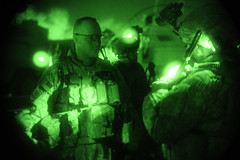
Go green, army. Photography by jrseles.


Being the devils advocate for a second: If they did go to war to secure oil in the first place how ironic if the warfare itself will lead to less need for oil!


The above stories were found at Toban Black and The Unsuitablog. Thank you for blogging.

Friday, March 07, 2008

Climate change and conflict frequency

The cornerstone of this blog here is a peer reviewed correlation of climate and war in historical China: see my first post from July 2007. I just wrote a thorough summary of the article at Shvoong.com; here's a shorter version and my own take on it.

Short summary


Zhang's study is a thorough mathematical correlation from climate to war frequency done on a macro-historical level. Warfare has already been theoretically described as an adaptive ecological strategy of humankind in situations of limited resources. Zhang provides some empirical evidence to go with the theory. The hypothesis of the study is that climate changes has catalyzed historical events by it's importance for agricultural productivity, and that temperature is the most important climatic factor due to it's very direct effect on growing season lengths, precipitation reliability, summer warmth etc.

The data used for the analysis are comprised of China's extensive historical records literally body counting 3 millennia back in time and a set of five different weather data measurements merged into one. The war data was pruned to 899 wars between year 1000 and 1911. The weather data synchronized with emphasis on the most reliable methods all of which correlate beautifully in regard to oscillations. Population data are available from year 1741 to 1851 "only".

The cold periods are defined by time frames of significantly low average temperatures. The cyclical pattern and the correlation is not just an abstract figure somewhat closer to 1 than 0. It is quite obvious how cold phases coincide with periods of high war frequency. The war periods generally lag the onset of cold phases by 10 to 30 years which makes sense since it would take some time for the reduced agricultural productivity to manifest as resource limitations and overpopulation.

The study goes into more detail; ie correlations are particularly strong for wars of type "rebellion" and stronger in the (wet, warm) south than in the (arid, cold) north. The north-south difference is explained by historical attitudes towards migration. Population growth is seen to rise (to 1.3%) during the 1741-1805 warm phase and drop (to 0.6%) during the 1806-1850 cold phase.

Zhang argues past research has been simplifying history, reducing causes of warfare to financial, political and ethnic ones while largely ignoring the ecosystem. Zhang emphasizes how current global warming is different from the warm phases of his study. However, his last words are that even if the developed world gets by most people still rely on simple farming techniques that are highly susceptible to ecological stress and that shortages of essential resources may "very likely" trigger future conflicts among groups of people.

Ecowar?


So, what does Zhang tell Ecowar? "Keep blogging"! Zhang must have been looking at some inconclusive data wondering pretty much the same thing I'm wondering when looking at the news of the world.

I have posted a bit about Jared Diamond who's straight out explaining some violence with what's basically "ecological stress". While Zhang highlights temperature drops, what we're mostly seeing right now is issues sparked from a temperature rise, ie drought. My Darfur: Drought or Islamism? post has the whole issue in it's little nutshell. Just like the Chinese food shortages inspired "rebellion", rising food prices gets today's consumers "up in arms". The UN has read the writing on the wall and has analyzed the Security risk of climate change. Et cetera, click backwards in time on my blog if you like. There are also more peer reviewed research on the subject out there which I plan to blog some time.

My enthusiasm when beginning this blog was fueled by the publication of Zhangs study. Although all I'd read was a journalist's interpretation. That article has now been pulled from the web. At the same time I have grown as weary of pseudo-science and political rants dressed as science in the blogosphere. So what better opportunity to introduce my flashy new Research Blogging icon!?


ResearchBlogging.org

Zhang, D.D., Zhang, J., Lee, H.F., He, Y. (2007). Climate Change and War Frequency in Eastern China over the Last Millennium. Human Ecology, 35(4), 403-414. DOI: 10.1007/s10745-007-9115-8


This basically means my post is about a piece of peer reviewed scientific work that I have read and understand myself. As well as a number of other criteria you can check out at Research Blogging. Anyway, I hope I just reinserted my cornerstone.


Search This Blog