Showing posts with label war. Show all posts

Wednesday, May 25, 2016

Surprise: Few wars are primarily about oil

The Washington Post recently published Oil wars: Why nations aren’t battling over resources by Emily Meierding. Does this article remove the entire foundation of this blog and the book I made of it?

Pointing at "invasion costs, occupation costs, international costs and investment costs", Emily Meierding says oil wars are just not worth fighting. With reference to The Falklands War (1982), The Iran-Iraq War (1980-1988), the Kuwait war (1990) and other wars, she argues these historical examples were about national pride, territory and Saddam Hussein's survival respectively. Similar alternative explanations for other wars.

So, why am I bookmarking this article? And why didn't I immediately delete my blog and forget about this whole thing?

Firstly, I have always bookmarked the opposing point of view. Go through my history of hundreds of ecowar bookmarks, and you will find plenty. Also see the beginning of chapter 4 (pages 74-) and the Objections part of chapter 6 (pages 123-) of my book, Ecowar - Natural Resources and Conflict.

Secondly, although Emily Meierding's headline says "nations aren't battling over resources", I don't think she really proves this statement in her text. What she does convincingly argue, is that in the cases she mentions, oil wasn't the primary causes of the conflict. To get academic about it, for each war one should list its causes and rate them in primary, secondary and even tertiary. I am guilty of having more or less skipped this discipline. But that doesn't mean conflicts with natural resources as their secondary causes aren't resource conflicts at all. For a very brief discussion of this, see the first chapter of my book or look up the works of some of the leading scholars.

What is also interesting about Emily Meierding's article, is how the discussion has gone full circle. When I first set out researching, claiming most wars were resource wars was taboo. While I wrote up the book, that changed (pages 126-128). Apparently, now it is quite main stream to associate natural resources with conflict. And what have we: An up and coming scholar seeking to prove things to be the other way around. Isn't that what we all want to achieve?


Saturday, March 09, 2013

George W. Bush is painting too many puppies

My brain was going into my feet from reading Salon.com (not The Onion) / George W. Bush’s art teacher says he’ll “go down in the history books as a great artist”.


He has painted "more than 50" puppies!?

However, after posting this breaking news to Facebook, a friend of mine pointed out the cosmos in this chaos. It's been 23 years in the making...


Too many puppies are being shot in the dark
Too many puppies are trained not to bark at the sight of blood that must be spilled so that we may maintain our oil fields
Too many puppies, too many puppies


Thursday, December 09, 2010

"Climate Wars" by Gwynne Dyer (a review / rip-off)

With a title like Climate Wars this book looks "alarmist" even to someone sick and tired of being called just that. But actually, it is far less dramatic than the action paced science fiction that may come to mind. Written by a veteran soldier with academic degrees in military history and years of experience in journalism. Based mainly on the projections made by army analysts of the world from the prognoses in the IPCC 2007 report.

For those of us with academic backgrounds in ecological science and/or a couple of years of climate debate behind us several of its chapters are climate change science and policy repetition. But for me - working on mapping the links between natural resources and conflict - chapter 1 is a great summary with extra insights to the geopolitics of predicted climate change impacts.

And the factual chapters are interspersed with scenarios which are great and briefly outlined below. Being eager to dissect the book for information I find the structure of the factual / non-scenario chapters a bit too mixed up to help make the book as a whole more of a page turning thriller. COP15, for example, is summarized in chapter 6, Real World Politics. Perhaps I could have done with the part about the Copenhagen Accord [p. 209]:
Only a last minute intervention by the British, Americans and Australians, who called for an adjournment and used it to bundle the hapless Rasmussen out of the chair [My emphasis. I have a thing about the obvious incompetence of the Danish prime minister], prevented the 'Copenhagen Accord' from being formally rejected at the plenary session. During the recess, they managed to negotiate a last minute compromise in which the accord was neither accepted or rejected. It was simply 'noted'. And with that, everybody went unhappily off to bed and thence to the airport.
But not only is that entire chapter about COP15 - the topic is mentioned several other places in the book. Similar little issues with, for example, the necessary scientific explanations which come and go in different chapters. Exactly where they are needed, perhaps, if you don't know them already and isn't a "book dissector" like me. And underlining the fact that diplomacy and war are each others extensions.

The Dyer scenarios

The future scenarios are not predictions. They are more like not unlikely cases told with some necessary filling from Dyer's imagination. The longer into the future one tries to imagine the more uncertainty is in play - but the first scenarios are quite imaginable. Although summed up in chronology below they are not necessarily interlinked while also not mutually exclusive.

Incident scenarios:
  • Scenario 2, Russia 2019: The Colder War. The oil and gas revealed beneath the melting North Pole and the new trade routes opening between fewer and fewer icebergs does not lead to war between Russia and the USA. Of course. But it does lead to a lot of discussions on interpreting traditions for drawing sea borders as well as incidents of alleged violations of said disputed borders. Not just regarding drilling but also with incidents of detained fishermen. After years of non-violent conflict - during which the negotiations under UNFCCC has suffered greatly - Russia comes out much stronger: Its northern shores have benefited most from new sea routes due to their head start with a strong fleet of sea ice capable ships and well settled infrastructure, they have strong claims for some of the new resources and it's all coupled with some positive climatic impacts on the nations agriculture.
  • Scenario 3, United States 2029: The US-Mexican border is finally sealed off forcefully and completely after surges of refugee influx caused by runaway desertification in a country whose farmers are already struggling financially. The United States of Mexico collapses and several northern regions are effectively ruled by warlords. Inside the USA a strong ethnic group of Mexican heritage is increasingly in opposition to the rest of the country.
  • Scenario 4, Northern India 2036: India and Pakistan have shared glacier fed rivers for their water supply for decades although otherwise having a periodically hostile relationship. Droughts worsened by climate change, growing populations and increasing consumption have tempted governments to blame the hardships of their peoples on externalities - the neighbours - and forced Pakistan to ration food. After years of fragile peace a military coup and an attack on a dam escalates into an exchange of nuclear warheads. The result is hundreds of millions of casualties and two devastated countries still ruled by the same governments.
  • Scenario 7, China 2042: During the '30ies two kinds of terrorist groups are added to the ones previously known to be desperate enough: some from disgruntled oil exporting countries experiencing unforeseen financial losses and some from within the West made up of "leftists" furious at their governments for doing much too little of what they have been asking for (renewable energy etc.) while stepping up efforts on what they have been arguing against (geo-engineering, nuclear power etc.). The former cannot attack inside the West and instead aim at those of their neighboring countries who have begun exporting, for example, sunlight generated power. The latter accomplishes some minor attacks on airlines and even a more serious one on a nuclear power plant. While the world heats and the people of the West become increasingly divided over geo-engineering suddenly China and Indonesia acts without anyone's agreement. The Earth is dimmed by "artificial volcanic sulfur" being released into the atmosphere. Unfortunately, shortly after the project has begun working a real mega-size volcanic eruption triples the effect. The following years harvests fail world wide: hundreds of million of people die from starvation and almost as many from the armed conflicts, local genocides and mass-migration it incites.
  • Scenario 1, The Year 2045:The EU has collapsed and the Northern Union of Scandinavia, Poland, Germany, Benelux and France is fending off hordes of immigrants while the north of Italy has separated itself from the south of Italy. Russia is enjoying relative prosperity due to positive effects on its agriculture but is also facing some trouble over disputed Siberian territories eyed by a re-united China. Britain and Japan is guarding their shores fiercely while stacking nuclear arms. Temperatures are up and still rising.
  • Scenario 6, United States and United Kingdom 2055: The American people never learned to understand the problem of climate change. Peak oil hits hard and the globalized food trade largely collapses: "in this new and unforgiving world, self-sufficiency was the sole basis for security" [p. 182]. Gulf Coast states are devastated by hurricanes and floods, California's agriculture collapses from perpetual drought. A third party - called "The Goddies" - gains major political influence and the borders are shut tight. Similarly in Europe, the northern countries are getting overrun by people leaving the southern EU states. European Union collaboration starts to strain as food aid is sent south and northern borders tighten despite treaties. Increasingly, the border patrols sealing off Africa and the Middle East is made up of soldiers from northern Europe but eventually these countries decide to pull back and guard only their own territories.
Multi-year scenarios:
  • Scenario 5: A Happy Tale: Sincere and determined action is taken to combat climate change - but only after conversely harsh shocks from peak oil causing price leaps, a series of brutal natural disasters around the world and a Bangladesh threat a radical geoengineering initiative on their own if the rest of the world does not cooperate in combination shake up humanity. Global diplomacy works - but too late and too little. A green society keen on geoengineering is created but only some are fortunate enough to survive with it.
  • Scenario 8, Wipeout: 150-200 years into the future the average temperature has climbed by about 9 degrees from failure to curb climate change. Two groups of civilized settlements survive along the Arctic shores and small, more primitive societies here and there where conditions allow. Inland territories on continents suffer complete desertification. Increasingly, the oceans start to smell like rotten eggs. A process is being initiated in which hydrogen sulfide is being released to deteriorate the quality of air for all breathing forms of life while also breaking down the ozone layer. Which in turn will help scorch the remaining life in ultraviolet radiation. Only the harshest and luckiest life forms will make it to the other side of the "greenhouse extinction" event. A phenomenon that was known to paleontologists, not climatologists. The progress of which no human will live to experience, only few will recognize as it starts.
So, Dyers book is really good. But my own will be even better ;-)

Related info
Video interview with transcript: Democracy Now!, July 2010 / Gwynne Dyer on "Climate Wars: The Fight for Survival as the World Overheats", Gwynne Dyer at Wikipedia, Gwynne Dyer's website. Plus the following video interviews / speeches:


Friday, August 27, 2010

Food & War: Highlights from 'An Edible History of Humanity'

Have been reading An Edible History of Humanity by Tom Standage. Good reading I can recommend!

You will find it interesting too if you, like me, is into Jared Diamond's books, agriculture or the more practical aspects of history. It is written in an accessible form and not quite as academic in nature as Diamond's books. If you, also like me, have already read all of Diamond's books as well as a selection of related literature and journal articles it will be repetitive at places. But at the same time full of great quotes and little stories.

The book tells the history of human civilization through the development of our food production and culture. A highly relevant book to the present blogging project although food is a special type of natural resource or products hereof and history is a wider subject than conflict.
The fate of nations hangs upon their choice of food.
 - Jean-Anthelme Brillant-Savarin
Part I: The Edible Foundations of Civilization

First, the domestication of maize, wheat and rise is retold - essential beginning of the tale. Then the spread of farming discussed. Hunter-gatherer societies have always been and still are much more peaceful than farming societies. Why and how is explored and explained in chapter 2 from reasoning with the needs and circumstances of them as well as the historical conditions.

Chapter 3: Food, Wealth, and Power

Picking up where chapters 1 and 2 left off, now the gradual transition towards hierarchical social order is described. Especially the significance of irrigation is compelling; here are a few of the explanations for the onset of organized conflict:
One theory contends that a big man or leader can become more powerful by coordinating agricultural activity, particularly irrigation. [...] control of the irrigation system would confer power on the leader [...] the irrigation system might also need to be defended, using full-time soldiers funded by the food surplus and placed under the leader's control. [p. 41]
Another theory suggests that the communal storage of agricultural surpluses might provide the leader with an opportunity to establish greater control over his followers. [...] Increasingly elaborate public-works projects then legitimize the leader's position and require a growing number of administrators, who emerge as the ruling elite. [p. 42]
A third suggestion is that competition for agricultural land led to warfare between communities in areas where such land was environmentally circumscribed. [...] When one village defeated another it then appropriated the defeated village's land or forced its people to hand over a proportion of their harvest every year. [...] This all sounds plausible, but there is no evidence that people reached the limit of agricultural productivity in any of the places where stratified societies first emerged. In the event of a drought or a bad harvest, however, it is possible to imagine villages with food reserves coming under attack from neighboring villages where the food had run out. [p. 43]
Part III: Global Highways of Food

Standage delivers a great tale of a near-global multi-millennial trade war over spices (which I must admit I've been mostly ignorant of hitherto). A mostly non-violent conflict that occasionally flared into brutality. And, amazingly, indirectly contributed to the collapse of the Roman empire that spent two digit tonnes of gold on importing spices annually, later helped spread the plague to Italy. The latter includes one of the book's interesting detours: plague infected corpses were used by Mongols as catapult ammunition against slave trading Europeans [p. 80-81].
After the year 1500 there was no pepper to be had at Calicut that was not dyed red with blood.
 - Voltaire, 1756
It is also explained how trade spread Islam by it providing suitable customs and laws. Then how the Portuguese (Pedro Álvares Cabral and Vasco da Gama) finally navigated around Africa to find unarmed trade vessels and immediately exploited it with extreme violence - bombardments of random cities, torture of innocent traders, mass executions, extortion et cetera.

Later in the 16th century the English and Dutch stepped up to compete in spice trade and global violence:
Clove production was concentrated on the central islands of Ambon and Ceram so that it could be more tightly controlled; the ancient groves of clove trees on other islands were uprooted, the clove pickers massacred, and their villages burned down. Where clove production was permitted, the growing of other crops was outlawed, to ensure that the local people would be dependent on the Dutch for their food. [p. 99]
Similar regimes were established to control nutmeg and mace production. Locals were enslaved for workforce, power was ruthlessly enforced by mercenary samurai warriors hired in Japan and problematic villages razed.

Obviously, the slaves-sugar-rum triangle is discussed. And later in the book one of the first consumer boycotts when in the 1790 British wanted slavery free tea.

Part V: Food as a Weapon

Needless to say: this is a central part of the book for Ecowar scrutiny. But it contains only two chapters. Chapter 9 on how food crucially influences warfare and chapter 10 on how some conflicts have been entirely centered around food.

Chapter 9: The Fuel of War

This  chapter explains how Alexander the Great and Napoleon Bonaparte won numerous battles thanks to superior logistics. And how the English lost the American Revolutionary War due to inadequate supplies.

The fate of Europe and all further calculations depend upon the question of food. If only I will have bread, it will be child's play to beat the Russians.
 - Napoleon Bonaparte
Starvation destroys an army more often than does battle, and hunger is more savage than the sword. [...] whoever does not provide for food and other necessities, is conquered without fighting.
 - Vegetius, 4th century
If you occupy your enemies' storehouses and granaries and seize his accumulated resources in order to provision your army continuously, you will be victorious.
 - Medieval Chinese military handbook
Besides stories of how food has influenced war we also get the story of how war inspired culinary research: Around year 1800 the French invented canned food for soldiers rations but failed to keep the technology to themselves. And it concludes with the stories of how sabotage of supplies helped settle the American Civil War and how the German General Rommel fought and lost his North African battles over and because of Middle Eastern oil supplies.

Chapter 10: Food Fight
Food is a weapon.
 - Maxim Litvinov, Soviet Minister of Foreign Affairs, 1930-39
Beginning with the story of the Soviet blockade of West Berlin in the post-WWII era this chapter moves on to talk of the famines caused by Stalin and Mao. Thus, not a war story but some of the silent brutality of the Cold War.

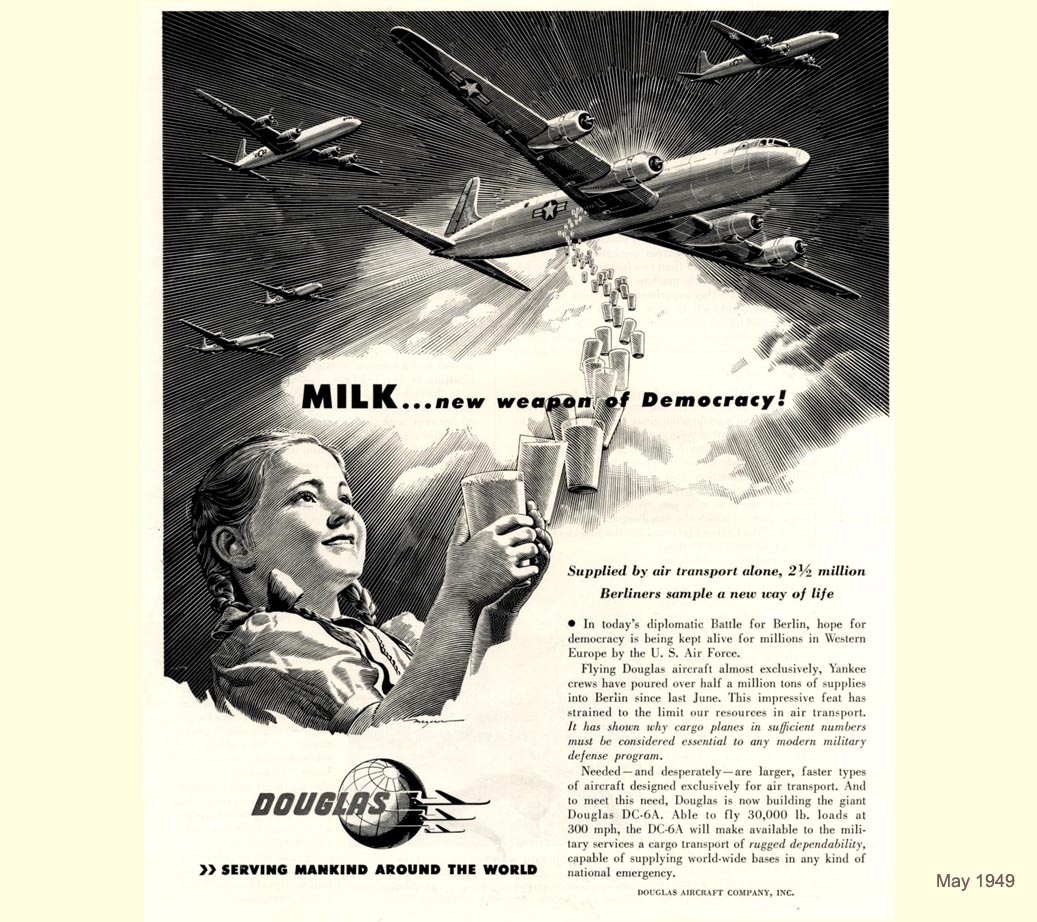
"Milk... new weapon of Democracy". A 1949 ad for Douglas Aircraft Company.

Chapter 11: Feeding the World

Once fertilizer was invented it became the new limit defining factor in agricultural production. Hence subject of competition and conflict.
[...] huge deposits of sodium nitrate [...] had been discovered in Chile. Exports boomed, and in 1879 the War of the Pacific broke out between Chile, Peru and Bolivia over the ownership of a contested nitrate-rich region in the Atacama Desert. (Chile prevailed in 1883, depriving Bolivia of its coastal province so that it has been a land-locked country ever since.) [p. 204-205]
When Fritz Haber invented nitrogen fixation fertilizer could be produced chemically and natural deposits would not have to be fought over any more. Since then it has only contributed to the demand for fossil fuel as the process is energy intensive. Curiously, Haber also eagerly developed chemical weapons for the German war to use in the 1st World War - which drove his wife to commit suicide and earned him protests when later he was awarded the Nobel Prize.


For a quick view at the book's relevance to development issues please see TH!NK3 / Food & Development: Highlights from 'An Edible History of Humanity'.

Monday, May 31, 2010

Presidents: "War is money"

The - now former - German President Horst Köhler has just resigned after a slip of tongue in an interview about his visit to the German troops in Afghanistan. So, what did he say?
[military operations serves to] protect our interests, for example, free trade routes, or to prevent regional instability, which might certainly have a negative effect on our trade, jobs and income.
(German president quits over military remarks, German president Horst Köhler quits over Afghanistan gaffe, German President Quits Over Remarks on Military.)

Incidentally, just the other day another epic George W. Bush quote saw the light of day:

The best way to revitalize the economy is war [...] the United States has grown stronger with war.
Coming clean, huh?

(Argentina’s former president: Bush once claimed, ‘the best way to revitalize the economy is war’)

Monday, May 24, 2010

Roosevelt's WWII Bill of Rights


From President Roosevelt's [Wikipedia] January 11, 1944 message to the Congress of the United States on the State of the Union in which he advocated a "Second Bill of Rights" [Wikipedia].

It is our duty now to begin to lay the plans and determine the strategy for the winning of a lasting peace and the establishment of an American standard of living higher than ever before known. We cannot be content, no matter how high that general standard of living may be, if some fraction of our people — whether it be one-third or one-fifth or one-tenth — is ill-fed, ill-clothed, ill-housed, and insecure.

This Republic had its beginning, and grew to its present strength, under the protection of certain inalienable political rights —among them the right of free speech, free press, free worship, trial by jury, freedom from unreasonable searches and seizures. They were our rights to life and liberty.

As our nation has grown in size and stature, however — as our industrial economy expanded — these political rights proved inadequate to assure us equality in the pursuit of happiness.

We have come to a clear realization of the fact that true individual freedom cannot exist without economic security and independence. Necessitous men are not free men. People who are hungry and out of a job are the stuff of which dictatorships are made.

In our day these economic truths have become accepted as self-evident. We have accepted, so to speak, a second Bill of Rights under which a new basis of security and prosperity can be established for all—regardless of station, race, or creed.

Among these are:

The right to a useful and remunerative job in the industries or shops or farms or mines of the nation;

The right to earn enough to provide adequate food and clothing and recreation;

The right of every farmer to raise and sell his products at a return which will give him and his family a decent living;

The right of every businessman, large and small, to trade in an atmosphere of freedom from unfair competition and domination by monopolies at home or abroad;

The right of every family to a decent home;

The right to adequate medical care and the opportunity to achieve and enjoy good health;

The right to adequate protection from the economic fears of old age, sickness, accident, and unemployment;

The right to a good education.

All of these rights spell security. And after this war is won we must be prepared to move forward, in the implementation of these rights, to new goals of human happiness and well-being.

Americas own rightful place in the world depends in large part upon how fully these and similar rights have been carried into practice for our citizens.

For unless there is security here at home, there can not be lasting peace in the world.


Never proposed, never passed. Franklin Delano Roosevelt was sick during the speech and died April 12, 1945.


"FDR's "Fireside Chats" With America" by Tony the Misfit.


Sunday, April 11, 2010

Water Wars at TH!NK3

Today there are two water war articles at TH!NK 3 Developing World: WATER IS ANOTHER MATTER by Hanna Clarys and Are you ready for Water Wars? by Hemant Jain.

The latter is an illustration and a couple of links.


Hanna's article is about the situation in Palestine. A few excerpts:

Palestinians have three main water sources, namely the river Jordan, the mountain aquifer (which is water underneath the West Bank) and the coastal aquifer (water underneath Gaza and the coast). These water sources are shared with Lebanon, Syria, Jordan and Israel.


When Israel occupied the West Bank, Jerusalem and the Gaza strip in 1967 the common water sources were controlled by the Israeli government.


Israel is building a barrier through Palestinian territory. But even more strikingly: this wall-fence-roadblock-thing is annexing the most fertile lands and the best water wells, which means they are now out of Palestinian reach.


Pleas do go to the TH!NK3 site to read the whole thing... or better yet, just subscribe to the RSS right away :-)

Tuesday, December 15, 2009

"The Risk of Caution" by Joachim Spangenberg

The second of three videos: Dr. Joachim Spangenberg, Vice Chairman of the sustainable Europe Research Institute Germany e.V. (SERI), speaks at "Climate change and conflict - The Danger of future wars", Klimaforum09 Sunday the 13th of December 2009. The video is of the first half of his presentation only (the rest I got on audio only).

Joachim Spangenberg at Klimaforum09 from Benno Hansen on Vimeo.


"The greenhouse gas in the atmosphere cannot be convinced by political majority decision it should behave differently."

"There is no substitue for water, there is no substitue for soil, there is no substitue for biodiversity. Which means we are dealing with resources which are all threatened by climate change. [...] We are organizing a multi-threat attack on mankind - at the same time not building up our defense lines."

"Economic tells you that if something's not scarce it's not valuable. [...] Which means biodiversity, as long as it's plentiful, it has no value. And when we begin to lose it it becomes valuable. So maybe the best method to enhance the value of nature is destroying it?"

Thursday, November 05, 2009

I'm TH!NKing about climate change

As duly advertised I'm spending my time blogging about climate change and COP15 in a European Journalism Centre project called "TH!NK ABOUT IT". Thus, not a lot of updates here lately.

But ironically, this has caused some bookmarked stories to go nowhere as I haven't addressed conflict at TH!NK yet. Here is a couple. Later I'll round up some Ecowar at TH!NK, stay tuned.

Climate change could kill 250,000 children
Ouch! That's the kind of headline that makes even hardened bloggers like me ask for some less pathos. Dead children, very well.
over 900 million children in the next generation will be affected by water shortages and 160 million more children will be at risk of catching malaria – one of the biggest killers of children under five – as it spreads to new parts of the world.

Not that controversial. It's just a bit of math and the obvious observation that climate change will aggravate existing issues. But I don't know about the "spin value" of this story.

Fix climate change or else, say military top brass
"Environmental security and climate change in particular are now issues which threaten world security and peace," says Brigadier General Wendell King of the US Army Command and General Staff College in Fort Leavenworth, Kansas.

Remind me to get my hands on the latest print of New Scientist.

International Alert Report: Climate change and conflict
The impact of climate change will make the poorest communities across the world poorer. Many of them are already affected by conflict and instability and thus face a dual risk. International Alert’s new research finds that the consequences of climate change will fuel violent conflict, which itself hinders the ability of governments and local communities to adapt to the pressures of climate change. We’ve identified 46 countries at risk of violent conflict and a further 56 facing a high risk of instability as a result of climate change.


Just sharing a handful of recent links. Will post much more at TH!NK soon, I promise.

Tuesday, September 22, 2009

Climate change: a multiplier for instability

As a participant in the TH!NK ABOUT IT Climate Change blogging competition I attended Monday's European Journalism Center conference in Bella Conference Center (venue of COP15 later this year). Among the speakers were Francois Roudié, Policy Coordinator of the European Commission. Very insightful and surprisingly willing to engage in open debate. One of his presentation slides more or less resembled an extract of my Ecowar Battlefields map (plus possibly a couple of details I need to pick up on!):


My apologies for the blurry image. From left to right the legend to the map is water scarcity (blue), demography (yellow), crop decline (green), hunger (brown), coastal risks (red lines) and recent conflicts (stars). Point being there is a correlation between areas marked with colours and location of stars.

Asked for a more precise quote Francois Roudié referred to "the Solana report" AKA CLIMATE CHANGE AND INTERNATIONAL SECURITY - Paper from the High Representative and the European Commission to the European Council (PDF) (which he'd been involved in writing). I took note of several media reports on that report when it came out last year: Tuesday, March 11, 2008 / EU assessing climate change security risks.

From the introduction: "The risks posed by climate change are real and its impacts are already taking place. [...] Unmitigated climate change beyond 2ºC will lead to unprecedented security scenarios [...] Investment in mitigation to avoid such scenarios, as well as ways to adapt to the unavoidable should go hand in hand with addressing the international security threats created by climate change; both should be viewed as part of preventive security policy. [...] Climate change is best viewed as a threat multiplier which exacerbates existing trends, tensions and instability. The core challenge is that climate change threatens to overburden states and regions which are already fragile and conflict prone. It is important to recognise that the risks are not just of a humanitarian nature; they also include political and security risks that directly affect European interests." Chapter two, "THREATS", first part is particularly interesting (here): Examples of climate change leading to Conflict over resources:
Reduction of arable land, widespread shortage of water, diminishing food and fish stocks, increased flooding and prolonged droughts are already happening in many parts of the world. Climate change will alter rainfall patterns and further reduce available freshwater by as much as 20 to 30% in certain regions. A drop in agricultural productivity will lead to, or worsen, food-insecurity in least developed countries and an unsustainable increase in food prices across the board. Water shortage in particular has the potential to cause civil unrest [...] The overall effect is that climate change will fuel existing conflicts over depleting resources, especially where access to those resources is politicised.


The other speakers included Svend Olling, Head of Department of COP15 logistics who made the slightly provocative point that "greening" the conference is only (his) fourth priority - after showcasing energy technology, providing sufficient logistics for a good conference outcome and as first priority: security! (no world leader will be shot in an electric car.) And Mads Christensen, executive director of Greenpeace Nordic who ensured us all protests will be "completely non-violent, peaceful".


Please consider subscribing to the feed of posts submitted to the climate change blogging "competition". I have a good feeling about this project.

Monday, May 25, 2009

Water wars - myth or reality?

It appears the San Fransisco Gate runs a "water blog". Latest entry is a take on the concept of water wars.

There has been a lot of discussion about "water wars," a term that sounds great, but to which I do not subscribe: wars start and are fought for many reasons and while water has often been a target, tool, or objective of violence, it is certainly hard to ascribe the primary reason for any war to water alone.

That being said, there are very strong and clear connections between water and conflict.


What has impressed the blogger - Peter Gleick - is the list of water conflicts listed chronologically (Water Conflict Chronology) which I also linked to when taking note of the debate in Nature. Check out the post for his favourite "water wars". He finishes...

We must not be complacent about the political and military risks of water disputes. The past examples from the Chronology can help inform our current diplomacy and strengthen tools for reducing violence over water. [...] as tensions and conflicts over water grow, far more care and attention must be given by the diplomatic and military communities to water.


If you are new to my little blog here and as Mr Gleick not too keen on the concept of water wars I suggest you try clicking my water-tag then scroll down a bit. Enjoy.

Friday, May 15, 2009

Debate on water wars in Nature

March 25, 2009 I posted Opinion: Nations don't go to war over water on a "peer reviewed opinion" (Nature 458, 282–283; 2009). In short, writer Wendy Barnaby discussed how a book project was stopped because research didn't turn up a significantly bloody past history of water wars. The objections are in and there are plenty of arguments on the shelf...


by psd


The potential for water conflict is on the increase by Z. W. Kundzewicz and P. Kowalczak disagree almost completely:
water has often been the object, target or weapon of military or terrorist action
...they say; referring to a quite thorough list of incidents. Although pointing to certain circumstances where cooperation is more likely than conflict, they finish...
as populations in water-stressed areas continue to grow and the demand for water increases to improve living standards with better sanitation and a water-intensive diet. In arid areas, water scarcity is likely to be exacerbated by climate change [...] The potential for water conflict — war or no war — deserves careful attention.


Increasing inequality is already making shortages worse by T. H. Meek and L. A. Meek says Barnaby was too "hasty" and points to her argument resting on at least three shady assumptions:
that developing nations will be able to afford food [...] that food itself is not also a limited resource being threatened by global warming [...that] poorer nations will become wealthier in the coming decades


Water is a source of cooperation rather than war by U. Shamir, S. Grand and N. Grand agree with Barnaby from the perspective of a senior adviser to the Israeli Water Authority. It is claimed that the Palestinian Territories receives more water from Israel than they are entitled to by the treaty.

Water: conflicts set to arise within as well as between states is by Ismail Serageldin, who was quoted by Barnaby, adds nuance:
arguments that have been made by others about international wars being unlikely for water, and they are probably right. But civil strife between competing groups within countries over water rights are very serious. [...] Drought has driven many tribes in Africa into terrain that they are not normally expected to occupy. When coupled with other factors such as ethnic or religious divides, this becomes a dangerous mix. Water may also become a casus belli between states, if the downstream nation is considerably stronger militarily than the one upstream, and the latter tries to block or reduce the flow of water.
His finish is perhaps the most important contribution:
The answer [...] is to manage our water resources better, learning from past experience, generalizing best practices and facing up to the mounting challenges that are coming our way, not to dismiss the issue as a myth.


Finally, in Water: resistance on the route towards a fair share for all M. Zeitoun largely agrees with Barnaby's attack on the "media hype" of water wars but like most others he adds details of conflicts within countries - from Iraq, Syria, Turkey, India... and Israel / Palestine:
Palestinian farmers eke out a living dependent on
highly variable and scarce rainfall, next door to the industrial farms of Israeli settlers whose irrigation water is state-subsidized.
And:
Water conflicts (not wars) are a clear and present danger for millions. They deserve our full collective scientific, financial and diplomatic attention.


by Snap®


On a more general note I'd say it is a bit naive to claim that because something didn't happen in the past - a declaration of war stating water as the issue - it will not happen in the future. Especially since conflict rarely plays by the book anyway and since low level conflicts about water seem to be common and on the rise.

Wednesday, April 15, 2009

Israel built its nuclear bombs with stolen Egyptian uranium

Funny how so many of Israels wars and occupied territories just happen to include a tale of a natural resource. There is the Palestinian water, the off shore gas and now: the Egyptian uranium. See 'Israel secretly exploited Egypt's uranium'; a story seen a couple of places around the net.

According to this story, Israel built its nuclear bombs using uranium taken from the Sinai Peninsula [Wikipedia] during the 1950ies. Israel has had various military operations on the peninsula in the course of its conflicts with Arab countries including a brief invasion in 1956. According to the official secret of Israels nuclear weapons the uranium used was from low quality deposits in the Negev desert. Perhaps not?

This story is told by 83-year-old Israeli Professor Uriel Bachrach who worked for the Science Corps of the Israel Defense Forces (IDF). In his recent Hebrew only book, The Power of Knowledge, he reveals how he participated in an undercover operation in the Sinai; disguised as German engineers. Very interesting - but I would like some more and better sources on the story from the book than Arab media briefs.

Tuesday, March 03, 2009

US Army captain: "eco-friendly practices need to be applied"

On military bases in Iraq, plastic, paper, aerosol cans, Styrofoam plates, food waste, batteries, digital equipment and hygiene products fall under one category: waste. It is simply dumped at the edge of the base, then burned at night, irritating soldiers’ lungs. Untreated wastewater is also haphazardly disposed of and gradually finds its way into Iraq’s waterways, which can pose health risks for Americans on the base and Iraqis who live nearby.

[...]

Soldiers at a base in Balad have accused one [waste disposal contractor] of making them ill from burning toxic materials like aircraft fuel and arsenic, and medical waste, including amputated limbs.

[...]

our counterinsurgency policy of securing the populace and providing access to essential services can’t be separated from environmental considerations. It’s vital that the people we live among are getting clean water, that farmers are able to grow their crops, that communities aren’t buried under trash.

Wednesday, February 25, 2009

Lord Stern: Deal with climate change or prepare for "extended world war"

"[Temperature change above 2 degrees Celsius would] transform where people can live [...] People would move on a massive scale. Hundreds of millions, probably billions of people would have to move if you talk about 4-, 5-, 6-degree increases [...And that would mean extended global conflict] because there's no way the world can handle that kind of population move in the time period in which it would take place."

Monday, February 23, 2009

Afghans killed... by pollution too

Three decades of war and severe drought have already damaged the country's environment with widespread desertification and deforestation and loss of vegetation and wildlife, deputy head of Afghanistan's National Environmental Protection Agency said.

But now, overpopulation in Afghanistan's cities, the burning of poor quality fuel, thousands of imported old cars, no proper waste management or sewage system and a boom in construction, have worsened air pollution, Jarullah Mansoori said.

[...]

"We are three times more polluted than the other capitals in the region. If everything is left as it is now, after two or three years, we will not be able to live in Kabul, said Mansoori.

"We will have to leave for another place, where we can find clean air, clean water and clean food. This is called environmental migration. When environmental migration takes place then it's a huge social problem," he said.

Reports: Nature's riches fought over - and over again

Two recent reports confirms the role of natural resources in armed conflict. One UN, one academic. From UN's report on the importance of the environment in conflict and peacebuilding:

Since the end of the Cold War, at least eighteen violent conflicts have been driven by the exploitation of natural resources. While political and military issues remain critical, conceptions of security and conflict have broadened, with environmental degradation now seen as a significant contributing factor to conflict. [...] Natural resources and the environment can be involved in all phases of the conflict cycle: from contributing to the outbreak and perpetuation of conflict and to spoiling the prospects for peace. The way that natural resources and the environment are governed has a determining influence on peace and security. - Consequently, it is clear that investing in environmental management and the governance of natural resources is an investment in conflict prevention. - Moreover, cooperation over the management of natural resources and the environment provide new opportunities for peacebuilding that should be pursued.

UNEP / From Conflict to Peacebuilding – the Role of Natural Resources and the Environment

Perhaps I'll grab a copy of the Conservation Biology article some time but for now we'll have to do with second hand accounts. Such as this from Conservation International / The Hottest Spots: Conservation in War Zones:
More than 80 percent of the world’s major armed conflicts during the last half century have taken place in some of the most biologically diverse and threatened places on Earth, according to a study published by the scientific journal Conservation Biology. The new paper entitled “Warfare in Biodiversity Hotspots” calls for conservation activities to remain strong during conflicts to ensure that local people will have the natural resources they need to survive and rebuild healthy communities post war. [...] A total of 23 biodiversity hotspots experienced significant violent conflict in which more than 1,000 people died between 1950 and 2000, and many suffered repeated episodes of violence. [...] War has devastating impacts on wildlife and other natural resources. Refugees are in no position to consider the environmental consequences of their actions. They hunt, gather firewood or build encampments to survive.


If in no mood for lengthy reports or academic lingo there are journalistic short versions - how I found the above documents anyway ;-) Check out New York Times's Dot Earth / Conflict Over, and in the Midst of, Nature’s Assets or AFP / 8 in 10 conflicts in environmental 'hotspots': study.

Sunday, February 15, 2009

2nd Iraqi oil conflict?

The closest U.S. allies in Iraq — the Kurds — feel abandoned by Washington these days and say war with the Arab-dominated central government is likely without American pressure to resolve disputes that predate even the era of Saddam Hussein.

Tension between the Arabs and Kurds is multifaceted, but one of the major flashpoints is the status of Kirkuk, an area that contains 13 percent of Iraq's proven oil reserves.

Sunday, January 18, 2009

War and Natural Gas: The Israeli Invasion and Gaza's Offshore Gas Fields

The BG Group drilled two wells in 2000: Gaza Marine-1 and Gaza Marine-2. Reserves are estimated by British Gas to be of the order of 1.4 trillion cubic feet, valued at approximately 4 billion dollars. These are the figures made public by British Gas. The size of Palestine's gas reserves could be much larger.

[...]

In 2006, British Gas "was close to signing a deal to pump the gas to Egypt." (Times, May, 23, 2007). According to reports, British Prime Minister Tony Blair intervened on behalf of Israel with a view to shunting the agreement with Egypt.

[...]

The decision to speed up negotiations with British Gas (BG Group) coincided, chronologically, with the planning of the invasion of Gaza initiated in June. It would appear that Israel was anxious to reach an agreement with the BG Group prior to the invasion, which was already in an advanced planning stage.

Sunday, December 21, 2008

"Conflict over resources could reemerge"

GLOBAL TRENDS 2025: THE NATIONAL INTELLIGENCE COUNCIL'S 2025 PROJECT


"Aging populations in the developed world; growing energy, food, and water constraints; and worries about climate change will limit and diminish what will still be an historically unprecedented age of prosperity.

[...]

In terms of size, speed, and directional flow, the transfer of global wealth and economic power now under way — roughly from West to East — is without precedent in modern history. [...] First, increases in oil and commodity prices have generated windfall profits for the Gulf states and Russia. [...] If current trends persist, by 2025 China will have the world’s second largest economy and will be a leading military power. It also could be the largest importer of natural resources and the biggest polluter.

[...]

Resource issues will gain prominence on the international agenda. Unprecedented global economic growth—positive in so many other regards—will continue to put pressure on a number of highly strategic resources, including energy, food, and water, and demand is projected to outstrip easily available supplies over the next decade or so. [...] Lack of access to stable supplies of water is reaching critical proportions, particularly for agricultural purposes, and the problem will worsen because of rapid urbanization worldwide and the roughly 1.2 billion persons to be added over the next 20 years. [...] Climate change is expected to exacerbate resource scarcities. Although the impact of climate change will vary by region, a number of regions will begin to suffer harmful effects, particularly water scarcity and loss of agricultural production. [...] Agricultural losses are expected to mount with substantial impacts forecast by most economists by late this century.

[...]

Types of conflict we have not seen for awhile — such as over resources — could reemerge. Perceptions of energy scarcity will drive countries to take actions to assure their future access to energy supplies. In the worst case, this could result in interstate conflicts if government leaders deem assured access to energy resources, for example, to be essential for maintaining domestic stability and the survival of their regimes. However, even actions short of war will have important geopolitical consequences. Maritime security concerns are providing a rationale for naval buildups and modernization efforts, such as China’s and India’s development of blue-water naval capabilities. The buildup of regional naval capabilities could lead to increased tensions, rivalries, and counterbalancing moves but it also will create opportunities for multinational cooperation in protecting critical sea lanes. With water becoming more scarce in Asia and the Middle East, cooperation to manage changing water resources is likely to become more difficult within and between states.


And that's just from the summary. Chapters 4: Scarcity in the Midst of Plenty? and 5: Growing Potential for Conflict no doubt has plenty more for Ecowar. The report appears rather US centric and conservative though.

Also see...
BBC / US Global Trends report: Key points
Global Trends 2025, a new report written by the US National Intelligence Council (NIC) ahead of President-elect Barack Obama's inauguration, envisages a future world marked by diminished US power, dwindling resources, and more people.

The NIC, an independent government body, emphasises that its report is not about "crystal-ball gazing" but offers a range of potential futures, including the following key trends.


Blog "Tragedy of the Commons" / Global Trends 2025
Reports like these really cause me concern. This is not some crazy doomer on a wacko peak oil message board. This is a consensus of top American Intelligence Community officials.

Search This Blog