AddThis

Bookmark and Share
Showing posts with label Writing. Show all posts

Wednesday, 24 June 2015

The Importance of Presence for a Writer

As a writer I have been encouraged by my publishers to meet my readers online. When having an online conversation I am often talking to a small square icon or thumbnail, yet this picture is very important to me as an idea or representation of the essence of the person.

Recently I went to a writing conference and looked for all the people I had met online. One by one I managed to identify each person from their thumbnail, but unsurprisingly the real person was always radically different from the person I had constructed in my mind from the online conversation. The icon, along with the typed conversation, flattens out the persona so that it is hard to get a sense of who is actually there, behind the words. 

When confronted with a real individual though, it is easy to hear the music of the voice, see the posture, appreciate the energetic or listening quality of the personality. In these days of online relationships it is easy to forget this presence – the most important part of the person.


Presence implies a deeper more connected awareness of the world around us, and so the ability to be a vehicle for what needs to be done. I believe words can carry presence if the writer is aware whilst writing; and that words can carry a certain intent. After all, without the written form so few religious or spiritual ideas of the past would have survived.

Yet to look at writing only as a way to preserve ideas, i.e. the end result, is to miss the point, and to forget the importance of presence. Writing is a form like any other artistic endeavour where the process is as important as the outcome. 

Becoming a Writer
Click to read PDF

In her classic book, still in print since 1934, ‘Becoming a Writer’ Dorothea Brande says that excellent writing has ‘innocence of eye’ and ‘freshness of response’. To create these qualities we must discipline ourselves to stop ‘doing’ and spend more time ‘being.’ From stillness of mind and body united, a new perspective can arise. 

To maintain presence in writing is to cultivate space in oneself to let new ideas emerge, but more importantly it is to maintain a space for the response from the reader. After all it is not only the writer, but the reader who has to imagine the book. Skilful writing is not only about what to include, but more often about where to leave things open.

I have been a meditator all my adult life, and that is how I find presence in my life. Other people find it by walking in nature, by using mindfulness techniques, or practising yoga. Do feel free to share how you nurture this aspect of your writing.

Wednesday, 20 May 2015

Editing historical fiction, my way

I am in the middle of edits for two of my books, one a young adult novel and one a 400 page adult novel. These are the edits I make before I send out to my agent, a publisher, or in some cases the public. There will be other edits later, but as some publishing houses edit very heavily, some hardly at all, it pays to be picky with your work.

Recently I have seen a plethora of writing books suggesting that you should edit in 'one pass'.

This does not work for me because of the amount of research I need to check. So here is my editing process. It takes as long as the actual writing of the book.

Editing

I always work with a printed copy of the manuscript, and initially I am editing for story. 
I read like a reader and not a writer, to identify  whether the nuts and bolts of the story work. At its heart, story is about change, so if it's getting static, alarm bells ring. I mark parts that are slow or boring with a big red pen. Though sometimes boring does not mean cutting stuff, but adding more detail to make it interesting and bring it to life. 

Usually the first time I print out the draft it needs a lot of re-working -  new chunks need to be written and others lopped off. At this stage I do extensive re-writes. That copy is then like an old rag covered in scribble and crossings out and is re-cycled onto our log-burner!

After more work on the computer to streamline the story, I'm ready for a more detailed edit. Usually I send this newer version out to some readers so I can incorporate their comments when I work on the next edit. One way of speeding it up is to mark all the pages that need edits with sticky post-its. I use the same manuscript and just go through it with different colours for each editing pass. Then with the copy next to me with its rainbow fringe, I trawl through the manuscript a page at a time making all the necessary alterations. At this point I am usually fuelled by coffee, a looming deadline, and a desperation to get it finished and move onto the next book.

Coffee
Here are the passes I make:
  • edit for character. Go through each major character's arc of action and emotion. Check what they are doing in the scenes where they are absent, and try to refer to these actions in the scenes where they are present. Get a sense of their daily routine - for example how long it takes them to dress, their relationship with servants or 'betters', and their class in relation to other characters. Check how they are feeling;  that it is consistent, and that it has development.  Make sure their attitudes are consistent with the period.
  • edit for theme. Highlight any themes that drive the novel, make sure sub-plots echo these themes. Look for metaphor, symbol and meaning. Try to find parallels with today, and highlight  them. They will be useful when you have to promote or tell people about your book.
  • edit for time-scale. In historical fiction it is particularly important to get dates right, and for the narrative to fit within certain fixed parameters or historical milestones. Check travelling times - horseback and boat are very slow, but mail can be surprisingly quick.
  • edit like the most eagle-eyed historian. I have made small errors in my books, (really sorry ) but not because I did not care - I did my best to make the history right! Often it is little things (like the taking for granted of walls and hedges before the enclosures act) that catch you out. Question everything and double check your research. Keep notes in case someone queries your sources. Make notes about where you have changed, bent, or ignored  supposedly 'known facts', and why. Two books down the line you might not remember why, but an expert reading your book is bound to write to you and ask.
  • edit for anachronistic dialogue, and for dialogue that fits the character. It is easy to slip into modernism in dialogue, and the quickest way to lose your historical atmosphere. Seemingly innocuous phrases like 'Oh my God' have taken on a distinctly teenage flavour since OMG!
  • edit for good English - cut out uninteresting language, spelling mistakes, faulty grammar and typos, or get someone else to proofread it.
My novel grows about 10% during this edit as I re-work dialogue, fill plot loopholes and deepen character.
What is your editing process? Do you have any tips or tricks?


Monday, 30 June 2014

Historical Fiction - the problem of too many Elizabeths


My latest novel in progress features a cast of real historical characters most of which have the real name 'Elizabeth.' My main character is not called Elizabeth, but her mother is, and her sister. Her aunts on her mother's and father's side are also called Elizabeth, as is her employer for whom she works as a lady's companion.
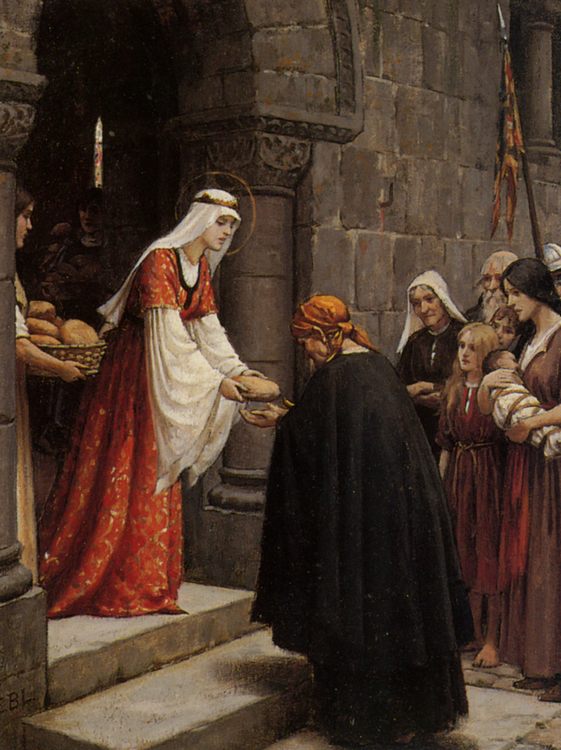
The Charity of Saint Elizabeth of Hungary :: Edmund Blair Leighton - History painting ôîòî
The Charity of St Elizabeth Of Hungary
Edmund Blair Leighton 
This is a real problem for historical novelists who are stuck with a cast of characters who all have the same name. I have taken the obvious way out which is to call them all by variants - so we have Aunt Beth, Aunt Eliza, Liddy, and yes, you've guessed it, Elisabeth (but spelled with an 's'.) Oh, and 'Mama' (who is also an Elizabeth, but I try to avoid using her actual name!)

Here are a few more common abbreviations that were used in the 17th and 18th centuries: Bess, Bessie, Beth, Betsy, Betty, Elisa, Eliza, Ella, Ellie, Elsa, Elsie, Elyse, Libby, Liddy, Lydia, Lilian, Lilibet, Lilibeth, Lillia, Lillian, Lisa, Lise, Lizbeth, Lizette, Lizzie, Lizzy, Tetty.

I imagine the general population had exactly the same trouble in knowing who was who, and that's why all the diminutives sprang up. But to add to 'Elizabeth mania', and not content with the English version, the pesky name crept into English at this time as these exotic variants as well:
Isabella (Spanish), Lise (Danish), Isabelle (French), Lisa (Dutch), Liliana, (Hungarian), Elísabet (Icelandic), Eilish, (Irish), Elisabetta,  Liana, (Italian), Belinha, (Portuguese), Elspet, Elspeth, Ishbel, Isobel, Lileas, Lilias, Lillias (Scottish) and Bethan or Bethany (Welsh).

Originally Elizabeth was the Greek form of the Hebrew name 'Elisheva' meaning 'my God is my oath'. The name appears in the Bible in two variants, but Elizabeth as a name was originally far more common in Eastern Europe where the twelfth century saint, Elizabeth of Hungary, made it fashionable. She was a wealthy princess, daughter of King Andrew II, who used her riches to help the poor. One day during Mass she placed her crown on the altar as a sign of renunciation and to symbolise her humility and poverty. In 1228, she renounced her position and the world entirely, and took vows as a Franciscan penitent.

Cate Blanchett as Elizabeth I
In medieval England the name was occasionally used in honour of the saint, though the Spanish version, Isabel, was much more common, until of course England went to war with Spain. Then of course English parents preferred the version used by our own Queen Elizabeth I. The centuries following Elizabeth's reign led to a great flowering of Elizabeths, as parents wanted to bestow upon their girl children the health, wealth and wisdom of the deceased monarch. For centuries afterwards, during the Civil Wars and upheavals of the 17th century, Elizabeth's era was looked back upon as a Golden Age, and girls were named after her in the hope of her long life and good fortune - hence my problem!

Friday, 14 June 2013

Blogging at the Historical Novel Society Conference, Florida

I will be speaking at the Conference on the panel entitled 
Virtual Salon: The Historical Fiction Blog
Today’s readers (and publishers) expect authors to have an internet presence. A blog is an effective way to join the writer, reader, and reviewer of historical fiction in dynamic interaction about novels and the history that infuses them. This panel at the conference will not only examine the benefits an author derives from maintaining a blog at various stages of her career, but will explore how blogging serves the historical fiction community as a whole. Topics include: finding a niche and establishing a voice; effective blogging strategies (regular features, guest posts, contests, blog tours); blogging etiquette; expanding one’s audience; and measuring success. 

I thought it would be nice to introduce you to my fellow-panellists on the 'Virtual Salon' panel at the Conference. We have only ever met 'virtually' so it will be lovely to meet them in real life. Click on their pictures to be taken to their blogs!

My PhotoJulianne Douglas has been organising us all for our panel discussion, and wrote the blurb at the top of this post. Julianne's blog 'Writing the Renaissance' focusses on historical fiction set in sixteenth century France. An avid reader who fell in love with all things French at the age of twelve, she went on to earn a Ph.D in French literature from Princeton.


Heather Webb's novel, 'Becoming Josephine' will be published in 2014 by Penguin/Plume and her blog 'Between the Sheets' is about her writing and publishing journey.


Amy Bruno's blog 'Passages to the Past' is a long-standing blog for the historical fiction community reviewing books of all periods and she boasts over 1000 followers and 418 networked blogs. Amy also runs the Historical Fiction Virtual Book Tours.


Heather Rieseck started her blog, 'The Maiden's Court' in 2009 as an outlet for her reading. It has since become well-known for its honest reviews of historical novels and her author interviews.


Please consider checking out the blogs and leaving a comment. If there is anything you would like to know about blogging and historical fiction, please leave me a comment so that I can flag it up for the panel. We are looking forward to a great discussion and look out for my report of the session on this blog.

Thursday, 6 June 2013

Four books on writing that go beyond the basics

Like all writers, I love my craft. Many writing books are aimed at beginners and often give more experienced writers the same information re-packaged. As a writer who is already published you might think that I don't need to read any 'how to' books about writing, but actually the more I write the more interested I get in the subtle nuts and bolts of how storytelling works, and the more I admire other writers who do it differently.

If like me, you want to increase the subtlety in your work then I can recommend the following books. None of them is written by a writer I know, and none of them is about how to write a bestseller.  What are your favourite books on writing? I'd love you to leave me a comment! 

179 ways to save a novel 

Matters of Vital concern to Fiction writers 
by Peter Selgin
The ideas in this book are grouped under six headings: Substance; Structure; Style; Symbol, Myth & Metaphor; Soul and Other Matters.


Self Editing for Fiction writers
How to edit yourself into print 
by Renni Browne and Dave King
This book has great examples and also wonderful cartoons, although it does cover ground that will be familiar to most, such as 'show not tell'. I include it because it is the best basic book on editing I have ever found, and the instructions are really clear.

Front Cover

Between the Lines
Master the subtle Elements of Fiction writing 
by Jessica Morrell
Few books attempt to explore subtleties of tone and voice. This book does just this. Most of the examples given are from the US and this can be off-putting if you are a Brit, but it is still a book well-worth reading.


The Art of Fiction 
Illustrated from classic and Modern texts 
by David Lodge
A series of articles from The Independent on Sunday, this book covers such things as 'the intrusive author', 'intertextuality' and 'defamiliarization' using examples as diverse as Charlotte Bronte and Michael Frayn. It is a book of literary criticism from which writers can learn a lot, although it is not strictly speaking a 'how to' book. The examples in this book show just how far you can go as a writer to make your voice your own.

Sunday, 13 May 2012

Spinning -The Roots of the Language of Writing

The language of story is peppered with references to the craft of spinning. We 'spin a yarn', and 'weave' a tale. The art of 'fabric'ation has very deep roots as one of the earliest forms of creation.


Spindles and spinning are also built into our mythology and folklore. Who can forget childhood tales of Rumplestiltskin or Sleeping Beauty? Plato says the axis of the universe is like the shaft of a spindle with the milky way as the whorl of wool in his Republic. In Greek mythology, Arachne challenges the goddess Minerva to a spinning and weaving contest and when she fails she is turned into a spider. Theseus follows a thread out of the Labyrinth. The three Fates, or Norns, spin, measure and cut the threads of life. The art of spinning is also identified with nature's spinner, the spider, and her web. Most of us writers use the web every day, without thinking much about its roots.

Before the spinning wheel, to make yarn, wool or plant fibre was twisted or spun by hand onto a stick or distaff and then wound onto a second stick or dropspindle. The act of turning the fibres bonded them together into a continuous thread. (Have you ever lost the thread of your story?) The female side of the family used to be called the "distaff" side of the family, the spinning of flax on a distaff being a female occupation.
Warterhouse - La Fileuse


Thus, the dropspindle was 'the primary spinning tool used to spin all the threads for clothing and fabrics from Egyptian mummy wrappings to tapestries, and even the ropes and sails for ships, for almost 9000 years.' (http://kws.atlantia.sca.org/spinning.html)

In order to increase the spin, a whorl was added. The spindle, or rod, usually had a raised lip to hold the whorl. A wisp of prepared wool was twisted around the spindle, which was then spun and allowed to drop. They are amongst the most common Medieval finds, as the process of spinning was the most common occupation. The majority of whorls were made from stone or recycled pot but some were carved from wood or cast out of lead.


It was a natural evolution that spinners invented a way of speeding up the process - the spinning wheel. However, no one knows who invented the first one, but it probably originated in India between 500 and 1000 A.D. It is said that the hand spinners in India were able to spin almost half a million yards of yarn from a single pound of cotton (Hochberg), a fine quality that machines until recently were unable to do. 

In the  past spinning was mostly done by women.The resulting thread was woven by men onto looms to produce cloth. Hand loom weavers were men because of the strength needed to batten the cloth. Many superstitions abound about winding thread - for example fishermen's wives would not wind wool after sundown, for if they did they would soon be making their husband's winding sheets.(Dictionary of Superstitions).

By the13th century spinning wheels appeared in Europe, putting an end to handspun thread, and in 1764, a British carpenter and weaver named James Hargreaves invented a hand-powered multiple spinning machine that was the first machine to improve upon the spinning wheel, ending the 'homespun' era for good and paving the way for modern machine produced goods.


Like Theseus, when writing  I often feel I am following my own thread out of the maze of the plot, and after writing a book, I often think of  editing as 'tidying up loose ends' and 'winding it up' neatly, both expressions which have probably originated in our lost spinning culture.

I can recommend this book, Women's Work, for those who want to know more about spinning and weaving in early history.


Want to try metal detecting to find some spindle whorls of your own?
http://www.colchestertreasurehunting.co.uk

Interesting You Tube video on spindle whorls http://www.youtube.com/watch?v=n6TGuypgXms


Tuesday, 3 April 2012

Transparency for writers - how not to point at yourself

When writing a book, I am obsessed by the quality of my own writing. I agonize over choice of words, apposite phrases, clever ways to convey what I want to say. When a reader reads a book they don't want to see any of that - they want to hear the story. They want the author to be transparent. This is why we are urged to use the word "said" for our speech attributions - a word that is neutral, invisible. As soon as we say "retorted" or "quipped" or (heaven help us) "declaimed", then we are pointing at ourselves with the "look at me I'm a writer" finger. The more the writer gets in the way of the story, the less involved in the reality of the story the reader will be.

Likewise, too many adverbs or exclamation marks make the writer suddenly appear at the reader's shoulder as convincer -
e.g  "Shut up!" he said crossly.
instead of, "Shut up," he said.
The writer is trying to force the reader to understand what they have probably already understood - thus making another unwanted appearance.

Too many similes or metaphors also point to our own cleverness, and can bring the reader up short.
eg Writer : "The water was black as treacle."
Reader: "Black as treacle? Is treacle black? What does she mean?"
Hey presto, the writer is muscling in again.

A lot of the knack of transparency is scrupulous awareness. If you are particularly proud of a phrase, view it with suspicion! It is probably a phrase where you are showing off, and therefore putting yourself between the reader and the page. Awareness for a writer is about being able to put yourself in the reader's seat and having the courage to remove your cleverness in favour of the truth of the story.

Many writers think that if they give up pointing at themselves they will lose their own unique voice. This is not so, as your voice will be there even more strongly if you get your ego out of the way of it.

This idea applies as much to life as it does to creativity.

The best book I can recommend on awareness in general is Awareness by Anthony de Mello. Eminently sane advice without any new-age nonsense.


For looking at this topic from a writer's perspective, the writer Dorothea Brande, (whose book, "Becoming a Writer" has been a classic for the inward journey since the 1930's) has another work, "Wake up and live!" available for free as a pdf here:
http://lesecret.net/DorotheaBrande-WakeUpAndLive.pdf
Although a little dated, it has some excellent ideas about how to succeed creatively.

As some people know, I am a great promoter of meditation in all its forms - here is a nice post by the writer Orna Ross on the benefits of meditation and awareness for writers: http://janefriedman.com/2012/01/02/meditation-increases-creativity/

And on a completely different topic,  for anyone interested, my post on 17th Century Garden Design for Women  is over at the English Historical Fiction Authors site. And you can win a copy of The Lady's Slipper at Brits United. (Until 5th April)

Friday, 22 July 2011

Doodle Day

Welcome to she-writers from the blog hop. How do you doodle!
You can find out more about the blog hop here.

Welcome to the SheWrites Blogger Ball!


Thinking Time

As a writer I often feel I need some thinking time. It is tempting to launch in to the writing with a feeling that only physical writing is what matters. And we are told to write, write, write.

But this can be a little unbalanced if it is not preceded by some thinking time. I don't even mean the "Let's work out the plot" thinking which feels like hard graft, but rather the free-form flow of thought which is the writer's equivalent of doodling. The doodle up top is from www.doodlerblog.com

I love to doodle down my ideas around my novel. These can be vague atmospheres, things I am interested in, images I'd like to include. Half-formed or unformed ideas. Some of my jottings seem random, but often I find that there is some sense in my nonsense. Did any of you make these sorts of doodles around people's names when you were at school? (See below) Go on, admit it! I use this idea sometimes to work around a concept or character in my writing.

The more professional doodle on the right shows how you might like to use word and image together, it is from this blog. Do you doodle? Happy Doodling!

Tuesday, 4 May 2010

Being my own Reader

I have just printed off my work in progress and have begun to read it as if I am a reader and have never seen it before in my life. This is a difficult task as from the outset I need to cast away all my knowledge of Restoration London, and imagine I know nothing about it except what I will find in these 300 or so pages.

In order to do this I have been treating the last few books I have read as if they were examples of my own work - to train the muscle into working - a warm-up if you like. In other writer's work I have been examining length of sentence, length of paragraph, amount of imagery, when and how the dialogue is integrated with the text etc. I am doing this to see whether it has an effect on the rhythm and feeling of the book, and whether the choices other writers make might work for me, or at least stimulate me into making more informed and better choices about my own writing.

For example in "Instruments of Darkness" the writer has decided not to start each chapter on a new page, but to let the chapters flow with only line breaks. The book is divided into six parts, so  the sections are headed with a Roman part number and a chapter number, such as III.4, III.5 etc. This has a particular effect in organising the book in a way it can be easily assimilated. At the same time the flow of narrative never stops, it hauls you along at a cracking pace, only allowing you to pause for breath at the section breaks.

So at the moment I am looking at structure and form in my book. My book also seems to fall naturally into sections, so likely it will have to be divided. But how the chapters might fall within that framework - well - there is an interesting question. Do I actually need chapters? What purpose are they serving? How long should they be?

picture credit
http://www.congregationalresources.org/
At the moment the book is written in a conventional way with forty chapters simply numbered, mostly ending with the end of one viewpoint and the beginning of another. But there are so many more possibilities! By the end of the week I might have sorted out a structure that actually reflects the book, not just arbitrary divisions. Meanwhile, I'd be interested to hear how and when other people structure their novel, or interesting examples of unconventional novel structures.

Sunday, 25 October 2009

Myth and Memory

Last night I was privileged to see a live storytelling event called "Hunting the Giant's Daughter" at Lancaster Litfest.
The story is a re-telling of an old myth from the Mabinogion. It is a tale that hides its wisdom beneath heroes and villains, blood and thunder, the living landscape of seed and tree.
At about two hours in length and told by one teller, with the help of a musical accompaniment, we were asked to conjure a whole world from the words of the storyteller. Today most of our stories are given to us visually on television or computer and very few are conjured in our own imaginations, spurred on by the poetry and rhetoric of a live voice. The experience was a potent one, not least because it was shared with the rest of the audience, who had the same, but also their own unique, rendition of the story in their imagination. Each person had made what was real for them.It led me to think about how we as writers create these "pictures in the head."

Memory or Imagination
So, are these pictures from our imagination - i.e are they something new, or are they a compilation of our memories? And if so, how much of the archetypal memory do we have access to? As a writer this topic interests me because part of the mystery of writing is that often I am the teller, but the story - the story, is not mine. It exists somewhere else already, and I need to remove myself somehow for the story to come to life. Anyone who has read Christopher Booker's "The Seven Basic Plots" will be familiar with the idea that stories perhaps follow archetypal patterns - an idea which can be ignored, or used to the writer's advantage. So here is an idea - perhaps next time approach your story as if it is a memory - a hidden memory. That you were there, but have just forgotten.

A Real Quest
If there is anyone out there who is interested in how Story and Myth meet, and wants to go on a real Quest, right now, this moment, a writer friend of mine has set up a website for just this purpose. You can find it at http://www.crystalsword.co.uk/

Riddle of the Day
Name me and I cease to exist.