Showing posts with label IPCC. Show all posts

Wednesday, January 31, 2018

My explanation of the global-warming 'pause' or 'hiatus'

By Denis Rancourt

It cannot reasonably be denied that the main continuous data series used by the IPCC to evaluate global mean surface temperature showed an approximately two-decade "pause" or "hiatus" starting around 2000, which deviated from the predictions of all the many general circulation models (more than 100 simulations from 41 climate models) that were calibrated from the same data series on data prior to 2000.

E.g., see IPCC itself; and Fyfe et al., Nature Climate Change 6, 224–228 (2016). doi:10.1038/nclimate2938

Those who would deny this plain historic fact should be discounted as climate trolls.

The question arises: How did this "pause" occur?

This is my best educated answer:
I believe the “pause” arose because the data could not continue to be manipulated to sustain such a large fabricated “warming” as in the previous decades of data manipulation.

Call me a crank but I am not the only scientist to have concluded that a global mean surface temperature cannot reliably be calculated from measured data with enough precision to confirm or infirm warmings or coolings of fractions of a degree (Celsius) on the modern observation timescale.

In my 2007 essay, I (in part) put it this way:

"It was no easy task to arrive at the most cited original estimated rate of increase of the mean global surface temperature of 0.5 C in 100 years. As with any evaluation of a global spatio-temporal average, it involved elaborate and unreliable grid size dependent averages. In addition, it involved removal of outlying data, complex corrections for historical differences in measurement methods, measurement distributions, and measurement frequencies, and complex normalisations of different data sets – for example, land based and sea based measurements and the use of different temperature proxies that are in turn dependent on approximate calibration models. Even for modern thermometer readings in a given year, the very real problem of defining a robust and useful global spatio-temporal average Earth-surface temperature is not solved, and is itself an active area of research.

This means that determining an average of a quantity (Earth surface temperature) that is everywhere different and continuously changing with time at every point, using measurements at discrete times and places (weather stations), is virtually impossible; in that the resulting number is highly sensitive to the chosen extrapolation method(s) needed to calculate (or rather approximate) the average.

Averaging problems aside, many tenuous approximations must be made in order to arrive at any of the reported final global average temperature curves. For example, air temperature thermometers on ocean-going ships have been positioned at increasing heights as the sizes of ships have increased in recent history. Since temperature decreases with increasing altitude, this altitude effect must be corrected. The estimates are uncertain and can change the calculated global warming by as much as 0.5 C, thereby removing the originally reported effect entirely.

Similarly, surface ocean temperatures were first measured by drawing water up to the ship decks in cloth buckets and later in wooden buckets. Such buckets allow heat exchange in different amounts, thereby changing the measured temperature. This must be corrected by various estimates of sizes and types of buckets. These estimates are uncertain and can again change the resulting final calculated global warming value by an amount comparable to the 0.5 C value. There are a dozen or so similar corrections that must be applied, each one able to significantly alter the outcome.

In wanting to go further back in time, the technical problems are magnified. [...]"

Several other scientist have stressed these same difficulties. The algorithms to correct known systematic effects (such as heat island effects, etc.) are guesstimates and the implementation choices affect the result...  I don't believe the GIS and spread-sheet magic.

I know what it is like measuring temperatures in a physics lab, and I know data analysis. There is no way geographers and data massage artists can take this kind of physical-measurement data and produce a meaningful global spatio-temporal mean with the claimed precision.

Such graphs should not even have been allowed to be published without complete transparency, from raw data through every algorythmic step to the final result. Any scientist should be able to see and reproduce every single step and know every assumption and manipulation and exclusion. Without this care, it is black-box magic, not testable science. The entire field has failed the test.

There you have it. Many have now argued that the "pause" is not "real". Well, I agree, as I have explained above. They argue that something else is real. I say none of it is real. None of it can even independently be verified.

Wednesday, June 7, 2017

Can't leave scientists alone with science

By Denis G. Rancourt, PhD

If the generalized global warming fever and "climate change" hysteria has taught societal observers anything it is that you cannot leave scientists alone with science.

The scientific enterprise is embedded, and scientists are manufactured service intellectuals.

Two outcomes are possible.

In the first extreme scenario, those scientists that are mainly responsible to recruit young minds and to fabricate the illusion of research freedom are given freedom within the framework of professional advancement based solely on peer-reviewed publication output. The result is irrelevant gibberish, as any institutional analyst would predict.

In the other end-point scenario, research funding is tied to professional advancement and is determined by government agencies and corporate interests. The outcome is again precisely as would be predicted: the research output exactly satisfies the contractual conditions.

This is true whether one is patenting a genetically modified organism, or approving a new "non-addictive" pain medication, or developing a next-generation delivery system for nuclear warheads.

The on-going episode of global warming "science" has illustrated a structural flaw in this otherwise functioning state-science system: If scientists are given career-enhancing supra-national political instruments to create exaggerated relevance of their work in driving a globalist agenda, then they will take the opportunity and run.

Such runaway irrelevance is already known to occur on its own within a career-centered science network (the so-called Gold Effect). [1]. With the climate scare example, we see that the phenomenon is highly amplified when there is a strong corporate or institutional and propaganda-supported driver.

Usually, societal observers and ordinary citizens would not notice. In this case however, the shrill alarmism that has been generated, propagated by the mainstream media, and condoned by the science establishment, is stratospheric. The independent-thinking blogger can detect the tenuous nature of the claims of everything from imminent human species extinction to continental flooding to engulfing forest fires to unprecedented mega-storms to war-causing droughts, and so on. [2].

You can't leave scientists alone with science. Thankfully, in this case, the propaganda runaway has caused the insanity to be palpable, influential domestic forces are not buying in, and a large segment of the middle-class is not swallowing it; species extinction or no species extinction, bumblebee migration or no bumblebee migration.

The heroes in this story -- in this unique and historic example where a large segment of society has correctly perceived a widespread profiteering construct -- are the bloggers and vloggers, the domestic industrial interests that resist finance globalization, the USA political networks that reject global governance, and, of course, the exceptional scientists that refused to compromise intellectual integrity and publicly said so.

All of this, in circumstances where the relevant planetary physics is straightforward, if anybody cared. [3].


Endnotes

[1] See the description of the Gold Effect in:  Rancourt, D.G., Cancer arises from stress-induced breakdown of tissue homeostasis, Research Gate (December 2015), 25 pages. DOI: 10.13140/RG.2.1.1304.7129

[2] My critical review of the global-warming "science" of forest fires may be one of the best illustrations of how bad the science is, as I document the "runaway" recorded in the scientific literature: Rancourt, D.G., Anatomy of the false link between forest fires and anthropogenic CO2, Research Gate (May 2016), 18 pages. DOI: 10.13140/RG.2.1.2059.6087

[3] Rancourt, D.G., Radiation physics constraints on global warming: CO2 increase has little effect, my climate blog (June 2011), http://climateguy.blogspot.ca/2011/06/radiation-physics-constraints-on-global.html

Denis Rancourt's articles and interviews on climate are listed HERE.

Friday, September 18, 2015

IPCC authors on the myth of scientific consensus, 2011 summary


Carbon-panic zealots and popular authors vehemently claim that "there is a scientific consensus" and that "the science is settled"; typically, in advancing that the human species itself is at risk.

(These claims are routinely debunked. For example, here, here, here; and on species extinction here.)

Their enthusiasm is of great service to the US Empire that wants to coerce competing independent blocs (BRICS) into accepting carbon instruments that are barely-covert geopolitical instruments.

But here is what major IPCC insiders have said about "consensus" and on the harm of an IPCC structure and culture that imposes consensus in the face of "the range of views" [1]:

5 The issue of consensus

To many, notably including Risbey and Curry in this special issue, the emphasis on consensus is the most troublesome limitation of IPCC assessment processes (for a general critique of the consensus approach to science, see Moore and Beatty 2010). Achieving consensus is, to be clear, one of the major objectives of IPCC activities. Paragraph 10 of the amended Procedures Guiding IPCC Work, for example, states that “In taking decisions, and approving, adopting and accepting reports, the Panel, its Working Groups and any Task Forces shall use all best endeavors to reach consensus” (http://​ipcc.​ch/​pdf/​ipcc-principles/​ipcc-principles.​pdf). The paragraph continues by noting that “for approval, adoption and acceptance of reports, differing views shall be explained and, upon request (by countries participating in the approval plenaries), recorded (in publically available documentation that is maintained by the IPCC Secretariat). Differing views on matters of a scientific, technical or socio-economic nature shall, as appropriate in the context, be represented in the scientific, technical or socio-economic document concerned,” but it is certainly the case that all participants in IPCC assessments would like this to be the exception rather than the rule. To our memory, such documentation has never been required at least so far as SPM’s are concerned.

Drawing the boundaries between consensus and disagreement is an activity which is so subjective that it ipso facto violates restriction #3 (Moore and Beatty 2010). As IPCC, in a search for objectivity in uncertainty assessment, has turned more to describing uncertainty in terms of the characteristics of ensembles of model outcomes, the deficiency in such an approach (its exclusion or limited treatment of systemic, structural uncertainty in models) has become increasingly apparent to the community (Winsberg 2010; Knutti et al. 2008; Goldstein and Rougier 2009). The exercise of subjective judgment in the comparison of ensemble outcomes to observational and paleoclimatic data provides a critically important means to augment the criteria internal to the model world. Indeed, there are examples in IPCC reports of willingness to acknowledge the importance of expert (subjective) judgment, if on a limited basis (e.g., see discussions of climate sensitivity, detection and attribution and climate and weather extremes in WGI report, assessment of response strategies in the WGII report of AR4; see also Knutti and Hegerl (2008) for futher details on the role of expert judgement in estimating climate sensitivity). But more salient is IPCC’s reluctance to fully couple the inevitable process of subjective judgment in a coherent way into its assessments of uncertainty and, absent this coupling, IPCC’s tendency, particularly in SPMs, to resort to emphasizing ensemble means rather than fully describing the range of views. In some cases, neither ranges of views nor are consensus judgments reported, leaving decision makers at a loss. Outstanding examples of the latter include, in addition to the examples of SRES and ice sheets above, authors’ avoidance of any estimates of carbon cycle feedbacks involving tundra or methane hydrate reservoirs; and avoidance of estimations of the degree of implementation of adaptation capacity under particular circumstances. [Emphasis added]

The latter "range of views" is the range admitted via the institutional-self-censorship mechanism of peer-review and citation indices [2][3][4]. It often does not even include these scientific views.


Endnotes

[1] Gary Yohe, Michael Oppenheimer, "Evaluation, characterization, and communication of uncertainty by the intergovernmental panel on climate change—an introductory essay", Article, Climatic Change, October 2011, Volume 108, Issue 4, pp 629-639.

[2] David F. Noble, "Regression on the Left", Climate Guy, May 30, 2007.

[3] Susan Mazur, "Peer Review as Censorship", CounterPunch, February 26, 2010.

[4] Denis G. Rancourt, "Peer-Review Failure in Climate Prof Denis Rancourt", YouTube -- 1000frolly channel, August 23, 2015.

Monday, March 10, 2014

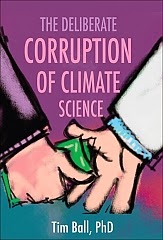
Dr. Tim Ball's new book "The Deliberate Corruption of Climate Science"

http://www.stairwaypress.com/bookstore/the-deliberate-corruption-of-climate-science/

Dr. Tim Ball's new book "The Deliberate Corruption of Climate Science" has just been released.

300 or so pages of analysis of the historical development of climate science itself, and some of its main players. Fascinating.

(Available from the publisher, and from amazon.com.)

Relevant radio interview featuring Dr. Tim Ball is here: LINK.

Relevant lawsuit: Dr. Ball is being sued in a defamation lawsuit pursued by Dr. Michael Mann: LINK.

Tuesday, October 1, 2013

Thank you Judith A. Curry!


Judith A. Curry, chair of the School of Earth and Atmospheric Sciences at the Georgia Institute of Technology, is doing us all a great favor by stepping into the public arena with her blog (Climate Etc.) and blasting all the bad politico-science gibberish of the IPCC.

Her style and sting are priceless.

Here is just one example of her remarks on the small matter of the on-going 15-year global temperature "hiatus", as avoided in characteristic style by the IPCC in its latest bible of wisdom. After a detailed summary of what the IPCC said (did not say) on the "hiatus", this (from the September 30, 2013 "IPCC’s pause ‘logic’" blogpost at Climate Etc.):

My original intention for this thread was to go through and try to map the IPCC’s logical argument.  I quickly got dizzy owing to seemingly unwarranted assumptions and incomplete information (such as: did the climate models use the correct external forcing for the first decade of the 21st century, or not?).  I was then going to illustrate how any reasonable propagation of uncertainty of individual assertions/arguments through their main argument would produce much lower confidence in their overall conclusions.  For example, they seem to have eliminated high CO2 sensitivity as a problem.   Not to mention high confidence in increasing trend following 2012 (this high confidence comes right after blowing the prediction of the previous decade).  And of course not to mention the relevant journal articles that didn’t get mentioned.

Apart from these obvious flaws, reading that text and trying to follow it is positively painful.  Can someone remind me again how and why all this is supposed to be useful?

Refreshing. Finally, we have a public scientist willing to take on her colleagues head on, on their own turf, from the position of an active researcher with impeccable credentials.

Why are there so few such individuals in science?! Why has it taken decades for establishment science to start spawning more of these much needed internal critics. And why did we have to wait for the IPCC and its gravy wagon followers to embarrass themselves to this degree before more than a few scientists start being concerned about the reputation of climate science?

There is not enough negative feedback against politically organized science. That seems clear. All those who said nothing and/or went along should be penalized with funding reductions.

Saturday, August 25, 2012

Radio interview with climatologist Dr. Tim Ball on the politics and professional ethics of global warming agitation

On July 12, 2012, CHUO 89.1 FM (Ottawa) The Train's Denis Rancourt interviewed Professor Dr. Tim Ball, climatologist, about climate science and the politics of global warming. Fascinating history of the climatology profession... Dr. Ball is being sued for defamation in regard to his criticisms of other climate professionals. The lawsuits are on-going and Dr. Ball is committed to getting to the truth and justice. LINK TO RADIO INTERVIEW

Monday, May 17, 2010

UN launches climate change investigation

Oooops, the political body known as the IPCC got it wrong despite extensively veiling itself in peer reviewed career-driven drivel...

So the UN needs to save face and salvage what it can:


We told you so... back in February 2007 HERE.