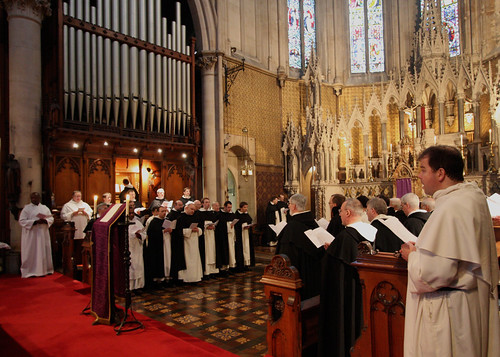
Showing posts with label Tradition. Show all posts

Monday, January 09, 2012

The Counts of Jesu Christo, Part II


The Massacre of the Holy Innocents by Fra Angelicosize=1 face=Times>

By Michael P. Foley

This article is a companion to an article of the same name in the christmas 2008 issue of the Latin Mass.

It might seem odd to think of anyone else besides the Infant Jesus or the Holy Family during the octave of Our Lord’s Nativity, but the Church in her wisdom does precisely that. Immediately following Christmas Day are the feasts of several holy men and boys known as the comites Christi, “the comrades of Christ.” Comes not only means “companion” but it is also the Latin word for the noble title of count. As this would suggest, the comites Christi are somehow close to their Lord in the way that a royal entourage is close to its king. The Church acknowledges a spiritual intimacy by placing the feasts of certain saints close to that of the birthday of their Sovereign: the Byzantine rite, for example, pays special honor to the Princes of the Apostles, Peter and Paul, by celebrating their feast on December 28.

* * * * * * *
It might seem odd to think of anyone else besides the Infant Jesus or the Holy Family during the octave of Our Lord’s Nativity, but the Church in her wisdom does precisely that.

* * * * * * *
size=4>

During the same week, the Western Church honors St. Stephen (December 26), the first martyr in both act and desire and hence the first to be honored after Christmas; St. John the Evangelist (December 27), the disciple closest to Christ during the Last Supper; the Holy Innocents (December 28), close to the Infant Jesus by their martyrdom; St. Thomas Becket (December 29), whose death at the hands of a Christian king on this day in 1170 so shocked Christendom that his feast day was given the privilege of remaining within the Christmas octave; and St. Sylvester (December 31), the Pope who lived to see the civic peace that followed the Roman persecutions and whose feast thus aptly gives voice to our prayers for the new civic year.

Three years ago, we looked at the feasts of two such counts, Saints Stephen the Proto-Martyr and John the Apostle.1 This year we turn our attention to the rest of the Roman rite’s Christmas Camelot: the Holy Infants, St. Thomas Becket, and Pope St. Sylvester.

The Holy Innocents (December 28)

Herod, perceiving that he was deluded by the wise men, was exceeding angry; and sending killed all the men children that were in Bethlehem, and in all the borders thereof, from two years old and under, according to the time which he had diligently inquired of the wise men. Then was fulfilled that which was spoken by Jeremias the prophet, saying: “A voice in Rama was heard, lamentation and great mourning; Rachel bewailing her children, and would not be comforted, because they are not” (Mt. 2:16-18).
St. Matthew’s chilling description of the massacre of Bethlehem’s baby boys does not indicate how many were killed in Herod’s effort to murder the Infant Jesus. The Byzantine liturgy mentions 14,000, the Syrian churches speak of 64,000, and some medieval authors, inspired by Revelation 14:3, speak of a staggering 144,000. Based on fertility rates and the size of the population of Bethlehem and its environs at the time, however, a more realistic estimate places the number of the slain somewhere between ten and twenty.

Matthew’s account is also silent about the date of the massacre, except for hinting that it happened within two years of the apparition of the Magis’ star. The Armenian feast day honoring the Holy Innocents falls on Monday after the Second Sunday after Pentecost in accordance with a belief that they were killed fifteen weeks after the nativity of our Lord. The Byzantine calendar has the feast on December 29, while the Syrian and Chaldean calendars have it on December 27.

The Church of Rome, from what we can tell, has always kept the feast of “Childermas” (Children’s Mass) on December 28, ever since it first began being celebrated there in the fifth century. In so doing, the Western Church presents an interesting array of Christly counts on December 26, 27, and 28: first St. Stephen, the Proto-Martyr who is martyr by will, love, and blood; then St. John the Evangelist, who is martyr by will and love (John is considered a martyr because of the attempts made on his life even though he died a natural death); and lastly, the Holy Innocents, who are martyrs by blood alone.

But if they are not martyrs by blood alone, how can they be martyrs at all? Isn’t a martyr someone who dies because he consciously professes faith in Christ? The very fact that the Church acknowledges the murder of these little ones as holy martyrdom is itself significant, as it tells us something about the nature of salvation and childhood. A child normally does not attain the use of reason until the age of seven, and even then he is under the care of his parents, who act as a kind of “surrogate reason,” helping him develop his rational faculties. Yet an infant, under the supervision of another surrogate (his godparents), may be baptized long before he has the ability to believe in the creed for the simple reason that just as he did not personally choose the curse of original sin with which he was born, so too need he not choose the cure of baptismal grace in order to be saved.

Similarly, the Holy Innocents did not choose martyrdom or even Christ, but this is not due to any failure on their part but to the undeveloped state of their minds. What matters here, as with baptism, is the action done to them. The fact that they died not only for Christ but instead of Him makes them flores martyrum, the “flowers of the martyrs.” As St. Augustine eloquently puts it: “They are the first buds of the Church killed by the frost of persecution.”2 The Breviary Hymn for the feast, Salvete Flores Martyrum, alludes to this botanical epithet, along with a touching portrayal of the Innocents playing with their symbols of martyrdom before the altar of God:
You, tender flock of lambs, we sing,
First victims slain for Christ your King:
Beside the very altar, gay
With palms and crowns, ye seem to play.
The Mass of Childermas

As this bittersweet image attests, even though martyrdom is a glorious event in which the Church rejoices, it is difficult not to be moved by the thought of helpless toddlers being cut down in the streets. The Church, therefore, taking heed of Matthew’s citation of “Rachel weeping for her children” from the prophet Jeremiah, assumed the role of a second Rachel and mourned for these little ones. Except for when the feast fell on a Sunday, violet was the liturgical color, and the Gloria and Alleluia were suppressed. In the early centuries, Roman Christians also abstained from meat on Holy Innocents’ Day. It was on the octave day of the feast (January 4) that the Church turned her thoughts to the young martyrs’ glory, the Mass being celebrated in red with the Gloria and Alleluia. In the 1950s, however, the octave was eliminated, and so currently in the 1962 calendar red is the color of Childermas, and the Gloria and Alleluia are used. The station church of the day, St. Paul Outside the Walls, was chosen because it is believed that it contains the bodies of several of the Holy Innocents.3


Massacred of the Holy Innocents (detail) by Reni Guidosize=1 face=Times>

* * * * * * *
But if they are not martyrs by blood alone, how can they be martyrs at all? Isn’t a martyr someone who dies because he consciously professes faith in Christ? The very fact that the Church acknowledges the murder of these little ones as holy martyrdom is itself significant.

* * * * * * *
size=4>

Childermas Customs

The twelve days of Christmas are a time of “topsy-turvy” customs, where social ranks and pecking orders are inverted in giddy imitation of the grandest inversion of all, the fact that Almighty God humbled Himself to be born a man in a chilly and foul-smelling stable. Childermas is no exception. In many religious communities, the novices had the privilege of sitting at the head of the table at meals and meetings, while the last person who had taken vows in the monastery or convent got to be superior for a day. Young monks and nuns would received congratulations and have “baby food,” such as hot cereal, served to them for dinner.4

A similar flip-flop occurred in the family. Customs like decorating the crib or blessing the baby were standard ways of observing the feast, and the youngest child was allowed special privileges and honors, even becoming master of the household. Not all customs, however, bode well for the young ’uns. In some places, children awoke to a spanking from their parents “to remind them of the sufferings of the Innocents!”5 Lover of tradition though I be, I do not recommend resuscitating this particular observance. It does, however, serve as a useful reminder to spoiled children when they complain about not being treated as royally on this day as they would wish.

In the Philippines and Spanish-speaking countries, Childermas is the equivalent of April’s Fools Day, a time of pranks and practical jokes called inocentadas. And, of course, all of Christendom once abstained from servile work on this day—along with the other twelve days of Christmas.

St. Thomas Becket (December 29)

Thomas Becket was born on December 21, the feast of St. Thomas the Apostle, in either 1118 or 1120. He became a trusted subordinate of Theobald, the Archbishop of Canterbury, who appointed him Archdeacon of Canterbury and eventually recommended to King Henry II that he be appointed Chancellor of England. Thomas and Henry became fast friends, sharing a commitment to hard work but also behaving in occasion “like two schoolboys at play.”6 Thomas acted vigorously in the interests of his monarch to the full extent of his conscience, but he disdained the licentious ways of his peers, hating “foul conduct or foul speech, lying or unchastity.”7 He also mentored the King’s son. The future Henry III later said that Becket showed him more love on the first day at his home than his father had in his entire life.

Becket became Archbishop of Canterbury in 1162 on the first Sunday after Pentecost. Some believe that his consecration is what eventually led to the placement of Trinity Sunday on the universal Roman calendar, since Becket procured permission for England to observe this feast as the anniversary of his archbishopric.8 The new Archbishop soon began defending the rights of the Church against the encroachment of the royal government. The most galvanizing issue was whether English clergymen were subject to ecclesiastical courts or the King’s. (In those days, as with our current practice of military courts, different segments of society were subject to different laws and magistracies.) Becket refused to budge, and the King eventually had him convicted of charges of malfeasance during his chancellorship. Thomas stormed out of the trial and fled to France, where he was protected by King Louis VII.


Death of Saint Thomas Becket by Meister Frnackesize=1 face=Times>

* * * * * * *
Some believe that his consecration is what eventually led to the placement of Trinity Sunday on the universal Roman calendar, since Becket procured permission for England to observe this feast as the anniversary of his archbishopric.

* * * * * * *
size=4>

Through the mediation of papal diplomacy, Becket returned to England in 1170. But the truce was not to last. Becket excommunicated three bishops when at the will of the King they crowned young Henry III at York, usurping a privilege reserved to Canterbury. Henry II, at the end of his wits, is then said to have retorted, “Will no one rid me of this meddlesome priest?” There are several versions of what exactly he said, but whatever it was, it was interpreted by four of his knights as a command to kill the archbishop. The men left their weapons outside the cathedral, confronted Becket within and, after he refused to absolve the bishops, returned with their weapons.

They met up with Becket as he was approaching the sanctuary for Solemn Vespers and this time drew their swords. Unlike the stylized movie version, the assassination was gruesome. The eyewitness account from his faithful cross-bearer reports that the knights’ blows opened his skull, spilling his brains onto the pavement. The killers then exulted, saying, “Let us away, knights; this fellow will arise no more.” Thus, as a hymn in his honor puts it, St. Thomas became “both priest and sacrifice in the church of Canterbury for the sake of the laws of justice.”9

It did not take long for all of Europe to venerate Becket as a martyr, and within three years he was canonized a saint by the Pope. A year later, the King himself did penance and was scourged at Becket’s tomb. The shrine was the most popular pilgrimage site in the British Isles until Henry VIII’s thugs destroyed it and the saint’s bones in 1538. St. Thomas’ four murderers fled England and eventually sought forgiveness from Pope Alexander in Rome, who had excommunicated them. The Pope made their penance a term of fourteen years of service as crusaders in the Holy Land.

Legends and Customs

There are several colorful legends about St. Thomas Becket, most of which pay homage to his lovable gruffness. Becket purportedly gave tails to the inhabitants of Strood, Kent, after they sided with the King and cut off the tail of the archbishop’s horse as he rode through town.10 In Otford, Kent, the saint did not like the taste of the drinking water and struck his crosier on the ground to form what is now called “Becket’s Well.” Otford is also said to lack nightingales because one of them made a racket while Becket was trying to pray, prompting him to banish them from the town. But this does not mean that the saint hated the fowls of the air. On one occasion, a little bird that had been taught to speak escaped from its cage and flew into a field. A hawk swooped in for the kill, and as it was about to strike, the panicked bird cried out what it had heard others say in times of distress, “Saint Thomas, help!” The hawk was struck dead, and the bird escaped unharmed.11

There are no universal customs on St. Thomas’ feast day, but it is not difficult to find ways of paying tribute to “England’s most vibrant flower,” as he has been called.12 English food and ale are a good start, along with the 1964 film Becket starring Richard Burton and Peter O’Toole. Based on a play by Jean Anouilh, the movie takes considerable liberties with the biographical details, starting with the fact that it portrays Becket, who was a descendant of the Normans, as a Saxon underdog. Nor was Becket a carousing and opportunistic nihilist prior to his elevation to the See of Canterbury, although he did become much more ascetical at that point, changing, as he once said, from being “a patron of actors and a follower of hounds to a shepherd of souls.” One sign of his transformation was a hair shirt that he wore under his archbishop’s garments (as was discovered by the monks who prepared his body for burial.) Still, the movie is a dramatic and psychological masterpiece, and it accurately portrays some of the challenges St. Thomas faced in his life.

Pope Saint Sylvester (December 31)

Saint Sylvester was Supreme Pontiff during the reign of Constantine, the Roman Emperor who ended the persecution of the Church and made Christianity the official religion of the Empire. There are several legends connecting the Pope and the Emperor, though their historical value is dubious. According to one, Constantine was baptized on his death bed by Sylvester; according to another, the baptism took place earlier in his life, when he allegedly contracted leprosy. One memorable version of the legend states that Constantine was told that the only cure for leprosy was to bathe in the blood of 3,000 newborn infants. As the infants were being gathered, Constantine recoiled at this barbarity as incompatible with Roman dignity. That night, Sts. Peter and Paul appeared to him in a dream and told him to go to Pope Sylvester, who baptized and thus cured him in the basilica of St. John Lateran.13 Today, an inscription at the base of the obelisk outside the basilica records this legend.


Pope Saint Sylvester I photo by Nick Exsillosize=1 face=Times>

* * * * * * *
Saint Sylvester was Supreme Pontiff during the reign of Constantine, the Roman Emperor who ended the persecution of the Church and made Christianity the official religion of the Empire.

* * * * * * *
face=4>

What we do know is that during Sylvester’s pontificate Constantine built several of the great churches of Rome, not only the Lateran but Santa Croce, the original St. Peter’s, and a number of cemeterial churches over the graves of martyrs. The Pope no doubt collaborated with this effort, and he also sent legates to the Council of Nicaea, the first ecumenical council in Church history. The first Roman martyrology was compiled during Sylvester’s papacy, and his name is associated with the “Roman school” of chant.

As mentioned above, there is something appropriate about issuing in the new civic year with the first Bishop of Rome to enjoy civic peace, when our hearts are filled with hope for “peace on earth.” But the reason for the feast day is more literal: after twenty one years of service to God as Pope, Sylvester was buried on December 31, 335.

Silvesterabend

Sylvester’s feast is so closely tied to December 31 that in many countries New Year’s Eve is simply known as “Silvester” or “Silvester Night” (silvesterabend or silvesternacht in German). In France and French Canada it was traditional for the father to bless the members of his family and for the children to thank their parents for all of their love and care.14 In central Europe, a pre-Christian ritual of scaring away demons with loud noises was retained; from this is derived our custom of fireworks and artillery salutes in welcome of the new year. In Austria, December 31 was sometimes called Rauchnacht or “Incense night,” when the paterfamilias of the family went through the house and barn purifying them with incense and holy water.15

And speaking of luck, Sylvester Night was a favorite occasion for attempts to peer into the upcoming year. The reading of tea leaves was once popular, as was pouring spoonfuls of molten lead into water and interpreting the future from the shapes it took. Young maidens prayed to St. Sylvester in traditional rhymes, asking him for a good husband and hoping through his intercession to catch a glimpse of Mr. Right in their dreams or in the reflection of a mirror.16

On the more pious side of things were vigil services of various kinds thanking God for the gifts of the year and seeking blessings for the new. To this day, Holy Mother Church grants a plenary indulgence, under the usual conditions, to a public recitation of the great Latin hymn of thanksgiving, the Te Deum, on the last day of the year. A partial indulgence, on the other hand, “is granted to those who recite the Te Deum in thanksgiving.”17

* * * * * * *
All of these ancient feasts speak in different ways to the Church today and the contemporary world. On Childermas, for example, some have begun to remember in their prayers the victims of abortion.

* * * * * * *
size=4>

The Feast of St. Sylvester was also considered a good time to feed the body as well as the soul. In Spain and other Spanish-speaking areas it was considered good luck to eat twelve grapes at the twelve strokes of midnight. In Austria, krapfen, apricot-jam doughnuts, are traditionally eaten when the clock strikes twelve on New Year’s Eve. In Poland, Poncz Sylwestrowy (“Sylvester’s Punch”), a strong rum mixture, was similarly imbibed.18

Conclusion

December 28, 29, and 31 celebrate a range of saints, from those who died thirty three years before the Crucifixion to those who died over 1,100 years after. Yet all of these ancient feasts speak in different ways to the Church today and the contemporary world. On Childermas, for example, some have begun to remember in their prayers the victims of abortion. Like their Bethlehem counterparts, the unborn now are innocents being slain by cruel Herods, but unlike the Holy Innocents they are bereft of the privilege of dying explicitly for Christ. Interestingly, there were once folk beliefs in German-speaking countries about some unbaptized babies going to Heaven on Childermas Day.19

Similarly, it would not be inappropriate to pray on St. Thomas’ Day for the return of the Church of England, and indeed of the entire English nation, to the Catholic Faith. Thomas gave his life to protect the Church from subordination to the Crown, as would another Thomas, St. Thomas More, four centuries later. In fact, More drew great consolation from knowing that he was to be executed on July 6, the day before another feast day honoring the brave Archbishop, the Feast of the Translation of the Relics of St. Thomas Becket. Let us pray that “Our Lady’s Dowry” re-embrace its ancient Faith and that Pope Benedict XVI’s generous provisions in his 2009 Apostolic Constitution Anglicanorum Coetibus be accepted.

Lastly, when St. Sylvester died he looked out on a world that no longer butchered Christians and was beginning to appropriate Christian morality in its laws and mores. Today we look at the photographic negative of that picture, as persecutions of Christians increase worldwide and Western society increasingly abandons its sacred heritage. As we celebrate in the octave of Christmas the Light that came into the world, let us pray that It dispel the shadows of our age and its global godlessness. St. Sylvester, help!

[Michael P. Foley, an associate professor of Patristics at Baylor University, is the author of Why Do Catholics Eat Fish on Friday? The Catholic Origin to Just About Everything (Palgrave Macmillan, 2005) and Wedding Rites (Eerdmans, 2008).]

Notes

  1. “The Counts of Jesu Christo,” TLM 17:5 (Advent/Christmas 2008), pp. 44-47. [back]

  2. Augustine, Sermon 10 on the Saints. [back]

  3. For more on station days, see my article, “Making the Stations: Stational Churches and the Spiritual Geography of the Roman Patrimony,” TLM 18:1 (Winter 2009), pp. 38-41. [back]

  4. Francis X. Weiser, Handbook of Christian Feasts and Customs (Harcourt, Brace, & World, 1958), 133. [back]

  5. Joanna Bogle, A Book of Feasts and Seasons (Gracewing, 1992), 59. [back]

  6. Herbert Thurston, “St. Thomas Becket,” The Catholic Encyclopedia, vol. 14 (New York: Robert Appleton Company, 1912), , retrieved October 3, 2011. [back]

  7. Thurston, ibid. [back]

  8. Thurston, ibid. [back]

  9. In templo Cantuariae/ Pro legibus justitiae/ Fit sacerdos et hostia, from the hymn, Pia Mater Plangat Ecclesia. [back]

  10. “Thomas Becket,” Wikipedia, http://en.wikipedia.org/wiki/Thomas_Becket, retrieved October 3, 2011. [back]

  11. From “The Translation of Saint Thomas of Canterbury,” in Jacobus de Voragine’s The Golden Legend. [back]

  12. Thomas totius Angliae/ Flos vernans, from the hymn, Pia Mater Plangat Ecclesia. [back]

  13. From “The Life of Saint Silvester,” in Jacobus de Voragine’s The Golden Legend. [back]

  14. Weiser, Religious Customs in the Family (Liturgical Press, 1956), 62. [back]

  15. Katherine Burton and Helmut Ripperger, Feast Day Cookbook (Catholic Authors Press, 1951/2005), 170. [back]

  16. Weiser, Handbook, 139. [back]

  17. Enchiridion of Indulgences, 60. [back]

  18. For the recipes, see Evelyn Vitz, A Continual Feast (Ignatius Press, 1985), 158-59. [back]

  19. See Weiser, Handbook, 133-34. [back]

[Michael P. Foley is associate professor of patristics at Baylor University. He is author of Why Do Catholics Eat Fish on Friday?: The Catholic Origin to Just About Everything(Palgrave Macmillan, 2005) and Wedding Rites: A Complete Guide to Traditional Vows, Music, Ceremonies, Blessings, and Interfaith Services(Eerdmans, 2008). Dr. Foley's article, "The Counts of Jesu Christo -- Part 2,” Latin Mass: The Journal of Catholic Culture and Tradition, Vol. 20, No. 4 (Fall 2011), pp. 44-48, is reproduced here by kind permission of Latin Mass, 391 E. Virginia Terrace, Santa Paula, CA 93060.]face=Times>

Monday, November 14, 2011

Showing the Tree to the Acorn: Feasts About the Resurrection of the Body


The Ascension by John Singleton Copleysize=1 face=Times>

By Michael P. Foley

“Glory be to God for dappled things!” exults the great Jesuit poet Gerard Manley Hopkins. And among those dappled things, shaded with their various spots and hues, we must count not just “skies of couple-colour” and “rose-moles all in stipple upon trout that swim,” but the traditional liturgical year, that great annual pageant of all things “counter, original, spare, and strange.”

And one of the strangest things found in the liturgical year and in Christian dogma (strange in that it is a surprise to common sense) is belief in the resurrection of the dead. In an age where victories over sin, ignorance, and doubt seem to be increasingly rare, it is easy for Catholics to forget that their ultimate hope is not simply in avoiding Hell and reaching Heaven but in enjoying God with their souls reunited to their bodies. Spiritual masters such as Saint Augustine have even gone so far as to suggest that until that reunion takes place, the blessed in Heaven experience a restlessness or “patient longing.”1 The Beatific Vision just won’t be the same without new bodies in a new Heaven and a new earth.

Our Glorified Bodies

Belief in bodily resurrection is no easy matter. The difficulty begins with answering a seemingly simple question, “what is the body?” Shakespeare plays upon this when Prince Hamlet describes how a king may go “through the guts of a beggar.” A king dies, his body is eaten by worms, a beggar goes fishing with one of the worms, and then he eats the fish that ate the worm.2 Whose body is whose?

And yet this ambiguity also belies a great potential. If we can’t pin down the nature of the body, then who can naysay what it is capable of becoming? Saint Paul chides doubters who ask, “How do the dead rise again?” by comparing the body to a seed that must die before it truly lives.3 It is a metaphor worth dwelling on. The human body, which is a magnificent creation, is a mere acorn in comparison to the oak tree it is destined to become. Acorns retain their substance when they grow into trees (they don’t become butterflies), yet the difference between an acorn and an oak could not be more profound; the former is virtually nothing in comparison to the latter. If our bodies, impressive as they are, are mere acorns now, imagine what they will be as trees on the Last Day.

* * * * * * *

As excellent as the Beatific Vision is, the human soul is naturally designed to rule a body, and thus there remains some unfinished business even
for a saint in Heaven.
size=4>

* * * * * * *

To give an example of what may await us, consider the four properties of a glorified body as singled out in Catholic theology: agility, subtlety, impassibility, and clarity. Agility is the perfect responsiveness of the body to the soul, which will allow it to move at the speed of thought. Subtlety is the power of penetrating solid matter, while impassibility is the impossibility of suffering or dying. Lastly, clarity is the total absence of bodily deformity and a “resplendent radiance and beauty.”4

The astonishing excellence of a resurrected body was cleverly expressed by a young colonial printer named Benjamin Franklin, who at the age of 22 wrote his own epitaph:
The body of B. Franklin, Printer
(Like the Cover of an Old Book
Its Contents torn Out
And Stript of its Lettering and Gilding)
Lies Here, Food for Worms.
But the Work shall not be Lost;
For it will (as he Believ’d) Appear once More
In a New and More Elegant Edition
Revised and Corrected
By the Author.5
God’s Path to Being All in All

The general resurrection of the body is also a most fitting consummation of Christ’s Paschal victory over death. The Passion, Resurrection, and Ascension of Our Lord open the gates of Heaven to our souls but do not immediately end our vulnerability to the effects of original sin. Those effects include a degradation of the body: every bodily deformity or disease, every violent injury or accident, every misuse or abuse, is a sad reminder that we still live east of Eden. And death remains what it always was, a literal humiliation for one and all, a return of the body to the ground (humus).

As excellent as the Beatific Vision is, the human soul is naturally designed to rule a body, and thus there remains some unfinished business even for a saint in Heaven. This body of ours, this temple of the Holy Spirit that is mocked and exploited by the world, the flesh, and the devil, is also in need of redemption. How splendid, then, that the Elect are not only promised eternal life in Heaven but a “reform” of “the body of our lowness” into a body like that of our risen Lord,6 a body that Saint Paul refers to as “glorified” and even “spiritual.”7 The body, which this side of the grave can be a handful to deal with, will become a luminous reflection of the soul’s divinely-given excellence once it is glorified. In Saint Augustine’s words, “what was once [the soul’s] burden will be its glory.”8 And how fitting that this glory is part of God’s ongoing transformation of creation until He becomes “all in all.”9

* * * * * * *

Our Lord assumed a human body in the Virgin’s womb, and the Feast of the Ascension celebrates the fact that that same body now sits at the right of the Father; therefore, our human bodies are included in the divine plan of salvation. For the first time in history, there is a human body in Heaven!size=4>

* * * * * * *

Easter Sunday

The extraordinary form of the Roman rite excels in the re-presentation of these eschatological realities, and it does so gradually. Easter, for instance, celebrates not only Christ’s victory over the grave but the first full-fledged instance of a glorified body. The New Testament makes it clear that Jesus’ body on that first Easter morning was not a resuscitated corpse like that of Lazarus, for although it was indeed the selfsame body that was born of the Virgin Mary, it had undergone a significant transformation. That is why His closest friends did and did not recognize Him,10 and it is why the risen Lord was able to pass through locked doors11 as well as appear and disappear.12 In other words, His body now possessed the properties of glorification. The implication for the rest of us is clear. As Saint Paul explains, our Savior will take “the body of our lowness” and make it like “the body of His glory.”13 Consequently, during the Easter Octave we pray that we may be transformed into a “new creature”14 and pass on to “heavenly glory.”15

Ascension

As a whole, however, the theme of our bodily glorification remains rather muted during the Easter season. This is true for the Feast of the Ascension as well, since the Church understandably focuses more on Christ’s completion of His earthly ministry and His promise to send the Holy Spirit. Indeed, the Collect for the Ascension prays that we learn to “dwell in mind amidst heavenly things,” not in body. Still, there are hints about the future of God’s Elect. To paraphrase Saint Gregory Nazianzus, “What is not assumed is not saved.”16 Our Lord assumed a human body in the Virgin’s womb, and the Feast of the Ascension celebrates the fact that that same body now sits at the right of the Father; therefore, our human bodies are included in the divine plan of salvation. For the first time in history, there is a human body in Heaven!

In fact, by the end of the first Ascension Day, there may have been three bodies: Our Lord’s, Elijah’s—who was finally allowed into the Empyrean Heaven (see below)—and Enoch, the figure in the Old Testament who was mysteriously “taken” by God after his death but who could not have been allowed to experience the Beatific Vision prior to the resurrection of our Lord.17 What we do know is that our Lord did not enter into the true Holy of Holies empty-handed: besides His own glorified body and body, he brought the souls He had rescued from limbo on Good Friday, when “He descended into Hell.” The Breviary hymn for the Divine Office speaks of our ascended Lord at the head of a “triumph,” a Roman parade in which a victorious general showcased all of the slaves he had captured in battle.18 The hymn artfully inverts this image, showing Christ as the liberator of souls from limbo now parading them into Heaven after having completed his earthy campaign, as it were.

Corpus Christi

Shortly after Paschaltide, the Church celebrates the Feast of Corpus Christi. Again the main focus is on the meaning of the feast at hand (in this case, the miracle of transubstantiation), but not without reference to our promised glorification. In the Divine Office for Corpus Christi, the Eucharist is called the “pledge of our future glory.”19 Jesus Himself says as much when He links Holy Communion to the Four Last Things: “He that eateth My flesh, and drinketh My blood, hath everlasting life: and I will raise him up on the last day.20 The Eucharist is not only essential to our earthly pilgrimage as spiritual food and medicine, it is preparing us, by what it is and what it does, for our final transformation into a glorified creature of God. For the Eucharist is not just the body, blood, soul, and divinity of Jesus Christ, but His glorified Body and Blood.21 When we receive Holy Communion, we are therefore receiving a token of what we, God willing, will one day become.


The Poem of the Soul - Memory of Heaven by Anne Francois Louis Janmotsize=1 face=Times>

And it is not just our bodies that are being glorified by the Eucharist. Pope Benedict XVI writes eloquently of the Holy Sacrifice of the Mass transforming the entire landscape of being:
The substantial conversion of bread and wine into his body and blood introduces within creation the principle of a radical change, a sort of “nuclear fission,” to use an image familiar to us today, which penetrates to the heart of all being, a change meant to set off a process which transforms reality, a process leading ultimately to the transfiguration of the entire world, to the point where God will be all in all (cf. 1 Cor 15:28).22
The Transfiguration (August 6)

The Pope’s reference to the transfiguration of the world brings us to our next feast. On the Second Sunday of Lent, the Transfiguration of our Lord is commemorated in order to arouse the faithfuls’ desire for the glory of Easter; and on August 6, we celebrate the Feast of the Transfiguration to reflect more properly on the significance of this event. Part of that reflection involves meditating on the refulgence and majesty that our own glorified bodies will one day have.23 The Breviary hymn for the feast speaks of the event in terms similar to the praise of the Eucharist we have just seen, as a “sign of perennial glory.”24 Moreover, the little chapter used during the Divine Office is Philippians 3:20-21, the passage about reforming our body of lowness. Just as the historical Transfiguration prefigured the Resurrection of Our Lord, so too does the liturgical celebration of the Transfiguration prefigure the general resurrection of the body.

* * * * * * *

The assumption of the Blessed Virgin Mary, body and soul, is therefore a beautiful thing not only in its own right (for who was more worthy than she of such an honor?) but with respect to all of the Elect, as it brings to the fore the doctrine of the resurrection of the body.size=4>

* * * * * * *

How interesting that both of Jesus’ spiritual companions on Mount Tabor that day had bodies missing in action. Elijah was taken up into heaven in a fiery chariot, while according to Jude 1:9, Saint Michael the Archangel and the devil fought over Moses’ body after he died. Some have interpreted Saint Jude’s cryptic statement to refer to the struggle between Michael and Satan through their earthly agents in Egypt, Moses being an emissary of God and the angels while Pharaoh and his magicians being minions of the devil. Others interpret the verse in reference to a fight over Moses’ remains, with Satan wanting the body buried in such a way that would seduce the Hebrews into idolatrizing it.25 But Saint Michael prevailed, and to this day the location of Moses’ grave is unknown.

A third interpretation is that both Moses and Elijah represent different states of the afterlife, Moses’ soul having come from limbo to witness the Transfiguration and Elijah’s body and soul (for they were never separated by death) coming from Heaven—albeit not the “Empyrean Heaven,” according to Saint Thomas Aquinas, for that is only accessible to man through Christ’s Paschal mystery.26 The Transfiguration on Mount Tabor thus discloses a fascinating spectrum of human existence: the living “acorn” bodies of Saints Peter, James, and John; the disembodied soul of Moses; the departed yet unglorified body of Elijah, and the transfigured body of Jesus as the foreshadowing of total glorification on the Last Day. In particular, our Lord’s Transfiguration foreshadows the gift of clarity, when “His face did shine as the sun, and His garments became white as snow.”27

The Assumption (August 15)

If bodily resurrection is promised to every faithful Christian disciple, then it is eminently fitting that Christ’s first and most faithful disciple should receive this gift before anyone else save Christ Himself. The assumption of the Blessed Virgin Mary, body and soul, is therefore a beautiful thing not only in its own right (for who was more worthy than she of such an honor?) but with respect to all of the Elect, as it brings to the fore the doctrine of the resurrection of the body.


The Assumption of the Virgin by Nicolas Poussinsize=1 face=Times>

The Mass for the Feast of the Assumption makes this connection explicit. The Collect prays that we “may deserve to be partakers of her glory,” while the Postcommunion beseeches God that through the intercession of the Blessed Virgin, “we may be brought to the glory of the resurrection.” This teaching emanates outward from the Mass to various private devotions. A novena to the Blessed Virgin on the occasion of the Assumption prays: “Teach me how small earth becomes when viewed from Heaven. Make me realize that death is the triumphant gate through which I shall pass to your Son, and that someday my body shall rejoin my soul in the unending bliss of Heaven.”

* * * * * * *

By defining the Assumption only five years after the close of WWII, it was as if the Pope were saying: Yet again, the Nazis and all such racists and eugenicists are wrong. Mary’s body, Mary’s Semitic body, is in Heaven, loved by God.size=4>

* * * * * * *

Even the timing of the proclamation of the dogma on the Assumption seems attuned to highlight God’s regard for our bodily existence, now and in the future. I once heard an outstanding sermon from an FSSP priest who speculated that Pope Pius XII’s infallible definition of the doctrine in 1950 was in part (intentionally or not) a corrective to World War II, the bloodiest war in human history. Specifically, the Third Reich, which the Pope so valiantly resisted, harbored an unprecedented hatred of not simply the Jewish religion but Jewish “embodiment,” the DNA of Abraham and his descendents, which is why they tried to exterminate that DNA entirely in their death camps. By defining the Assumption only five years after the close of WWII, it was as if the Pope were saying: Yet again, the Nazis and all such racists and eugenicists are wrong. Mary’s body, Mary’s Semitic body, is in Heaven, loved by God.

Time After Pentecost

These festal reminders of the resurrection from the dead elide nicely with the Time after Pentecost, that portion of the liturgical year which commemorates the pilgrimage of the Church from its birthday to the end of days—in other words, the period in which we are currently living. Because the Time after Pentecost symbolizes the time of the Church on earth, it is also a profoundly eschatological season, a season that looks ahead to the “Eschaton,” the Last Day, just as Christians facing east when they pray or assist at Mass do so as a sign of their anticipation of the Second Coming, when Christ shall come in glory from the East.


The Poem of the Soul - Up the Mountain by Anne Francois Louis Janmotsize=1 face=Times>

The eschatological note of the Time after Pentecost becomes noticeable around the Eighteenth Sunday, at which point the readings and prayers grow increasingly apocalyptic in tone. Verses from the prophets become much more common and references to the final manifestation of Christ more insistent. This sense of anticipation grows each week until it crescendos with the last Sunday after Pentecost (the last Sunday of the liturgical year), when the Gospel recalls Christ’s ominous double prophecy concerning the fall of Jerusalem in 70 A.D. and the terrifying end of the world.

* * * * * * *

The Lord’s Bride escorts us through a patchwork of feasts that teach us bit by bit about the immutable beauty that, God willing, will not only be ours but will render us, in the twinkling of an eye and at the sound of the trumpet, perfect icons of His brilliant glory.size=4>

* * * * * * *

But the eschatological theme is present earlier as well, and it includes a meditation on the future of our bodies. On the Fifteenth Sunday after Pentecost, for example, the Gospel reading is of our Lord’s raising from the dead the only son of the widow of Naim (Luke 7:11-16), while the Postcommunion prays: “In soul and in body, O Lord, may we be ruled by the operation of this heavenly gift; that its effect, and not our own impulses, may ever prevail over us.” And the bodily theme is central on the Twenty Third Sunday, when the Epistle lesson returns to Philippians 3:21 and the Gospel reading proclaims the resurrection of the daughter of Jairus, a prominent official of the Capharnaum synagogue (Mt. 9:18-26).

The Temporal and Sanctoral cycles of the Church calendar thus reinforce each other in marvelously conveying to us the meaning of the article in the Creed we pray every Sunday: “I look for the resurrection of the dead and the life of the world to come.”

Conclusion

Hopkins ends his poem “Pied Beauty,” which began this essay, with the verses, “He fathers-forth whose beauty is past change: Praise Him.” The Lord God, Hopkins tells us, is past change, and yet the way He brings us to His changeless beauty is through a revolving and dynamic symphony of patchy or “pied” beauty. In a similar way, the Lord’s Bride escorts us through a patchwork of feasts that teach us bit by bit about the immutable beauty that, God willing, will not only be ours but will render us, in the twinkling of an eye and at the sound of the trumpet, perfect icons of His brilliant glory.+

Notes

  1. City of God 13.20. [back]

  2. Hamlet IV.iii.27-31. [back]

  3. I Cor. 15:35ff. [back]

  4. John A. Hardon, S.J. Pocket Catholic Dictionary (New York: Doubleday, 1985), 79. [back]

  5. The epitaph was not used when Franklin died at the age of 84. [back]

  6. Phil. 3:21. [back]

  7. See Phil. 3:21; I Cor. 15:44. [back]

  8. Literal Meaning of Genesis 12.35.68 [back]

  9. I Cor. 15:28. [back]

  10. See Lk. 24:13-32; Jn. 20:1-16, 21:1-7. [back]

  11. See Jn. 20:19, 26. [back]

  12. See Lk. 24:36, 24:31. [back]

  13. Phil. 3:21. [back]

  14. Postcommunion for Easter Wednesday. [back]

  15. Secret for Easter Tuesday. [back]

  16. Gregory of Nazianzus, Letter (101) to Cledonius the Priest Against Apollinarius. [back]

  17. See Genesis 5:24. [back]

  18. See the hymn Jeus nostra redemptio: “Breaking through the gates of Hell/ Redeeming Those of yours held captive/ A Victor in a noble triumph/ You now reside at the Father’s right hand.” [back]

  19. Magnificat antiphon for II Vespers. [back]

  20. John 6:55. [back]

  21. In fact, this is one of the reasons that Holy Communion is not act of cannibalism, even though it involves consuming the flesh and drinking the blood of our Lord. No cannibal has ever come close to receiving a living and glorified body. [back]

  22. Sacramentum Caritatis, 11; see also 71. [back]

  23. For more on this topic, see Michael P. Foley, “Divine Do-Overs: The Secret of Recapitulation in the Traditional Calendar,” The Latin Mass 19:2 (Spring 2010), pp. 46-49. [back]

  24. The hymn is Quicumque Christum quaeritis, and the verse is Signum perennis gloriae. [back]

  25. A divergent theory posits that Satan argued that Moses was unworthy of burial at all since he had murdered an Egyptian as a young man. [back]

  26. See Summa Theologiae III.45.3.ad 2. [back]

  27. Mt. 17:2; see Mk. 9:1; Lk. 9:29. [back]

[Michael P. Foley is associate professor of patristics at Baylor University. He is author of Wedding Rites: A Complete Guide to Traditional Vows, Music, Ceremonies, Blessings, and Interfaith Services(Eerdmans, 2008) and Why Do Catholics Eat Fish on Friday?: The Catholic Origin to Just About Everything(Palgrave Macmillan, 2005). Dr. Foley's article, "Showing the Tree to the Acorn: Feasts About the Resurrection of the Body,” Latin Mass: The Journal of Catholic Culture and Tradition, Vol. 20, No. 3 (Summer 2011), pp. 38-42, is reproduced here by kind permission of Latin Mass, 391 E. Virginia Terrace, Santa Paula, CA 93060.]face=Times>

Thursday, July 14, 2011

The Great School of Spirituality: Learning to Love the Divine Office


Dominican Vespers photo by Lawrence OPsize=1 face=Times Roman>

By Michael P. Foley

During a recent Angelus address, the Holy Father referred to the liturgy as “a great school of spirituality.” By that the Pope meant not simply the Mass but the Divine Office. Together these two sacrifices—one of the altar, the other of praise—school the believer in the divine mysteries, shaping his sensibilities, honing his judgment, and conditioning his heart to a life of holiness. The Divine Office is also a key to unlocking the great secrets of the Catholic liturgical year: its prayers and readings perfectly complement the propers of the Mass.

Today, however, the Divine Office remains relatively unknown or unused by lay Catholics, even by those who otherwise savor every morsel of our grand and sacred tradition. To address this situation, we offer a brief overview of the Divine Office and discuss some available “back-to-school supplies.”

What It Is

The Divine Office consists of the hours of Matins (originally 12:00 a.m.) and Lauds (3 a.m.), Prime (6 a.m.), Terce (9 a.m.), Sext (12:00 p.m.), None (3 p.m.), Vespers (6 p.m.), and Compline (9 p.m.). Most of these predate Christianity by several centuries. Lauds and Vespers, for instance, are heirs to the grand morning and evening liturgies before the Ark of the Covenant ordered by King David, liturgies in which over a hundred Levites would chant the Psalms.1 Since their institution on Mount Zion, these services have never been discontinued: Solomon’s Temple, the Jewish Diaspora, and now the Church have kept up the daily praise of God in this form.2

The so-called “Little Hours” of Terce, Sext, and None, on the other hand, arose from the Jewish custom of going to the Temple for private prayer at the third (tertia), sixth (sexta), and ninth (nona) hours of the day (Sts. Peter and John were observing this custom when they cured the man lame since birth).3 Finally, Matins, Prime, and Compline were added in the early centuries of Christianity: Matins began as an anticipation of the Second Coming and a commemoration of the Resurrection, while Prime and Compline are the products of early monasticism.

Together, these eight daily sacrifices of praise fulfill Psalm 118:62 and 164 -- “I rose at midnight to give praise to Thee” and “seven times a day I have given praise to Thee.” Moreover, they punctuate the day, helping to keep the soul from becoming overwhelmed by worldly concerns, and they consecrate time itself with the fragrant incense of prayer.

* * * * * * *
Since their institution on Mount Zion, these services have never been discontinued: Solomon’s Temple, the Jewish Diaspora, and now the Church have kept up the daily praise of
God in this form.


* * * * * * *
size>


God’s Prayer Book

The format of each Hour varies, but at their center is the chanting or reciting of the Psalms. As the only book of prayer written by God, the Psalms hold a unique place in the devout life. In the eloquent words of St. Augustine (354-430): “That God may be praised well by man, God Himself has praised Himself; and since He has been pleased to praise Himself, man has found the way to praise Him.”4 St. Basil (330-379) called the Psalter the natural voice of the Church,5 and St. Thomas Aquinas (1225-274) goes so far as to say that the Psalms contain the whole of theology.6 No wonder that St. John Chrysostom (347-407) wrote that the Christians of his time used the Psalms more than any other part of the Old or New Testament.7

Special mention must also be made of the Latin hymns in the Breviary (the name of the book that contains the Divine Office). Penned by saints as early as the fourth century, these hymns are, in the words of the great liturgist Fr. Adrian Fortescue, “immeasurably more beautiful than any others ever composed. Other religious bodies take all their best hymns from us. It would be a disgrace if we Catholics were the only people who did not appreciate what is our property.”8

Later History

The Divine Office essentially received its current configuration from Pope St. Gregory the Great, though it continued to develop long after and in somewhat diverging directions. The multiplication of saints’ days, for instance, ended up superseding the weekly rotation of the Psalms, with the result that the whole Psalter was no longer being recited within the year, let alone in a week, as intended by St. Gregory.9 The Council of Trent (1545-1563) was forced to deal with this problem, and calls for radical reform were legion. As Vilma Little, writing in 1957, notes with eerie relevance to our own times: “As so often happens in times of general abuses calling for redress, the suggested remedies would have been worse than the disease. Ruthless plans of wholesale alterations were put forward by certain French and German theorists.”10

Fortunately, Little continues, “the saner views of the more level-headed bishops prevailed.”11 Trent outlined a moderate plan for revising the Breviary, which was enacted by Pope St. Pius V. The Sunday and weekday offices were restored while not upsetting the arrangement as a whole.

Not all changes to the Breviary during the Tridentine period, however, were for the better. In 1632 Pope Urban VIII allowed the spirit of Renaissance humanism to affect the hymns of the Breviary, revising almost all of them so that they would conform to the rules of classical prosody. The original verses of St. Ambrose and the like were butchered on the grounds that they were not “good Latin,” yet the new versions were hardly improvements.

Speaking of the four Jesuits commissioned with revising these hymns, Fortescue writes: “They slashed and tinkered, they re-wrote lines and altered words, they changed the sense and finally produced the poor imitations that we still have in place of the hymns our fathers sang for over a thousand years. Indeed their confidence in themselves is amazing.”12 Fortunately, there is a note in the 1912 Antiphonale stating that the old hymns can be used where they are permissible “by law, custom, or indult.” It is difficult to say what this would mean after Vatican II, but it is my personal opinion that a certain latitude can be applied in good conscience.13

* * * * * * *
“As so often happens in times of general abuses calling for redress, the suggested remedies would have been worse than the disease. Ruthless plans of wholesale alterations were put forward by certain French and German theorists.”

* * * * * * *
size=4>

But while the modifications made by Trent were sensible, they were not complete; it was left to Pope St. Pius X to enact further reforms. The Pope redistributed the entire Psalter, again with the goal of ensuring its recital within a single week. Further changes were made in 1956 and again in 1960 which simplified certain aspects of the Hours and accorded greater dignity to the Sunday Office.

Around the same time, some editions of the Breviary began to use the Psalterium Novum or Pius XII Psalter,14 which was an unfortunate repeat of the same classicist hubris that marred the hymns in 1632 now applied to the Psalms themselves.15 Fortunately, these Ciceronianized Psalms were made optional but never mandated.

Happily, all of the books considered in this article use only the traditional Vulgate Psalter. The Fraternity of St. Peter has published an impressive, new, two-volume edition of the Breviarium Romanum with the Vulgate and in accord with the rubrics of 1962, and so has Angelus Press. Both of these publications reflect the loving care that went into them: their only drawback, from a typical layman’s perspective, is that they are in Latin only. Baronius Press promises to remedy this with a new, three-volume version in English and Latin based on the popular Collegeville Breviary from 1963, which will be out in August. For bilingual alternatives currently in print, we must turn to the different variations of the Breviary.16

Variations

The celebration of the Divine Office has always admitted of greater variety than that of the Mass. To begin with, the Office used by the secular clergy and others (the “Roman Breviary”) was different from the Office used by various monastic orders (the “Monastic Breviary”). And even within this division there were further subdivisions. The Carmelites, Dominicans, Franciscans all had their own versions of the Roman Breviary, to say nothing of different regions and dioceses; and the Benedictines, Carthusians, and Cistercians all had their own versions of the Monastic Breviary.

One of these versions now back in print is St. Michael’s Abbey Press’s The Monastic Diurnal, Or the Day Hours of the Monastic Breviary.17 A diurnal is an abridged monastic Breviary containing only the “day Hours,” that is, every canonical hour except Matins. Diurnals were originally designed to be a handy single volume for monks and nuns to use when they were away from the cloister during the day, but they can also be used by laymen. This edition, originally compiled by the Benedictine monks of St. John’s Abbey in Collegeville, Minnesota and published between 1948 and 1963, has been lovingly reproduced according to the highest standards. Bound in Moroccan leather with gilt edges and six cloth marker ribbons, The Monastic Diurnal is a visual treasure. In addition to all of the Psalms one needs for the week, it contains all of the relevant propers for the entire liturgical year in both Latin and English.

Another variation to the Divine Office were the breviaria parva, or “little Breviaries,” abridged editions tailored to specific uses or devotions. The best known of these is the Little Office of the Blessed Virgin Mary, which was especially popular with the laity and with religious communities with active apostolates and not a great deal of time for communal or private prayer. A beautiful edition of the Little Office of the Blessed Virgin Mary has been reprinted by Baronius Press featuring a blue leather cover, gilt edges, all of the prayers in both Latin and English, and much helpful information. The Little Office is an exquisite prayer to our Lady: its only drawback is that it does not include the calendar’s various saints of the day and some of its seasons.

Another abridged Breviary, which has been specially published by Angelus Press for use by the laity, is Divine Office: Officium Divinum. This handsome, leather-bound volume contains, in both Latin and English, Sunday Lauds, Prime, Sext, Vespers, and Compline, as well as Prime, Sext, and Compline for the entire week. Each Office and Psalm are prefaced by brief and enlightening excerpts from Fr. Pius Parsch’s The Breviary Explained, the first book of its kind when it was published in the early 1950s. The Divine Office also includes musical notation for much of the chant. Like the Little Office and the other breviaria parva, its only drawback is the absence of feast days.

Not Just For Clerics

A common misconception is that the Divine Office is only for the clergy. It is true that clerics are required to say the Divine Office: indeed, priests and seminarians sometimes joke about this requirement by calling the Office the onus Dei (burden of God) instead of its more poetic title, opus Dei (the work of God).

However, this does not mean that the Church wants the clergy to have a monopoly on the Office. St. Augustine tells us that his mother St. Monica went twice a day to church for Lauds and Vespers in addition to daily Mass,18 and the crusader king St. Louis of France, a man with eleven children and a country to rule, is said to have grieved more about the loss of his Breviary than being taken captive by the Saracens. In addition to hearing Mass twice a day, St. Louis also rose at midnight for Matins and said Prime when he woke in the morning. More recently, the Dominican spiritual master Fr. A.G. Sertillanges recommended Prime to the layman first thing in the morning, for “there are no prayers more beautiful, more efficacious, more inspiring.”19

Solemn Vespers on the Lord’s Day was once so well known among the faithful that Sunday dinner was known in some parts of Europe as the Vespers meal. St. Alphonsus Liguori assumed Sunday Vespers would be available at most parishes when he wrote: “Although there is no express commandment which makes it a mortal sin to be absent from Vespers, yet every good Catholic will make it his duty to attend when he can, and see that his family are present also. We are commanded to sanctify the Lord’s day, and the other Holy days of obligation; but if a Catholic neglects the public service of the Church on Sunday afternoons, without any reasonable excuse, how can it be expected that he will apply himself to sanctity in other ways?”20


Vespers by Karl Brulloffsize=1 face=Times Roman>

* * * * * * *
Making the effort to understand the Psalms is well worth it. With their exultations of joy or their impassioned pleas for mercy, help, and even vengeance, the Psalms speak from the heart.

* * * * * * *
size=4>


How

The best way to learn any method of prayer is directly from an experienced practitioner. For those who do not have access to such a person, there are several useful resources available. Both Preserving Christian Publications (PCP) and the Fraternity of St. Peter offer reprints of Cardinal Cicognani’s Rubrics of the Roman Breviary and Missal, translated by Leonard Doyle. This booklet contains the English translation of the sections in the Rubricae Generales of the 1962 Missale Romanum and Breviarium Romanum, as well as the motu proprio of Pope John XXIII introducing the changes made to the liturgy in 1960. It explains both the Breviary and Mass in minute detail and contains all of the textual changes of 1960 so that one may use this book in tandem with an older edition of the Missal or Breviary and still stay current. The PCP reprint is more handsome and durable than its FSSP counterpart (which has a comb binding), and subsequently it costs a little more: $15 for the former, $10 for the latter.

PCP has also reprinted Bernard A. Hausman’s Learning the New Breviary, “new” referring to the changes of 1960. Hausman’s little book, which retails for $14, is an excellent introduction to the mechanics of reciting the hours and following the calendar: it is written in clear, accessible prose and follows a “user-friendly” order. In 2008, the Fraternity, on the other hand, came out with its own aptly named Pocket Guide for the Recitation of the Divine Office According to the 1962 Edition of the Breviarium Romanum. This tiny, 21-page booklet is a compendium of all you need to remember about the Breviary once you have already learned it from a more thorough source. It also has a helpful section titled, “Frequently Asked Questions about Reciting the 1962 Breviary.” The Pocket Guide sells for a mere $1.50.

Seeking Understanding

At first, praying the Divine Office can be confusing, but like any other form of prayer, once it becomes familiar, its value becomes apparent. The most valuable part of the Office, however, is also one of its lingering challenges: the Psalms. The Psalms are unquestionably beautiful, but they are often difficult to understand, since we are often ignorant of the context out of which they arose. It is not unusual to recite a Psalm verse and to find oneself asking: “What on earth does that mean?” Yet making the effort to understand the Psalms is well worth it. With their exultations of joy or their impassioned pleas for mercy, help, and even vengeance, the Psalms speak from the heart.

Fortunately, there are several fine aids to assist our efforts. Thomas Merton, before he went a bit screwy in the late 60s, wrote a lovely little book on the Psalms in general entitled Praying the Psalms. A more detailed alternative is St. Robert Bellarmine’s (1542-1621) A Commentary on the Book of Psalms, translated by John O’Sullivan and reprinted by PCP. This well-made, single volume is able to contain Bellarmine’s commentary on every Psalm because it omits some of his more arcane analyses of the Hebrew wording. The result is a readable commentary which, at $56, is an excellent value.

* * * * * * *
The Divine Office essentially received its current configuration from Pope St. Gregory the Great

* * * * * * *
size=4>

There are also aids to understanding the hymns. Fr. Joseph Connelly’s 1957 Hymns of the Roman Liturgy explains the meaning and history of the 154 hymns of the Roman Breviary, as does Dom Matthew Britt’s 1922 Hymns of the Breviary and Missal. Both are still in print.

For those who pray the Office in Latin, Dom Britt’s A Dictionary of the Psalter is an essential resource. This meticulously researched volume, again reprinted by PCP, provides vital information about the peculiar Latin of the Vulgate not found in typical Latin dictionaries. To give but one example: years ago I used to recite Friday Vespers with my mentor, a priest who had suffered a stroke and was no longer able to read. When we came to Psalm 138:3, funiculum meum investigasti, he would sometimes ask, “What’s a funiculus?” I looked it up in a conventional Latin dictionary and discovered that it meant a thin cord or rope. Hence the verse literally says, “you have investigated my little rope” (the Douay Rheims renders it, “my line thou hast searched out”). That made us even more confused.

Had I only had Britt’s Dictionary, I could have learned that funiculus also signifies a measuring cord, and thus by way of metonymy it refers to one’s estate or inheritance, the portion of land measured out by surveyors’ lines. The verse, then, is stating that God has marked out my inheritance for me; God is not portrayed here not as a glorified string-inspector but a benevolent probate judge. Clearing up that ambiguity alone was worth the price of the book.

As for the Office itself, the text of Parsch’s The Breviary Explained is available online at Breviary.net;21 excerpts from it are also used in Baronius Press’s forthcoming Breviary and in Angelus Press’s abridged Divine Office. Votaries of the Little Office of the Blessed Virgin, on the other hand, have at their disposal Angelus Press’s reprint of Sr. Marianna Gildea’s 1955 Living the Little Office: Reflections on the Little Office of the Blessed Virgin Mary.This accessible book guides the reader through the prayers of the Office as it follows their order. Sr. Marianna’s commentary is insightful but not overbearing.

Conclusion

“It is good to give praise to the Lord,” the psalmist sings, “and to sing to Thy name, O most High: to shew forth Thy mercy in the morning, and Thy truth in the night” (Ps. 91:2-3). How true that is, as those who mold their daily lives to the rhythm of the canonical Hours know so well.

Resources Notes
  1. See 1 Paralip. 15 and 16. [back]
  2. The fact that incense may only be used at Lauds and Vespers hearkens to this Davidic tradition. [back]
  3. Acts 3:1-8. [back]
  4. In Ps. Cxliv, 1. [back]
  5. Homil. In Ps. I, 2. [back]
  6. Postilla super Psalmos, prologue. [back]
  7. Homily 6 on penitence. [back]
  8. Adrian Fortescue, quoted in Michael Davies, The Wisdom of Adrian Fortescue (Roman Catholic Books, 1999), p. 45. [back]
  9. Gregory, in turn, took this arrangement from St. Benedict, the founder of Western monasticism. [back]
  10. Vilma G. Little, The Sacrifice of Praise: An Introduction to the Meaning and Use of the Divine Office (P.J. Kennedy & Sons, 1957), pp. 17-18. [back]
  11. Little, p. 18. [back]
  12. Davies, pp. 30-31. As the old saying has it, Accessit latinitas, recessit pietas: When Latinity came in, piety went out. [back]
  13. It should also be mentioned that the changes of 1632 only affected the Roman Breviary, not the Monastic Breviary. [back]
  14. It is also called the Bea Psalter after its main author, the Jesuit priest Augustin Bea, Rector of the Pontifical Biblical Institute and confessor of Pius XII who was later made a cardinal by Pope John XXIII. [back]
  15. To be fair, these retranslations were often more accurate renderings of the Hebrew. [back]
  16. Online, however, the impressive divinumofficium.com contains the entire Breviary in both Latin and English. Musicasacra.com has a downloadable book of the Diurnale as well as other resources. [back]
  17. The FSSP and PCP also sell an all-Latin Diurnale Romanum. [back]
  18. Confessions 5.9.17. [back]
  19. A.G. Sertillanges, O.P., The Intellectual Life, trans. Mary Ryan (CUA Press, 1998), p. 89. [back]
  20. St. Alphonsus Liguori, The Mission Book: A Manual of Instructions and Prayers Adapted to Preserve the Fruits of the Mission, Drawn chiefly from the works of St. Alphonsus Liguori (NY: D & J Sadlier & Co., 1853), p. 67. [back]
  21. http://Breviary.net/comment/comment.htm. Unfortunately, the rest of the website is a sedevacantist mishmash. [back]
_____________________________________
Michael P. Foley is an associate professor of Patristics at Baylor University. He is author of Why Do Catholics Eat Fish on Friday?: The Catholic Origin to Just About Everything (Palgrave Macmillan, 2005) and Wedding Rites: A Complete Guide to Traditional Vows, Music, Ceremonies, Blessings, and Interfaith Services(Eerdmans, 2008). Dr. Foley's article, "The Great School of Spirituality: Learning to Love the Divine Office," Latin Mass: The Journal of Catholic Culture and Tradition Vol. 20, No. 2 (Spring 2011), is reproduced here by kind permission of Latin Mass, 391 E. Virginia Terrace, Santa Paula, CA 93060, and the author.

Thursday, June 23, 2011

The Political Problem of Religious Pluralism


Christopher Oleson reviews Thaddeus Kozinski, The Political Problem of Religious Pluralism: And Why Philosophers Can't Solve It

To the typical inhabitant of a modern liberal democracy, the title of Thaddeus Kozinski's intriguing new book will probably sound a little puzzling, inasmuch as, within contemporary democractic culture, religious pluralism is not generally understood to be a "political problem." On the contrary, for the democratic soul, religious pluralism seems to be more a positive good, something to be protected and celebrated, rather than "solved" or overcome. One's religious commitments would have to be "extreme" and thus "anti-democratic" to take issue with liberalism's positive affirmation of religious diversity, for it is one of democratic modernity's greatest achievements to have crafted institutional arrangements that allow for the easy co-existence of various religious groups both with one another and with the overarching liberal political order.

* * * * * * *
Secular democratic modernity can only claim not to have a religious pluralism problem because it has already implicitly solved this problem by subtly emasculating traditional religious identitysize=4>

* * * * * * *

One of the many insights of Thaddeus Kozinski's valuable contribution to the on-going conversation about the relationship between Faith and politics is to articulate with precision how secular democratic modernity can only claim not to have a religious pluralism problem because it has already implicitly solved this problem by subtly emasculating traditional religious identity and establishing, under the false veil of political neutrality, institutional arrangements charged with theological and metaphysical significance.

Thus, only by becoming enculturated to re-interpret religious belief in such a way that it can have no substantive implications for the social and political order, and correspondingly, by becoming miseducated to not notice the tacit establishment of a quite partisan sense of the good, freedom, and selfhood, do the citizens of secular democracies think that they have a neutral social order that need not view religious pluralism as politically problematic. For those whose religious creed is not merely an emotional accoutrement, this situation is obviously deeply troublesome, for the logic of secular liberalism, as Kozinski makes clear, would force the believer to treat his Faith commitments as merely therapeutic preferences of an autonomous self.

Clarifying this situation and working towards articulating a solution to it which is at once both honest about its principles, coherent in working them out, and politically expressive of the truth and ultimate happiness of man is the task that Kozinski sets himself in his book. He does this by successively engaging the thought of three influential and progressively illuminating political philosophers. John Rawls, Jacques Maritain, and Alasdair MacIntyre. Rawls serves as the quintessential philosophical voice of secular democratic liberalism, Maritain as the exponent of a Catholic hybridization of Thomistic political philosophy and modern democratic ideals, and MacIntyre as the most penetrating philosophical critic of liberal modernity and advocate of a local Thomistic politics of the common good against the bureaucratic nation-state.

Of the three, Kozinski is by far the most sympathetic to MacIntyre. Nevertheless, even his proposal falls short in Kozinski's eyes, for MacIntyre's vision of small communities of virtue does not quite attain to the level of truly political existence, remaining as it does, Kozinski claims, too local in its aspirations. More importantly for Kozinski, MacIntyre's thought problematically remains at the level of mere philosophy. Studiously avoiding the role of theologian, MacIntyre deprives himself of the resources of political theology, and thereby fails to affirm the necessity of a public recognition of divine revelation and Magisterial teaching as the most propitious conditions for a stable and morally healthy political state. As Kozinski's subtitle indicates, philosophy as such can offer little or no light on how to move a community of seriously diverse worldviews to a unified political order of virtue and human happiness. Only the eventual achievement of a confessionally Catholic state, Kozinski concludes, can overcome the limitations of political philosophy in general, and liberal modernity in particular.

Kozinski begins his argument by unpacking the hidden premises of John Rawls' mature work, Political Liberalism. Rawls' primary aim in this book is to articulate how, given the "fact of a reasonable pluralism," citizens with rival "comprehensive views" can equally affirm a unified democratic political order. Paradoxically, Rawls attempts to accomplish this by self-consciously not providing an account of the truth or goodness of his liberal conception of justice. Consequently, he invites each private citizen to affirm and justify it from within their own particular comprehensive view.

One might reasonably ask: what precisely is the "it" that such citizens are being asked to affirm, and where does the recognition of "it" come from? Rawls' answer is the purely political conception of justice implicitly embedded in the public political culture animating contemporary liberal democracies and giving us our sense of what is "free," "equal," and "fair." In other words, there simply is a customary way we democratic liberals politically order our lives that does not, and need not, have any intrinsic theoretical foundation or justification. In this way, Rawls does not defend this conception as "true" and indeed, he does not even think it can be defended as true in some universal, philosophical sense. It is simply the way "we," who inhabit the democracies of the modern west, publicly regard it as good to associate together as a political community. Hence, each citizen can accept and justify "our" liberal sense of justice in whatever way he wants to, so long as he does, in fact, accept it.

This prescinding altogether from the truth of political liberalism is what Kozinski calls Rawls' "postmodern turn." It is a pragmatic attempt to articulate a "politics for the post-enlightened" democratic societies whose political assumptions, Rawls believes, already functionally exist in good working order within the political culture. While these assumptions are not philosophically "true" for Rawls, they are nevertheless "reasonable," at least "for us." Kozinski quotes Richard Rorty's formulation of Rawls' position: "given our history and the traditions embedded in our public life, it is the most reasonable doctrine for us."

In this way Rawls claims to be making room for the comprehensive views of the religiously diverse members of a democracy, and thus not to be imposing anything unreasonable on others. However, this self-image of toleration is thoroughly dispelled by Kozinski, who points out that, for Rawls, the "public political culture" exists as an exclusive and unimpeachable authority beyond which there is no appeal. Accordingly, any comprehensive view that does not correspond to the public political culture, or which regards political cultures as subject to dialectical scrutiny or some higher authority, are ipso facto deemed "unreasonable" and thus unacceptable within a liberal order. Not surprisingly, any traditional Christian "comprehensive view" falls under this category.

Even more objectionable, as Kozinski points out, is the fact that the very idea of the public political culture functioning in this totalizing and exclusivist way is not even a real aspect of our actual political culture, and so, as Kozinski points out, it is "a private belief of Rawls' own comprehensive doctrine, and thus inadmissible, according to Rawls' own criteria, as a public political authority." In other words, Rawls' position, if honestly and consistently viewed, is self-refuting. At the end of the day, Kozinski concludes, Rawls' project involves smuggling controversially foundatinalist and theologically charged principles into the political order under the guise of a purely "reasonable" and "non-theological pragmatism."

It is perhaps worth mentioning here another line of criticism which Kozinski later in the book levels against Maritain, but which perhaps applies even more to Rawls. It involves challenging the very idea that we have a coherent and commonly understood "public political culture" at all. Such an idea entails the existence within our culture of one, conceptually unified and commonly accepted set of political ideas. Yet, one of MacIntyre's most consistent and trenchant criticisms of liberal modernity is that no such thing exists. We may all use the words "freedom," "equality," "rights," "dignity," "law," "responsibility," "justice," but when pushed to be clear about the meaning of such terms, our culture has not common meaning for them.

What contemporary secular democracies actually have is an inconsistent and ultimately incommensurable mélange of fragmentary moral and political concepts derived from diverse and incompatible traditions (e.g., Biblical, Lockean, Puritan, Thomistic, Utilitarian, Marxist, Weberian, Feminist). What we do have in common is what MacIntyre calls a "common moral rhetoric," but this only serves to disguise our deep and interminable disagreements and confusions. If this is, in fact, the case, then Rawls cannot invoke the "public political culture" supposedly operative within modern democracies, as though there were actually such a thing providing us with a common understanding of liberal justice. What we really get from Rawls is not a formulation of our common political culture, but Rawls' own tendentious Ivy League brand of secular democratic socialism.

Far superior in Kozinski's eyes, and yet still inadequate to meet the challenges of authentic political order, is Jacques Maritain's call for a New Christendom that is both democratic and pluralistic. It is superior in that, whereas Rawls sought to craft a political philosophy that supposedly remained agnostic about the human good, Maritain maintained that "exact knowledge of the ends of human life" is essential for a sound understanding of the right order of the state. And since man is ordered to a Good which transcends the political, the political common good must recognize and integrate this truth into its actuality. Thus, for Maritain, political philosophy must become "subalternated" (i.e., dependent for some of its principles) to theology.

Nevertheless, this does not entail a return to the sacral order of Medieval Christendom in Maritain's mind. As Kozinski makes clear, this is because " there is a convergence, for Maritain, of the accepted core of values of today's liberal democracies with the temporal prescriptions of the Gospel." In other words, the democratic notions of human rights, equality, and religious freedom are exactly what the Gospel demands, so there can exist a happy co-existence of a Christian social order with constitutionally pluralistic democratic politics. While a Thomistic political philosophy is thus the de facto justification, and indeed the only coherent grounding, for such a political order, citizens of other religious and philosophical perspectives are free to provide their own understanding of its truth and goodness, no matter how false or incoherent, for Maritain's democratic charter does not prescribe the expression of alternative political self-understandings.

Kozinski argues that this hybridization of Thomistic political philosophy and democratic pluralism is ultimately unsuccessful for a number of reasons, not all of which can be discussed here, but all of which are worth listening to. To begin with, Kozinski claims that Maritain simply misjudged and seriously overestimated the lasting Christian content of modern democratic sensibilities. He mistook the emergent moral sobriety and spiritual openness of devastated, post-war Europe for the settled convictions and habits of Western democracies. In this way he underestimated the past and present countervailing, anti-Christian currents operative in modern culture and politics.

As a result, Maritain was far too sanguine about the desacralization of the modern state and far too unwary about the consequent subjugation of the Church to a purely private (and hence irrelevant) sphere once the secular state came to possess a complete monopoly of temporal power. As a result, Maritain's formulation does not have the resources to recognize the gradual subversion and transposition of operative moral and political priniciples that has taken place within Western democracies during the modern period.

* * * * * * *
The consequence of Maritain's vision, Kozinski reasons, is to create a "morally obligatory divorce" between a citizen's religious truth claims and his social and political lifesize=4>

* * * * * * *

More problematically, Kozinski asks, "would not active participation in a political order that a priori precludes the political implementation of religiously particularistic political theologies tend to habituate the citizen into privatizing his politically relevant religious truth claims, at least in his political habits, but even in his private thoughts?" The consequence of Maritain's vision, Kozinski reasons, is to create a "morally obligatory divorce" between a citizen's religious truth claims and his social and political life. The consequence will be the unwitting establishment of a liberal political theology, a "democratic faith," Kozinski argues, that is unreconcilable with a fully Catholic understanding of political life. Kozinski sites William Cavanaugh: "Although Maritain wishes to purge rights language of its basis in liberalism and locate its inspiration in the Gospel, it is the Gospel which ends up being supplanted, precisely because it is banished in effect from explicit insertion into public discourse."

While I am sympathetic to Kozinski's concerns and agree that any democratic order that categorically forbids its citizens from advocating and working toward the realization, within political society, of their moral and religious commitments, will harmfully tend to compartmentalize and privatize those beliefs, I wonder whether this criticism of Maritain might not be stating things a bit too categorically. Perhaps it's not, but I wonder if, at least on this specific issue, Kozinski and Maritain are really more divided in cultural and historical judgment rather than in philosophical and theological principle. For the latter to be the case, it would have to be true that Maritain would not want every citizen to embrace the Gospel and then to publicly reason morally and politically from its principles. I am not entirely persuaded that this is true.

The difference, at least as it seems to me, lies in their contrasting assessment of the practical insurmountability of the modern condition of religious pluralism. Maritain thinks that it is not going to be overcome in any foreseeable future, and so he reasons accordingly. Kozinski, on the other hand, envisions and proposes a path to its eventual transcendence. I could be wrong, but were the latter to actually happen within a political community, I doubt that Maritain would have a problem with such a society giving political recognition to its common Catholic Life, especially because such a political recognition would ipso facto recognize the right and duty of every human being to seek the truth about God free from political coercion. If Kozinski himself regards it as imprudent to force a Catholic establishment upon a predominantly non-Catholic society, then perhaps their ositions on this issue are less starkly opposed than might otherwise appear to be the case. This is not to say that there are not other problems with Maritain's position, and it needs to be said that Kozinski's treatment of all this is much fuller and more nuanced than I can here do credit to. I would only caution that Maritain might apply his political principles differently if his cultural and historical assessment were different.

The final thinker Kozinski analyzes is, as we have mentioned, Alasdair MacIntyre. I will not begin to pretend that I can adequately do justice to Kozinski's wide-ranging and provocative treatment of this eminent philosopher. Suffice it to say that Kozinski provides a nice background to the development of MacIntyre's critique of liberal modernity and lays out the principal reasons why MacIntyre regards it as conceptually bankrupt. Kozinski then explains the nature of MacIntyre's understanding of rationality as "tradition constituted." This conception of rational enquiry sees the human intellect as capable of grasping objective truth, but of always doing so only within a particular community characterized by a particular and developing history. There are many profound issues and pertinent questions to be raised about MacIntyre's tradition-constituted rationality, but they cannot be adequately treated here. Suffice it to say that there is much insight in MacIntyre's formulation of the matter, although there are places in his writings where his formulation appears, at least to me, to be in danger of reducing philosophy to dialectic.

As MacIntyre is at pains to show, the fullest and most perfect expression of tradition-constituted rationality is to be found in the tradition of Aristotelian-Thomism, for not only has it been able to continually confront and overcome the questions and problems that have internally arisen within it, but it is also only in light of the principles and explanatory power of this particular tradition that the problems and failures of the philosophical traditions that have subsequently emerged in Western intellectual life are adequately explained and resolved. In other words, in the internal and external dialectical engagements that have characterized the history of the Thomistic tradition, Thomism has shown itself again and again as singularly successful.

Applying this to politics, MacIntyre uses the resources of this tradition to mount a fierce critique of modern liberalism and from it to lay down the outlines of a healthy political philosophy rooted in an authentic understanding of the common good. Such a politics is, for MacIntyre, localist, virtue-based, and rooted in the natural law. Moreover, it can only be truly lived within a community that shares a common tradition of rational enquiry, which is to say, that accepts a common understanding of what is virtuous and what is according to nature. If such communities are to survive under the conditions of the modern nation state, they will always have to maintain an uneasy and merely pragmatic modus vivendi with the large-scale bureaucracies and powerful financial interests that presently exercise a disintegrating monopoly over contemporary nation-states and the market.

While Kozinski is deeply sympathetic to MacIntyre's critique and to the broad contours of his positive proposal, he nevertheless has some very substantive criticisms of his overall project. I will only mention two. First, MacIntyre has "a defective notion of the state" inasmuch as he unreasonably rejects large-scale instantiations of it as legitimate vehicles of political life. His local, tradition-constituted communities are "insufficiently political" because they are, according to Kozinski, simply too small to embody the "law, authority, and citizenship" necessary for real political life in the face of the liberal state. "if MacIntyre's practical model could be adjusted for a larger-scale application, it could acquire a genuinely political character." As it is, "MacIntyre is left with no possible site for overarching political community compatible with the basic condition of modernity -- he offers Aristotelianism without a polis."

This criticism appears to me to be rooted in an ambiguity. Its cogency, it seems to me, depends upon not recognizing a distinction in MacIntyre's writings, which I have always (although perhaps mistakenly) presumed to be operative in them. This distinction is one Aristotle himself makes between the best constitution simply speaking, and the best constitution for a particular people existing within particular circumstances here and now. Thus, there is a difference between what would be the best form of tradition-constituted political community all other things being equal, and what would be the best form of tradition-constituted political community forced to exist under the omnipresent hegemony of secular, emotivist, bureaucratic nation-states. I take "the communities of moral and intellectual virtue" whose formation MacIntyre regards as necessary in this "new Dark Ages" ruled by managerial barbarians to be the latter variety. Given that there is not immediate, realistic prospect of forming truly independent, tradition-constituted and small-scale political communities on the order of the fifth century Athenian polis or the Republic of Venice as it existed from the seventh to the end of the eighteenth century, it is inevitable that MacIntyre's communities will not be able to embody a fully political existence. But of course, one could make the same criticism of Benedictine monasteries during the first Dark Ages. They too were not fully political inasmuch as they existed under intolerable external conditions which prevented the full actualization of political life around them by those of its members striving to keep civilization alive as best they could under such hostile circumstances.

Nevertheless, even if a MacIntyrean tradition-constituted community could come into existence without having to worry about external factors like the surrounding Nanny State or the threat of being swallowed by China, MacIntyre would still affirm that such a community still needs to be small-scale in order to be authentically political. Here MacIntyre is simply being a true Aristotelian, for in Book VII of the Politics Aristotle asks the question of the proper size of a polis' population and geographical boundaries. He writes, "certainly experience shows that it is difficult and perhaps impossible for a polis with too large a population to be well-governed." This is because real political order requires mutual recognition and common deliberation. When a state gets too large it cannot be inhabited by citizens jointly sharing in political life, but only subjects of a distant and relatively anonymous power. I think this, at least in part, is what MacIntyre is getting at in the text quoted by Kozinski: "The second condition for an acceptable political order is its size, 'a relatively small scale society whose relationships are not deformed by compartmentalization'" (166).

It seems to be that the United States had something like this authentically local politics back in the 1830s when Tocqueville visited our shores. Speaking of New England townships, Tocqueville wrote in Democracy in America, "In that part of the Union, political life was born in the very heart of the townships; one might almost say that in origin each of them was a little independent nation... In all that concerns themselves alone the townships remain independent bodies, and I do not think one could find a single inhabitant of New England who would recognize the right of the government of the state to control matters of purely municipal interest."

These are truly remarkable words for a twenty-first century American ear. What citizen of New Haven, for example, would now think it preposterous for the state of Connecticut or the federal government to try to regulate his city's internal affairs in significant matters relating to education, public health, standards of public decency, or economic policy? What citizen of Hartford, Concord, or Providence still thinks of their political life and identity as primarily bound up in their township? And who would now regard their town or city as a kind of independent political community whose right to govern its internatl affairs in these matters is both substantive and protected? The answer, of course, is "no one today," and yet Tocqueville could write that, in America, where the instinct for independence was especially pronounced, "every village is a sort of republic accustomed to rule itself."

Further highlighting the political distance separating our modern, centralized nation-state from earlier American political existence is the way in which Tocqueville describes the nature and role of the individual states. Summing up their political status, Tocqueville says succinctly: "In a word, there are twenty0four little sovereign nations who together form the United States." Tocqueville could make this astounding statement because, for our earlier American brothers and sisters, "interest, custom, and feelings are united in concentrating real political life in the state, and not in the Union," for the latter "is in the peculiar position that it only forms one people in relation to certain aims; for all other purposes it is no such thing."It is this kind of political life which I think MacIntyre is calling us to attempt to recover. The fact that we cannot fully do so in any way "compatible with the basic condition of modernity" is not a flaw in MacIntyre's proposal, but a lamentable reality of the unpolitical condition which is modernity. If MacIntyre is offering us "Aristotelianism without a polis," it is not by choice.

The second criticism that I will mention touches on the central thesis of Kozinski's book. It pertains to the inability of philosophy by itself to solve the problem of political order. Kozinski writes, "MacIntyre the philosopher is unable to argue effectively against any anti-Thomistic or anti-Catholic prescription for an ideal political order because such a prescription would inevitably involve theological judgments and commitments... The methodological avoidance of theological judgments and commitments is the primary weakness in MacIntyre's project, for it attenuates the effectiveness of both the vindication of his own theologically based and informed Thomistic tradition, and its dialectical challenge to rival traditions. Any intellectual tradition articulating an ideal political order must necessarily include a judgment as to whether God has communicated His will to man regarding the political order." Accordingly, as MacIntyre himself recognizes, "a purely secular, purely philosophical understanding of the moral life of man is inevitably insufficient." There can be no political wisdom that is not ultimately theological in its scope and political in its aspirations.

Rooted as it is in perennial Catholic teaching on the nature of the political community and its right relation to God, there is a great deal of truth in Kosinzski's conclusion. Surely the most stable, healthy, and politically wise society is one where its people are both publicly and personally united in the true Faith, illumined by Divine Revelation, and able to be sanctified by Sacramental Grace. My only concern here is a potentially misleading sense of philosophy that one might take away from Kozinski's book. As a final reflection, I would only urge a greater caution, or at least more explicit qualification, in how Kozinski formulates the limitations of philosophy. Limitations there certainly are, but a "purely philosophical" understanding of the moral life of man is not a "purely secular" understanding.

It is Saint Thomas' correct understanding that the natural light of the intellect is able to see that the perfection of human nature, and the only thing that can ultimately fulfill human nature's desire for happiness, is to see the essence of God. Accordingly, it is, for Saint Thomas, a prudential dictate of moral philosophy and a precept of the natural law that one should seek to contemplate God as best one can if one is to be as happy as possible and move toward one's end. Indeed, prayer, devotion, and sacrifice are all, for Saint Thomas, dictates of the natural law, for unaided human reason can come to see philosophically that God exists, is the creator and governor of the universe, the giver of all good things, and the ultimate source from whom we derive our being, to whom we owe our obedience, and in whom we find our joy. Because of this, Saint Thomas annexes the virtue of religion under the cardinal virtue of justice. In other words, it is a natural virtue, before it is, like the other virtues, taken up and perfected by grace.

What all of this means is that philosophy, understood properly, is not a secular activity, if "secular" means having no theoretical or practical reference to God as the beginning and end of all things. As Saint Thomas sees it, the deliverances of both the theoretical and practical activity of natural reason, which is to say, the conclusions of metaphysics and moral philosophy, are ultimately theological and religious in nature. Indeed, the very name Aristotle gives to first philosophy is "theology," for the end of the speculative intellect is the contemplation of God. Similarly, the virtue of "religion" is the perfection of reason's moral activity. Saint Thomas argues that religion is the greatest of the moral virtues because it directs all of the other virtues to be done for the sake of adoring, obeying, and giving thanks to God. That these natural activities of the intellect are hindered by our sinful condition and made dramatically easier by the infusion of grace and the light of revelation does not change their being properly philosophical conclusions of the natural intellect. If Saint Thomas is right about all this, and I believe that he is, then I think philosophy might have more to say about the right ordering of a political community than Kozinski's argument seems to allow.

I do not mean to claim that Kozinski is denying philosophy's legitimate role in the dialectical conversation between rival traditions. Indeed, he explicitly criticizes the "Radical Orthodox" theologian, John Milbank, for his fideistic assertion that philosophy can play no role in the adjudication between competing narratives. Kozinski clearly does not think, as Milbank does, that the Christian story can only "out-narrate" the liberal-nihilistic story, as thought it were only a more attractive mythos. Nevertheless, it is sometimes hard to avoid the impression that, for Kozinski, natural reason can accomplish noticeably less than what Saint Thomas, for instance, thought it could. Whether, and in what way, this might be the case remains to be further developed in Kozinski's future contributions to this conversation.

Even with this caveat in mind, Thaddeus Kozinski's book remains a gold mine of rich reflection on the dilemma of articulating a just political order in the condition of secular, pluralistic modernity. As such, it has been a difficult struggle to limit my reactions to this book, for there is so much in it to provoke and challenge one to think more deeply and fruitfully about the issues it treats. There are few thinkers out there astute enough to call into question the regnant assumptions of liberal modernity and open enough to avail themselves of the Church's perennial teaching on these matters. For anyone seeking insight into the deeper philosophical issues of our present political conundrum, The Political Problem of Religious Pluralism: And Why Philosophers Can't Solve It is a worthy book that deserves a careful reading. +

Christopher Oleson is a tutor at Thomas Aquinas College. He received his Ph.D. in philosophy from the Catholic University of America. He lives with his wife, Rachel, and their six children in Santa Paula, CA. The Political Problem of Religious Pluralism is published by Lexington Books, 2010. Dr. Oleson's review, originally published in Latin Mass: The Journal of Catholic Culture and Tradition Vol. 20, No. 2 (Spring 2011), is reproduced here by kind permission of Latin Mass, 391 E. Virginia Terrace, Santa Paula, CA 93060.