Showing posts with label schick. Show all posts

Thursday, March 21, 2019

Revisiting Karameikos

Sometimes (often?), when I have a blog idea that really gets me jazzed up, I end up doing a bunch of "research"on the subject, that can distract or derail me for days (or weeks) on end. Such is the case with this post, which has been sitting in "draft form" since January 18th. While this info doesn't matter all that much to the subject at hand, I feel like folks might be interested in the fact that I'm not (always) pulling these missives out of my ass, and that when I have a delay in posting it's (sometimes) due to me trying to get more info for my readers' benefit.

[BTW: I put "research" in quotes, because a lot of my study is simply culling and collating stuff from various places on the internet...it's hardly locking myself in some shadowy corner of the library. Not trying to put on airs, people!]

GAZ1; Published 1987
The Grand Duchy of Karameikos is a campaign setting that's been around (in published form) at least as long as I've been in the hobby. As I mentioned the other day, Aaron Allston did the bulk of the work fleshing out the Duchy in the BECMI supplement Gazetteer #1 of the same name. I won't go over too much of what's covered in the Gaz; interested folks can get a brief overview of the setting from this podcast (which draws from multiple sources post-1983, i.e. after the advent of Mentzer's BECMI edition).

[there's another video review specific to the Gazeteer itself, but while longer it has a lot of extemporaneous nonsense, ranging from opinionated asides to factual errors regarding both the setting and the game's development...I gather Mr. McCoy is more of a 2E/Forgotten Realms enthusiast, so his musings may be pertinent to folks interested in his perspective]

Karameikos first appears in published form in 1981, both as a territory of "the Known World" in module X1: The Isle of Dread, and detailed as a "sample wilderness" in the Cook/Marsh Expert set (the "X" rulebook of B/X). As has been noted by others, the Known World setting was originally created by Tom Moldvay and Lawrence Schick for their home campaign and in that setting (per Schick's old notes) Karameikos appears to have been little more than a Thyatian city-state existing on a skinny peninsula.

Besides changing the city to a Grand Duchy (and much larger territory), the Expert rulebook offers the following details of the land of Karameikos:

"The Duchy is a large tract of wilderness and unsettled land claimed by Duke Stefan Karameikos the Third. Although he claims control of a large area of land on paper, large portions of it are held by humanoids and monsters. The two main settled areas are the coast near the main city of Specularum and the Black Eagle Barony on the Gulf of Halag.

"The weather throughout the area represented...is generally temperate and mild with short winters of little or no snowfall and long summers. Rainfall is ample but not heavy and easterly winds blow cool breezes from over the sea.

"The mountain range running along the north edge of the map is known by different names by the peoples of the territory including the Black Peaks, the Truth Mountains, or the Steach. The two large river systems that provide drainage from the area are left for the DM to name.

"Due to the climate, large sections of this map are heavily forested. Humans engage in lumber operations near the edges of the forests, but are loathe to venture too deeply without good cause. Timber, both hardwood and softwood, is a prime resource of the area, and is either exported or used to build ships in the shipyards of the port of Specularum."

- D&D Expert Set, Page X60

In addition to this overview of the territory, the book (briefly) describes the three areas primarily inhabited by humans (Specularum, the Black Eagle Barony, and Luln) and the gnome community residing in the foothills of the mountain range (north of the coastal capitol). The map shows three inhabited castles (not counting the Duke's fortress), two ruins (Wereskalot and the Haunted Keep from the Basic set), and several humanoid areas within the Duchy: two forests of "elves," three different tribes of "goblins," some "orcs," and a region of "frost giants" (!!) in the mountains of the northeastern border.

I'll discuss the "human lands" in a later post. What's most interesting to me, in light of the development that has occurred in the years since its first appearance, are all the things that are NOT mentioned in the description here that became later "plot points." Missing is any mention of a Thyatian connection, nor is there any discussion of conquest or of an indigenous (Traladar) people. There is no discussion of native religion, mythology, or history...the Lost Valley (site of the 1986 adventure module B10: Night's Dark Terror) isn't even part of the territory (being located over the northern border). No familial connection is made between Baron Ludwig and Duke Stefan, and the baron isn't portrayed as quite the "scheming villain" he becomes later in the Gazeteers (also: no mention of any mage named "Bargle"). The gnomes are not the Duke's silver-smiths...they don't even seem to be allied with Karameikos at this point, though this appears to be a possible adventure opportunity (building an alliance with the community). For folks only familiar with Mentzer's Expert set, there is no mention of Threshold at all...it's not even on the map (and I'm inclined to believe it was entirely a Frank Mentzer invention).

Mainly, Karameikos is presented as an underpopulated area ripe with adventure opportunities; a place to be explored and (at higher levels) settled by the player characters. Specularum appears far more of an Old West style "border town" than a place rife with intrigue and feuding merchant clans (as detailed in B6: The Veiled Society and GAZ1). For me, a guy who mostly ignored BECMI when writing my "what-could-have-been" B/X Companion, I find myself intrigued by the possibility of re-inventing (re-imagining?) Karameikos along my own lines...something a little less "good two shoes" with its O So Noble Archduke, his pleasantly banal family, and the mustache-twirling Baron of "Fort Doom." While I did play a good deal of BECMI in the past, my players never spent much time in Karameikos (at least, after exploring the various scenarios in Threshold and the Keep on the Borderlands), instead spending most of their time in Glantri, Darokin, and (to a lesser extent) Ethengar. I think that the Grand Duchy, even with slight twists to the existing "canon," could be a pretty neat setting for a campaign.

I'd definitely like to dig a bit deeper into it.
: )

Tuesday, April 19, 2011

P is for Prestidigitation

[over the course of the month of April, I shall be posting a topic for each letter of the alphabet, sequentially, for every day of the week except Sunday. Our topic this month? Things necessary to take your D&D campaign from “eh, fantasy” to “kick ass.” And who doesn’t want that?]

P is for Prestidigitation, the ol’ slight o hand, now-you-see-it-now-you-don’t bit. Flim flammery. The ol’ switcheroo. Trickery, in other words.

We need more of it.

The most recent editions of D&D (and here I’m going back to the Rules Cyclopedia edition even) have done quite a job of codifying and stream-lining the game. Now there’s a difference between “dumbing things down” and working for consistency of design, and I think the most recent designers to work on the game have MOSTLY done the latter. But consistency comes at a price…it limits imagination.

Now that is NOT to say you can’t go “off the reservation” with any edition of the game. Hell, they’re your books, you are allowed to scribble sections out and add as desired and freely mix-n-match editions. But one of the reasons the designers have been striving for consistency (since 2nd edition, really) is an attempt to CLEAN UP the game, to define what was undefined, to set some boundaries.

Which is to say “limits.”

If you want to play balls-to-the-wall craziness where the lines are so broken it’s hard NOT to “color outside the boundaries,” then you’re going to be playing an older edition more often than not (or else, house-ruling your new edition game into something that resembles an older edition). In the older editions we find the rule is Anything Goes most of the time.

You can do this when there are no hard and fast rules for spell and magic item creation…and when monsters are defined by half-a-dozen stats that bear little or no resemblance to a player character’s stat block.

3rd edition is where the changes to the latter bit really comes to the fore with the monsters, but even BECMI put limits on what could and could NOT be created as far as magic goes. You want to make a +6 sword? Tough…unless it’s an artifact (and there are very strict limits on artifacts, too). Yes, you can ignore the limits of the game…but then, why play that edition?

If you DO go back and look at earlier games you’ll see a ton of craziness, especially in the published adventures of Mr. Gygax. The iron golem in Mordenkainen’s Magnificent Adventure? Lasers and froghemoths in Barrier Peaks? The crazy tricks and traps in Tomb of Horrors and Lost Caverns of Tsojcanth? Hell…in ANY of the older, 1st edition adventure modules. How does that 3rd level priest animate dead zombies and skeletons in Caves of the Chaos…especially as there’s no clerical “animate dead” spell in the B/X rules? It’s a “mystery.”

No…it’s just craziness.

TRICKS…much more so than traps, in my opinion…are a huge part of the joy of Old School D&D. Traps are usually mechanical, often dis-armable, and almost always detectable and avoidable. With TRICKS, all bets are off. How do you deal with the Mouth of Annihilation in the Tomb of Horrors? Um…you don’t. I mean you can DIE IN IT, I suppose…but otherwise, there’s nothing else to do with it.

How do you deal with falling into lava? How should you handle a monster that can decapitate you with a single blow. How do you handle magic objects that change your character’s sex or teleport your character one way and all your gear another? How do you cross a frictionless room?

Who knows? As I said, all bets are off when it comes to tricks. Later modules tone down the level of tricks by about 100-fold. Why? Because they break the internal consistency and logic of the game. I look at a later edition module…even late 1st edition modules like H4: The Throne of Bloodstone…and I see a lot of pedestrian stuff, simply adhering to the rules of the game. So much so that, in that last example (H4), you’re advised to own copies of all the Monster Manuals, the Manual of the Planes, BattleSystem…and probably Legends and Lore. All so you can run a pedestrian fight with Orcus, a pedestrian fight with Tiamat, and celebrate a pedestrian victory over Evil (and not even a PERMANENT victory…”Orcus will return some day.” So then why did we go through all this BS? Jeez!).

Whether or not Gygax and Schick and Moldvay (check out his dimension-hopping Castle Amber!) and Sutherland (Demonwebs!) understood their own genius or not, I can’t even guess. Clearly, they knew what they liked themselves when it came to adventure design…nutty stuff that was waaay off the reservation. Regardless of whether they knew it or not, WE should be learning from their examples when it comes to adventure design:

1. Break the rules.
2. Tricks over Traps.


“But tricks aren’t FAIR,” whines the geek who’s angry his naked paladin just jumped into a Mouth of Annihilation. You know what? So what? Your character was 14th level…doesn’t one of his buddies have a ring of wishes or something that’ll bring him back to life?

And even if he doesn’t…TRICKS are the way you truly challenge the players rather than their characters (and their characters “stat blocks”). A spear trap has a certain chance of being detected (a “difficulty class” in 3rd edition, or your thief’s “detect traps” skill in 1st). A poison needle or pit is the same. Throw a bunch of those into your adventure and you just get players saying, “I search EVERYTHING for traps,” every single damn room.

But give ‘em a cavern of boiling mud to somehow traverse…or a floating river…or a lake of lava…or drooling radioactive monkey whose spit and saliva burns holes through plate armor…give ‘em SOMETHING WEIRD to overcome and THEN you’ll see your players get creative.

More trickery, that’s what I’m advocating. More switcheroos. More dopplegangers and rust monsters and cursed magical items and insane magical traps that “don’t make sense.” It doesn’t have to make sense. Haven’t you ever read Vance’s Dying Earth books?

: )

Tuesday, April 12, 2011

J is for Jackassery

[over the course of the month of April, I shall be posting a topic for each letter of the alphabet, sequentially, for every day of the week except Sunday. Our topic this month? Things necessary to take your D&D campaign from “eh, fantasy” to “kick ass.” And who doesn’t want that?]

J is for Jackassery…as well as Jest and Jocularity.

It should almost go without saying that humor should be a part of any D&D campaign. ALMOST goes without saying. The fact is, it’s hard NOT for humorous situations to arise…especially when low level characters are almost guaranteed to flub a skill and/or fall on their own sword/spell every one to two game sessions.

“Friendly fire” is certainly a semi-regular occurrence in MY D&D games…and how can you not laugh when such things happen. I mean, I suppose you could cry…but it IS just a game after all.

But I’ll tell you the truth, this is one of those things that I as a DM have a difficult time remembering…I am one of those folks that take these games Way Too Seriously, I do admit. My brother, laughing buffoon that he is, has been known to REALLY get me riled up specifically because he does NOT take the game all that seriously. He knows it’s just something meant for fun and entertainment, and he derives his fun/entertainment both from annoying me, and mocking the game and its setting.

Fact of the matter is, the founding fathers of D&D weren’t any strangers to buffoonery at the game table…at least judging by the monsters, spells, anagrams, and cheap puns found throughout the early texts of the game. Just looking at the names of famous NPCs of the Greyhawk campaign is ample evidence of the whimsical nature of our hobby’s founders (Lawrence Schick’s character “Elrond Hubbard?” Really, Lawrence? Really?).

However, that’s par for the course when one considers the literary basis for Dungeons & Dragons…many of the books, stories, and influences of the game have humor sprinkled (or strewn) throughout their texts. It is only us…old school grognards that we are…who hold such works up on a pedestal. I find most fantasy authors (with perhaps the notable exception of Tolkien) to be quite humorous in their works. Science fiction authors…not so much. Though today’s Sci Fi definitely tends to have more humor (or at least dark humor) in it.

The important thing to remember is that humor is OKAY. Not only that, but sometimes, it is perfectly acceptable to roll with the absurd craziness that occurs at the game table. Most of my favorite “war stories” from gaming sessions involve the humorous or ridiculous things that happened in game…things that would no doubt shoot all sorts of holes in “suspension of disbelief” if viewed in a film or television show. But you know what? Role-playing games aren’t films and they aren’t television! They are their OWN ARTISTIC MEDIUM.

Hell, sometimes they’re not even really “games;” at least not in the sense that they have hard and fast rules. One major source of humor (and player consternation) in the D&D game is the deliberate misinterpretation of wishes by the DM…”misinterpretation” meaning “misinterpretation of intent” while sticking rigorously to the letter of the wish itself. This has long been the purview of DMs in the D&D game…and yet, such twisting of powerful magic often leads to the “breaking” of game conventions or normal game rules. Such is the nature of the beast…and I would rather break a few Rules As Written in order to have an entertaining moment than worry and agonize over “internal game logic” and “consistency.”

Screw that noise…let’s have some fun!

Anyway, as I said, I have often been the “stick in the mud” when it comes to humor at the table…though I’ve tried (really) over the years to “loosen up.” When I’ve been able to do so, the game has certainly ended up being much more fun, memorable, and entertaining. And just because there IS humor doesn’t mean there can’t be anguish and pathos and tragedy right next to it…even in the same game session. But being able to play fast and loose AND find humor in the game can make those darker moments all the more poignant.

After all, when folks cry at a funeral, they’re not missing the bad and dark things about a person, but the fun moments, laughter, and good times, right?

Right.
: )

Tuesday, November 9, 2010

And Now…Wave (P. 3)

[continued from here…I’ll wrap up and then discuss a bit about this final encounter]

Gustav and Borgnine were thoroughly dead and gone, and the others (with the exception of Bryan and Weas) weren’t out of “hot water” yet. Farnsworth and Sexy Kevin worth both protected from the heat of the water half-filling the 10’ by 10’ chamber in which they were trapped, but Allster did not and suffered a modicum of damage…though I did allow him to then cast resist fire upon himself (I suppose I could have been a hard-ass and said he was unable to “concentrate” while boiling alive, but what about all those prayerful martyrs of ancient times? I assumed his deity would give the cleric a break).

By the time the spells faded in potency, the heat of the water in which they stood had cooled to no more than a warm bath. However, there was enough water still pressed against the doors that the party members were unable to pull them open, freeing themselves.

[I had decided that it would take a combined strength of 45 to open the doors, and the trapped party members had just less than that]

Fortunately, Weasel was still “on the outside.” While the other party members stewed in their watery prison cell, the elf went back to the corridor he had initially fled. Although unable to push the doors by himself, he did have a scroll containing the spell knock. The magic of the scroll was enough to throw open the portal, unleashing a deluge of water that thoroughly soaked the elf’s fine doeskin boots.

Pounding at the second set of doors revealed the elf’s trapped companions behind it, and with Weasel’s help, the party was able to get the second set of doors open, more water emptying into the corridor.

Allster cast locate object, searching for Wave (or maybe even Blackrazor) beyond the 3rd set of doors, but nothing was found within range of the spell. Presuming the weapon had been destroyed (along with all the other treasure! Why had they let the Halfling carry everything?!), they turned dejectedly to leave the dungeon. They did not even attempt to open the third set of doors, knowing the boiling water being held back on the other side.

The party had gathered themselves and slogged as far back as the kelpie room, when they encountered the bobbing lantern of Bryan, gigantic Wave in his free hand. “Hey, guys! I’m still alive!” Thus reunited (the Halfling had run back to the dungeon as fast as his little legs would carry him), the group used the ring of water walking to traverse the kelpie pool and make their way out and down to Dead Gnoll’s Eye Socket, where they could rest and recuperate and recount their experiences.

[this is where we ended for the evening]

DM Notes:

If any Old School adventure called for the DM to put on his “referee hat,” White Plume Mountain is it. Descriptions for rooms like the frictionless chamber and the “boiling bubble” are extremely sparse: Schick tells you what’s in the room and how it acts, but after that there’s a lot of judgment calls on the part of the Dragon Master.

In this particular session, the metal doors are as described (the module states they are present to prevent a “bubble breakdown” from flooding the dungeon…kind of an airlock/failsafe mechanism), but no guidance is provided as to how this occurs. Will one set of doors suffice, while the others are their only for “back-up?” How fast does the water flood? How much damage will total immersion do?

The bubble itself is little better: the text states that a slash from an axe or sword will cause the thing to collapse in D6 rounds, though it doesn’t say what happens then. Presumably, being caught in the collapse results in instant death (i.e. “doing an Ali Baba”)…at least that’s how I interpret it based on the text regarding Wave’s ability to save the PCs. But aside from characters being scalded by a jet of water on a “miss” (that’s in the text) there’s no guidance for on-going rounds. Do jets of water continue to cook the party? I’d assume so…and don’t they end up standing in boiling water up to their armored greaves? What’s the on-going damage?

The resist fire spell is pretty clear that it prevents damage from heat and extreme temperature. The ring of fire resistance is pretty clear that it only prevents damage from fire (normal and magical). A kindly DM would probably have allowed the ring to prevent damage from the water, but I wanted to make sure ALL the characters were feeling a bit of danger. In the end, of course, it didn’t matter as Borgnine was drowned…but really the damage caused by the bursting bubble nearly saved him, as he was forced to retreat to the entrance of the chamber (and thus closer to the exit). Unfortunately, he was one of the few party members NOT wearing magical armor, and his movement rate just wasn’t enough to make it to the first set of doors.

There’s a lot of flooding and “water movement” in White Plume Mountain…including the inverted ziggurat…which can result in PCs being slammed and buffeted around the dungeon. However, the module gives no guidance as to what kind of damage or danger might result from this kind of water hazard. While this is cool for a DM…make something up instead of spending time searching for obscure “water buffet” rules…it does make me feel slightly guilty about my own rulings, especially when they result in character death.

Don't get me wrong: as I’ve written often enough, I’m all about killing PCs in a dungeon…that’s half the fun of running a D&D game as a DM (the other half is energy drain…). However, if I’m acting as an “impartial referee” and I make an arbitrary ruling on “how something works” and that ruling gets someone killed…well, it feels a bit like DM fiat and THAT’s a “death attack” for which there is no saving throw.

In the end, I just have to let things go I suppose. The game’s not a perfectly granulated model of reality, and I am not a perfect judge of how best to arbitrate abstract hazards. The players already complain when they get surprised by a pair of wights…and them’s in the rules!...I don’t think there’s a chance in hell I’d be able to satisfy them 100% with my arbitration.

Mainly, I simply strive to make rulings/decisions that make sense in light of the game at hand, while keeping the pacing steady. It doesn’t serve any purpose to strive for “fairness,” as what is fair is pretty much in the eye of the beholder. But I CAN attempt to be consistent, and use the rules already provided in the game. Hopefully, that will be enough to keep me from getting lynched by my players.

Regarding the players: how is it the Halfling ends up with all the loot AND both magic weapons? After all, this IS B/X…we are talking a standard Halfling warrior, not a Halfling Thief. I don’t get it…apparently his beneficent demeanor is above reproach. Pretty crazy though that they keep sending him into dangerous situations (with no thief present, the party wanted to task him with opening the chest and pawing through the loot, or diving underwater looking for Kelpie lairs). Matt has been fairly good about point-blank refusing crazy requests (like going down the lava chute), but I find it all fascinating: does the Halfling seem like the most expendable party member? Or does he seem like the most indestructible party member? And regardless, why are you letting him carry ALL the loot? What happens if he gets disintegrated or something?! Sheesh!

All right, that’s enough blather for one morning. Thursday looks to be Josh’s last week with us due to upcoming parental responsibilities, and Matthew (“Cod Sandwich”) is going to be taking a couple-three weeks off for the holidays starting this week. Just as well, I guess, that both their characters bit the dust. However, I have a bunch of time off myself this week (starting tomorrow!), so I want to be prepped and ready for our game Thursday…hopefully, we’ll be able to finish White Plume Mountain...one way or another.

; )

Sunday, October 31, 2010

"No, Blackrazor!!! Not my souulll...!"


Thursday night's Baranof game started right where we left off the week before. That is: the part had apparently discovered the first of the three missing magic weapons...the black blade Blackrazor...as well as the halfling champion, Quentin Nogg, whom the party had also been tasked with finding.

Folks who own, or who are familiar with, White Plume Mountain are probably going to say, "what the hell is this all about?" There is, of course, no Quentin Nogg in the original S2 module, and certainly no one just hands Blackrazor over to the PCs without a fight.

Instead, the final encounter beneath the "inverted ziggurat" is with an ogre-mage named Quesnef. Quesnef has polymorphed himself into the form of a "doughty halfling warrior" in order to catch the players off-guard and hopefully do them some harm.

Yeah, right.

I've run White Plume Mountain several times over the years, generally with the straight Quesnef encounter, and guess what? No one has ever bought off in the claim Quesnef was a "halfling warrior;" certainly no one has ever considered him to be anything but a villainous enemy, no matter how straight-faced I ran it.

In my experience, ALL the adventurers that ever made it to the Quesnef encounter have drawn blade and executed a full-on Charlie Manson Special before the creature could even begin to spin its pack of lies. They made it past ghouls and crabs and manticores (not to mention microwave corridors and frictionless rooms) and now they find a friendly face? Right where Blackrazor is supposed to be? No way!

Nah, for me the encounter has always turned out to be a big, fat dud. The ogre-mage maybe gets a chance to turn invisible, possibly gets off a cone of cold, and then falls beneath the spells and weapons of a murderous group of experienced adventurers...all with little fuss or muss. Lame.

So instead I added the Quentin encounter. Quentin Nogg is an ACTUAL doughty halfling of the heroic variety. He was initially sent to recover the magic weapons, captured, and held in durance vile. Unable to escape past manticores and ziggurat, he's been rotting down here for three or four weeks, fed by Keraptis's servants and quartered in sumptuous surroundings, but still a captive whom the wizard has been unable to turn.

Placing Quentin as an objective ensured the party would at least pause before gutting him. Not that they trusted the halfling a whit...Terril the cleric still cast know alignment on the halfling immediately (I don't remember if Sweet Tito used his wand of enemy detection or not...I think the party was satisfied once they discovered Quentin wasn't some Chaotic miscreant). Even if they had, Quentin would not have been detected as an enemy...he was indeed a fellow adventurer in need of rescue.

Blackrazor was the true enemy.

The party finished gathering treasure...loot Keraptis had left trying to entice the halfling to join his forces...and then prepared themselves to exit the dungeon. As they had certain challenges they would need to navigate (not to mention possible wandering monsters) I didn't automatically rule "okay you backtrack your steps and leave the dungeon..." as I sometimes do when players are looking to retreat for some rest. The party re-traced their steps, climbing the ropes past the polar bears (who continued to honor the "non-aggression pact" previously negotiated) and headed back towards the frictionless room.

Blackrazor decided to strike once the party was in the narrow confines of the upper passages.

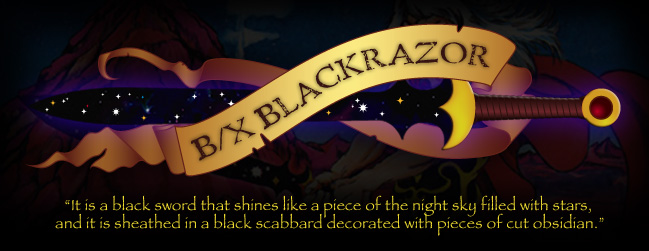
For those unfamiliar with Blackrazor, the blade is a sentient sword based more than a little on the Moorecock weapons, Stormbringer and Mournblade. As an intelligent sword, it has a special purpose: "to suck souls" in the words of Lawrence Schick. It does this by killing sentient beings and devouring their souls, feeding strength to its wielder, even as it satisfies its own dark hunger. Though it doesn't say so in the book, I have always taken the glowing star-like constellations of the blade to be actual imprisoned souls...a new star winks into existence with every death caused.

Blackrazor is never actually used against the players in the normal adventure module...instead it is an objective of play and (possibly) a trap: a Chaotic weapon that can turn on those of weak will, dominating them and compelling them to satiate its lust for souls through ruinous bloodshed.

Anyway...such was the circumstance here. Quentin Nogg was no enemy of the player characters, but Blackrazor was hungry after so many weeks of isolation, and it was determined to have its due in stolen lives.

The party marching order was this: Farnsworth and Gustav, Brian and Sly, Sweet Tito (still weak from his recent raising), Quentin and Terril, and Alster and Borgnine bringing up the rear. Since Terril was closest to Quentin, I had him roll the party's surprise roll. It came up a "1." I had Terril and Sweet T both dice off to see who the halfling would attack, as there was an equal chance of either, and the cleric lost.

With blinding speed (Blackrazor can caste haste on its wielder), Quentin turned on the cleric, black blade flashing. The halfling's eyes had rolled back in his head and he was obviously no longer in control. "Blood and souls!" He hacked at the cleric, inflicting severe wounds, even as Terril yelled for help.

In the following round, Blackrazor stabbed the cleric, deep through the kidneys. The cleric died with a curse as his soul was sucked out of his body. Without missing a beat, the halfling wheeled and brought the black blade crashing down on Sweet Tito's head, pulping his skull and driving his jaw deep into the elf's body cavity.

Alster attempted to cast hold person on the halfling, but Quentin made his saving throw. Brian loosed an arrow at him and Bornine hewed with his axe, but despite the wounds inflicted, Quentin seemed stronger than before as the blade fed him lifeforce. Sly tried to contact Sweet T telepathically, and could still feel his spirit hovering about his body.

[Sweet was wearing a broach of shielding which, in B/X, protects against death magic like finger of death. I decided to allow it to provide him with a saving throw versus Blackrazor's soul-sucking ability...'cause I'm such a nice guy...and Sweet managed to save. The only soul he'd permanently destroyed was the cleric's]

In the next round, Quentin again achieved initiative. A light flashed from the ring on his hand and suddenly there were TWO halflings wielding Blackrazors! Both attacked the cleric praying desperately for a miracle, but neither was able to strike home as the cleric blocked with his shield. Alster cast his 2nd (and final) hold person spell, but the possessed halfling again saved, this time with an 18.

Things were looking a might grim for the adventurers at this point.
; )

Friday, July 23, 2010

Damn...I Hate It When I Do That

To anyone that downloaded my B/X conversion of N1:Against the Cult of the Reptile God, please be advised that the original module was authored by Douglas Niles (as I've blogged before), NOT by Lawrence Schick (who did write the excellent S1:White Plume Mountain). I was so anxious to upload it this morning that I didn't bother to review it very closely. My bad.
: (

Saturday, November 28, 2009

Scourge of the Slave Lords (Part 4)

[continued from here]

And finally we come to the 4th and last module in the Slaver series, the whole reason I decided I wanted to write about these four modules, A4:In the Dungeons of the Slave Lords, written by Lawrence Schick (author of the excellent S2:White Plume Mountain, of which much has been written) and largely illustrated by Erol Otus (again, of whom much has been written). So let me ask straight off the bat:

Were Schick and Otus the "cool kids of school" in the TSR workplace?

'Cause I'm reading through this thing and it feels a lot like the whole was mainly brainstormed from their minds, probably developed while dropping 'shrooms or smoking a fat joint and listening to Grace Slick sing about the White Rabbit.

No really...mushroom people that work with fungal alchemy and sit in bonding circles while sharing a group hallucination? The mechanics of the thing is one issue, but the Otus's psychedelic artwork is positively inspiring...which came first in this vision, Schick's words or Otus's drawings? I can't help but thing they did it together building off each other's craziness.

Not to take anything away from Jim Roslov, whose art I love and which is present throughout the module, but you'll notice the treasure of the Slave Lords includes a drawing by Ool Eurts (an obvious anagram), not Mr. Roslov. Schick and Erol are in cahoots, folks.

Well, maybe more on that in a bit. Let's talk about the adventure itself.

I can't for the life of me remember where I was (recently) reading about NOT allowing your players to be captured. How this was a VERY BAD THING. It was in some recent RPG I picked up, or perhaps an adventure supplement, but I can't seem to find the reference anywhere...perhaps it was in a book I was thumbing through (like the Serenity RPG) that I didn't actually purchase.

ANYWAY, the gist of this game's advice was to never have players captured, that capturing players was WORSE than killing them...that at least if they died, they could always make new characters. Capturing player characters is a method of de-protagonizing them after all...cutting their balls off, so to speak.

I wonder if that game designer ever had a chance to play A4:In the Dungeons of the Slave Lords.

For those that haven't read, played, or heard about A4 here's how it starts: the player characters are captured, knocked out, stripped of all possessions (including clothing) and left in a lightless, underground cavern complex. Even the spellcasters are left without spells.

Let me quote Schick's take on the whole "capture" thing:

Many players think of their characters in terms of their powers and possessions, rather than as people. Such players will be totally at a loss for the first few minutes of play. It is likely they will be angry at the DM for putting them in such an "unfair" situation. They will demand or beg concessions. DO NOT GIVE THEM ANY HELP, even if they make you feel sorry for them, Inform the players that they must rely on what they have, not what they used to have, and that this includes their brains and their five senses. Good players will actually welcome the challenge of this scenario....

...To escape, the player characters will have to make the best of the opportunities offered by the contents of the various encounter areas. These opportunities may seem meager to the players at first, but this dungeon contains more than enough material for the players to escape from any of the exits if they have the wits and resourcefulness to recognize and utilize it. However, this module is also a test of the ability of the Dungeon Master! It is a virtual certainty that good players, forced to rely on their own initiative, will attempt to use what they find to do things not covered by the rules. In these situations, it is entirely up to the DM to handle these requests with fairness, objectivity, and imagination.

Hot damn! I wish I'd had this module as a kid. THIS is a perfect example of "challenging the players" rather than the character or stat block. It's also a great example of what is possible with the older editions of D&D.

Schick has created a challenging and exciting adventure that really does force players (including the DM!) to use their wits. There ARE plenty of "found objects" throughout the dungeon that can be used to equip and outfit the characters, as long as the referee uses "fairness, objectivity, and imagination."

But can you imagine how this module would work with D20/Pathfinder? It wouldn't. Unless characters had some sort of "craft spear" skill they're going to be using their fancy feats with bare fists.

And what would they be using those bare fists against? A 3HD badger is plenty tough for 7th level character in AD&D that's fighting naked, but would barely register on the Challenge Rating meter in D20. After all, the whole CR system takes into account PC's "expected equipment for level." They're not supposed to lose their gear. Cries of an "unfair" situation? You bet...'cause D20 ain't designed to challenge the player.

Ah, well...I don't play D3 or 3.5 anymore so it's a non-issue.

Schick has done such an excellent job with this capstone module that I want to play the whole series just to get to A4...psychedelic mushroom folk or not (and by the way, I remember the myconid from the Monster Manual II, but I never used 'em...here I would). I was slightly disappointed that Schick decided to blow up the whole Aerie of the Slave Lords....areas like Dragon Meadow and Drachen Keep were left un-detailed in A3 with the admonishment to keep players from exploring these parts of the map as they'd be "descried in the follow-up module." Instead Schick just covers 'em with lava and magmen and worries about his own little adventure. Which is cool 'cause his adventure is great, but it is a little annoying.

I'm reminded of the Phillip Jose Farmer-edited series The Dungeon, each novel penned by a different author. Author #1 introduced a green-haired love interest for the main protagonist and author #2 killed her off in the 1st chapter or so of the 2nd novel. Which would have been just fine (a series of novels with different authors will naturally evolve different from how the original author intended)...EXCEPT that Author #1 also pens the final novel of the series and has the protagonist once again waxing sadly for his green-haired lady friend...even though no other author has mentioned her in four books.

Fortunately, the Slaver series finishes with a bang and doesn't retread the ground Cook laid down, though I suppose one might consider an exploding volcano to be fairly reminiscent of Schick's own White Plume Mountain ending. Oh, well. Personally, I think that A4 offers something entirely new from other TSR modules of the time, and a real challenge to players, comparable even to the S modules...hell, moreso as players need to think outside the normal boundaries and parameters of the game, not just figure out colored key cards or riddles.

It's too bad there're no monks or assassins in B/X play...I'm afraid conversion of the slaver series would be exceptionally difficult much as I'd like to do it. Maybe I'll need to dust off my old AD&D books.
; )

Friday, November 20, 2009

A True Expert: Dave Cook Kicks Ass

Sometimes I worry that I'm a crashing bore. Sometimes I worry that someone I know is going to read something uncharitable I say about them and feel hurt. Sometimes I worry that I'm going to step on someone's feelings just because I couch my opinions with in a bit of inflammatory prose.

Mostly though, I don't worry too much about it...I know I've got my insecurities, and my worries are only as strong as my thought that I'm throwing typos and grammatical errors left and right. If I stopped to worry about all this...well, I guess I'd just be reading blogs instead of writing one.

But folks who've been reading know that I do detour off into the occasional attack post regarding...oh, pretty much everything at one point or another. But those same readers know that I save an especially large share of my bile for a particular edition of D&D...the 2nd edition. I mean, I have turned the cold shoulder to D&D3+ and completely ignored the fact that 4E exists at all. Why, why must I rail against all things 2nd edition.

Um...habit? Who knows? Who cares? Damn...it's just one guy's opinion!

However, in launching so many attacks at the game, it's possible (however slightly) that I might be pissing all over David "Zeb" Cook, the lead designer for that particular edition of the game. I don't know...does he consider it his "baby?" Well, anyway, if it seems like I've got a bone to pick, let me state right for the record now that I do NOT.

Dave Cook is a frigging' genius.

Maybe genius isn't the right term...I want a term like savant, but in my head that always has the word "idiot" at the front and I don't think of Mr. Cook as an idiot. Master might be a better term...you know, like the Old Masters of the Italian Renaissance?

Dave Cook is one of the true masters of D&D. If Gygax is the equivalent of Da Vinci, Cook has got to be Michaelangelo. Maybe that's not a fair comparison (Robert Kuntz might feel he's heir to the Michaelangelo title)...but certainly Dave is one of those Ninja Turtle names.

Mr. Cook's old school cred is not in question...he was working at TSR for a long time, and prior to AD&D2 worked on a whole slew of things. Just looking at the works credited to the man on wikipedia, I see a whole lot of stuff that I've owned and continued to own, all of which I certainly enjoyed in my youth: Unearthed Arcana (with Gygax), Star Frontiers, A1:Slave Pits of the Undercity, B6:The Veiled Society, BH2:Lost Conquistador Mine, X1:The Isle of Dread (with Moldvay). I can honestly say that I have used and played everything I've ever owned that was written by Dave Cook. And some things...noteably X1 and I1:Dwellers of the Forbidden City...I have used and played extensively with multiple gaming groups.

Of course, just being the hand behind a lot of good product isn't enough to qualify one as a "master" in my book. Lawrence Schick hit a homerun out of the park with S2:White Plume Mountain, but in my opinion one (exceptionally wonderful) adventure ain't enough. And quantity's not enough either...Doug Niles, I'm looking at YOU.

[there I go talking smack again! bad JB!]

It's only the last couple days that I've decided Cook is firmly in the master category...and this is DESPITE AD&D2 and the non-weapon proficiencies of Oriental Adventures. I've been reading his modules X4:Master of the Desert Nomads and X5:Temple of Death.

They are superb.

Taking into account his work on X1:The Isle of Dread, I can only come to the conclusion that Mr. Cook is a true master of B/X, ESPECIALLY mid-high level play or what might be termed "Expert D&D" (hell, even I1:Dwellers of the Forbidden City is designed for characters level 4-7). No wonder of course when one considers he was the main force behind the incredibly underrated (in my opinion) D&D Expert Set.

Underrated? Hell yes! I played Expert for a loooong time just subbing in the AD&D Monster Manual before I ever got a DMG or PHB. And many of the standard rules from the Expert set were simply 'ported in to AD&D once we started playing AD&D, including all wilderness movement and naval combat stuff. Sure Expert, like Moldvay's Basic, was just a streamlining and codifying of the original LBBs, but they were done in such expert fashion that they were a lot easier to use than either the LBBs or AD&D. And let us not forget that aside from a few extra clerical spells and Larry Elmore art, Mentzer's Expert set is pretty much word-for-word the Cook/Marsh book. And a lot of people still prefer BECMI and the Rules Cyclopedia.

But let's talk about X4 and X5. Wow. Just wonderful. First off, now I understand why the Expert set bothers to throw both Nomads and Dervishes into the mix. Cook uses every last scrap of Expert goodness in these two adventure modules. After playing through it, players will never relegate ESP and Dispel Evil off into the realms of the "optional miscellaneous" and creative use of spells in general is going to be particularly important. Heck, just about every magic item in the Expert set makes an appearance in one place or another, and scrolls and potions feature prominently...the NPCs sure aren't afraid to use 'em to good advantage!

The monsters are clever and their tactics explicit (very nice for a DM, very challenging for the players...and thanks to the fact this is B/X not 3.5, combats are still a dream to run). The new monsters are especially cool...comparing the Soul Eaters to the Death Leeches of CM2 for example and Cook's creations win hands down as interesting, challenging, while not being "F the players" AND they all have nice "personality." I prefer the new critters in X4 to the ones in X5 (the Fraggle Rock geonid look downright silly), but the Dusanu and Malfera are totally worthy opponents.

There are a LOT of demonic type creatures in the game...monsters like the Malfera, Spectral Hounds, and Soul Eaters all hail from different dimensions or planes (the Nightmare Dimension? the Vortex Dimension?) that don't conform to any particular "D&D Cosmology." I LOVE this. Cook displays what the REAL potential of B/X is...you can make your games a grim Sword & Sorcery tale and completely leave out the Immortals of BECMI or the planar/clerical specifics of AD&D and later games. B/X has THE EXACT SAME OPEN-ENDEDNESS OF OD&D, except that the rules are better written and organized.

And Cook only uses what he's got...unlike Moldvay's X2:Castle Amber, there is no speculation of what a 25th level character would be like (c.f. Stephan D'Amberville). The highest level character in either book is 14, where he ended his own Set. His additional rules are nothing that would later need to be retconned.

For example: the people of Hule worship Chaotic deities. Which Chaotic deities? Who knows? Who cares? Doesn't matter because they are DEITIES and they work in mysterious ways, granting strange powers to some and undying life to others, and flaming damnation to the poor souls that drop down the wrong chute. Ha! Does everything need to be codified (BECMI, D20...I'm looking at YOU)? Nah...I don't think so.

These modules reiterate all the things I love about AD&D that I hated in later editions...edginess and open-endedness ("an anything goes mentality"). Except it uses B/X...wow.

Saturday, June 6, 2009

Moorcock and More

As Schick himself has pointed out, Blackrazor is heavily based on Michael Moorcock’s famous blade Stormbringer.  Actually, I believe his exact phrasing was something like “blatant rip-off.”  

Well, BR may be inspired by Stormbringer, but I see them as two very different swords, and consider them such.

For those who haven’t read Michael Moorcock’s books, his most well-known character outside of Jerry Cornelius is the albino sorcerer-emperor Elric of Melnibone, a tragic character who ends up slaying friends and lovers on his way to destroying kingdoms and (eventually) the world.  He’s one of the earliest anti-heroes found in fantasy literature, and extremely compelling. 

At least, I always found him to be.  Before actually reading Howard’s books, my associations with Conan were more of the bare-chested He-Man/Masters of the Universe image.  The idea of a skinny, pasty intellectual kicking so much ass was music to my young mind (being kind of a skinny, pasty, intellectual myself).  Plus, I find a very angsty-teenager feeling in the Elric books that appealed to me through my formative “grunge years” (15-21 or thereabouts) growing up in Seattle in the 90s.  Vampire the Masquerade only wishes it could be so dark and nihilistic as my man Elric!

Much of Elric’s power came from his sentient blade, Stormbringer. Stormbringer was a demon incarnated in the form of a black "greatsword," covered in glowing scarlet runes.  That’s as much description as is really definitive.  Sometimes wielded one-handed with shield, it is just as often described as requiring two hands to use. 

Stormbringer has the power to suck the soul (utterly slaying) any person suffering the slightest hurt from the blade.  However, since Elric tends not to do “slight hurts” (every described strike with blade seems to be a mortal wound), perhaps this power is only activated on a “killing blow.”  In exchange for the taking of souls, Stormbringer confers upon Elric tremendous strength and vitality.  However, once sated (the blade stops being hungry for souls after a few hours in battle), it ceases to confer extra power.

Stormbringer also has properties resembling a dancing sword from D&D.  Being a sentient being, on certain planes it takes a roughly humanoid shape rather than that of a blade. It is intelligent but neither talks nor communicates telepathically…instead it “moans” or “wails” and communicates with Elric via a kind of deeper/baser empathic understanding.

And that’s really the extent of it…besides the “soul sucking” ability (really not much different from a life draining sword), Stormbringer’s powers are quite a bit dissimilar from Blackrazor.  Only on a most superficial level does Stormbringer’s purpose even resemble that of Blackrazor…Stormbringer has no purpose but to serve Elric and (ultimately) Arioch, Elric’s infernal patron. Oh, yeah…and eventually help Elric destroy the world in the Final Conflict (Moorcock’s version of Armageddon).  Blackrazor’s purpose: to suck souls. No more, no less.

Interestingly enough, there were AD&D stats for Stormbringer at one time, and it was quite a bit different from the write-up of Blackrazor.  Stormbringer was present in the Melnibonean Mythos of the 1st printing of Deities and Demigods, subsequently re-called and re-issued minus the Moorcock and Lovecraft sections.  I had the chance to borrow a copy years ago and even made (un-authorized) photocopies of the relevant pages, such copies being now lost in the mists of time. 

As I recall, Stormbringer converted stolen life energy into both Strength and Constitution for Elric…there were a maximum number of (hit points? Constitution? Levels?) it could drain before becoming satiated, though the number was in the hundreds.  I do not recall if the blade conferred “experience levels” on its wielder like Blackrazor, but it DID have the dancing capability.  It also had a tremendous ego/intelligence.

All things considered, I can truly say I prefer Blackrazor to Stormbringer.  Here’s why:

  1. Limitless versus limited power
  2. Encourages berserking Hand-to-Hand combat
  3. While both names are cool, "Blackrazor" is totally badass

Regarding #1…when I do my B/X write-up of Blackrazor, its power will be slightly reduced due to B/X level restrictions…which will actually make it a bit more like Stormbringer!

Though, of course, Stormbringer had a "sister blade" in the form of Mournblade.

White Plume Mountain (Part 1)


For most old school D&D players, the Willingham art in the title bar should be immediately recognizable as the back cover of S2: White Plume Mountain by Lawrence Schick.

In an interview on Grognardia, Mr. Schick explains how this module was created as a writing sample to get hired on at TSR. Personally, I'm not qualified to judge its literary merits, but from a design standpoint I find the adventure is fantastic, perhaps the best of all the Golden Age modules.

For one thing, it combines two very basic elements to create an archetypal adventure: the dungeon crawl and the quest. Plenty of early modules included a dungeon with very little objective (exploration, treasure seeking, monster killing being the de facto motives for entry). White Plume Mountain has strong objectives with a definite "victory condition." Find the magic weapons. You do this and you win.

For another thing, it is both short and self-contained. Unlike the sprawling S3 or S4 modules, it has one simple map and can be completed in one or two sessions no sweat. I've lost count of the number of times I've run this module over the years, but it has so few encounters (less than 30, including the optional one at the end) that it requires very little preparation for me as a DM to familiarize myself with the adventure.

Likewise, as there is no "spill-over" from the adventure, it can be plopped-down in any campaign world, with little affect. White Plume Mountain itself isn't in danger of eruption, the wizard Keraptis isn't plotting to take over the countryside, failing to find the magic weapons doesn't set off Armageddon. It has a nifty little outdoor map that has no bearing on the adventure itself, and can be discarded wholly (unlike the later Return to White Plume Mountain module).

The third thing this module has going for it are its encounters, an excellent mixed bag of monsters, tricks, traps, and treasure. Monsters range from evil humans, to mythological creatures, to 1950's giant monster, to undead. Many of the encounters require cleverness from the players and player inventiveness is well rewarded. Mr. Schick says he borrowed "the best bits" from other adventures, and boy, he sure got the best! To me, it's a great introduction to what D&D is all about.

Finally, the magic weapons themselves feel truly magical in nature. Objective and reward both, they have their own names, purposes, and curses associated with them...in addition to being powerful weapons. I suspect this blog will be discussing each in turn, and the titular Blackrazor especially.