Saturday, December 22, 2012

The Waltons--a History

The whole Walton family and Reckless the dog
I did not grow up on Walton's Mountain, nor did I live in a house full of brothers and sisters and grandparents, nor did I experience the hardships of the Great Depression.  But I did grow up with the Walton's.  They came along when I was just in high school.  They had far less than I had, and to this day, I envy them.

"The Waltons," you are thinking.  That was a TV show of some years back.  There was an innocent simplicity to the era of that show.  It was a season where the cornfield came to prime time television:  "Little House on the Prairie" and "Hee Haw" and "The Waltons."  And cornfield translates into cornpone which translates into corny.

Not so fast.  "The Waltons" as a TV series was doomed to failure.  It was too rural, too old fashioned, too family oriented to succeed.  And, it would have failed and was expected to last only one season at the most, but something happened.  People loved the show, and people loved the family.

And for an awkward, out-of-step confused teen-age boy like me, the Waltons gave me an anchor and a direction.  Hip, cool, and groovy never resonated with me.  I liked Roy Acuff, Bill Monroe, and Hank Snow, and even they were long past their glory days.  I listened on Saturday nights to the fading in and fading out of WSM 650 AM to hear the Grand Ole Opry.  I read Jesse Stuart and Robert Frost and wondered why the world didn't stop when they wrote.  I never understood cities or trends or things that defined pop culture.  I was a fugitive without knowing it.

So, the Waltons came along at just the right time for me.

It all began with the same family, different name.  It was a movie, an old one.  It came on the late show; meaning, that on a Saturday night, after the 10:30 news, an old movie would come on television.  You had to stay up late to watch it, for there were no means of recording the shows.  It was called "Spencer's Mountain" and it starred Henry Fonda.  It was the story of Clay Spencer and his wife and passel of kids who lived on a mountain.  The oldest son, Clay-Boy, was trying to get into college.  Clay was trying to build a dream home on the mountain for his family.  As it turned out, the dream home was the family.

The movie "Spencer's Mountain" was based on a novel by the same name by a Virginia author named Earl Hamner.  (I read the novel some years after watching the movie.  Read it in one of those Readers' Digest Condensed Books, which constituted most of our family library while I was growing up.)

Hamner, whose main writings were on television scripts, also wrote a short sequel to Spencer's Mountain.  It was another story about the Spencer family living in Virginia during the Great Depression.  This book was called The Homecoming.  This beautifully poetic story concerned a Christmas eve during the heighth (or depth) of the Great Depression when the Spencer family fretted all evening over when and if the husband and father, Clay, would get home.  He had been forced to find work far from home due to the depressed economic conditions.  His family was struggling more than ever to find the meager means to celebrate.  And with snow and other problems, it looked like he might not make it home.
With Edgar Bergen playing the grandpa, the Walton kids gather around the radio--a frequent event in the later Walton series where they listened to "Edgar Bergen and Charlie McCarthy."
In 1971, the book was adapted to the screen and became a Christmas special.  Keep in mind, that in those days, there were 3 channels on television and only a few Christmas shows. 

I remember seeing the advertisements for "The Homecoming."  I knew I would love it.  The cast included Patricia Neal as Olivia, with Andrew Duggan appearing at the end of the show.  Edgar Bergen, an old radio star and ventriloquist (who had a dummy named Charley McCarthy), played the grandfather, and Ellen Corby, an older actres who played many minor parts in television, played the grandmother.

Dominating the show was an incredible cast of children.  They were to become the seven Walton children.  They were an attractive and quite talented bunch of kids, with at least four of them having the red hair that was part of the Spencer story.  The central character was John-Boy Walton.  (In the book, it was Clay-Boy.)  Hamner, probably with good reason, had him called John-Boy instead of John, Jr.  In the television story, he was always John-Boy in the process of becoming John Walton, Jr.

Mary Ellen, Jason, Elizabeth, John Boy, Ben, Erin, and Jim Bob
Beginning with that Christmas in 1933, the Waltons entered my life and the culture of America.  The transition from "The Homecoming" to "The Waltons" entailed quite a few changes.  The house in "The Homecoming" was plain and cabin-like.  The house in the television series was a period two-story house with an incredible front porch.  (I would love to have such a house.)  John Waite and Miss Michael Learned became the parents on the series.  They both became defining characters.  Perhaps outshining them was the combination of Will Geer and Ellen Corby as the grandparents.  As a subtle tribute to Edgar Bergen's brief role as Grandpa Walton, the family on the series would gather around the radio to listen to Edgar Bergan and Charlie McCarthy.

Miss Michael Learned as Olivia Walton, the mother, and John Waite as John Walton, the father.
Not surprising, Will Geer and Ellen Corby won numerous awards for their roles as Grandpa Zebulon and Grandma Esther Walton.  They were a beautiful couple.

The Walton's house, my dream home.

"The Waltons" went for nine seasons, and the cast re-assembled for a few movies in the later years.  (I wish they would do at least one more movie.)  The show did quite a few two things that were amazing:

1.  The show paralled the history of the 1930s.  The New Deal and FDR, the abdication of King Edward, the Bank Holiday, the rise of Naziism in Europe, the explosion of the Hindenberg, and other historical events became either central points or background to the stories.  By the end of the sixth season, the whole family is gearing up for and fearing the impending entrance of America into World War II.

2.  The show had a continuity to the characters, both the regulars and guests.  If ever a cousin visited the Waltons, they were mentioned later and maybe they visited again.  A whole community existed on Walton's Mountain.  Besides the Waltons, there was Ike Godsey and his wife Corabeth (a cousin to the Waltons), Emily and Mamie Baldwin (famous for the recipe), Reverend Fordwick and his wife, who was also a teacher, Mrs. Hunter, Yancey (the epitome of a good ole boy), Maude Gormley (an elderly widow), Mrs. Brimmer (who runs a boarding house), Verdie and Harley Foster (an African-American family) and Sheriff Ep Bridges. 

3.  The Waltons were rooted in the land and history.  One of the most defining and powerful shows was "The Conflict," a two part segment at the beginning of Season Three.  The Walton's on Walton's Mountain visit some of their kinfolk.  We meet Martha Corinne Walton whose home is being taken away by a road building project.  This story is rich in the theme of being rooted to the land. 

Beulah Bondi, who played as George Bailey's mother in It's a Wonderful Life, capped her career with the role of Martha Corinne Walton.

4.  The Waltons were closely connected as a family.  Remember this is the television world, so there are flaws, errors, and inadequacies; however, the Waltons had a strong father and mother.  There was wisdom to be found in the grandparents.  The kids were growing and struggling through all types of issues.  But the bonding love of the family defined the show.  Almost every episode of the show featured the family sitting around the table having a meal, and someone always prayed before the meal.


5.  The Waltons were Christians.  Again, the show really blundered at points.  When religion was front and center, the faults were greater.  But the Waltons were part of a church and they applied the faith to life.

In recent years, I have loved watching our collection of Waltons DVDs and watching my children get to know the Waltons.  I have studied the Walton family, read The Homecoming each Christmas, read and studied Goodnight John-Boy, and made Olivia's Applesauce Cake.  Whatever it takes to get me closer to the Walton experience, I have tried. 

Wednesday, December 19, 2012

Two Views of Life

I finished two books this morning.  I enjoyed one and despised the other.  I did not make a connection between the two books until I was finished with them.

Wild at Heart by John Eldredge
Over a period of a month or two, I read Wild at Heart: Discovering the Secret of a Man's Soul by John Eldredge.  The only other book by Eldredge I have read is his short evangelistic work titled Epic.  I love Epic and like Wild at Heart.  I have read some of the concerns and criticisms of Eldredge's writings and doctrines, and I concur with many of the cautions.  He is a gifted and challenging writer, but he is not as careful with doctrine and Scripture as I would like.  But I did not read him for precision; instead, I read him for encouragement.

Wild at Heart does address a vital issue in the church and family:  Manhood.  Eldredge challenges men to be men, to take on challenges, to model themselves after the great men of history and literature.  With lots of good illustrations, examples, and quotes, he calls upon men to move beyond their safety zones and take risks and face challenges.  As long as the reader has a good dose of Scripture and doctrine, this book is useful.  I felt lots of conviction and am still thinking of the many implications.

A person, and a man since a man is a person, needs to assess his life, break away from the fears, understand the wounds he bears, and step out to do things bigger, harder, and greater than he has ever done.  Everything in that previous sentence is futile and dangerous apart from Christ.  Being adventurous and being adventurous for Christ are two different things.  Two men can both take on great challenges that look similar, but one is serving Christ and the other is serving self.

The Mulligan:  Lots about golfing and trout fishing.  Even more about selfish sinfulness.
The Mulligan looked like a good book.  The cover indicated a western setting.  It is a book about second chances, about starting over.  It is a book about a man who abandons the things that constrict his life and faces new and great challenges and opportunities.  It is garbage.  Literally, a foul mouthed book about foul people.  It deals with an empty marriage, a failed husband and father, a God-less man, a person who hates his work (dentistry),  abandonment of all commitments, adultery, lying, and extreme self-centeredness.  Add to that, the writing style was weak and repetitive.  I thought that if I had to read about him drinking another diet soda or about how empty his life was with Jess, his wife, I would have to burn the book. 

I have read lots of modern fiction over the past year.  I am used to, although not approving of, rough language.  I read Faulkner, so I know people aren't nice.  My sense of this book was that there was no redemption.  The wages of sin were personal success and satisfaction for the main character. The disgruntled, looking for meaning in life, lead person in this story needed to read John Eldredge.

Sunday, December 09, 2012

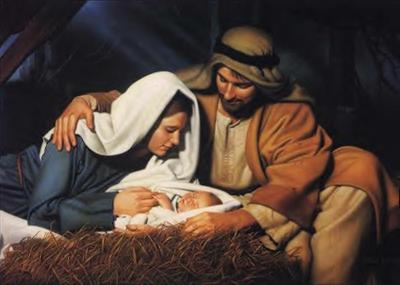
You Shall Call His Name Jesus--a few sermon notes

Matthew begins his Gospel with the genealogy of Jesus. As I said last week, a modern editor would have other ideas. We would affirm that Matthew, under the direction of that greatest of editors—the Holy Spirit—was right.


Still, this opening portion of the story of the life of Jesus is incredible.
Last week, I described it as a love triangle. A triangle is the typical pattern for a love story.
“Boy meets girl; they fall in love, get married, and live happily ever after” is convenient, but does not make for good stories, movies, and songs.
There has to be a third party, a foil to the plan, another person or issue that intervenes long enough to create a full story.
(In the case of Romeo and Juliet, the third party was the family feud.)

One of the great masters of the romance was Jane Austen.
She almost never gave any physical description of her characters.
She often wrote in a passive rather than an active voice.
Her humor, ever present, was so dry and subtle as to be lost to many readers.
Even though she lived during the times when England was at war with Napoleon, there are almost no references and certainly no actions relating to anything on or near a battlefield.
The only dangers in her stories seem to be rainstorms, which inevitably leaves some poor girl almost hopelessly sick. Or the danger of someone having to marry a merchant, that is, a person who actually works for a living.
The first impression of a book like Pride and Prejudice is “Why does it take her so long to get Elizabeth and Darcy married?”
A deeper reading suggests that Jane Austen very tightly compressed lots and lots of wisdom in a relatively short and simple tale.
If she is a master of subtlety, mystery, and the slow unveiling of truths, how much more so is the writer of this romance, this love story, the Gospel of Matthew?

Matthew’s Little Bible

This portion of God’s Word--Matthew 1:18-25-- is itself a little Bible. A systematic theology in 8 verses. A pattern for life. A compressed, compact, concentrated story that tells you everything you need to know about life.

What doctrines and applications are contained in Matthew 1:18-25?

There is a reminder of the creation. “The Spirit of God was hovering over the face of the waters.” Here again the Spirit is creating.
You have the Trinity—the Father, Son, the Holy Spirit.
The incarnation of the Son, that is, His becoming human flesh.
The two natures of Christ: Humanity and Deity.
The blending of the natural and the supernatural.
The physical world and the spiritual world, with the physical being the realm of men and the spiritual world inhabited by angels. Hence, the doctrine of angels.
You have natural revelation, Joseph learns that Mary is pregnant, and supernatural revelation. Things Joseph could not know apart from God.
The law and mercy: Joseph…a just man…not wanting to make her a public example
The story of the Davidic Covenant and Kingship—Son of David.
The Old Testament story is here as well as the New Testament story.
Faith: "Do not be afraid to take to you Mary as your wife."
Works: "Joseph, being aroused from his sleep, did as the angel of the Lord commanded."
Promise, Fulfillment.
Prophecy--Future: “He will save His people from their sins."
The Fall:  Sins
Atonement:  He will save, atone for, pay the price for...
A covenant people:  His people
The doctrines of grace: an elect people, irresistibly drawn and set apart.
Providence
Human responsibility
Serving Christ, suffering for Christ, living for Christ.
Marriage
Manhood
An eschatology of victory: A view toward the end of things where God triumphs.
The unexpected, the miraculous, and the life changing.

It is hard to think of a doctrine or aspect of life that is not found here in this little Bible—Matthew 1:18-25.

It is, as it were, like the Big Bang theory of the Universe. All matter compressed together that explodes and expands to form into everything we know.

And in the manner God enjoys so much: He gives us these truths in a story.
Robyn Miller said, “Story molds us. There’s hardly anything we change our minds about because we’re convinced by logical arguments. Story makes us who we are.”

Aristotle said, “The mind never thinks without a picture.” (Same source, page 87)

So here is the story. The story of this world. The story of your life. The story of promise.

Thursday, December 06, 2012

Books for the History Man in your life, Gift Ideas 4

There is no better book for the history student, teacher, or afficiando than this one:

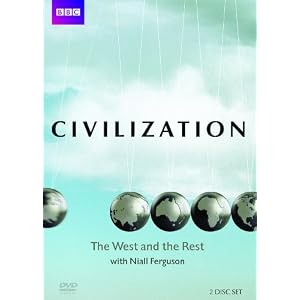
Civilization: The West and the Rest
The Scotsman Niall Ferguson's book Civilization: The West and the Rest is brilliant.  Ferguson is an amazing thinker and writer.  His specialty is economic history.  I generally assume that I need every book he writes.  I read this book back in January of this year.

Right now, at the galloping pace of 2 to 4 pages a morning, I am reading another of his books:

The Ascent of Money: A Financial History of the World
I acquired this book several years ago and read the first few pages several times.  Now I am trying to get on into it.  It will take a while, but it is always a mental delight to read a historian, thinker, writer like Niall Ferguson.

Historian Niall Ferguson
Ferguson's other books like Empire, The American Colossus, and The Pity of War are all worthy selections to add to yours or your special friend's bookshelf.

I already have the books mentioned above, but I would not be one bit angry if Sinterklaus were to drop off a DVD copy of the documentary on Civilization.

Civilization: West & The Rest
Have not watched this, but would like to.

Saturday, December 01, 2012

Books about Jesus, Gift Ideas #3

I love weightlifting, as long as the weights are books.  December has begun well with my awakening early and able to begin some readings and work on tomorrow's sermon.  I am excited about the beginning of the Advent Season at church.  I will be preparing sermons from the Book of Matthew and will, Lord willing, continue through Matthew for the next several months.

These are some of the books that I have read or am reading from while both preparing sermons, focusing on Christ during this season, and doing my devotional and theological studies.  As usual, I am seeing an evergrowing stack of books.  Some I will taste; others I will read completely.  I think there are some good gift choices here for anyone you might know.

Jesus: A Theography by Leonard Sweet and Frank Viola
It took me several weeks of looking and thinking before I was convinced to buy this book, but it only took a few pages of reading after I got it to convince me of its worth.  Jesus: A Theography is centered around the idea that the entire New Testament is a commentary on the Old Testament, and each part of the Bible is a central story about Jesus Christ.  If I wrote "Wow" in the margins, I suspect this book would be very marked up quickly. Jesus: A Theography is published by Thomas Nelson Publishers.


Voted Best Book of the Year for 1996
The Jesus I Never Knew by Philip Yancey won the 1996 Gold Medallion Christian Book of the Year award. I really wish I had read this book years ago.  I am not even sure that I had heard of it until recently.  My copy is a like-new used copy.  I started it a few weeks ago and am now about half-way through it.  Phhilip Yancey is a great writer in terms of style.  I am not sure that he and I share all or many of the same "isms," but I find his writing quite challenging and refreshing.  I have already passed on an extra copy of this book to my son Nick, and I wish I had a dozen more to give away.

A book on harmonizing the Gospels
Inerrancy and the Gospels: A God-Centered Approach to the Challenges of Harmonization by Vern Sheridan Poythress is a more theological and scholarly book than the previous two.  (None of that is said to disparage any of the books discussed in this post.)  The details of the Gospel stories differ.  Some are minor, some are supplemental, but some are a bit challenging to figure out.  I admit that I approach the Scriptures with a presupposition that the Word of God is infallible and the various accounts can be reconciled.  It is good that others have delved more deeply into these topics.  I am currently in the process of reviewing this book for Crossway Books.

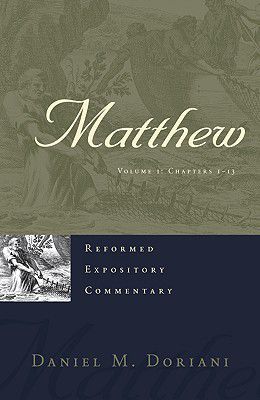
Volume One of a Two Volume Set
 I want the entire "Reformed Expository Commentary" set that is being published by P and R Books.  This series consists of expositions based on preached sermons by pastor-scholars.  This particular selection is a two volume work on Matthew's Gospel by Daniel M. Doriani. I will be reading through these sermons as I continue in Matthew.  Whether it is a pastor needing serious commentary or a laymen wanting good spiritual reading, these books are good.  I am raiding these sermons for all sorts of help.

A couple of other reads:

Sermons from the Book of Mark
Last December, I read King's Cross: The Story of the World in the Life of Jesus. That book elevated Timothy Keller into being one of my favorite authors.  (He has two new books out that I really want.)
King's Cross consists of sermons from the Book of Mark.  I was getting set to re-read this book when I decided to take up studying Matthew.  But I will continually to highly recommend this work.

God, it turns out, is the one who spends wildly!
A shorter read is The Prodigal God, also by Timothy Keller.  This story focuses on the famous story of the Prodigal Son.  Be ready to hear a familiar story and then see things you have overlooked.  This book would make a good present for anyone.

Tuesday, November 27, 2012

History for Christmas, Gift Ideas

I live in denial.  "There are no history books that I want for Christmas.  And I have too many that I still need to read. So, no books on history for me.  Really."  But it is not true.  I discovered just a few days ago that someone had finished writing the third volume of the Churchill biography that William Manchester never completed.  How can I live without that?  And Jon Meacham, who wrote a good biography of Andrew Jackson a few years back, now has a book about Thomas Jefferson.  AND, Peter Ackroyd has written the first in a series of books on English history.  It is titled Foundations:  The History of England from Its Earliest Beginnings to the Tudors.

But enough about me and my impoverished book shelves.  What can you get for the historian in your life?  I am tempted to refer back to the 100 greatest books on non-fiction that I posted many moons ago.  Also, I have many blogs from days past that list books.  But I will confine myself to a few new selections.


John Locke:  Another Influence on the Founders
 In my Modern World Humanities class, I teach about the four world-changing revolutions.  They were the Glorious Revolution in England in 1688, the American Revolution of 1776, the French Revolution of 1789, and the Russian Revolution of 1917.  The first two were radically different from that last two.  And the first two were inspired in large part by the thinking and writing of John Locke.  Most Americans are familiar with Locke indirectly through Thomas Jefferson's writing of the Declaration of Independence.  Locke's Two Treatises of Government are a classics in political philosophy.

Christians interested in politics, and that should be all Christians, should rejoice in the book John Locke: Philosopher of American Liberty by Mary-Elaine Swanson.  This work was among the last labors of Mary-Elaine Swanson.  Her works go back to a time when Christians started rediscovering the forgotten Christian influences in history.  Christians began realizing that they could actually teach their own children and teach them a different perspective.  But what was that perspective?  That were plenty of oversimplications and distortions.  Puritans were bad and the Founding Fathers were secularists (or maybe Deists).  Books started being published, old sources started being rediscovered, and books from the past started getting reprinted.  This movement was propelled by such people as Peter Marshall Jr., Paul Jehle, Marshall Foster, Verna Hall, Rosalie Slater, and Mary Swanson.

Today, a Christian can fill quite a few book shelves with both scholarly and popular historical works dealing with the Christian figures, movements, and influences on American history.  I know that from personal experience.  Of course, Locke is not an American, but he was widely read by the Founding Fathers. 
One of the books I use in my government class is John Eidsmoe's Christianity and the Constitution.  One of the best features of that book is the chapter that deals with some of the key thinkers who influenced the Founders.  And of course, Locke tops the list. 

Thanks to my friends at Nordskog Publishing for making this book available.


Bullinger:  A peer to Calvin and Luther
Maybe I recommended this book last year, but it is worthy of highlighting again.  Henry Bullinger: Shepherd of the Churches by George M. Ella.  This book is valuable simply to help us all to see that God did not just raise up Luther and Calvin in the 1500s.  There were quite a few other key theologians and pastors who spoke and wrote just as boldly and with the same convictions as Luther and Calvin.  People still read Luther's Bondage of the Will and Calvin's Institutes.  (Or at least, they buy the books to put on the shelves or recognize the titles.)  Martin Bucer, Philip Melancthon, Henry Bullinger, and quite a few other Reformers appear as almost footnotes or shadow figures.  Some readers might think that this biography overstates Bullinger's importance.  And those of us who have identified ourselves as Calvinists for years would find it stressful to now have to call ourselves Bullingerists.  Nevertheless, this book is a necessity for Reformed pastors and history teachers.

I am thankful to my friend David Leach for calling my attention to George Ella's writings.  David is an excellent bookman with a vast awareness of many authors and titles.  I have bought many, many books from him through the years. Having gotten acquainted with the author and this book, I would love to acquire quite a few more of Ella's books.   The only problem with this biography of Bullinger is that it is published in England.  That boat trip across the pond hikes the price of such books.  This book, along with some of George Ella's other titles, are published by Go Publications.

I have more history suggestions for later.

Sunday, November 25, 2012

Philosophy for Christmas, Gift Ideas

Books make good decorations for the tree, but are better used as gifts.

I collect books on philosophy and start books on philosophy and intend to read books on philosophy.  Occasionally, I finish a book.  I honestly believe that philosophy is not my field, gift, inclination, or calling.  Yet, as a history and literature teacher and as a pastor and teacher in the church, I cannot ignore the field. 
I have managed to read some philosophical works this past year.  In my Humanities class last spring, we read Plato's Republic.  It was a good and overdue read for me.  And this past month, I read and taught through about half of Augustine's City of God.  More recently, I read a short book called Philosophy and Theology by John D. Caputo.  This is an 84 page study that calls for another and a closer reading.  It was set right about at the level I needed.  It would do for your Christmas list.

Short and witty introduction to a key topic.
Here are a couple of more suggestions for the philosopher in your life:

Another useful book that helps unlock the thinking of Herman Dooyeweerd.

A few years back, I was working on a lecture series called "Calvinistic Worldview Thinkers in the Wilderness Years."  One of the most important influences on Calvinist thinkers in the 20th century that I discovered was the Dutch philosopher Herman Dooyeweerd.  I began collecting books by Dooyeweerd and about his thinking.  At that time, many of the books on Reformational Philosophy were either out-of-print or expensive.  In the last several years, Paideia Press has been publishing books by Dooyeweerd and related thinkers at really affordable prices. 

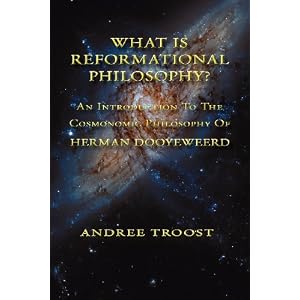
I have only been able to scan through a bit of What is Reformational Philosophy?  An Introduction to the Cosmonomic Philosophy of Herman Dooyeweerd by Andree Troost.  Still, I am glad to see this book available.  The back cover states, "If the busy student can read only one volume on Christian philosophy, this is preeminently the book to read."  I probably have 2 dozen books that are the "one volume a busy student should read"; nevertheless, this book is inviting.  I just wish I had talks and travel to places ranging from Virginia to Alaska so that I could justify spending time reading this book.  (List for $9.50 on Amazon--a steal!)

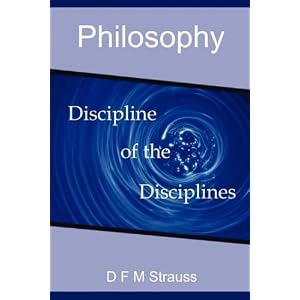
Besides the books by Dooyeweerd (and three more have been recently republished), Paideia Press began its ventures just a few year back by publishing a 700 plus page book titled Philosophy as the Discipline of Disciplines by South African scholar D.F.M. Strauss.  I am the proud owner of an inscribed autographed copy of this book.  This is not a beginner text.  But for the serious student who wants to pursue philosophy from a Christian viewpoint, this would be marvelous gift. And it is a 700 page book that sells for $15 from Amazon. 

Weighty

Dooyeweerd, Troost, and Strauss are all from the Reformational view of philosophy.  Or, we might say, they are in the Calvinist Protestant tradition.  I always feel a natural alliance with such men.  However, there are others who hold to different perspectives whose work I like.  One is the Catholic thinker Peter Kreeft.  I have read several of his books and have enjoyed teaching through Socrates Meets Jesus.  As far as a philosophical thinker excelling at providing introductions to beginning students (meaning, high school students, college freshmen and sophomore, or overaged people like me who are forever playing intellectual catch-up), Kreeft is quite good.

I have recently received a copy of Summa Philosophica by Peter Kreeft.  This book is published by St Augustine's Press and I would like to have every book they publish.  Let me note what the cover says about this book:  "Kreeft employs the medieval quaestio debate format so successfully employed by St. Thomas Aquinas in his Summa Theologiae.  This tour-de-force takes up 110 perennial questions asked through the centuries. Kreeft covers questions about metaphysics, knowledge, and ethics....If you want a summary of all the most important questions in philosophy, as well as the most convincing answers to these questions, this book is the single most reliable and enjoyable guide available." (Christopher Kaczor)

Summa Philosophica
Serious cover, deep thoughts, fun book.
To get a sense of how Kreeft himself writes, note this from inside the book: 
"Dear prospective reader,
If you are wondering whether this book is worth your time to read or your money to buy, don't read the long, dull Introduction first. Browse through the book itself."

I cannot imagine that Kreeft will be dull and I affirm that his books are worth the time and money.

Coming up next:  Books for the Historian in your life.

Friday, November 23, 2012

Books for Christmas, Part 1

Books require little or no external wrapping.  That is because books are wrappings.  In the book world, covers, especially paperback covers, are referred to as wraps.  The cover, whether an inviting work of art or a more stately solid color, is an invitation.  The cover itself is a gift.  It is art and definition and stability.  The spine, preferably gilded with the title and author's name, will quietly adorn the shelves, taking its place among its comrades.  Row upon row of books will silently remind you and inform listeners of wisdom, mortality, beauty, and the quest for story.  Every pause in every human conversation, every glance to the shelves during other ways of wiling away the hours, the spines speak.  Deep, silent, haunting, they are stationary in the midst of the passing hours and solid in the midst of the fluidity of life.


  Then consider the title, and if you, the reader are special, sub-title, of a book.  The title may inform you or it may intrigue you.  Sometimes, we need to know exactly where we are going.  We need the title that is the GPS to our thoughts.  At other times, we don't know "for whom the bell tolls" or how to be "surprised by joy."  The sub-title is the promise of the book to change your life or thinking in some way. Sometimes the sub-title reveals (and sales the book) and sometimes it conceals. 

 Then then there is the author.  Again, the name of the author is a gift.  I recently bought (you could almost say "stole") a beautiful three volume set of the works of John Bunyan.  It was his name that convinced me to purchase this gift for myself.  The author's name is the way the gift says, "Meet a new friend. You will enjoy getting to know this person."  If it is a familiar author, it says, "Hey, it is time we got back together and get caught up on what has been happening."  If it is a well known author, one whose books are deemed as classics, it says, "You have heard a lot about me, no doubt.  But I would like for you to know me for yourself."

All this only brings the reader to the opening of the book.  Each page or chapter invites the reader to stay longer, to relax, to put aside some minor distraction (like work or eating or sleeping), and to enjoy a little more conversation. As the pages begin to turn and as the story or thoughts develop, the reader begins to find the need for some accessories.  A chair, or pillows propped up on the bed, or a lamp, and a mute button on the surroundings.  Some books call for strong caffeine in the mornings to enhance the flavor, while others promise to help end the pressures of the day and cushion the hour leading up to (or delaying sleep).

The reading then progresses to that other beginning portion of the book--the last page.  A good book, the really good ones, only begin when the last word on the last page is read.  There are those books that are so impacting that it is a different person who puts the book down than the one who picked it up.  Not every book is a Damascus Road experience, but some are.  Most books are road experiences of some sort, whether the road is a pleasant country drive or an interstate highway easing the passage from one place in life to the next.  It has to be admitted that not every road is profitable, beneficial, or enjoyable.  And some roads are wrong roads.  Thankfully, no book has foreboding red signs in it saying, "No U-Turn."  You have some editorial privelege.  You can insert the words "The end" anywhere you wish. Yes, there are cases where the visit has been like a root canal, cases where yours and the author's time together ends with,  "It's been nice knowing you.  So long."  But in the better cases, the last page either invites the reader to race to the bookshelves for more books or, perhaps better, to turn the pages back over to the beginning, so as to relive the experience.

So, we will start sharing some gift ideas.  I will assume that the classics of literature, theology, and history are already on the lists.  I don't need to be a dull echo telling you to acquire the works of Augustine or Austen, of Dickens or Dostoevsky, or of William Shakespeare or William Faulkner.  Stay tuned. 

Wednesday, November 21, 2012

The Mormonizing of America

In humor, timing is everything.  Timing is important in pretty much every endeavor.  A three point shot made after the game is irrelevant.  During the game, it is a game changer.  Timing is critically important in when a book hits the market. 

Good popular history of a distinctly American religion.

The Mormonizing of America by Stephen Mansfield hit the market in July of this year.  Mitt Romney was awaiting the formal nomination as the Republican candidate and no one was sure how the political season would end.  Evangelicals had expressed great doubts over Romney's Mormonism.  But as the more acceptable candidates either faded, never appeared, or got knocked out of the running, conservative evangelical Republicans had to make a decision.  Election year 2012 was not exactly a "dream come true" time for the Religious Right holdovers, Tea Party supporters, or Puritans.

For many of us, the question regarding who to vote for or whether to vote got down to the stark alternatives.  I have grown weary with the "lesser of two evils' phrase and the various approaches people take to it.  It was simply a matter of competence.  I firmly believed that Mitt Romney could step into the Oval Office (or virtually any executive office) and quickly figure out what needed to be done.  I did not assume that I would like all that he did, but believed then and now that he would show great skill in taking on the task of executive leadership.

Mormonism became a side issue.  After all, the Democrat President is in no way an orthodox or evangelical Christian.  I will let others decide how to best define President Obama's theological convictions or lack thereof.

Stephen Mansfield's book will, no doubt, get quickly remaindered and discounted due to Mitt Romney's loss.  A Romney win would have at least raised the question of a revision with the addition of a chapter specifically devoted to how a Romney Presidency would impact our culture.

But this book need not be pushed over into the discount bin and be disregarded.  The subtitle states, "How the Mormon Religion Became a Dominant Force in Politics, Entertainment, and Pop Culture."  The "Mormon Moment" that the book describes has not yet passed.  The history of the movement and the theology of the LDS church is still rather unknown to most people.

Undiscerning Christians and the people who routinely think all evangelicals are prejudiced nitwits will easily buy into a certain viewpoint toward Mormons.  After all, John F. Kennedy's Roman Catholicism was once an issue, but both VP candidates this year were Catholics.  Just as Protestants once voted for Kennedy, so evangelicals voted for Romney.  A Presidential candidate being a Mormon will not be questioned in the future.  And currently, the Senate Majority Leader Harry Reid is a Mormon, and his political problems don't stem from his religious convictions. 

But the statement made by Franklin Graham remains true:  Mitt Romney is not a Christian. He is a Mormon.  The same can be said for Glenn Beck, Harry Reid, and other prominent Mormons.  Christians and Mormons have some similar language and similar beliefs, but they are not the same. And these differences are not comparable to the differences between a Wesleyan Methodist and a Southern Baptist. In the past, Mormons were very adamant about defining themselves as different from all forms of traditional Christianity.  They do trend today toward defining themselves as just another denomination.  Re-defining their image has been a staple part of Mormon history.

Mansfield's book lays out the background to the movement.  We can call Mormon history weird and that is putting it lightly.  This book still calls for reading.  The movement still calls for some serious theological and historical evaluation.

Saturday, November 03, 2012

Great Hunting

It's November and so it is a great time for hunting.  Well, for me that means book hunting.  Today's hunt was unexpected.  A lady told me about an inside sale at the fair grounds.  It cost a buck to get in, and there were dozens of booths filled with all sorts of garage sale items and crafts.  I thought it would be an easy run through the place with nothing to find.

And then, I stumbled across this set:
The Works of John Bunyan
Three volumes...Banner of Truth....The Works of John Bunyan.
The price tag said $25 for the set or $10 per volume, but the lady running the booth said, "What about all 3 for five dollars." 
And they are in new condition. 
What a find! I would like to have everything Banner of Truth has ever published.  Their selections are always fine works in the Reformed and Puritan Traditions.  And their books are quality productions.
All in all, a good day of book buying.

All three volumes are quite large and the books are in perfect shape.

Sunday, October 28, 2012

For Work and Pleasure

This is the third time I have worked through and taught through Augustine's City of God.  I have been more plodding, more deliberate than ever.  It really takes several readings to get below the surface of this defining Christian classic.

City of God - Abridged


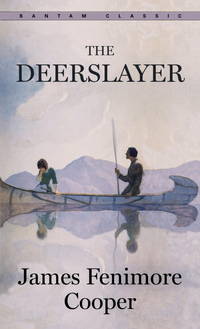
This is about the fourth time for me to read The Deerslayer by James Fenimore Cooper.  And this is the third time for me to teach my junior high students through this book.  For sure, junior high kids of today are not prone to plow through 500 plus pages of Cooper's labored prose.  He is worth the effort.  The Deerslayer, that is, the character Natty Bumpo, is the epitome of the frontier hero, a man of honor, a knight, and a Christian gentleman.  The true gist of the story is the definition of true manhood.  I need the lessons myself and am certain that my students do as well.


I am also reading The Mormonizing of America by Stephen Mansfield.  The Mormon movement is a very powerful force in America.  I hope that it is a more powerful force after November 6.  But with all of the appreciation due for the work ethic and general morality of the members of the Church of Latter Day Saints, we need to understand their history and beliefs.  These are not mere Christians with a few quirks. 


I have also recently started Faulkner and Hemingway: Biography of a Literary Rivalry by Joseph Fruscione.  I love the works and styles of both writers.  In the subtle feud that existed between the two, I would have bet my money on Hemingway if the matter were to be settled with fists.  If they were in a drinking contest, who knows?  As far as the depth and durability of the writings, I think Faulkner has the upper hand.  Nevertheless, I am quite interested in delving further into this study.


Fills in a Gap Among Us Reformed Folk

  The doctrinal teachings of the Reformed faith are like a great mountain range.  Whether one is scaling a particular mountain or admiring the vast slopes from a distance, the effects are awesome.  Along with the grandeur of Reformed theology, there are the great worldview thinkers and applications.  I was first made alive to the beauty of the Triune God and the grace of God and the Incarnation of Christ through reading theology.  The application to all areas of life and thought came through the worldview thinkers.  Whether it was Abraham Kuyper's Lectures on Calvinism or Francis Schaeffer's How Should We Then Live?, I have been stunned, shaken, and driven by the power of God's transforming Word and Grace as applied in education, history, family life, politics, art, economics, and other realms of human action.

But there is a third powerful pillar to the Reformed experience.  It is what we might call experiential theology or practical theology.  More commonly, we might speak of the spiritual disciplines or of personal holiness.  Admittedly, it has sometimes been disappointing to see others and embarassing to see myself caught up in a theological point or focused on some aspect of applyng a Christian worldview, and yet, deficient in the area of personal pursuit of holiness.  In other words, it is easy to argue with an Arminian and even easier to trump a secularist, but hard to cultivate a heart after God.

In the great tradition of Christian holiness.
Through the years, I have read, in part or in whole, from many fine works emphasizing personal holiness.  One can glean from the great men of the Puritan era, such as John Owens or Richard Baxter.  Or one can read more recent authors like Jerry Bridges and Donald Whitney.  Such reading is vital for the spiritual heart health.  It is also vital that sound preaching be directed toward holy living as well.

Kevin DeYoung has added another fine book to the list of books on personal Christian living.  Titled The Hole in Our Holiness, it calls attention to the neglect we often have toward holiness.  It is easy to fall off on the side of legalism, or to lean the other way and fall off in looseness in Christian living.

I read this book about a month ago and have now started rereading it.  This is a fine morning read.  DeYoung is witty and searching.  I am contemplating how to get this book in the hands of many friends and church members.  It is short and hits hard.

I hope maybe to list more specifics later.

Saturday, October 13, 2012

Some Books on Politics

Every now and then, I have to break away from the all consuming political atmosphere.  The debates, the articles on the Internet, the discussions.  If politics had calories, I would be weighing 400 pounds by now. 
So, to ease my mind off of the recent radical turn in the political race, Gov. Romney's first debate with Pres. Obama, and the laughing revival of Vice President Biden, I break away from it all and go back to the books.

I recently read Behind the Oval Office: Winning the Presidency in the Nineties by Dick Morris, who had been President Clinton's chief strategist for many of his political campaigns.

A look at Pres. Clinton's success before his public moral failures
This book has a fascinating perspective.  Time has changed much of what is described here.  Morris was a friend and advisor to Bill Clinton when he was governor of Arkansas and especially when he was running for re-election in 1996.  We forgot that Clinton was vulnerable in 1996.  He could have been defeated.  He had, however, a strong economy, a weak opponent (Sen. Bob Dole), and a good campaign strategy, or strategist.  The Clinton moral scandals were only hints or rumors in this book.  Morris is now much more strongly favorable to Republicans, and he has been a frequent and strong critic of the Clintons in recent years.

I read this book to better understand this year's election.  What does an incumbent President need to do to get re-elected.  One thing is clear:  2012 is not 1996 and Pres. Obama is not Bill Clinton.  The latter part is a compliment to Clinton, not Obama.

What I came out of the book disliking about Clinton:  He governed by polls.  Morris fed him constant polling data.  Morris even advised Clinton on where to vacation.  Voters liked to see the President going to Yellowstone Park rather than to Martha's Vineyard.

What I came out appreciating about Clinton:  Clinton did know how to govern.  He worked wisely with Republican leaders in the Senate and the House, particularly the Senate majority leader, Trent Lott.  Clinton wisely steared away from the extreme liberalism of many on his staff.  He wisely figured how to find a middle ground on issues that enabled him to rule from the center.  He had the genius of a Reagan, although not the principles of Reagan.  Sadly, the current President cannot govern with either his own party or with the other party.

Currently, I am reading Game Change by John Heilemann and Mark Halperin.

The election that brought Hope and Change to America
This book, in which I am approaching the half-way mark, is about the 2008 election.  I got a nearly new looking copy cheap and am consumed with trying to figure out this election by comparing it to the last one.  One thing is clear so far:  Obama, the Clintons, and John Edwards are not nice people.  This book was written by journalists shortly after the 2008 election.  Barack Obama and Hillary Clinton were game changers.  Then-Senator Obama's unreadiness for office is apparent from the book.  Hillary Clinton had her own troubles, and John Edwards was a complete jerk.  (I haven't gotten to Sen. McCain or Gov. Palin yet in the book.)  Another thing is clear from the book:  2012 is not 2008.

And now, for a really good book in a really good series:

The newly published fourth volume of The Years of Lyndon Johnson
I recently read and thoroughly enjoyed The Master of the Senate, which was the third volume of the multi-volume biography of Lyndon Johnson by Robert Caro.  I read and loved the first volume over 20 years ago and read the second volume many years ago.  I bought the third volume back around 2002, but didn't pick it up to read until I realized that the latest volume was out.

I am now well into this book.  This series is absolutely essential for anyone interested in politics.  It has nothing to do with either liking or disliking LBJ.  He was largely unlikeable.  But it has everything to do with understanding how politics works.  You may not like the nitty gritty of politics, but one had better know the field before getting involved.

One of the main lessons of this book and its prequel is this:  Johnson knew how to get things done.  Even conservatives can learn from the life of Johnson.

Big question:  When will Caro, now 76 years old, get the next volume completed and how long (how many pages) will it be?

Monday, October 01, 2012

Andrew Jackson--Fightin' Gen'ral

Robert Remini's 3 volume set on the life of Andrew Jackson

For the serious students of American history, particularly pre-Civil War or military history or Presidential history, the biggest name associated with studies of Andrew Jackson is Robert Remini. He has written around 10 volumes on Andrew Jackson and several other books on Jackson's contemporaries. Another great read is Jon Meacham's Pulitzer Prize winning AMERICAN LION: ANDREW JACKSON IN THE WHITE HOUSE. Yet another major work on Jackson that has been around for some time is Arthur Schlesinger's Age of Jackson.  An older book is Marquis James' biography of Jackson. And if one simply wants to listen to a song, you cannot beat the Jimmy Driftwood song, best performed by Johnny Horton, "The Battle of New Orleans."


And, by all means, go to the Jackson homeplace, just to the east of Nashville, Tennessee, the Hermitage.

Jackson's plantation house in Nashville:  The Hermitage

Andrew Jackson is a powerful force in American history. He was baptized in blood in the War for Independence. He was the defining image of the self-made frontiersman. He was a self-educated, rough-hewn, battle scarred, impulsive, courageous all-American. It is hard to not love him, but even harder to love him. He would probably run most of the current Washingtonians out of town, or hang them.

It is an irony of the economic idiocy of our time that Jackson's face is on the paper-printed Federal Reserve Note that we call a twenty dollar bill.

Jackson would abolish the Federal Reserve if he were the President.
Jackson was a leader. There were basically two types of men who came in contact with him during his earthly days: those who followed him and those who were crushed by him.

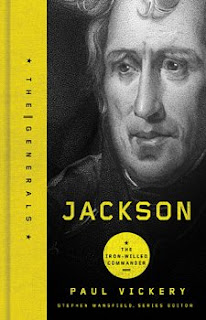
Paul Vickery's short biography is a good starting place (or a good review) of Jackson's life. Much of the book's focus is on Jackson's military campaigns. That is fitting since it is part of a series published by Thomas Nelson called The Generals. It is also fitting since so much of Jackson's life and career was fighting.


A straight-to-the-point biography of Old Hickory.

As a young teen-age boy, Jackson fought against the British in the War for Independence. That war nearly wiped out his entire family. It gave Jackson a life-long enmity against the British.

Jackson fought duels throughout his life. Much of his adult life, he suffered from numerous ailments due to the bullets he carried in his body.

Jackson fought against the Indian tribes in Tennesee, Alabama, and Florida. He captured West Florida for the United States.  Some of his battles were for control of his rebellious troops or against officials who blocked his efforts to reach his goals.  It was his strong-willed leadership that earned him the nickname "Old Hickory."

The high point of his career was his defeat of General Packenham and the British army at the Battle of New Orleans. Of course, the peace treaty had already been signed and the combatants did not know it. But after New Orleans, Americans knew they had a hero who could whip any and every opponent who stepped in his path.

Jackson's political career that took him to the White House and sustained him for 8 years and 3 Presidential elections was one continual battle.

Again, Vickery's book is short, but nevertheless, a good primer or review of the life of a defining figure.

One final note: Jackson was raised on the Westminster Shorter Catechism. He was a product of the Scots-Irish Presbyterian theology that was transplanted from Europe to the American frontier. He married a pious woman. All his days, he honored the Christian faith, and in his last years, he made his own public profession of faith and was baptized. That too is covered in this delightful book.

I received this book as a review copy from the publisher. I didn't have to be favorable, but really did like the book and the topic.

Thursday, September 20, 2012

Election Sweep...and Houseblog Scoop

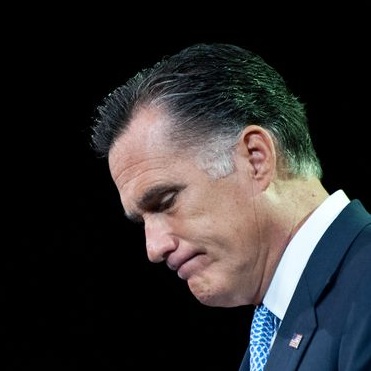
Romney realizes mistake:  Opposing Obama, the Democrats, and everyone needing guv'mint help
In case you haven’t realized it, the Presidential election for 2012 is over. It ended this week, or maybe last week. If you happen to be tied to the old “first Tuesday after the first Monday in November” routine, you may have thought the election would be decided about 40 plus days from now by an election.


Wrong. It is over. President Barack Obama has won a resounding re-election. A landslide. A mandate. A renewed affirmation for hope and change.

No, the people have not voted. No electoral votes have been cast. The debates haven’t even been held yet. But the election is over. Countless members of the media have told us so. Romney is finished. Romney has sealed his defeat. Romney has proven his ineptness for the job. The media have cast the deciding votes. Polling showing Romney gains in certain swing states is irrelevant.  Obama wins second term. Over and done.

Actually, the election was finished twice. First, Romney’s comments on events in Libya proved he is not up to the job in regard to foreign policy. Heck, the guy has never even won a Nobel Peace Prize. Second, in a secret talk, Romney he admitted, confessed, realized that people who are dependent upon government will not be seen at welfare agencies sporting “Romney for President” buttons. This 47 percent of the people will no more support Romney than rural Pennsylvanians would give up God and guns.

Most of that 47 percent had been reading National Review and The Weekly Standard and seriously contemplating putting a Romney sign in the front yard until they heard that comment. But that You-tube ended the election.

Actually, the 2012 election has ended several times along the way. Each time, Romney has lost and Obama has won.

Mitt Romney, facing a brokered convention

First in ended back in the spring. During the primary season, Romney did not seal the deal on the nomination in the Iowa caucus. Or New Hampshire. Or South Carolina. Stupid Republicans kept insisting that primaries should have more than one candidate and they kept voting for different candidates. This would, as predicted, lead to a brokered convention. By March, the brokered convention was an accepted fact. The brokered convention would produce a candidate other than either Romney, Santorum, or Gingrich. That poor candidate, who might have been Jeb Bush, would have only had 3 months to make his case to the American people.

Up through at least the 1960s, it was not always certain who a party’s candidate would be until the convention. (Nominations were actually not totally settled until the conventions as late as 1980.) How in the world could a candidate reach out to and present himself to America in only 3 months? Even though both Roosevelts, Kennedy, Eisenhower, Harding, Taft, Wilson, and dozens of other Presidents and Presidential candidates made their case in the past, it is impossible now. Before the Internet, before television, before radio, nominees were chosen at conventions in the summer and either elected or defeated in November. But it is impossible now. A candidate needs at least 4 years to clarify his views to the American people.

Romney also lost the race during the summer. His trip to the Olympics in London and to Europe proved his lack of foreign policy skills. Also, he is too rich. And cruel to dogs. Also, he was a businessman. And wealthy.

Romney realizes that Ryan is a Right Wing ideologue and thinking, "Why didn't I chose a liberal Democrat as my running mate?"

Then he chose Paul Ryan as his Vice Presidential candidate. Romney lost the election when he made that choice. It was clear that Romney was caving in to the Right Wing of the Republican Party. When will they (more moderate Republicans) learn? The more the candidate is like Ronald Reagan, the more he will cause Republicans to lose, like Reagan. Romney could have won the election if he had not kowtowed to the extreme Right Wing. He could have chosen someone who would have signaled a different perspective, like maybe picking Barack Obama or Michele Obama as his Veep.

In the case of Ryan, his economic policy was clear:

1. Tax breaks to the rich.

2. More taxes on the middle class.

3. Cut off all government help to the 47 percent who don’t vote for Romney.

4. Fill gullies with elderly people who don’t vote for Romney.

Note also that the name Ryan is purposely designed to rhyme with Ayn, as in Ayn Rand. Therefore, Paul Ryan would enact Ayn Rand’s economic and social policy as found in Atlas Shrugged. Except, he would not use any part of her social policy that interfered with abortion or gay marriage. Note his first name—Paul, as in Pope Paul. Sharing a name with a Catholic Pope means that Ryan is really a southern Protestant Christian fundamentalist who wants to impose creation science in the classroom and stone all non-Christians. Paul Ryan would impose harsh social moralities on all the 47 percent who were not thrown into gullies.

Next Romney lost the election when he gave his acceptance speech. Whatever he said or didn’t say, it was unconvincing. He could have said something like, “One million dollars to the first 279 callers who are part of the 47 percent who receive government support,” or “I concede” or “Vote for Barack Obama, my running mate.”

Next he lost when he did not receive enough of a convention bounce. A convention bounce is what elected Michael Dukakis to the Presidency. If Romney had started polling numbers around, say 95 percent in the swing states after the convention, then maybe we would still need an election.

Romney uses a calculator and does Bill Clinton's arithmetic.

Next, Romney lost when former President Bill Clinton added up the arithmetic. Even Republicans ought to figure this out: The economy was booming under Bill Clinton, the economy is awful, under Barack Obama, therefore, Re-elect Obama.

Then Romney lost once again when President Obama gave his acceptance speech. Because it could possibly have rained, the Obama venue was moved indoors. Had it been possible, all America, including the 47 percent dependent upon government transportation, would have been there.  Nevertheless, it was great.  It pointed out how Barack Obama, in just one term, was...Barack Obama.

Election 2012 is over. Now let’s look ahead to 2016. Will it be Hillary or Joe Biden?
Election 2016:  Joe or Hillary.  I'll take them both!