Showing posts with label Vivian. Show all posts

Monday, May 3, 2010

Goddess of the Week


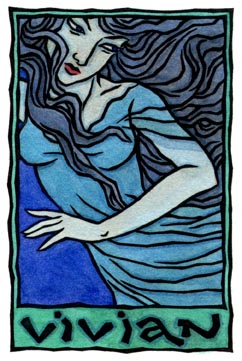
Vivian is the Lady of the Lake in the Arthurian legends. This is the first time She has come up as Goddess of the Week.

Her name is variously spelled as Vivian, Viviene, Niniane, Nimianae, Niviene, Nimue, &c. She was said to live at the bottom of a lake and to have been Lancelot's foster-mother, (which is why he was called 'du Lac') and to have given the magical sword Excalibur to Arthur. She was also the pupil and lover of the great magician Merlin; in time She became more powerful and learned than he, and imprisoned him in a tree or a cave, depending on the version of the story.

Now. I'm primarily concerned with Goddesses; and when I did the art for these, some dozen years ago now, well, first, I was operating with a fairly loose definition of 'Goddess', and, second, I was going more by intuition than anything else, which in this case, told me that Vivian, Nimue, &c., had Her origins in some sort of Celtic Goddess.

Which is probably true. However, tracking it down is nearly impossible. The Arthurian legends are extraordinarily dense and tangled, having both been transmitted orally back and forth between quite a few cultures, Irish, French, and Welsh to name a few, and copied and recopied in writing (frequently badly, with many misspellings and misreadings, which may account in large part for the myriad variations on Vivian's name, especially when you consider medieval styles of calligraphy, in which U, V, N, and M look very similar).

So in researching this, frankly, I'm over my head, and just about cross-eyed from trying to sort it out in a succinct manner. Still, I'll take a stab at it.

She is quite likely related to Morgan le Fay, at the very least as far as the elements to Her tale(s) goes; Morgan in turn may (or may not) have some affinity, or may derive from, the Irish Goddess Macha and/or the Mórrígan, and/or the Irish Modron ('the Mother'), famous as the mother of Mabon, Who derives (this one at least is certain, or as certain as these things get) from the Gaulish Matrona, Who gives Her name to the Marne River in France; Matrona in turn is related to the triple Matres of Gaul in the time of the Romans. That, at least, is (some of) the Morgan side of things.

She has also been linked to the Irish Bébinn, sometimes anglicized to Vivionn (though my Dictionary of Celtic Mythology by James McKillop says the Irish and French names are not related, others disagree); this name is one born by several women of Irish legend, one of Whom is an early Irish Goddess of childbirth.

None of this is clear cut, though. There are elements and influences from stories that reminded the tellers of others they had heard, and so were partly incorporated into their tales; and I'm sure the general idea of a sea, river, or lake Goddess or fairy got stuck in there somewhere.

Perhaps this doesn't matter that much, and I should just concentrate on Her role in Arthuriana; but I like origins, and digging. It is tangled, and perhaps cannot be separated. And maybe that is the message this week. At the river's mouth, who can say what part of the water originated in which stream?

I would expect this week to be rather tangled then, but rich. The search is nourishing, even if you don't get to the bottom of things. A big part of the Arthurian appeal is the longing for an older, more magical time, one that is (supposedly) long past. I do not know to what extent this is actually an illusion; but enjoy the pleasant melancholy anyway, if you can.

Though keep in mind, also, that it may be a distraction from the real heart of the matter. It is the week after Beltaine after all, and the faeries are said to be out and about; and they are tricksy types. Try to keep a clear head.

What does She say?

Of course I'm a Goddess.

Trace back and back yet there is no real source is there? All the water on this earth has been around and around the globe many many times. All waters are one water. This is the key part you must remember.

There are no clear boundaries, either, with water. It all flows into itself and a line may not be drawn. By nature it is always in-between.

Remember, also, that a good deal of your body is water. This is your nature too.


What do you think?


References:

Dictionary of Celtic Mythology by James MacKillop.

"Morgain La Fee and the Celtic Goddesses," by Roger S. Loomis. Speculum, Vol. 20, No. 2 (Apr., 1945)

Wednesday, March 31, 2010

Here Comes The Flood

Hi. I live in New England. Massachusetts, to be precise. In an area of the state that yesterday and the day before got oh I don't know something like EIGHT inches of rain.

It's a quaint town, my town, though the local news doesn't seem to be able to get the name right. The one they're using is I suppose technically correct, but certainly no one here uses it. Really we're two villages, of differing names, complete with their own post offices and habits. It's a bureaucratic fiction, my town. But anyway, it certainly is quaint. Unbelievably quaint, in fact, and old, very old, for a New English town, anyway. Old enough that a good number of the important bridges in town have arches made of stone, set dry with no mortar. Little antique bridges that cars regularly drive over and all, since they are on some of the main, old, streets of the town, like the two little arched bridges that went over the mill streams just down the street from me. Cute little things, those drystone arched bridges.

That's 'went', past tense.

They washed out yesterday, something they didn't even do in the '38 or'54 hurricanes. Which is very sad; they were awfully historic, those little bridges. But--

My road, and my neighborhood, are set on a little space of land squoze in between the old mill streams and a larger local river. And though the space is small, there are an awful lot of people over here--there's a whole island community at the end of it as well as a school for developmentally disabled adults.

And.

There is one road in.

Was, that is, past tense. Those bridges were it.

Well now.

Now there is a bit of a way around, but it's not actually a road. There are a couple of ball fields above where the mill stream bridges let go, and a way can be sort of made through there to the main street, behind where the original mill was, though it's mostly flooded and mudded itself. So today they were shuttling people into the rest of town (you know, where the bank, post office, and pharmacy are) in these way cool wicked awesome moon-rover-mud-bus things. Behold the muddy glory:


('So,' I asked the cop who'd driven it, after he'd let me off, 'what color is that thing supposed to be?')

By the way that may look a little familiar, if you saw the national news tonight. One of the stations, I think NBC, flashed a picture of the thing, taken literally three houses down the street from mine, for about two seconds in their piece about the rains up here. I was all OMG THAT'S US!!! at the screen, then it was gone.

Ah, fame. So fleeting.

I don't know how the selectfolk (since we have two selectmen and one selectwoman, not sure quite what that correct plural is) are going to figure this one out. The bridge isn't going to be able to be properly fixed any time soon; they've dumped a bunch of rocks (some really big ones, too; watching the news last night I felt one dropped into place. The noise came down the chimney and shook the house) and some gravel down, and apparently it's at least okay for emergency vehicles, which is good, but not for regular cars, which is bad. But properly building a new one? Years, I'd imagine.

The rumor is that they are going to try to build a temporary but real (as in paved) road through the ball field area. But that too will take some time, with eminent domain, and permits, and all the bureaucratic hoops through which the town will have to jump. And until then? Will they use the moon-mud-busses? How are we going to buy groceries? Without a car it'll be limited to what you can carry and are willing to schlepp home. Now luckily like I said I only live a few doors away; but it's at the top of a hill, which, though it meant this house wasn't flooded more than maybe an inch in the cellar (enough that we did move the litter box so Sir Isaac Mewton didn't have to wade, which, you know, is manifestly unfun for a cat), but it's a real drag, man, to carry stuff up it.

So I don't know. Though today was fun, it's true, with the local kids having the day off from school, and everyone in town it seems out walking to look at the damage, whoa. Almost like the fourth of July, in some ways. Even the cops were in good moods. And luckily I work from home, so I don't have to go somewhere else to work every day.

But how is this ever going to work?

Monday, November 2, 2009

Goddess of the Week


Apparently we are on Southern Hemisphere time this week, since this week's Goddess is Gwenhwyfar, Who I've depicted here as the quintessential May Queen (and yes I've spelled it wrong on the card). But it is a little odd to be looking at Her up here in New England, since we are now in the starting days of grey miserable yucky November (can you tell it is my least favorite month?) and are still in the season of Samhain, of death, decay, and the thinning veil.

However Samhain and Beltaine have more in common than one might think. The veil is thin at both times, though Samhain favors ghosts and the dead while at Beltaine it's more likely to be the faeries coming through. Not too surprising, really, when you consider that even though from one location the holidays are at opposite ends of the year, from the Earth's point of view they happen at the same time.

Gwenhwyfar last came up both the first and second weeks of May, at what would seem a far more appropriate time, given Her connection with the idea of the sacred marriage. Called Guinevere in the Arthurian legends, she is the wife of the great King Arthur, and famous for having an illicit affair with the best of his knights, Lancelot du Lac. ("Du Lac", incidentally, meaning "of the Lake" because he was brought up by the otherworldy Lady of the Lake, Vivian.) Her origins have mostly been forgotten but may well lie in an old sovereignty Goddess Who embodied the land; and there are hints of a Divine origin for Gwenhwyfar, here and there.

And I know all this, and you do too if you've clicked on the links above; but I was still having an impossible time figuring out why She might show up now when Samhain is just so strong up here, aside from the lesson to remember that opposites contain the other (Samhain/Beltaine), or that the northern hemisphere isn't the only one the globe possesses.

Then I remembered Her name.

Gwenhwyfar means "White Phantom."

And I think of those other Celtic sovereignty Goddesses, like Epona, and Rhiannon, and even Blodeuwedd, Who embody the land; and each of Them has Their winter, Their dark, chthonic side: Epona is held to be a psychopomp, a Soul Guide Who brings the newly dead to the Otherworld; Rhiannon's first husband, Pwyll, was the King of that land for a time; and Blodeuwedd, though made from spring flowers, has as Her emblem the owl, that lonely haunter of the night.

And what is under there, then? It is hard to tell. Gwenhwyfar's, Guinevere's, story as we know it now has been so thoroughly interwoven with a later set of rules it is hard to know which threads to pick; I had never understood, for example, why, once Arthur was killed, Guinevere never married Lancelot, and instead chose to become a nun; I had thought that it was some kind of strange strict Christian morality play (which it may well be), but now I see that given the underlying logic of things she cannot marry Lancelot. For if she does, he becomes King. And the story, being that of greatness and glory irretrievably lost, is such that it must end.

Perhaps that is the thread. When Arthur first meets Guinevere, Merlin warns him against the marriage; and indeed the Queen is often indirectly (or directly) blamed for the fall of Camelot because of her affair with Lancelot.

I can see her flickering at the corner of my vision, now, stopped in a doorway to glance at me, before She is gone. She is all in white. This time is a threshold, is it not?

So I ask the Goddess as always, What do You have to say?

White am I, like hawthorn, like snow. I am white, white as ever I am, as white as apple blossom as white as bone, both, as I always am and always have been. As I am ever I, all of me, the White Lady, the Great Queen, the bone-white Mother, the white shadow of the land. I am all these things, these are all myself, one I, the horse carved in the chalk, winter's water overrunning summer's settlement, the white at the heart of the dark, the white you cannot see, the bone hidden within the flesh and the body that does not see the light of day whilst one lives. Except in bared teeth, that is, and that is a clue to my nature; it is the white smile of a gentle lady, and the knowing grin of the skull. This is nothing new; I am surprised you have not learnt it by now.

Remember both. Like Samhain and Beltaine happen at once, I am at once both, and so thoroughly both it is only one thing. My left hand and my right hand, identical and perfect and mirrored. If you look now you will see them both.