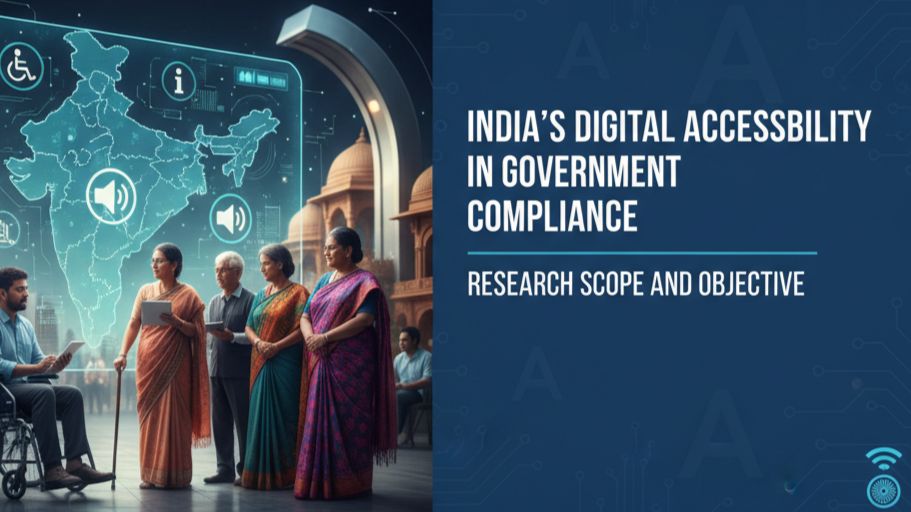
A. Problem Statement
India has a comprehensive legal and standards framework for digital accessibility, the Rights of Persons with Disabilities (RPwD) Act, 2016; the notification of IS-17802 (ICT Accessibility Standards); and the Government of India’s GIGW 3.0 guidelines. Collectively, these establish accessibility as both a legal right and a technical requirement for all government websites and mobile applications.
However, compliance remains fragmented. Central government portals often show higher levels of adoption (partly due to visibility and monitoring by NIC/MeitY), while state and local government digital platforms lag significantly. This unevenness exposes a structural gap: laws and standards exist, but enforcement and implementation mechanisms are weak or inconsistent.
The core problem is not a lack of standards, but a misalignment between policy intent, institutional capacity, procurement practices, and technical expertise. This disconnect results in government services that are legally mandated to be inclusive, yet remain partially or wholly inaccessible to the very citizens they aim to serve.
B. Research Question(s)
- Compliance Reality vs. Policy Framework:
- To what degree do government websites and mobile apps adhere to IS-17802 and GIGW 3.0?
- Are compliance rates improving over time, or stagnating?
- Institutional Effectiveness:
- How effective are enforcement mechanisms (audits, empanelled auditors, penalties, procurement rules) in driving sustained accessibility adoption?
- Are there accountability gaps in the institutional chain (MeitY, DEPwD, BIS, state IT departments)?
- Root Causes of Non-Compliance:
- What systemic factors (budgetary priorities, procurement design, lack of trained developers, reliance on outdated CMS platforms, limited testing capacity) contribute to accessibility gaps?
- How do vendor ecosystems and contract structures perpetuate or hinder accessibility?
- User-Centric Impact:
- What barriers do PwD users encounter when attempting to access essential e-governance services (education portals, welfare schemes, tax filing, digital IDs)?
- Do these barriers differ across disability types (visual, hearing, motor, cognitive) and language preferences?
- Comparative and Forward-Looking Dimension:
- How does India’s compliance approach compare with international accessibility regimes (e.g., ADA in the U.S., Section 508, EU Web Accessibility Directive)?
- What lessons can India adapt to strengthen its own compliance and enforcement ecosystem?
C. Hypothesis
- H1: Compliance with digital accessibility standards among Indian government digital services is uneven and largely superficial; many departments meet checklist requirements but fail in real user-centered accessibility.
- H2: Institutional bottlenecks (weak procurement clauses, inadequate penalties, and scarcity of skilled auditors) are the primary drivers of non-compliance, rather than absence of standards.
- H3: Platforms developed and monitored by centralized agencies (NIC, MeitY, STQC) demonstrate higher compliance than those managed at the state or municipal level.
- H4: Involving PwD users in co-design and structured usability testing would uncover latent accessibility barriers (especially for Indian language screen readers and legacy document formats) that current compliance audits overlook.
- H5: Embedding accessibility at the procurement and vendor contracting stage will have a greater long-term compliance impact than post-development remediation.
D. Define Success (Research Outcomes)
The research will be deemed successful if it produces multi-layered, evidence-backed insights rather than surface compliance snapshots. Specifically:
- Compliance Mapping: A quantified picture of accessibility compliance across a representative sample of central, state, and local government services, highlighting disparities.
- Causal Analysis: Identification of systemic and institutional factors responsible for compliance gaps (procurement design, vendor ecosystem, enforcement weakness).
- User-Centered Validation: Documented evidence of lived accessibility barriers from PwD users, triangulated against audit findings.
- Policy-Relevant Recommendations: Actionable reforms for procurement rules, enforcement models, auditor training, and user participation.
- Comparative Benchmarking: Positioning India’s digital accessibility enforcement within the global context, offering cross-national insights.
- Impact Pathway: A roadmap showing how improved compliance directly translates into greater digital inclusion, higher adoption of government services, and empowerment of PwD communities.
What Is Web Accessibility Testing?
Web accessibility testing evaluates a website’s compliance with accessibility standards like the Web Content Accessibility Guidelines (WCAG). Its primary goal is to ensure that digital platforms cater to users’ diverse needs, particularly those relying on assistive technologies. Common barriers uncovered during accessibility testing include:
- Poor color contrast.
- Missing alt text for images.
- Inaccessible forms.
- Navigation that isn’t keyboard-friendly.
Addressing these barriers not only ensures compliance but also improves the overall user experience.
How to Conduct Accessibility Testing
A thorough accessibility evaluation combines automated and manual testing methods for comprehensive results. While automated tools efficiently scan for common issues, manual testing dives deeper into usability concerns that tools may miss.
Automated Accessibility Testing
Automated tools, such as ADA compliance checkers, provide a quick assessment of website accessibility. They identify common violations, including:
- Missing alt text on images.
- Improper heading structures.
- Insufficient color contrast.
These tools give a baseline overview of your site’s accessibility, but they cannot detect nuanced issues or assess usability comprehensively. Thus, automated testing should be supplemented with manual evaluations.
Manual Accessibility Testing
Manual testing involves accessibility experts conducting in-depth evaluations of a website. Key techniques include:
- Keyboard Navigation Testing: Ensuring all interactive elements are accessible without a mouse.
- Screen Reader Compatibility Testing: Using tools like JAWS or NVDA to validate how content is read aloud.
- Focus Indicator Validation: Checking for visible focus states on interactive elements.
Manual testing allows for the identification of complex errors, such as confusing navigation paths or improperly labeled buttons, that automated tools may overlook.
The Role of User Feedback in Accessibility Testing
Even the most thorough automated and manual testing cannot replicate the experiences of individuals with disabilities. This is where user feedback becomes invaluable.
Use Case Testing
Use case testing involves having native users of assistive technologies interact with a website to complete core tasks, such as making a purchase or submitting a form. Their firsthand insights uncover real-world usability issues.
Gathering User Feedback
Organizations can gather feedback directly from users through surveys, feedback forms, or focus groups. This approach highlights barriers that other methods may miss, such as:
- Confusing navigation paths.
- Poorly implemented multimedia captions.
- Difficult-to-use forms and error messages.
Why User Feedback Is Critical
Involving real users in the testing process provides several unique benefits:
- Prioritizing Issues: Feedback helps identify and prioritize critical accessibility fixes.
- Enhancing Usability: User insights go beyond compliance to improve the overall user experience.
- Fostering Empathy: Interacting with users of assistive technologies helps developers and designers understand the importance of accessibility.
Take a Holistic Approach to Accessibility Testing
Achieving web accessibility is not just about meeting standards—it’s about creating inclusive, equitable experiences for all users. Combining automated tools, manual testing, use case testing, and user feedback ensures a robust evaluation process.
By prioritizing web accessibility testing, organizations can:
- Reduce legal risks.
- Improve user satisfaction.
- Expand their audience reach.
Remember: Accessibility is a continuous journey, not a one-time task. Regular testing and feedback loops ensure that your digital content remains inclusive as it evolves.
]]>Why ADA Compliance Matters in India
The ADA mandates that websites and digital platforms in the U.S. are accessible to individuals with disabilities. Indian businesses, especially IT companies and digital agencies catering to U.S. clients, must ensure their work meets ADA standards. Here’s why:
- Legal Necessity for U.S. Projects
ADA compliance is a requirement for most American businesses. Indian companies delivering non-compliant projects risk client dissatisfaction, loss of contracts, or even legal repercussions. - Enhanced Credibility
Demonstrating expertise in ADA compliance builds trust with American clients, showcasing your commitment to global standards. - Expanding Your Market
ADA-compliant digital solutions are inclusive, broadening the user base to include individuals with disabilities, which can be a significant market segment. - Global Best Practices
By aligning with ADA principles, Indian businesses adopt universally accepted accessibility standards, paving the way for collaboration in other international markets.
How to Raise Awareness About ADA in India
- Workshops and Training Programs
Conduct sessions for developers, designers, and content creators to understand WCAG (Web Content Accessibility Guidelines) and ADA standards. - Collaborate with American Partners
Indian companies can partner with U.S.-based firms to learn about compliance requirements and ensure projects meet client expectations. - Leverage Local Accessibility Laws
Align ADA principles with Indian laws like the Rights of Persons with Disabilities Act (RPwD), 2016, to highlight the shared commitment to inclusivity. - Promote Accessibility as a Value
Showcase success stories where accessible design has positively impacted businesses, emphasizing that accessibility drives innovation and growth.
Business Benefits of ADA Compliance
- Increased Client Satisfaction
Delivering ADA-compliant projects strengthens relationships with American clients, ensuring long-term partnerships. - Reduced Legal Risks
Proper compliance minimizes the risk of lawsuits, saving businesses from costly legal battles. - Competitive Edge
Being a pioneer in accessibility gives Indian companies a distinct advantage in the global market. - Improved User Experience
ADA principles enhance usability for all users, resulting in higher engagement and satisfaction.
Final Thoughts
For Indian businesses, ADA compliance is not just about meeting foreign regulations but embracing a culture of inclusivity. By understanding and implementing ADA standards, businesses can enhance their credibility, deliver superior results, and unlock global opportunities. Accessibility is no longer optional—it’s the future of digital innovation.
]]>India Digital Accessibility Initiative (IDAI)
Mission
The India Digital Accessibility Initiative (IDAI) is a W3C Community Group dedicated to fostering an inclusive digital landscape in India. Our mission is to promote web accessibility standards, best practices, and innovative solutions that empower individuals with disabilities to access and engage with the digital world equally.
Scope
- Advocate for the adoption of W3C accessibility standards such as WCAG (Web Content Accessibility Guidelines), ARIA (Accessible Rich Internet Applications), and others.
- Address accessibility challenges specific to the diverse linguistic, cultural, and technological contexts of India.
- Collaborate with stakeholders, including developers, designers, policymakers, educators, and accessibility advocates, to create a cohesive ecosystem for digital inclusion.
- Provide a platform for knowledge sharing, discussions, and brainstorming innovative approaches to digital accessibility.
Deliverables
- Guidelines and Resources: Develop and share India-centric accessibility guidelines, tutorials, and best practices tailored to regional needs.
- Research and Reports: Conduct studies on digital accessibility challenges in India and publish findings to drive awareness and improvements.
- Collaborative Tools: Create templates, checklists, and frameworks to assist organizations in implementing accessibility standards.
- Events and Workshops: Organize webinars, meetups, and hackathons to raise awareness and build capacity for accessibility in digital spaces.
- Feedback Mechanisms: Act as a channel to relay accessibility-related feedback and requirements from India to the W3C community.
By joining IDAI, you’ll be part of a community dedicated to bridging the digital divide and building a more inclusive web for millions of users in India. Together, let’s make the web accessible for all!
In order to join the group, you will need a W3C account. Please note, however, that W3C Membership is not required to join a Community Group.
This is a community initiative. This group was originally proposed on 2024-12-27 by Ajay Malhotra. The following people supported its creation: Ajay Malhotra, Ajit Nongmaithem, Karthikeyan Sivaperumal, Rakesh Keny, Anoopa Sundararajan and Tejeshri p. W3C’s hosting of this group does not imply endorsement of the activities.
The group must now choose a chair. Read more about how to get started in a new group and good practice for running a group.
We invite you to share news of this new group on social media and other channels.
If you believe that there is an issue with this group that requires the attention of the W3C staff, please email us at site-comments@w3.org
Thank you,
W3C Community Development Team