Unlike existing enterprise-level automation that relies on manual input, AI agents are capable of autonomously coordinating complex tasks, interacting with multiple tools and environments across an organization. In early applications that center on customer service, HR, and sales, adoption of agentic AI has led to productivity gains of 30-50%.
Their autonomy positions agents more as collaborators than tools, working side-by-side with human employees in blended teams that look poised to upend traditional workplace dynamics.
More than three-quarters of HR leaders believe that the deployment of AI agents will transform existing workplace norms, driving a complete reappraisal of how roles and responsibilities are distributed, how skills are prioritized, and how workplace culture is shaped.
Though many admit they’re in the early or preparatory phase of this shift, 86% of chief HR officers predict that navigating digital labor shaped by agentic AI will be a central component of their role in the years ahead.
Fluency in the change management aspect of agentic AI adoption will be a crucial differentiator when it comes to unlocking the full potential of the technology going forward, believes Ateet Jayaswal, chief culture and employee experience officer at Wipro, a leading technology services and consulting company. This moment is one that he says, “calls for a mindset shift in how HR leaders would enable their organizations.”

Redeploying roles to enable higher-value work
As AI agents assume ownership of more complex and integral tasks, the distribution of roles and responsibilities within an organization will undergo significant change. It’s estimated that three-quarters of current roles will require redesign, reskilling, or redeployment by 2030 as a result of agentic AI.
For leadership, this shift should be about reskilling employees toward higher-value work in order to optimize the potential of an agent-human hybrid workforce, says Jayaswal.
For example, Wipro is a complex organization of 240,000 employees across 65 countries. It previously had multiple policies, documents, and knowledge fragmented across different systems, which delayed response to employee queries.
But the company has recently integrated a custom agentic AI assistant—an agent co-created in partnership with enterprise agentic AI platform Ema Unlimited—that can swiftly navigate this complex system, assuming responsibility for 50 HR tasks that had previously fallen to human employees. With the help of an AI agent, average response time to queries has lowered from 48 hours to five seconds.
Human employees have more time to focus on work “that requires a creative and imaginative mind and cross-functional collaboration, leveraging diverse ideas and thoughts to problem-solve,” says Jayaswal. The AI agent, meanwhile, handles rote administrative tasks like sorting timesheets or helping employees navigate policies and take actions in the flow of work.
When reallocating employee responsibilities, though, it is imperative that humans remain in the loop, Jayaswal caveats. When agentic AI is incorporated into enterprise technology, it must work with sensitive and personal data and therefore needs even more stringent guardrails and constraints than consumer applications. “When you expose an AI agent to organizational data, when you integrate it into multiple enterprise systems, then pathways around the AI agent become extremely important,” he says. “It’s an evolving space that leadership needs to have front-of-mind.” Governance should include robust data privacy rules and the establishment of governance layers, such as an AI council, he suggests.
At a fundamental level, the adoption of AI agents will force a re-evaluation of human roles, believes Jayaswal. Rather than employees primarily performing repetitive tasks or troubleshooting, a significant proportion of their time will shift to designing, teaching, and optimizing an AI agent that can do this work for them with far greater speed and predictability and without the agent getting bored.
“The nature of your job changes from being the hero who comes in to solve the problem to designing the hero who can solve the problem,” he summarizes. “The individuals who I have seen thrive in this environment are the ones who make this shift.”
An evolving employee skillset
Just as roles and responsibilities will be reconfigured to reflect the input of AI agents, the core skills of human employees will be reprioritized. More than four in five HR leaders say they’re planning to reskill workers to become more competitive in a market shaped by AI agents.
Technical skills will be increasingly important. Leading employers such as Salesforce, Danone, and Walmart are already rolling out dedicated AI and digital skills programs that aim to equip everyone from frontline workers to C-suite executives with a baseline level of AI literacy in response to the pervasiveness of the technology.
But desirable soft skills will also evolve, Jayaswal points out. Employees who assign tasks to an AI agent need to plainly articulate what modular steps may be needed to accomplish a task, what the desired outcome should be, and what parameters or guardrails need to be in place to ensure the agent doesn’t access or share confidential data.
As HR executives adapt to a blended workforce, three skills are emerging as top priorities during recruitment, according to a recent survey: relationship building, like forging constructive partnerships and account management; collaboration; and adaptability.
Maintaining a healthy workplace culture
In freeing up human employees to focus on higher-value tasks, the hope is that AI agents can elevate the employee experience, deepening fulfilment and satisfaction in the workplace.
“At Wipro, our vision is to improve the life of Wiproites,” says Jayaswal. “We are taking away non-value added work by embracing modern ways of collaborating, engaging, and transacting, leaving associates with higher order work content.”
But leadership teams embracing agentic AI will also need to plan for the new pressures and stressors that the technology can place on a workforce.
There is already confusion and knowledge gaps, with 73% of HR leaders reporting their employees don’t yet understand how digital labor will impact their work. Many organizations have opted to define AI agents as teammates or colleagues on org charts, but new research says this could erode trust and a sense of professional identity. It also raises new questions around accountability and ownership.
The role of management in addressing these concerns is critical, says Jayaswal. To maintain healthy dynamics, managers need to become skilled at orchestrating blended systems, splitting their focus between supervising AI agents and motivating human employees as they also build and supervise AI agents.
Upgrading employee well-being programs will be a core part of maintaining a robust workplace culture. “As there are more interactions with AI agents, you are losing some of the human touch that was provided by service delivery partners or leaders, or often even by colleagues and peers,” Jayaswal says. Employee services that encourage social connection and empathetic communication may help teams navigate this.
A breakneck transformation
Agentic AI looks set to scale at breakneck speed across many enterprises, and it will significantly transform how these organizations operate.
Carefully considering and deciding how to adapt to this newly blended workforce is now a top priority for leadership teams. Reviewing and refining organizational strategies is essential for optimizing both technological gains and the employee experience.
This content was produced by Insights, the custom content arm of MIT Technology Review. It was not written by MIT Technology Review’s editorial staff. It was researched, designed, and written by human writers, editors, analysts, and illustrators. This includes the writing of surveys and collection of data for surveys. AI tools that may have been used were limited to secondary production processes that passed thorough human review.
]]>The outspoken longevity scientist David Sinclair has been predicting that one day, you’ll go to the doctor and get a prescription that will make you 10 years younger.
Now MIT Technology Review has learned that he has plans to launch human tests of an oral “reprogramming” drug as part of a $101 million competition organized by the XPrize Foundation.
The foundation is offering cash awards to teams able to “restore” a person to an earlier apparent age, as measured by improvements in immune, cognitive, and muscle function.
The grand prize goes to any team able to show a 10-year (or greater) relative improvement after one year of treatment.
Reached by phone, Sinclair, a biologist at Harvard Medical School, confirmed that he plans to give an oral drug mixture to volunteers in a bid to seek “evidence for age restoration in humans.”
The trial, if it goes forward, will be a significant new development in the race to harness so-called epigenetic reprogramming. That technology is based on the discovery, 20 years ago, of powerful genes able to turn an adult cell into a stem cell similar to those found in embryos.
The age-reversal effect is believed to occur via a resetting of molecular controls on DNA known as epigenetic marks, which help determine a cell’s overall metabolism and identity.
Companies are now racing to use that phenomenon for a new form of rejuvenation medicine. Only this January, one of Sinclair’s companies, Life Biosciences, made news by winning approval to launch an initial human trial using a set of powerful reprogramming genes. The company announced today it had treated its first patient.
But that test involves a complex gene therapy and is limited to patients’ eyes, where it could treat conditions like glaucoma.
Sinclair’s new plan is bolder: a reprogramming drug you’d swallow in order to promote such effects across the body.
“What we’re aiming to do is to epigenetically restore the animal and eventually the person,” he says. “It is true that we’ve been doing extensive animal studies with the oral agent and are looking to compete in the XPrize.”
This alternative method, chemical reprogramming, uses drugs to mimic the effects of the embryonic genes. That is significant because drug compounds can travel through the bloodstream, reaching most or all cells in a person’s body.
Some experts expressed caution, saying the chemical process, at least as used in labs, is extremely harsh and not even particularly effective. “Who doesn’t dream of whole-body rejuvenation? I think it’s a great goal,” says Sergiy Velychko, founder of Soxogen, a stealth reprogramming company in Boston. “But these chemicals are used in very, very high concentrations for cell reprogramming.”
Sinclair declined to describe the exact makeup of the drug candidate, code-named SL-100, calling its contents “highly, highly confidential.”
However, he has previously published lab studies of what he called “epigenetic age-reversal cocktails,” which mixed powerful chemicals with known supplements and commercially available medicines.
It’s those latter components that would be easiest to test on people, since doctors are free to prescribe them, even for unusual objectives like age reversal. James Clement, head of Betterhumans, an organization that specializes in life-extension studies using existing drugs, said in a message that he is “running clinical trials” of an oral reprogramming cocktail for Sinclair’s XPrize team.
Sinclair’s team is competing in the XPrize Healthspan Competition, launched in 2023. It follows several previous competitions that focused on commercial spaceflight, lunar landings, and other goals. The XPrize Foundation is led by executive chairman Peter Diamandis, also an active promoter of longevity research.
“If two teams are equivalent, they would split the award,” says Jamie Justice, a doctor and executive director for the contest, which was bankrolled by Saudi Arabia’s Hevolution Foundation, “But it will be incredibly hard to even get to one winner.”
Justice says a judging panel is now in the process of picking 10 finalists from 65 teams that have been exploring health foods, lifestyle interventions, digital trackers, and drug compounds.
Sinclair’s team, Justice says, was a late entrant to the contest, but like all teams, it would be required to move into wider human tests starting this year. “You have to be ready and in trials,” she says.
The race to harness the reprogramming phenomenon and apply it to living people is heating up, even outside the XPrize competition. On June 2, a startup called NewLimit, founded by the crypto billionaire Brian Armstrong, said it had raised a further $435 million, from investors including Peter Thiel’s Founders Fund, to support what it calls “age reprogramming.”
The company says it is working toward delivering genetic reprogramming instructions to the liver, to treat diseases of that organ.
But Sinclair has been saying that whole-body rejuvenation is a possibility too. And for that, chemicals, rather than gene therapy, could be the most practical strategy.
Sinclair says his lab has been searching for such compounds and is starting to use AI “to improve the oral agents that we’re testing.”
Chemical reprogramming cocktails, as used in labs, typically involve a mix of vitamins, approved drugs, and experimental molecules. For instance, one recipe Sinclair filed a patent on includes the supplement forskolin, the antidepressant tranylcypromine, and an experimental chemical, laduviglusib, which has been tested against Alzheimer’s, among other ingredients.
“In those days it was a six-factor cocktail,” Sinclair says of his earlier research. “But we’ve come a long way. I can’t disclose what’s in it, but it’s an improvement and an advance on that, and we’ve done a number of animal studies. They are not published, but we’ve been doing them for a long time, and we want to make sure that we’ve done a full investigation of safety and efficacy before we release any of the data.”
While Sinclair’s results aren’t published, other teams say attempts to reverse the age of entire animals using chemical drugs haven’t worked yet. Last year, the lab of Vadim Gladyshev, another Harvard biologist and a member of a different XPrize team, reported on its attempt to rejuvenate mice by installing pumps in their bodies that released controlled doses of seven compounds.
Gladyshev says the procedure proved to be toxic. “The idea was to see if we could rejuvenate whole animals. Unfortunately, we have not found [the right] conditions,” he says. “At low concentrations there was no effect, and high concentrations were toxic.”
Gladyshev says he doesn’t know what is in Sinclair’s cocktail, but says that “trying to improve the combinations makes sense.”
Sinclair, who is the author of several books on aging and has a large social media following, has frequently been criticized by other scientists for making unproven rejuvenation claims.
In 2024, he resigned as president of the Academy for Health and Lifespan Research after claiming that a supplement developed by a company his brother runs had “reversed” the age of dogs, a claim for which there was so little evidence that one scientist called it a “lie.”
Part of the problem is that scientists still disagree on how to measure aging. And they don’t have a reliable way to measure age reversal, either, should it ever be achieved.
Justice, the XPRIZE director, says a primary purpose of the competition is to solve that problem by encouraging the development of standardized measures of aging. That is so that anti-aging drugs can be assessed reliably, and, one-day, approved by regulators if they work.
“We as a scientific field have been forced to ask, ‘If a medicine improves how we age, how would we know?” Justice said during a public meeting with FDA officials in May. “If something worked, what would convince us as scientists, what’s meaningful to the general public?”
Finalists in the Healthspan competition will be announced in August.
]]>At SXSW London last week I gave a talk called “Five things you need to know about AI,” in which I shared what I think are the biggest themes in AI right now.
I pulled a few things from our first AI10 list, an annual guide to the most important trends in this buzzy world, but I also veered off on a number of tangents. In my half-hour slot, I tried to cover the key talking points that I think help to make sense of what’s going on in tech—and thus the economy—today.
(I gave a talk with the same title at SXSW London last year with five different things you needed to know. A lot has happened since then!)
So: This is how I’m thinking about AI midway through 2026. Let me know if you would pick different points!
1. Strictly speaking, I didn’t need to show up to give this talk.
Tongue in cheek? Maybe. But generative AI tools have already become mundane, used by millions to automate everyday office tasks (including producing and delivering talks). It’s no surprise that one of the biggest questions out there right now is what this all means for jobs. People are confused and scared.
The frustrating answer is that despite the hype coming from the top about the potential for AI to join the workforce soon—and viral social media posts yelling that something big is happening—there is almost no data to say either way what kind of effect this technology will have on employment and the economy overall. That’s not to say it won’t have an impact, even a huge one, but it’s just too soon to tell.
In theory, teams of agents working together toward common goals could become assembly lines for white-collar work, doing to offices this century what Henry Ford’s innovations did to factories in the 20th century.
In theory. Because in order to know what will happen to jobs, we need to know what will happen inside the companies that create those jobs. But most companies are still figuring that out.
2. AI is getting scary (for real this time).
There have been scary stories about AI for years—claims that it will kill us all or bring about the end of civilization. There’s still a loud crowd of doomers, but those scenarios remain dystopian science fiction.
What’s happened instead is that many of the worst near-term, real-world fears have come true.
Take deepfakes, AI-generated images or videos of people doing things they didn’t actually do. Deepfakes have been used to incite violence, swing votes, and sow distrust. Trump’s White House is among those creating and publishing fake images.
Many deepfakes are also used to abuse women and girls. One study found that 98% of deepfakes are pornographic and 99% involve women.
Another concern is the rise of dangerous and delusional relationships with chatbots. Many people turn to chatbots to seek private advice and to feel heard. But there are now multiple lawsuits against AI companies alleging that the technology encouraged or aided suicides and other forms of self-harm.
AI is also being used in warfare in new and worrying ways. LLMs are now giving advice, not just being used for analysis. One US defense official told my colleague James O’Donnell that you could now give a military chatbot a list of targets and ask which one to hit first. Anyone who uses AI knows that its output needs to be reviewed carefully. In fact-paced, high-stress active conflict, the risk that corners get cut is high.
3. A lot of people really hate AI.
I checked out an anti-AI protest in London earlier this year and found a very broad mix of complaints. Banners proclaiming the end times bounced along to chants of “Stop the slop! Stop the slop!” Protests are getting more organized and drawing larger crowds.
There’s pushback from fans of films and video games, who object to the use of generative AI in their favorite titles. In one notable case, the acclaimed 2025 game Clair Obscur was stripped of an award when the developers admitted to using AI in just one small, specific part of its production.
And there’s the data center backlash. The US has more than 5,400 data centers and counting. With the energy demands of AI growing, people are unhappy about the environmental impact and their rising electricity bills. Activists are managing to stall development in a number of places.
Regulation is becoming politically popular. Grassroots movements like QuitGPT have gained momentum. A small number have turned to violence; a few weeks ago somebody threw a Molotov cocktail at Sam Altman’s house. It’s not clear where all this leads. But the apocalyptic hype from tech leaders is not helping people stay calm.
4. AI for science is a very big deal.
It’s early days yet, but the potential for AI to help make a genuine and important scientific discovery is greater than ever.
Google DeepMind has developed Co-Scientist, a multipurpose tool that can help researchers dig up and compare previous results, generate hypotheses, and devise experiments to test them. OpenAI told me this year that its North Star is the goal of building a fully automated researcher by 2028.
Mathematicians are excited too. Fundamental math underpins many everyday technologies, from internet security to video streaming. The last few months have seen a string of claims that AI has cracked unsolved math problems. And software that can solve really hard math problems will be able—so the argument goes—to solve more general-purpose real-world problems too.
What are the downsides? Some scientists are warning that an overreliance on AI tools could narrow the scope of research because scientists may choose problems that are most suited to AI assistance. There are also concerns that AI-assisted research will lead to a flood of inaccurate or fake results: science slop.
5. AI is everywhere all at once.
So where does that leave us? There are a lot of exciting things, a lot of worrying things, and a lot of hot air. It can be exhausting to keep up, and yet it all feels inescapable. Some people will tell you we’re in a race to the top; some will tell you we’re in a race to the bottom. But it’s really not clear where we’re headed.
AI companies want us to march to their tune and buy into the propaganda about artificial general intelligence, whatever that means. They are selling a vision that feels inevitable, but it isn’t.
We’ve built a technology that can do humanlike things, and I think that makes it hard to get our heads around the fact that it is still just a technology.
Something is happening. Maybe even something comparable to the invention of electricity or the internet. But technologies like that take time to settle and bring lasting change.
Get ready for a marathon, not a sprint.
This story originally appeared in The Algorithm, our weekly newsletter on AI. To get stories like this in your inbox first, sign up here.
]]>Why this year’s World Cup ball may not fly as far
Much is new about this month’s FIFA World Cup tournament. It hosts more teams than ever before. It’s the first to occur in three different host countries.
And, like every World Cup for over half a century, it will employ a football with a brand-new design.
Through wind-tunnel experiments, researchers found that long-distance kicks with Adidas’s new Trionda ball might not travel as far as they did in the past. The payoff is a more predictable flight path, something players have not always enjoyed from World Cup balls.
Find out how a few grooves and seams can change the way the game is played.
—Jenna Ahart
The must-reads
I’ve combed the internet to find you today’s most fun/important/scary/fascinating stories about technology.
1 OpenAI plans to turn ChatGPT into a ‘super app’ before its IPO
The revamp would combine coding tools and AI agents. (Financial Times $)
+ The super app ambitions first emerged last year. (Fast Company)
+ OpenAI is also building a fully automated researcher. (MIT Technology Review)
2 Trump wants the US government to take a stake in AI companies
He will meet AI leaders to discuss the plan. (BBC)
+ Which would create “a partnership with the American public.” (Reuters $)
+ He wants a slice of the AI boom. (Axios)
3 Google has agreed to pay SpaceX $30 billion for AI computing power
The $920 million-a-month contract runs through June 2029. (NYT $)
+ Google will use about 110,000 Nvidia GPUs owned by SpaceX. (CNBC)
+ It comes days after Anthropic struck a SpaceX data center deal. (WSJ $)
4 AI is set to make everyday life more expensive
Its insatiable thirst for resources is likely to push up inflation. (WP $)
+ We did the math on AI’s energy footprint. (MIT Technology Review)
5 Europe is accelerating its withdrawal from US Big Tech
New analysis reveals dozens of moves to alternative providers. (Wired $) + Last week, the EU launched a “made in Europe” drive. (Reuters $)
6 ICE plans to give local police a new facial recognition app
It would allow them to verify a person’s immigration status. (404 Media)
+ Is the Pentagon allowed to surveil Americans with AI? (MIT Technology Review)
7 Silicon Valley’s lure is fading for India’s tech talent
Due to Trump’s immigration policies and AI-driven layoffs. (Rest of World)
8 ‘Recursive self-improvement’ has sparked fears of AI escaping control
Nobody is sure about the consequences of RSI. (The Economist $)
+ Here are five ways that AI is learning to improve itself. (MIT Technology Review)
9 Gene-edited embryos are getting closer, but a key safety gap remains
Current techniques still fail to edit every cell. (New Scientist $)
+ “Base-edited baby” is one of our 10 Breakthrough Technologies for 2026. (MIT Technology Review)
10 NASA astronauts will wear high-tech Prada underwear on their moon trips
Ventilation tubes are knitted into the garments. (The Verge)
Quote of the day
“Chat is dead.”
—A senior OpenAI employee tells the Financial Times why the company is shifting focus from chatbots to AI agents.
One More Thing

How AI is helping historians better understand our past
The digitization of historical records is making it possible to study the past in new ways. Historians are now using machine learning—particularly deep neural networks—to analyze everything from centuries-old astronomy textbooks to ancient Greek inscriptions.
The technology is helping researchers uncover new patterns in the historical record. But it also introduces risks, including the possibility that machine learning will slip bias or outright falsifications into our understanding of the past.
Read the full story on how AI is transforming the study of history.
—Moira Donovan
We can still have nice things
A place for comfort, fun, and distraction to brighten up your day. (Got any ideas? Drop me a line.)
+ Take a tour of extinct everyday objects to travel back to pre-smartphone life.
+ This a cappella cover of “I Want To Know What Love Is” nails the power-ballad drama.
+ Korea’s ingenious “one-a-day” banana packs are designed so each one ripens sequentially.
+ Casino dialogue has been synced over Looney Tunes footage in this unexpectedly perfect mashup.
One group of researchers that has been testing the physics of World Cup balls for the past 20 years recently studied this new entry, called the Trionda. Made by Adidas, the Trionda features four red, green, and blue panels textured with deep grooves and maple leaf, green eagle, and star emblems to represent the three host countries. Through wind-tunnel experiments, the research team found that this ball improves over previous versions in some ways, but long-distance kicks might not go as far as they did in the past.
“The simple picture is that Trionda may very slightly punish extreme distance, but it should reward clean technique and predictable flight,” says team member John Eric Goff, who researches sports physics and is an incoming professor of engineering practice at Purdue University. “Goalkeepers, defenders hitting long passes, and long-range shooters are where I would look first for visible differences.”
Adidas has been designing new balls for each World Cup since the 1970s. Some of the design changes in the first few decades were aesthetic: The 1986 ball featured graphics inspired by Aztec temples for the Mexico tournament, and 1994’s had space graphics in honor of the moon landing’s 25th anniversary. There were some structural differences too, such as upgraded foam cores and improved water resistance. But by and large, the balls used the same design of 32 pentagonal panels stitched together.
That changed in the 2006 World Cup in Germany, when Adidas introduced the +Teamgeist ball. It featured just 14 curved panels, which were thermally bonded together rather than stitched. The design helped keep moisture out so the ball wouldn’t grow heavier throughout the game, Goff says. It was around this time that he started studying soccer balls. In the years since then, he and his colleagues have followed the transformations as Adidas has released balls with different surface textures and even fewer panels—design changes significant enough to affect game play.
In-flight motion
Goff discovered early on that by analyzing a ball’s trajectory data, he could derive its drag coefficient—a number that determines the air resistance it experiences midflight at a given speed. Shortly after, he began working with a team in Japan to analyze how the World Cup ball’s in-flight behavior changes with each new design.
The experiments, carried out at the University of Tsukuba in Japan, have been purposely consistent over the years because “maintaining continuity is important for comparing new data with historical data sets,” says Takeshi Asai, a professor there who works on the experiments. They entail attaching the ball to a metal rod connected to an instrument called a force balance, which measures aerodynamic forces such as drag and lift as the ball is exposed to the same wind speeds it would experience in a real soccer game—seven to 35 meters per second.
The team tests the ball in different orientations, “but you can only do a few because the Trionda ball is $170,” Goff says, and each new test effectively destroys it. The experiments show the team how the drag coefficient changes with speed, and Goff then writes code to simulate the ball’s overall trajectory as it flies through the air.
The team’s analysis has shown how recent World Cup balls evolved since the eight-panel Jabulani ball for the 2010 event. The Jabulani faced much criticism from players—particularly goalkeepers, who said it had a deceptive trajectory that “dipped wickedly,” as one player told the Guardian.


The 2010 Jabulani ball (left) had eight panels and a smooth texture that translated into unpredictable performance. Later balls, like the 2014 Brazuca (center) and this year’s Trionda (right), have fewer panels but more roughness.
The ball had one key flaw: It was too smooth. Even though its drag coefficient was relatively low at high speeds, once the ball slowed to a certain point the coefficient would ratchet up, causing it to lose speed quite fast and behave as the 2010 players complained. This sudden transition—called the drag crisis—occurs at higher speeds for smoother balls, but with added texture like seams and grooves, the transition can be avoided until a ball reaches lower speeds. This allows the ball to travel farther and generally behave in a more predictable way during typical play.
“It’s the same reason why golf balls have dimples and baseballs have those nice 108 double stitches. If those rough features of those balls were not there, you would not get anywhere near the kind of distance when those balls are thrown or hit that you see now,” Goff says. “There has to be some kind of a roughness on the ball to move this transition to a smaller speed.”
New grooves
Subsequent designs have been able to push the drag crisis to lower speeds, according to the analysis by Goff and his colleagues. The Brazuca ball used in 2014, for instance, has only six panels, but their total seam length is much longer, adding to the surface’s roughness. And this year’s Trionda ball contains just four panels, but each panel also has three deep grooves for more texture.
There’s a trade-off to this roughness, though. While Goff and his colleagues found that the Trionda ball experiences the drag crisis at the slowest speed since 2010, its drag coefficient is also higher than that of the other balls at high speeds. That means that even though the most dramatic change doesn’t happen until the ball is moving quite slowly, the ball will still slow down faster than its recent predecessors during the faster portion of its flight. So the trajectories of long kicks may be a few meters shorter, Goff says. Adidas did not respond to a request for comment.
Fortunately, players in the upcoming World Cup should already be familiar with these added nuances, as they’ve had access to the new ball for at least a few months. The ball, Goff notes, is quite similar to Nike’s Flight ball in design, so players who’ve spent more time with that ball may have an added advantage.
Meanwhile, Goff continues sending the group’s papers to his colleagues FIFA and Adidas in hope of providing some new insights, and he’s been sent balls by Adidas in the past. Adidas does perform its own unpublished tests of each new ball. The New York Times reported last year that the Trionda’s 3.5-year testing process included robotics designed to kick the ball at specific speeds as well as testing in seven of the 16 host locations.
But as Goff sees it, soccer is “the world’s most popular sport, [this is] its most important tournament, and the most important piece of equipment in that tournament is this ball right here,” indicating the the Trionda ball that he had on camera with him during our Zoom call. “I think they’re interested in what some external testing looks like.”
]]>The Meta hack shows there’s more to AI security than Mythos
On Monday, reports emerged that attackers had used Meta’s AI customer support agent to steal Instagram accounts. Their approach was simple: they asked the agent to link the accounts to email addresses they controlled, and it complied.
Since Anthropic announced that its Mythos model was too good at hacking for a general release, cybersecurity concerns have focused on the risk of superpowered AI systems overwhelming computer infrastructure. But the Instagram hack shows that far simpler exploits can still cause damage.
As companies offload more work to AI, these comparatively unsophisticated attacks are becoming harder to ignore. Read the full story to understand why.
—Grace Huckins
Are AI chatbots making us lose control of our brains?
Gloria Mark, a psychologist at the University of California, Irvine, fears that digital technologies are weakening our cognitive abilities.
Her research suggests attention spans have fallen sharply over time, leading to higher stress and lower performance. She now believes AI tools like ChatGPT and Claude may accelerate this shift. “You’re deferring your cognitive work to AI,” she said. “And it’s not good for us.”
Mark argues this could weaken critical thinking and emotional intelligence. Luckily, she thinks we can course-correct by changing our relationship with these technologies.
Find out how AI could reshape attention and thinking.
—Jessica Hamzelou
This story is from The Checkup, our weekly newsletter giving you the inside track on all things biotech. Sign up to receive it in your inbox every Thursday.
The must-reads
I’ve combed the internet to find you today’s most fun/important/scary/fascinating stories about technology.
1 Anthropic has called for a global slowdown in AI development
It flagged the risk of models “self-improving.” (WSJ $)
+ And wants a coordinated plan to stop them. (Reuters $)
+ Skeptics note that the timing is awfully convenient. (The Register)
2 In a first, scientists have precisely edited human embryo genes
They relied on a newer gene-editing technique. (NYT $)
+ Genetically-modified babies could be on their way. (Guardian)
+ Companies have big plans for the technology. (MIT Technology Review)
3 US officials have discussed taking financial stakes in the AI firms
They’ve held talks about the government acquiring shares. (Reuters $)
+ Sam Altman pitched the idea to the White House last year. (WSJ $)
4 Bot web traffic has overtaken human web traffic
Cloudflare said 57.4% of traffic now comes from bots. (NBC News)
+ Its CEO expected the milestone at the end of 2027. (CNET)
5 The White House plans to bring AI doctors into American medicine
It wants chatbots to diagnose illness and prescribe medicine. (WSJ $)
+ But we don’t even know if healthcare AI actually helps patients. (MIT Technology Review)
6 Meta quietly added facial recognition code for smart glasses to its app
The exploratory feature would identify people via biometric data. (Wired $)
+ Smart glasses are also entering warfare. (MIT Technology Review)
7 South Korea’s labour minister wants tech firms to share AI profits
Kim Young wants staff and suppliers to get a share. (Reuters $)
+ He helped avert a huge strike over AI profit-sharing at Samsung. (NYT $)
8 Canada’s highly-anticipated AI strategy has launched
It promises over $2 billion in funding and aims to create 250,000 jobs. (BBC)
+ AI could strengthen democracy. (MIT Technology Review)
9 Investment in agricultural tech is booming
That’s good news at a time when we’re facing unprecedented levels of food market volatility. (The Economist $)
10 Bumblebees can use tools to solve problems, new research shows
Not just busy—they’re clever too! (Guardian)
Quote of the day
“Welp, that happened faster than I predicted.”
—Matthew Prince, co-founder and CEO of Cloudflare, one of the largest internet hosting services, reacts on X to reports that bots have overtaken humans in driving web traffic.
One More Thing
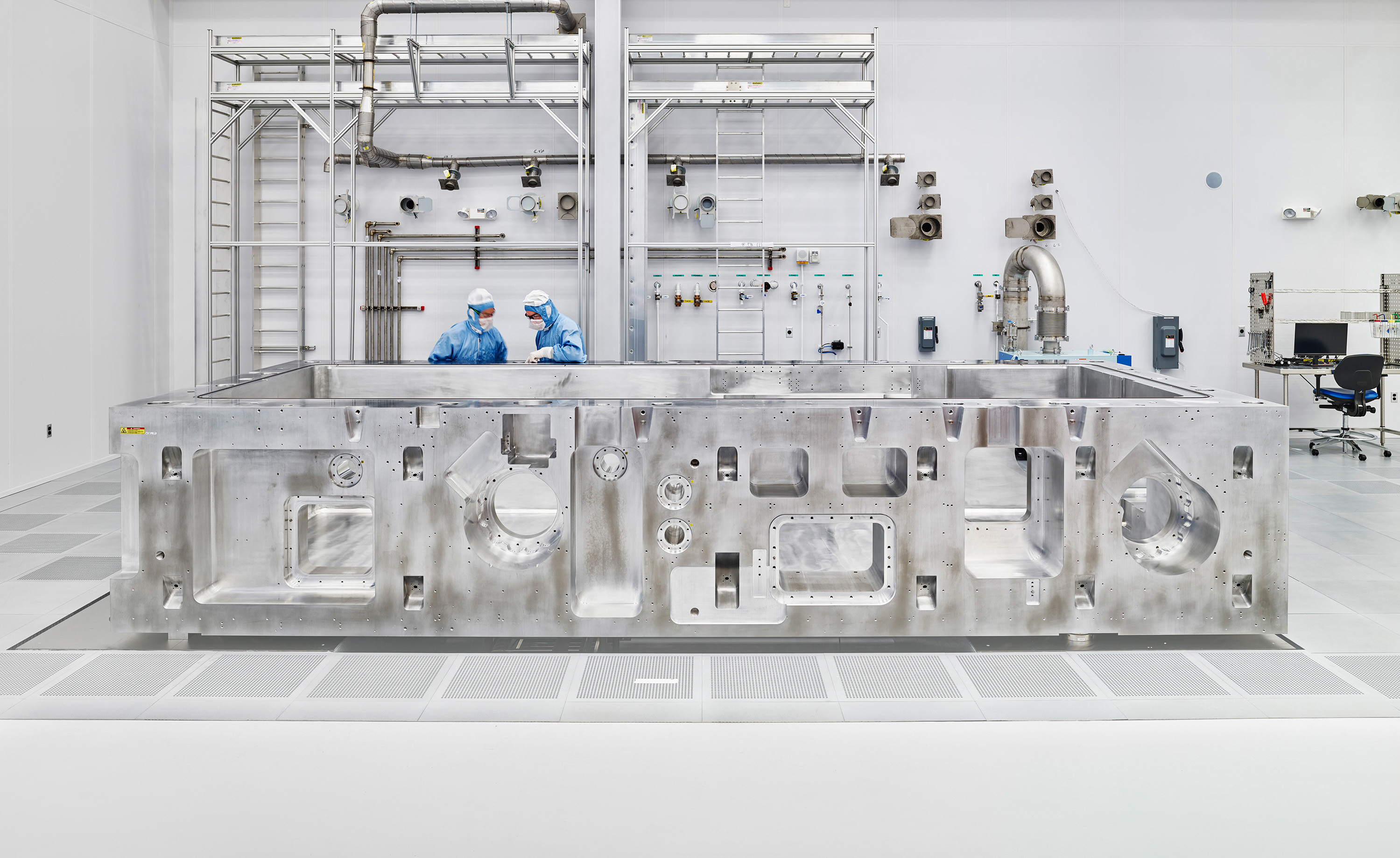
Inside the machine that saved Moore’s Law
In a Connecticut clean room, the Dutch company ASML is developing the world’s most advanced machine for extreme ultraviolet (EUV) lithography, a crucial process for manufacturing microchips.
The system has become vital to Moore’s Law—the observation that the number of transistors on a chip roughly doubles every two years as components shrink, driving gains in performance and efficiency. “Without this machine, it’s gone,” says Wayne Lam, a director of research at CCS Insight. “You can’t really make any leading-edge processors without EUV.”
Discover how ASML’s EUV technology saved Moore’s Law.
—Clive Thompson
We can still have nice things
A place for comfort, fun, and distraction to brighten up your day. (Got any ideas? Drop me a line.)
+ Tech bosses love Tolkien. Here’s what the writer might think of them.
+ Rare footage captures an underwater volcano erupting beneath the Pacific Ocean.
+ Watch a tiny rescued cub grow into adulthood in this heartwarming tiger compilation.
+ This medieval version of “Take On Me” is like stepping into a tavern of synth-pop bards.
This week I’ve been at SXSW London. There’s been music, film, and a lot—and I mean a lot—of talk about AI. I also had the opportunity to sit down with Gloria Mark, a psychologist at the University of California, Irvine, who has spent the last 30 years studying how people interact with digital technologies.
Early in her career, the biggest concerns were the potential impacts of internet and email use on our brains. We may laugh those concerns off today, but it’s true that as the technologies became more ubiquitous and ingrained in our daily lives, our attention spans began to shrink.
Mark is worried that things are only getting worse. The title of our session was “Have we lost control of our brains?” Unfortunately, Mark told me, the answer is yes.
Around two decades ago, Mark started wondering about how our use of devices might affect our attention spans. She set up what she calls “living laboratories,” using sensors and trackers to monitor adult volunteers’ attention, mood, and behavior when they were using devices.
In 2003, she found that the average user had an attention span of around two and a half minutes. That’s how long people could spend focused on one thing before moving on to something else. “That surprised me at the time,” she told me during our session on Wednesday. “I thought: Wow, this is really short.”
But when she repeated the experiment in 2012, she found that attention spans had shrunk—all the way down to around 75 seconds on average, she said. In research she conducted between 2014 and 2020, attention spans shrank further still—to a mere 47 seconds, on average. Yikes.
And it’s not good for us. Mark told me that she’s found switching our attention so frequently is stressful. “We would have people wear heart rate monitors, and … we would see direct correlation between switching attention fast and stress going up,” she told me.
All this distraction makes it harder for us to get stuff done, too. “It just takes longer to do any single task if you’re switching your attention,” she told me. “It’s not great for performance. It’s not great for our emotional well-being.”
And that’s for adults. What about the effects of digital technologies on children? A few months ago, Meta (which owns Facebook and Instagram) and Google’s YouTube were ordered to pay millions of dollars in damages to a 20-year-old woman who had accused the companies of creating products that led her to develop a childhood addiction.
Just a couple of weeks ago, Meta settled another lawsuit, this one brought by a rural school district in Kentucky. The district had also accused the company of designing addictive products that were harmful to students and had sought more than $60 million to cover the costs of their mental-health needs. Around 1,200 other school districts are taking similar legal action against social media companies.
But social media isn’t all bad, all the time. It can provide opportunities for some people, including those from marginalized groups, to form connections that might otherwise be difficult. A 2024 survey of LGBTQ+ teenagers found that while some described social media as a place of rejection and fear, others described it as a place where they felt a sense of belonging, where they could develop friendships and cultivate their identity.
In truth, we can’t definitively say what effects using social media is having on children across the board, says Mark. “There have been lots and lots of studies, and the evidence is to date inconclusive,” she told me. (Despite what you might read in best-selling books on the subject.)
Mark is hopeful that large, long-term studies might finally start shedding a bit more light on this question. An effort of this nature is underway in Australia, which enacted a social media ban for under-16s at the end of last year.
Given this uncertainty over a 20-year-old technology, I wondered if Mark had any thoughts on the potential impacts of AI—an obviously much newer offering that within the space of a couple of years appears to have become deeply integrated into our digital lives.
She told me she’s worried.
When we put in effort to do something—such as evaluating or summarizing content—we’re doing what’s known as “depth of processing,” she told me. “When you’re actively engaged with information, you’re processing it on a very deep level,” she said. “Then you’re more likely to learn it, to understand it, [and] to retain it.”
That’s not happening when most people use AI bots like ChatGPT, Claude, and Gemini. When we ask these tools to write, summarize, or evaluate for us, we’re no longer doing that depth of processing. “You’re deferring your cognitive work to AI,” she said. “And it’s not good for us.”
The risk is that our cognitive abilities will weaken over time. “If you’re not constantly exercising your muscles, they can atrophy,” Mark said. “And that’s exactly what can happen with our minds.” People with weaker critical thinking skills are more likely to fall prey to misinformation, she added.
Interactions with AI-powered “synthetic companions” can be just as harmful. Relationships between human beings take work—time, effort, and understanding. None of that is needed if you’re forming a relationship with a sycophantic bot. The “muscle” we risk atrophying here is emotional intelligence, which surveys suggest is already on the decline, said Mark.
She’s not painting a particularly rosy picture.
“If we continue on this trajectory, attention spans are diminished, loneliness is rising, boredom is rising, emotional intelligence decreasing, and actually our sense of purpose, according to studies, is also decreasing,” she said.
Luckily, she thinks we can course-correct by changing our relationship with these technologies. The key factor is effort.
The more effort we put into something, the deeper the satisfaction we stand to gain, Mark told me. That means making an effort to read a book rather than skimming its summary, and to meet with friends in person when you can. Try not to use GPS in places where you can probably manage without it.
“I love technology; we can’t give it up,” she told me. “[But] we have to learn how to create new life routines.”
This article first appeared in The Checkup, MIT Technology Review’s weekly biotech newsletter. To receive it in your inbox every Thursday, and read articles like this first, sign up here.
]]>On June 5, 404 Media reported that attackers had been using Meta’s AI customer support agent to steal Instagram accounts. Their approach was simple: They asked the agent to link the accounts to email addresses that they controlled, and the agent complied. One attacker broke into the dormant Obama White House account and made pro-Iran posts; others took over accounts with valuable, single-word handles, possibly in order to sell them.
AI cybersecurity concerns are nothing new. Since Anthropic announced in April that its Mythos model was too good at hacking to be released to the general public, commentators, researchers, and federal officials alike have fixated on the idea that superpowered AI systems could lay waste to our computer infrastructure. That’s not quite what this Instagram hack was: There, AI was the target rather than the attacker, and the method was far simpler than anything Mythos would cook up. But as companies offload more work to AI, these comparatively unsophisticated attacks could wreak their own havoc.
“As AI becomes more and more widely used—especially when AI is more and more widely used to automate our work flows, like account recovery—I think attackers are going to be more and more motivated to attack AI itself,” says Neil Gong, a professor of electrical and computer engineering at Duke University.
Gong and other scholars have been issuing warnings about the security vulnerabilities of AI agents for a while. They publish papers and blog posts detailing exploits such as indirect prompt injection, which involves hijacking agents using commands hidden in websites, emails, or other seemingly anodyne data sources. Compared with these techniques, the Meta hack was practically mindless. The only complication that hackers had to overcome was using a VPN that matched the true account owner’s location; then they directly asked the support agent to change the account’s email address, and it complied.
Meta has not commented publicly on how this vulnerability slipped through the cracks. But given the simplicity of the exploit, Gong says, it should have been uncovered easily, before the agent was deployed. “It’s really surprising,” he says. “I don’t understand why they didn’t find this simple problem.”
Jessica Ji, a senior research analyst at Georgetown’s Center for Security and Emerging Technology, agrees. “It raises questions like: Were there even guardrails in place?” she says. “Did anyone think to test for this kind of scenario?” She notes that the oversight is particularly striking coming from a company like Meta, which has extensive expertise in both AI and cybersecurity. Meta did not respond to a request for comment for this article, but on Monday a Meta spokesperson said on X that the vulnerability had been resolved.
As embarrassing a moment as this might be for Meta in particular, it also highlights some core vulnerabilities shared by all AI agents. Unlike traditional software, agents can respond in flexible—and unexpected—ways to new circumstances, which is why they might be able to substitute for human customer support agents. But AI agents can also be tricked in ways that humans wouldn’t be, and because they can take real-world actions, those mistakes have consequences. “A human would say, ‘Okay, why do you want to change the email address?’ and maybe respond with a security question,” says Somesh Jha, a professor of computer science at the University of Wisconsin–Madison. “What is going on with these agents is they’re very eager to finish the task. It’s almost like some elementary school student who just wants to please the teacher.”
There are ways to mitigate the risks. Companies can use traditional software to build guardrails that make sure agents follow strict rules, such as always asking for answers to security questions before sending sensitive account information to a new email address. And the experts consulted for this article all agree that agents should undergo rigorous red-teaming, a process in which developers try their best to attack a system in order to discover its vulnerabilities before it is deployed.
But there are also countervailing forces. Companies want to deploy capable agents, and the more power an agent has—and the fewer guardrails it is subject to—the more work it can potentially take on. “Security and utility always have a trade-off,” says Bo Li, a professor of computer science at the University of Illinois Urbana-Champaign. And adequate red-teaming can be expensive. Defenders have to expend more resources than attackers do, because attackers only need to discover a single exploit, while defenders try to discover and patch as many as they can. When attackers are working toward something as valuable as a single-word Instagram handle, they’ll pour resources into finding exploits, so defenders have to spend even more money to protect that prize.
As AI models continue to improve, hardening their defenses might actually get easier. Though the probabilistic nature of large language models means that LLM agents will always be vulnerable to some forms of attack, a more sophisticated model might have identified an attempt to change the email associated with the Obama White House account as suspicious. And AI systems can be used for agent red-teaming, much as participants in Anthropic’s Project Glasswing use Mythos to identify vulnerabilities in their software.
Still, experts expect that the problem of securing AI agents will only become more pressing in the future. As agents grow more capable, companies that adopt them may want to give them more power, both to provide more services with fewer humans and to avoid being left behind by their competitors. In the fast-moving world of AI, the time needed to carefully secure risky agentic systems might seem like an unconscionable delay.
“Everybody wants to be the first to do something and just push things out without careful scrutiny and red-teaming,” Jha says. “I think it’s a very dangerous thing.”
]]>How courts are coping with a flood of AI-generated lawsuits
Most days in her chambers, Judge Maritza Braswell, a federal magistrate judge in Colorado, sifts through stacks of documents written by people without a lawyer. The number of these filings has more than doubled compared to before 2023. She puts that jump down to AI.
But while AI appears to be expanding access to justice, it doesn’t seem to be improving people’s chances of winning. Judges are starting to question what rights and duties chatbots should have as they stand in for lawyers. Lawmakers, meanwhile, are grappling with who should pay the price when chatbots produce bad legal advice.
Read the full story on how AI is reshaping access to the law.
—Michelle Kim
How virtual power plants could provide energy for data centers
Would you take a payment to ramp down your electricity use? Would it change anything if you were doing so to help power a local data center? A new project backed by Google will put those questions to the test.
The company has signed a deal to fund a virtual power plant in the largest power grid in the US. The system will group together devices like electric vehicles and smart thermostats, paying customers to adjust their usage when the grid is stretched.
The project could free up capacity for Google’s data centers—but there’s a catch: people might not play along. Find out what the future holds for these virtual power plants.
—Casey Crownhart
This story is from The Spark, our weekly newsletter giving you the inside track on all things climate. Sign up to receive it in your inbox every Wednesday.
The must-reads
I’ve combed the internet to find you today’s most fun/important/scary/fascinating stories about technology.
1 The EU has proposed new legislation to end its Big Tech dependence
The laws aim to boost domestic cloud, AI and semiconductors. (CNBC)
+ US firms would be blocked from critical public tenders. (Reuters $)
+ It also wants to make sure non-EU actors cannot disrupt tech services with a “kill switch.” (The Guardian)
+ But the proposal needs to be negotiated with EU member states. (Politico $)
2 Intelligence agencies warn Chinese spies are recruiting on LinkedIn
The Five Eyes alliance said Beijing is using job platforms for espionage. (BBC)
+ The spies are allegedly recruiting government and military staff. (Politico $)
+ The Chinese embassy in the UK condemned the accusations. (Bloomberg $)
+ Meet the man hunting the spies in your smartphone. (MIT Technology Review)
3 AI CEOs have called for a law protecting against biological weapons
They warn that synthetic DNA could be used for bioweapons. (Wired $)
+ Sam Altman, Dario Amodei, and Demis Hassabis joined the call. (WSJ $)
+ No one’s sure if synthetic mirror life will kill us all. (MIT Technology Review)
4 Firms are using Reddit to manipulate ChatGPT and Google AI search
They’re spamming subreddits to get posts scraped by chatbots. (404 Media)
+ What we’ve been getting wrong about AI’s truth crisis. (MIT Technology Review)
5 Meta keeps delaying the launch of its new AI model
The new Muse Spark AI model API still has no release date. (WSJ $)
+ Which is hampering Meta’s plans to monetize its AI investments. (Reuters $)
6 For the first time, a US city has voted to permanently ban data centers
Monterey Park, California, voted in favor of the move. (LA Times)
+ Should we be moving data centers to space? (MIT Technology Review)
7 China is betting on household chore training to advance robotics
Data harvested in homes and factories provides a scaling edge. (Rest of World)
+ Gig workers are training humanoids at home. (MIT Technology Review)
8 Sam Altman will urge US lawmakers not to require AI model approvals
He’s advocating against proposals for new AI rules. (Reuters $)
+ His move comes after President Trump signed a new AI order. (Wired $)
9 Quantinuum raised $1.68 billion in an IPO as quantum computing rises
Investors flocked to one of the fast-growing sector’s leaders. (Reuters $)
10 Someone finally wants to hire philosophers: Silicon Valley
Big tech hopes they will help build better machines. (The Atlantic $)
Quote of the day
“Historically, these companies have been very willing to play Russian roulette—and they’re playing another round.”
—Connor Leahy, an AI researcher, former hacker and US director of ControlAI, tells the Financial Times why he’s concerned about Anthropic’s relentless race to the top.
One More Thing

What an octopus’s mind can teach us about AI’s ultimate mystery
Emily Bender, a linguist at the University of Washington, has developed a thought experiment she calls the octopus test. It involves an octopus learning to copy patterns in human writing and produce squiggles in response. But does the animal actually understand the language or are we merely projecting meaning onto it?
Bender’s octopus is a stand-in for AI systems like ChatGPT. The intelligence we see in these machines is also projected on them by us. The same applies to consciousness: we may claim to see it, but it remains unclear whether it is really there.
Read the full story on the debate over machines with minds.
—Will Douglas Heaven
We can still have nice things
A place for comfort, fun, and distraction to brighten up your day. (Got any ideas? Drop me a line.)
+ Discover where iconic sound effects actually came from in this fabulous audio history.
+ Need a serotonin boost? Then tune into this live puppy cam from Denali National Park.
+ Linux lovers can try 570 extinct operating systems at a new virtual museum.
+ Beethoven’s “Moonlight Sonata” becomes something entirely different in this lightning-fast bass guitar performance.
Most days in her chambers, Judge Maritza Braswell, a federal magistrate judge in Colorado, sifts through stacks of documents written by people without a lawyer. Many of them can’t afford to hire a lawyer, and others have cases too weak or too small to interest one. She reads each one carefully, mindful of how daunting it is to walk into the courtroom alone.
Lately, like many judges across the US, she has seen a noticeable uptick in such filings. According to a new study that examined 4.5 million federal civil cases from 2005 to 2026, the share of lawsuits brought by self-represented people increased from 11% in 2022 to 16.8% in 2025. Within those cases, the number of filings made more than doubled from pre-2023 levels.
Judge Braswell puts that jump down to AI.
“I do correlate that to AI in part because I see AI use,” she says. As a tech-savvy judge who uses AI to vet court documents, she’s learned to recognize how large language models write. She can tell from the prose and at times, hallucinated cases and fabricated quotes.
“I’m also actually seeing better-drafted pleadings,” she says.
But while AI appears to be expanding access to justice, it doesn’t seem to be improving people’s chances of winning. Judges are also starting to question what kinds of rights and responsibilities large language models should bear as they step into lawyers’ shoes. For example, they ask whether a chatbot has a duty to provide good advice, as a human lawyer does. And a growing number of lawmakers across the US are starting to grapple with who should pay the price when chatbots dish out bad legal advice.
AI supercharges lawsuits
To test whether AI was driving the increase in lawsuits filed by people without a lawyer, the authors of the study, Anand Shah at MIT and Joshua Levy at the University of Southern California, ran 1,600 randomly sampled court documents through Pangram, a commercial AI-text detector. The share flagged as containing AI-generated writing rose from 1% in 2023 to 18% in 2026.
To Judge Braswell, that’s not necessarily a cause for concern. While the surge of AI-assisted filings might be adding to their workloads, she and many other judges find the cases easier to rule on because AI is helping people without legal training better articulate their arguments.
Court documents written by people without lawyers are notoriously hard to decipher. Some arrive as handwritten scrawls bordering on gibberish that judges take a while to decode. However cryptic, judges are required to read them charitably.
These days, Judge Braswell has been churning through motions drafted by AI faster than the ones written by the litigants. “I have to be really careful because some of them contain hallucinations and errors, but I can generally understand what they’re arguing better with AI assistance from them than without it,” she says.
The clearer filings let Judge Braswell hear them better. “If I understand an argument a little bit better, I’m probably going to be able to help a little bit more,” she says.
Online communities are springing up to trade self-help guides on using AI to sue. In December 2024, a viral Reddit post walked immigration applicants through suing the United States Citizenship and Immigration Services over delayed review of their applications: draft a writ of mandamus with Microsoft Copilot, pay a lawyer $150 to polish it, and file in the expedient District of Vermont. Cases filed by people without lawyers in Vermont rose from about 45 a year before 2022 to more than 1,100 in 2024.
Even so, people without lawyers are far more likely to lose their case than people with lawyers, and that’s not changing even with the addition of AI, the study found.
“It turns out that mounting a lawsuit is a complex, multifaceted task. Not all of it is just drafting text,” says Levy.
Chatbot-client privilege
Judge William Garfinkel, a federal magistrate judge in Connecticut, has served on the bench for three decades, pondering all sorts of questions about lawyers’ relationship with their clients. Lately, he has been wondering whether people’s conversations with chatbots dispensing legal advice should be privileged, the way their conversations with lawyers are.
“You can make a good argument that … conversations with large language models like Claude or ChatGPT or Grok should deserve some protection,” he says.
Courts are starting to grapple with this question. In February, a federal court in Michigan ruled that a self-represented person’s conversations with ChatGPT to prepare her case were work product—legal work that is shielded from the opposing side.
The decision came on the same day a federal court in New York held that documents a criminal defendant had generated using Claude were not privileged attorney-client conversations or work product. The court argued that Claude is not an attorney and that a user has no “reasonable expectation of confidentiality in his communication” with it because AI companies can disclose user data to third parties.
In March, Judge Braswell ruled that a self-represented person’s use of a chatbot should stay off limits. “It is true that AI systems like ChatGPT, Claude, Gemini, and others … collect user data for training and other purposes. But … that does not eliminate all expectations of privacy,” she wrote. Courts have since remained split on the issue.
Malpractice without a pulse
Some judges are also wondering whether a chatbot, like a lawyer, has a duty to provide good legal advice. Judge Allison Goddard, a federal magistrate judge in California, has noticed that people without lawyers often get the wrong advice from ChatGPT when trying to assess the value of their case during settlement negotiations. In one case, a plaintiff who slipped and fell in a store asked for $700,000 from the store, which was wildly more than the case was worth.
“Where are you getting the idea that you’re getting $700,000? Did you go to ChatGPT?” Judge Goddard asked. “Well …” the plaintiff mumbled. She then walked the person through the law to explain why ChatGPT was wrong and suggested a lower amount. “It’s like Dr. Google went to law school,” she says.
Then there’s the question of who’s liable when a chatbot makes such mistakes. In March, Nippon Life Insurance Company sued OpenAI alleging that ChatGPT practiced law without a license and helped a woman reopen a lawsuit that was already settled, flooding the court with frivolous filings. “ChatGPT is not an attorney,” the lawsuit said.
In May, OpenAI asked the court to dismiss the case, arguing that ChatGPT does not practice law. “ChatGPT is not a person and neither has nor uses any degree of legal knowledge or skill,” OpenAI said in its filing. The case is still pending before the court.
States have started to weigh legislation that would hold AI companies liable when their chatbots offer bad legal advice. New York introduced a bill in March that would bar chatbots from impersonating lawyers, even if they notify users that they are interacting with chatbots. In Congress, a series of bills have been proposed to ban chatbots from posing as lawyers, doctors, and other licensed professionals. The bills have yet to gain traction.
For now, people will continue turning to AI to be their lawyer. For many of them, the rewards outweigh the risks. Not long ago, when Judge Braswell asked self-represented litigants why they wanted a particular piece of evidence, they mumbled timidly. Now, they answer her questions confidently, having rehearsed with a chatbot.
“This is a really tough system to navigate. With AI, though, it gets a little less complex,” she says.
]]>