
Waterfall testing is a sequential testing approach where testing begins only after the complete development of the software. It follows a linear and structured process in which each phase is completed before moving to the next. Development and testing are handled separately, which ensures organization but delays defect detection.
- Testing starts after development is fully completed.
- Testing and development teams work separately.
- Each testing level is executed one after another.
Example: A company develops an e-commerce website completely first, and then the testing team tests all features together, leading to multiple defects being found at once.
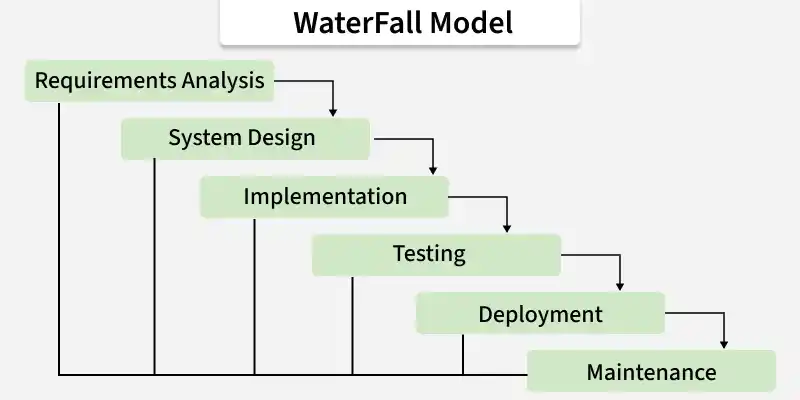
Phases
This diagram shows the sequential flow of phases where testing begins after development is completed and moves level by level.
- Requirement Analysis: Understanding system needs.
- System Design: Creating architecture and design.
- Implementation (Coding): Developing the system.
- Testing: Verifying and validating the system.
- Deployment: Releasing the product.
- Maintenance: Fixing issues and updates after release.
Testing Levels
In the Waterfall model, testing is done in multiple levels after development is completed. Each level focuses on a specific aspect of the system and is performed sequentially.
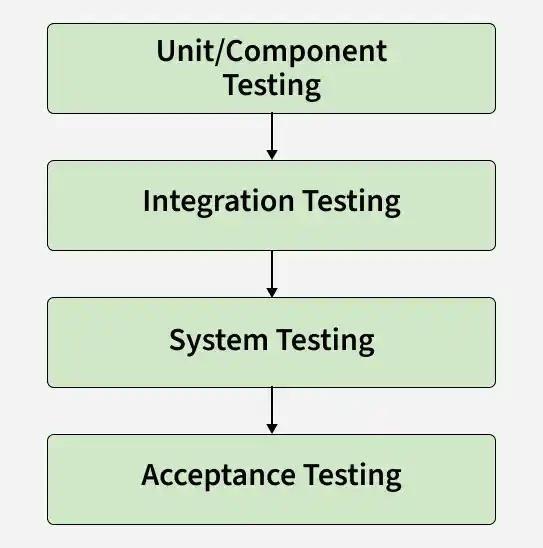
1. Unit Testing
This is the first level of testing where individual components or modules are tested separately.
- Focuses on small units like functions or methods.
- Usually performed by developers.
- Helps in identifying coding errors early.
2. Integration Testing
After unit testing, different modules are combined and tested together.
- Checks interaction between modules.
- Detects interface and data flow issues.
- Ensures modules work correctly when integrated.
3. System Testing
At this level, the complete system is tested as a whole.
- Validates the entire application.
- Checks functional and non-functional requirements.
- Performed by the testing team.
4. Acceptance Testing
This is the final level of testing before deployment.
- Done by the client or end-users.
- Ensures the system meets business requirements.
- Decides whether the product is ready for release.
Advantages
This approach offers a structured and predictable testing process with clear separation of responsibilities.
- Ensures a clear separation between development and testing, improving focus and accountability.
- Provides a well-defined and organized workflow, making it easy to understand and manage.
- Reduces interruptions during development since testing is performed after completion.
- Helps in identifying defects in the complete system rather than in isolated parts.
- Suitable for projects with fixed and well-defined requirements.
Disadvantages
Despite its simplicity, this approach has limitations due to its rigid and sequential nature.
- Delays defect detection since testing begins only after development is completed.
- Fixing multiple defects at a later stage becomes time-consuming and costly.
- Lack of flexibility makes it difficult to handle changes in requirements.
- Increased workload on the testing team as all testing is done at once.
- Not suitable for large or dynamic projects where continuous feedback is required.