
A blockchain is a digital ledger of transactions distributed across a network of computers (nodes). Instead of relying on a central server, each node records, shares, and synchronizes transactions independently. Blockchain uses technologies like digital signatures, encryption, and distributed networks to enable secure applications. It is a type of DLT where transactions are stored with an unchangeable cryptographic signature called a hash, which is why distributed ledgers are often referred to as blockchains.
What is Distributed Ledger Technology (DLT)?
Distributed Ledger Technology (DLT) is centered around an encoded and distributed database where records regarding transactions are stored. A distributed ledger is a database spread across various computers, nodes, institutions, or countries and accessible by multiple people around the globe.
Key Features:
- Decentralized: It is a decentralized technology where every node maintains its own copy of the ledger, and any data change triggers an independent update on each node. Even small changes are quickly reflected, and the update history is shared with all participants within seconds.
- Immutable: Distributed ledger uses cryptography to create a secure database in which data once stored cannot be altered or changed.
- Append only: Distributed ledgers are append-only in comparison to the traditional database where data can be altered.
- Distributed: In this technology, there is no central server or authority managing the database, which makes the system more transparent. Instead of relying on a single authoritative copy, the ledger follows specific rules for updates, ensuring decentralization. Every node verifies transactions using consensus algorithms or voting, depending on the ledger’s rules. For example, Bitcoin uses the Proof of Work consensus mechanism for node participation.
- Shared: The distributed ledger is not associated with any single entity. It is shared among the nodes on the network where some nodes have a full copy of the ledger while some nodes have only the necessary information that is required to make them functional and efficient.
- Smart Contracts: Distributed ledgers can be programmed to execute smart contracts, which are self-executing contracts with the terms of the agreement between buyer and seller being directly written into lines of code. This allows for transactions to be automated, secure, and transparent.
- Fault Tolerance: Distributed ledgers are highly fault-tolerant because of their decentralized nature. If one node or participant fails, the data remains available on other nodes.
- Transparency: Distributed ledgers are transparent because every participant can see the transactions that occur on the ledger. This transparency helps in creating trust among the participants.
- Efficiency: The distributed nature of ledgers makes them highly efficient. Transactions can be processed and settled in a matter of seconds, making them much faster than traditional methods.
- Security: Distributed ledgers are highly secure because of their cryptographic nature. Every transaction is recorded with a cryptographic signature that ensures that it cannot be altered. This makes the technology highly secure and resistant to fraud.
How DLT Can Replace Traditional Book-Keeping Methods?
- Decentralization: Unlike centralized systems, DLT operates on a network where multiple participants maintain synchronized copies of the ledger, reducing the risk of data manipulation and single points of failure.
- Real-time Updates: DLT enables immediate transaction recording and updates across all network nodes, enhancing accuracy and providing real-time visibility into financial status.
- Enhanced Transparency: Transactions on a DLT are visible to authorized participants, fostering trust and reducing the need for extensive audits.
- Improved Security: DLT utilizes cryptographic techniques to secure data, creating an immutable chain of transactions that is resistant to tampering and cyberattacks.
- Cost Reduction: By automating processes and minimizing the need for intermediaries, DLT can lower operational costs and improve efficiency.
- Streamlined Processes: DLT enables automation through smart contracts, reducing manual intervention and errors in transaction processing.
- Secure Audit Trail: DLT automatically creates a secure and immutable record of all transactions, simplifying audits and enhancing accountability.
- Interoperability: DLT facilitates seamless data sharing and collaboration across different accounting systems, reducing data silos.
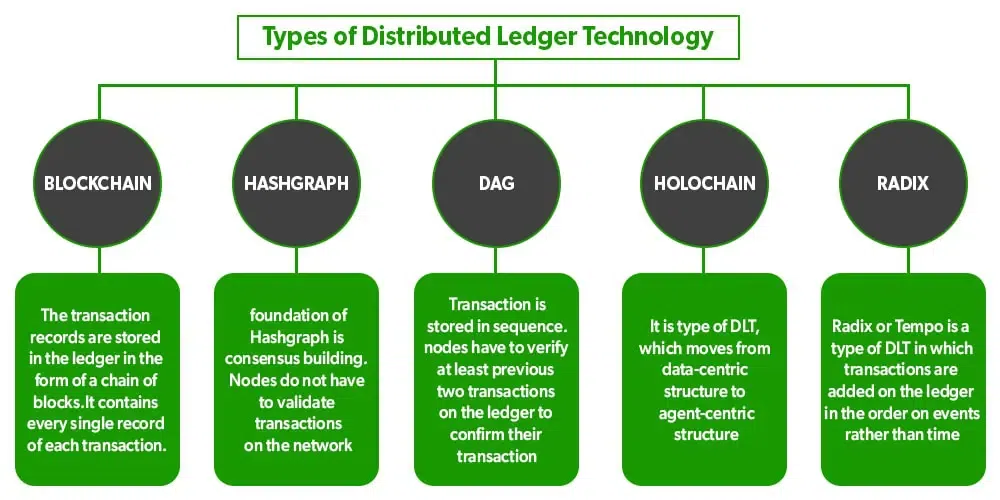
Types of Distributed Ledger Technology
- Blockchain: This DLT stores transactions as a chain of blocks, where each block generates a unique hash as proof of valid transactions. Every node has a copy of the ledger, ensuring transparency.
- Directed Acyclic Graphs (DAG): This uses a different data structure to achieve consensus. Transaction validation usually requires majority support from network nodes. Each node must verify at least two previous transactions before confirming its own.
- Hashgraph: This DLT stores records in a directed acyclic graph and uses virtual voting as its consensus mechanism. Nodes do not need to validate every transaction directly.
- Holochain: Considered more decentralized than blockchain, Holochain lets each node operate on its own chain. It follows an agent-centric model, giving nodes more autonomy.
- Tempo (Radix): Tempo shards the ledger into partitions and orders all events in the network. Transactions are added based on event order rather than timestamps.
Use Case: How a Blockchain Validates and Adds a Transaction
Step-by-step Algorithmic Workflow (Bitcoin example):
- Transaction Creation
- A user signs a transaction with a private key -> generates a digital signature.
- The transaction is broadcast to the peer-to-peer network.
- Mempool Processing
- Nodes validate signatures using ECDSA (Elliptic Curve Digital Signature Algorithm).
- Valid transactions are stored in the mempool.
- Block Creation (Mining)
- A miner picks transactions and builds a block with:
- Transaction list
- Previous block hash
- Timestamp
- Nonce
- Merkle root (binary tree hash of all transactions)
- A miner picks transactions and builds a block with:
- Proof-of-Work Algorithm
- The miner repeatedly hashes the block header using SHA-256.
- The goal: find a hash value lower than the difficulty target.
- This requires trillions of iterations -> ensures security.
- Block Propagation
- When a miner finds a valid hash, the block is broadcast to all nodes.
- Nodes verify:
- Hash validity
- Merkle root correctness
- Transactions
- Signatures
- No double-spending
- Ledger Update
- If valid, nodes append the block to their local ledger copy.
- Consensus emerges as the longest valid chain becomes the accepted version.
Advantages Of Distributed Ledger Technology
- High Transparency: DLT offers strong transparency since all transaction records are visible to everyone. Data additions must be validated through consensus, and any attempt to alter the ledger is instantly reflected across all nodes, preventing invalid changes.
- Decentralized: Unlike centralized systems that risk a single point of failure, DLT removes reliance on a central authority. This boosts trust among participants and significantly reduces transaction costs thanks to distributed validation.
- Time Efficient: With no central authority required for verification, transaction validation becomes much faster. Network members validate data using consensus mechanisms, reducing overall processing time.
- Scalable: DLT is highly scalable due to the variety of consensus mechanisms that improve speed, reliability, and security. Newer technologies like Holochain and Hashgraph offer even more advanced and secure alternatives to traditional blockchain.
Applications of Distributed Ledger Technology
Because of all these benefits of distributed ledger technology and this technology has the potential to revolutionize many sectors like Financial, energy, healthcare, governance, supply chain management, real estate, cloud computing, etc.
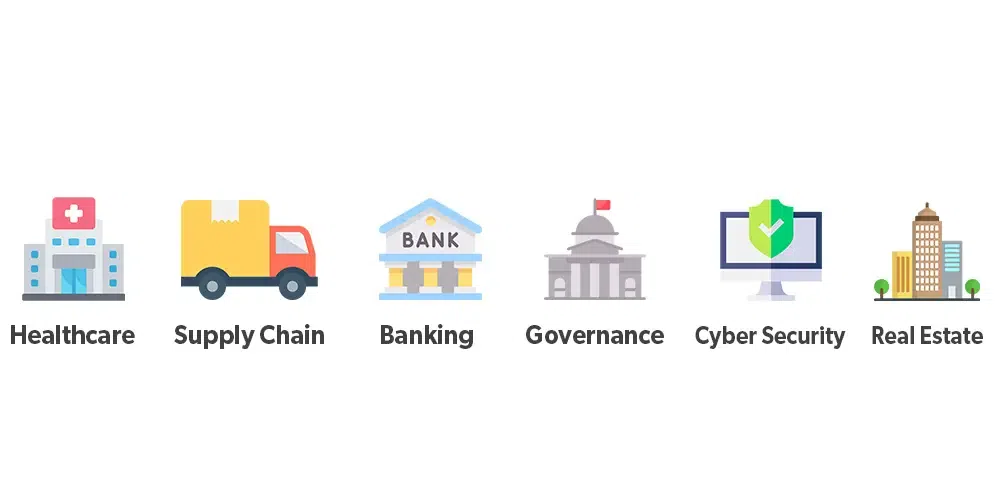
- Banking: Money transfers today can be slow, costly, and complex—especially internationally. DLT offers a decentralized and secure network that reduces time, cost, and reliance on third parties, making transactions faster and simpler.
- Cyber Security: Cyber threats are rising across governments, enterprises, and individuals. DLT secures data using strong cryptographic algorithms, ensuring transparency, encryption, and protection against unauthorized tampering.
- Supply Chain Management: Supply chains are complex and difficult to trace. DLT enables end-to-end tracking, as all data added to the ledger is validated, permanent, and transparent, making it easy to identify faults or issues.
- Healthcare: DLT removes central authority and provides fast, secure access to medical data that cannot be altered. Any attempted change is instantly visible. It can also help detect false insurance claims due to its transparency.
- Governance: DLT can make government systems more transparent and reliable. Many governments are adopting blockchain for secure processes, including voting. A decentralized voting system can prevent fake votes and allow citizens to vote from anywhere with verified identities.
How are Blockchain And Distributed Ledger Different?
In general blockchain and Distributed Ledger Technology are considered as same, but there are some differences between these two technologies. Blockchain can be classified as a type of Distributed Ledger Technology. We can say that Blockchain is a type of DLT, but every Distributed Ledger can not be called a blockchain.
Blockchain is the parent technology of DLT. But the idea behind them is the same. Blockchain technology has the potential to solve many problems in the banking and financial industry. Here, blockchain is the advanced version of Distributed Ledger Technology with many useful functionalities. Developers have many other variants of DLTs in the technology world. However, they do not have the many real-life implementations and applications that blockchain has been able to do.
| Aspect | Distributed Ledger | Blockchain Technology |
|---|---|---|
| Block Structure | In DLT, blocks can be organized in different forms. | In Blockchain, blocks are added in the form of a chain. |
| Power of Work | It is more scalable because it does not need the power of a work consensus mechanism for the validation of each transaction. | It is a subset of DLT, the power of the work consensus mechanism adds more functionalities and security. |
| Tokens | It does not require any tokens or digital currency. | In it, tokens must be considered while working with Blockchain. |
| Sequence | It does not require any specific sequence of data. | All blocks are arranged in a particular series. |
| Trustability | Trust among participating nodes is high. | Trust among participating nodes is less than DLT. Decision-making powers can be on one hand because everyone can mine. |
Advantages of Using Distributed Ledger Technology In Blockchain
- Security: All records of every transaction are securely encrypted. Once the transaction is validated, it is completely secure and no one can update or change it. It is a permanent process.
- Decentralization: All network members or nodes have a copy of the ledger for complete transparency. A decentralized private distributed network improves the reliability of the system and gives assurance of continuous operations without any interruption. It gives control of information and data in the hand of the user.
- Anonymity: The identity of each participant is anonymous and does not possibly reveal their identity.
- Immutable: Any validated transactions can not be changed as they are irreversible.
- Transparency: Distributed technologies offer a high level of transparency. Which is necessary for the sectors like finance, medical science, banking, etc.
- Speed: Distributed Ledger Technology can handle large transactions faster than traditional methods.
- Smart Contracts: Distributed Ledger Technology supports smart contracts which are self-executing contracts with the terms of the agreement between buyer and seller being directly written into lines of code. Smart contracts reduce the need for intermediaries and offer transparency and automation in the execution of the contract terms.
- Lower Costs: Distributed Ledger Technology eliminates intermediaries and reduces the costs associated with intermediaries, which makes the system more cost-effective.
- Improved Efficiency: Distributed Ledger Technology reduces the time and costs associated with traditional transaction methods. It offers faster settlement times, reduced paperwork, and increased efficiency.
- Auditing: Distributed Ledger Technology makes auditing easier as every transaction is recorded and the ledger cannot be altered. This improves the transparency and accuracy of financial audits.
- Resilience: Distributed Ledger Technology is more resilient than traditional databases as it is spread across multiple nodes. This means that even if one node goes down, the network can still function as the rest of the nodes can continue to validate transactions.
- Traceability: Distributed Ledger Technology offers complete traceability of assets, from their creation to their current ownership. This improves accountability and reduces the risks of fraud and theft.
Disadvantages Of Distributed Ledger Technology
- 51% Attack: The 51% attack is a bit concerning part of this distributed ledger technology that is to be checked routinely.
- Costs of Transaction: The connected nodes are expected to validate the transaction of a given Distributed Ledger Technology which gives high transaction cost as the other nodes are paid incentives to validate the transaction.
- Slow Transaction Speed: The major disadvantage of this DLT is the slow speed of transactions as multiple nodes are attached to this network and it takes time to validate the transaction by all the other nodes.
- Scalability Issues: Due to low speed and high transaction costs DLT faces very difficulties to expand on a large scale.
- Lack of Regulation: As DLT is a decentralized technology, it operates outside the control of any centralized authority which can lead to a lack of regulation, making it difficult to hold accountable any wrongdoings or fraudulent activities on the network.
- Energy Consumption: Distributed Ledger Technology requires a significant amount of energy to maintain the network and validate transactions, especially in the case of Proof of Work consensus mechanisms, which can lead to a negative impact on the environment.
- Complexity: Implementing and managing Distributed Ledger Technology can be complex and requires a high level of technical expertise, which can be a barrier to entry for many organizations and individuals.
- Privacy Concerns: While the anonymity of participants on the network is considered an advantage, it can also be a disadvantage as it can lead to privacy concerns and illicit activities on the network.
- Lack of Interoperability: Different Distributed Ledger Technologies may use different protocols, which can lead to interoperability issues, making it difficult for different networks to communicate and transact with each other.
Future of Distributed Ledger Technology
- Experts in this area promote DLT as a solution for many problems that are present on the internet and will drastically be able to solve all these problems. Distributed Ledger Technology is termed the "Internet of Value". Transactions and processes will occur in real-time with the help of the internet.
- Distributed Ledger Technology has the potential to impact problems in financial or banking, cyber security, healthcare, government, data security, etc. sectors with effective solutions.
- Enterprises and visionaries are now faced with the challenge of establishing networks of entities that together can take advantage of DLT to radically change how they share and keep records, and innovate where DLT can enable entirely new processes and business models.