
is an AI technique where models perform tasks without any task-specific examples, relying on knowledge learned during pre-training. It is a part of Zero-Shot Learning (ZSL) and enables models to handle new tasks without additional training data.
- Eliminates the need for labelled examples, making it efficient and scalable
- Enables models to generalize to new and unseen tasks using prior knowledge
Working
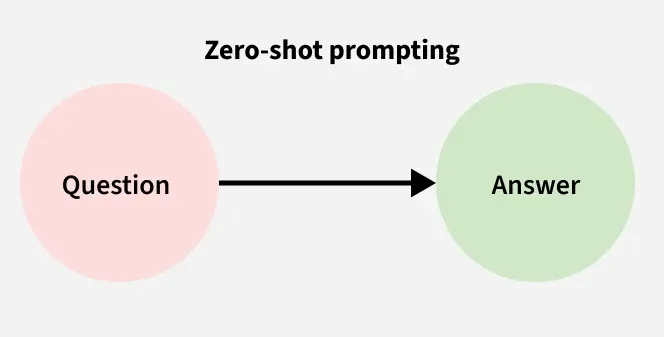
works by allowing an AI model to perform tasks without the need for examples or additional training on task-specific data. The process uses the model's pre-existing knowledge and training, enabling it to tackle a wide range of queries directly.
- User Query: The model receives a task without examples or extra context.
- Task Understanding: It infers the task using its pre-trained knowledge.
- Model Processing: Analyzes the query using learned patterns and concepts.
- Generated Output: Produces an answer based on existing knowledge.
Examples
Here are a few prompt examples to demonstrate how Zero-Shot Prompting works:
Example 1: Text Generation
Prompt: “Write a short story about a journey through space.”
AI Output: The stars glittered like diamonds against the vast emptiness of space. As the spaceship zoomed past distant ...
Example 2: Question Answering
Prompt: “What is the tallest mountain in the world?”
AI Output: Mount Everest
Example 3: Classification Task
Prompt: “Classify the following product as either a 'Laptop' or 'Smartphone': 'A portable device with a large screen and keyboard for computing tasks.'”
AI Output: Laptop
Zero-Shot vs Few-Shot Prompting
Aspect | Zero-Shot Prompting | Few-Shot Prompting |
|---|---|---|
Definition | Model performs tasks without any examples, relying on its pre-existing knowledge. | Model learns from a few examples provided in the prompt to perform the task. |
Efficiency | Fast and efficient for general tasks but can be less precise for specific tasks. | Effective for tasks where a few examples are enough to guide the model. |
Task Adaptability | Models handle tasks directly without the need for task-specific examples. | Models adapt to the task through provided examples in the prompt. |
Example | “Translate this sentence to French.” (No examples needed) | “Translate this sentence to French, based on these examples: [example translations]” |
Advantages
- No examples needed, useful when task-specific data is unavailable.
- Fast and efficient as it skips example-based learning.
- Flexible to handle multiple tasks without retraining.
- Cost-effective since no labeled data is required.
- Works across various domains using prior knowledge.
Challenges
- Accuracy may drop for complex or nuanced tasks.
- Depends heavily on pre-trained knowledge.
- May produce biased or incorrect outputs.
- Struggles with tasks needing detailed context.
Best Practices
- Use clear and direct prompts for better results.
- Choose well-trained models with diverse data.
- Keep task descriptions simple and specific.
- Monitor outputs and refine prompts as needed.
Real-World Examples
- Translation converts text between languages without examples.
- Sentiment analysis classifies text as positive or negative.
- Summarization condenses text into short, meaningful summaries.