
Web APIs (Web Application Programming Interfaces) allow different software applications to communicate and interact over the Internet. They define rules and protocols for requesting data or performing actions on another application's resources, enabling integration and interoperability between systems.
Key Aspects of Web APIs:
- Standardized Communication: Uses protocols like HTTP/HTTPS.
- Data Exchange: Supports formats like JSON and XML.
- Integration: Access external services and third-party functionalities.
- Security: Implements API keys, OAuth, or JWT for protection.
- Interoperability: Works across different platforms and programming languages.
Web APIs Basic Interview Questions & Answers
1. How do Web APIs work?
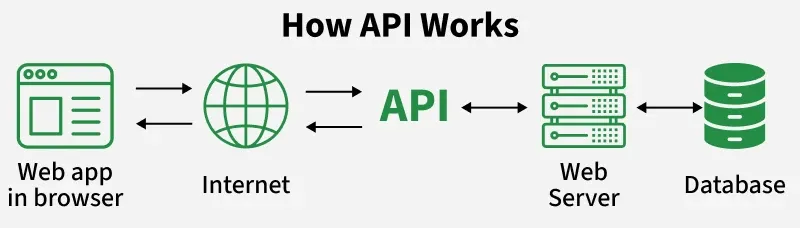
Web APIs allow different applications to communicate over the Internet by sending and receiving data. The process works as follows:
- Client Request: The client (browser, mobile app, or another server) sends a request to the API endpoint.
- URL Routing: The server identifies the requested resource and the appropriate handler based on the URL.
- Request Processing: The API processes the request, which may involve authentication, validation, or business logic.
- Data Handling: The API interacts with databases or other services to retrieve, update, or delete data.
- Response Generation: The server prepares a response, usually in JSON or XML format.
- Client Response: The response is sent back to the client for display, processing, or further actions.
2. What are the key components of a Web API?
Key components of a Web API include:
- Endpoints (URLs): The addresses where clients send requests.
- Request Methods: HTTP methods like GET, POST, PUT, DELETE that define the action.
- Request Headers: Provide metadata such as authentication tokens or content type.
- Request Parameters: Inputs sent with the request, either in the URL or body.
- Response Status Codes: Indicate success (200), errors (400, 404, 500), or other outcomes.
- Response Data Formats: The format of returned data, commonly JSON or XML.
3. What is RESTful API?
A RESTful API (Representational State Transfer Application Programming Interface) is an architectural style for designing networked applications.
- Uses Standard HTTP Methods: GET, POST, PUT, DELETE to perform actions.
- Stateless: Each request from the client contains all information needed to process it.
- Resource-Based: Interacts with resources identified by URLs.
- Uniform Interface: Provides a consistent way to access and manipulate resources across applications.
4. What is the difference between SOAP and RESTful APIs?
| SOAP (Simple Object Access Protocol) | RESTful API (Representational State Transfer Application Programming Interface) |
|---|---|
| Protocol with strict standards | Architectural style using standard HTTP methods |
| Uses XML for messaging | Typically uses JSON (can also use XML or others) |
| Rigid and feature-rich (security, ACID compliance) | Simpler and lightweight |
| Relies on defined operations and endpoints | Uses URLs to represent resources |
| Common in enterprise applications requiring strict contracts | Widely used for web and mobile applications |
5. Explain the difference between GET and POST requests.
| GET | POST |
|---|---|
| Retrieves data from the server | Submits data to the server to create or update a resource |
| Request parameters are sent in the URL | Request data is sent in the request body |
| Idempotent and safe (no side effects) | Not idempotent; can change server state |
| Can be cached and bookmarked | Cannot be cached or bookmarked easily |
| Limited amount of data can be sent | Can send large amounts of data |
Example:
- GET request:
GET /api/users?id=123This asks the server for the user with ID 123. The server just returns data and does not modify anything.
- POST request:
POST /api/users
{
  "name": "Rahul",
  "email": "rahul@example.com"
}
This sends data to the server to create a new user named Rahul. The server processes the request and updates its database.
6. What is JSON and why is it commonly used in Web APIs?
JSON stands for JavaScript Object Notation is a lightweight data interchange format that is easy for humans to read and write, and easy for machines to parse and generate.
Widely used in Web APIs due to:
- Simplicity and readability.
- Compatible with JavaScript and most programming languages.
- Ideal for data exchange between client and server in web applications.
Example:
{
  "id": 123,
  "name": "Rahul Kumar",
  "email": "rahul@example.com"
}
This JSON object represents a user with an ID, name, and email. It can be sent in a request body (POST/PUT) or received as a response from a GET request in a Web API.
7. What are differences between JSON and XML?
Both JSON and XML are data exchange formats used by Web APIs. Below are the key differences.
Here are the key differences between JSON and XML, expressed as bullet points:
- JSON uses key-value pairs and arrays; XML uses tagged elements and attributes.
- JSON supports native data types (number, boolean, string, null, arrays, objects); with XML, everything is text by default and data types rely on external schemas (e.g. XSD).
- JSON does not support mixed content (text + element interleaving) well; XML handles mixed content naturally.
- JSON doesn’t natively support namespaces; XML supports namespaces to disambiguate element/attribute names.
- JSON parsing is generally faster and lighter in memory, especially in web / JavaScript environments
- XML has additional features like processing instructions, entity references, mixed content, etc., which JSON intentionally omits for simplicity.
8. What is authentication and authorization in the context of Web APIs?
Authentication and authorization are two distinct but related security concepts.
- Authentication: The process of verifying the identity of a user or client making a request. It ensures that the entity is who it claims to be. Example: logging in with a username and password or using an API key.
- Authorization: The process of checking whether the authenticated user has the required permissions to access a resource or perform an action. Example: an authenticated user may access their own profile data but not modify another user’s account.
9. What is the purpose of HTTP status codes in Web APIs?
HTTP status codes are standardized codes returned by a server in response to a client’s request. They indicate whether the request was successful, redirected, or encountered an error. These codes help both clients and developers understand the outcome of the request.
- 2xx (Success): The request was successfully received, understood, and processed. Example:
200 OK. - 3xx (Redirection): Further action is needed to complete the request. Example:
302 Found. - 4xx (Client Error): The request contains bad syntax or cannot be fulfilled. Example:
404 Not Found. - 5xx (Server Error): The server failed to process a valid request. Example:
500 Internal Server Error.
10. What is CORS and why is it important in Web APIs?
CORS (Cross-Origin Resource Sharing) is a security feature implemented by web browsers to control how resources are accessed from a domain different from the one serving the application. Without CORS, browsers block cross-origin requests by default to protect users from malicious sites.
- It allows servers to specify which domains (origins) are permitted to access their resources.
- Prevents unauthorized access to sensitive data, while still enabling legitimate cross-origin interactions such as calling an API from a frontend hosted on another domain.
- A frontend running on
http://example.comcan make API requests tohttp://api.example.orgonly if the API server explicitly allows it via CORS headers.
11. Explain the concept of rate limiting in Web APIs.
Rate limiting is a technique used to restrict the number of requests a client can make to a Web API within a specified time period. It is a key mechanism for protecting APIs from misuse and ensuring fair access to resources.
- Maintains server performance, prevents abuse such as denial-of-service (DoS) attacks, and guarantees fair usage across multiple clients.
- The API enforces a limit (e.g., 100 requests per minute per user). Once the limit is reached, additional requests are either blocked, delayed, or returned with an error status such as
429 Too Many Requests. - Typically managed by API gateways, middleware, or load balancers using strategies like fixed window, sliding window, or token bucket algorithms.
12. What are query parameters and how are they used in Web API requests?
Query parameters are key-value pairs appended to the end of a URL in a Web API request. They allow clients to pass additional information to the server in order to filter, sort, or customize the response. Query parameters follow a ? in the URL, with multiple parameters separated by &. Provide flexibility in API requests without changing the endpoint itself.
Example:
Filtering:GET /api/users?active=trueSorting:GET /api/products?sort=pricePagination:GET /api/items?page=2&limit=10
13. What is content negotiation in Web APIs?
Content negotiation is the process of selecting the appropriate representation of a resource based on the client’s preferences and the server’s capabilities. It ensures that the client receives the data in the most suitable format.
- Client specifies preferences using HTTP headers like
AcceptorAccept-Language - Server selects the best representation supported, such as JSON, XML, or HTML
- Example:
Accept: application/json-> server responds with JSON data
14. What is versioning in Web APIs and why is it important?
Versioning is the practice of maintaining multiple versions of an API to handle changes over time.
- Ensures backward compatibility so existing clients continue to work
- Allows safe introduction of new features or breaking changes
- Provides developers a smooth migration path between versions
- Common strategies include URI versioning (
/v1/,/v2/), query parameters, and custom headers
15. What is HATEOAS and how does it relate to RESTful APIs?
HATEOAS (Hypermedia as the Engine of Application State) is a REST constraint that requires API responses to include hyperlinks to related resources, enabling clients to navigate the API dynamically. It promotes a self-descriptive and loosely coupled API design.
- Clients discover actions and resources through hyperlinks in responses
- Reduces dependency on hardcoded URLs in the client application
- Example: A
GET /orders/1response includes a link to/orders/1/paymentfor proceeding with payment
16. What are the advantages of using Webhooks in Web APIs?
Webhooks are HTTP callbacks that enable real-time communication between applications. They allow servers to notify clients about events and updates without requiring constant polling.
- Provide real-time event notifications
- Reduce server load by eliminating continuous polling
- Improve efficiency and resource utilization
- Enable faster response to critical events
17. Explain the concept of idempotence in Web API requests.
Idempotence is the property of an operation that produces the same result no matter how many times it is executed with the same input parameters. In Web APIs, it ensures that repeated requests do not cause unintended side effects.
- Safe to retry or repeat the same request
- Guarantees consistent results across multiple executions
- Commonly applied to HTTP methods like
GET,PUT, andDELETE
Example:
- PUT (Updating a user profile):
PUT /api/users/123
{
  "name": "Rahul Kumar",
  "email": "rahul@example.com"
}
Here, Repeating this request multiple times always results in the user profile having the same data.
- DELETE (Deleting a user):
DELETE /api/users/123Here, First request deletes the user. Subsequent requests return a success or “resource not found” response, but the final state remains the same: the user is deleted.
18. What is the purpose of caching in Web APIs and how is it implemented?
Caching is the process of storing frequently accessed data in memory or on disk to improve the performance and scalability of Web APIs. It reduces response time for repeated requests by serving cached data instead of regenerating responses dynamically.
Benefits:
- Minimizes server processing for repeated requests.
- Improves performance and scalability of APIs.
- Reduces latency for clients.
Implementation Methods:
- HTTP Caching Headers: Using headers like
Cache-Control,Expires, andETagto instruct clients or proxies on caching policies. - Server-side Caching: Using in-memory stores like Redis to cache frequently accessed data for faster retrieval.
- CDN Caching: Content Delivery Networks cache API responses closer to users geographically, reducing latency and server load.
GET /api/users/123
If-None-Match: "abc123"
The server responds with 304 Not Modified if the resource hasn’t changed, saving bandwidth and processing time.
19. What is the role of documentation in Web APIs and why is it important?
Documentation provides developers with clear instructions on how to use and interact with a Web API. It includes details about endpoints, request parameters, response formats, authentication, and error handling.
- Promotes easy adoption of the API
- Facilitates smooth integration with client applications
- Ensures a better developer experience
- Reduces support and maintenance overhead
20.Explain the concept of hypermedia in the context of RESTful APIs.
Hypermedia refers to the inclusion of hyperlinks in API responses that guide clients to related resources. It allows clients to navigate, discover, and interact with the API dynamically without prior knowledge of its full structure.
- Enables dynamic discovery of resources through links
- Promotes flexibility and adaptability in API design
- Reduces tight coupling between client and server
- Example: A
GET /users/1response includes a link to/users/1/orders
21. What are the best practices for designing a secure Web API?
Designing a secure Web API requires implementing measures that protect data, prevent unauthorized access, and defend against common security threats.
- Enforce strong authentication and authorization
- Validate all input and sanitize outputs
- Protect against vulnerabilities like XSS, CSRF, and SQL injection
- Encrypt sensitive data in transit and at rest
- Monitor and log requests to detect suspicious activity
22. What is GraphQL and how does it differ from traditional RESTful APIs?
GraphQL is a query language for APIs that allows clients to request exactly the data they need and get predictable results in a single request. It provides more flexibility compared to RESTful APIs, which expose fixed endpoints with predefined responses.
- Clients specify the exact fields they want in the response
- Reduces over-fetching and under-fetching of data
- Supports combining multiple queries into a single request
- REST APIs rely on multiple endpoints, while GraphQL uses a single endpoint for all queries
- GraphQL supports real-time updates via subscriptions, allowing clients to receive data automatically when it changes on the server.
Example:
query {
  user(id: "123") {
    name
    email
    posts {
      title
    }
  }
}
In this example:
- This fetches only the specified fields (
name,email,posts.title) for a user in a single request. - Using a subscription, clients can get notified whenever a new post is added by that user.
23. What are the common methods for securing Web API endpoints?
Securing Web API endpoints involves protecting data in transit, verifying user identity, and controlling access to resources.
- Use HTTPS for encrypted communication
- Implement authentication with API keys, OAuth, or JWT tokens
- Enforce role-based access control and permissions
- Monitor and audit API usage for suspicious activity
24. What are the differences between stateful and stateless authentication in Web APIs?
Stateful and stateless authentication differ in how they manage user sessions and verification.
- Stateful authentication: Server maintains session state for each user, often using cookies or session tokens
- Stateless authentication: Relies on self-contained tokens (e.g., JWT) that carry user information and can be verified without storing session data on the server
- Stateful methods increase server load but simplify invalidation, while stateless methods scale better and reduce server overhead
25. How do you handle errors and exceptions in Web API responses?
Handling errors in Web APIs involves returning meaningful and consistent feedback to help clients diagnose and fix issues.
- Use appropriate HTTP status codes (e.g., 400 for client errors, 500 for server errors)
- Provide clear and informative error messages
- Maintain a consistent error response format (e.g., JSON error objects)
- Avoid exposing sensitive server details in error responses
Intermediate Web APIs Interview Questions & Answers
26. What is the difference between REST and GraphQL APIs?
REST and GraphQL differ in how they expose and retrieve data from an API.
- REST APIs: Use multiple predefined endpoints for resources and return fixed data structures
- GraphQL APIs: Use a single endpoint where clients define exactly what data they need
- REST may cause over-fetching or under-fetching, while GraphQL ensures efficient data retrieval
- REST is simpler for standard CRUD operations, while GraphQL offers more flexibility for complex queries
27. Explain the concept of content negotiation in Web APIs.
Content negotiation is the process by which a server determines the best representation of a resource based on the client’s request and its own capabilities. It ensures that data is exchanged in a format suitable for both parties.
- Clients specify preferences using headers like
AcceptorAccept-Language - Server responds with the most appropriate format (e.g., JSON, XML, HTML)
- Enhances flexibility and interoperability between clients and servers
28. What are the advantages of using JWT for authentication in Web APIs?
JWT (JSON Web Tokens) is a compact, URL-safe format used to securely transmit information between parties as a JSON object. It is widely used for stateless authentication in Web APIs.
- Enables stateless authentication, removing the need for server-side session storage
- Scales easily across distributed systems and microservices
- Can carry custom claims such as user roles or permissions
- Easy to implement and works across platforms and programming languages
29. How does OAuth 2.0 differ from OAuth 1.0a in the context of Web APIs?
OAuth 2.0 and OAuth 1.0a are both authorization frameworks, but they differ in complexity, security mechanisms, and adoption.
- OAuth 1.0a: Relies on cryptographic digital signatures for authentication, offering strong security but with added complexity
- OAuth 2.0: Uses access tokens for authorization, simplifying implementation and making it more flexible and widely adopted
- OAuth 1.0a is more secure in some aspects, while OAuth 2.0 prioritizes usability and scalability
30. Explain the concept of API rate limiting and its importance in Web APIs.
API rate limiting is the practice of restricting the number of requests a client can make to an API within a given time window. It helps maintain system stability and ensures fair usage across clients.
- Prevents abuse and denial-of-service attacks
- Ensures fair distribution of resources among users
- Protects API performance and availability under heavy load
- Can be enforced based on IP addresses, API keys, or user accounts
31. What are the common authentication methods used in Web APIs, and when would you use each?
Different authentication methods are used in Web APIs depending on security requirements and use cases.
- API Keys: Simple method for identifying clients, often used for server-to-server communication or low-security scenarios
- OAuth 2.0: Provides delegated access, widely used for allowing third-party applications to access user resources securely
- JWT (JSON Web Tokens): Used for stateless authentication, ideal for scalable, distributed systems
- Basic Authentication: Sends credentials with each request, mainly used in simple or legacy systems with HTTPS for added security
32. How do you handle pagination in Web API responses?
Pagination is used to break large datasets into smaller chunks, improving performance and reducing response times in Web APIs.
- Use query parameters like
pageandpageSizeto request specific pages - Return metadata such as total item count, current page, and next/previous links
- Common approaches include offset-based pagination, cursor-based pagination, and limit-offset queries
- Enhances efficiency for both clients and servers when handling large datasets
33. What is the role of API gateways in Web API architectures?
An API gateway is a centralized entry point between clients and backend services. It manages API traffic, enforces security, and simplifies cross-cutting concerns.
- Provides authentication and authorization mechanisms
- Enforces rate limiting, throttling, and caching policies
- Handles logging, monitoring, and analytics of API usage
- Improves scalability by offloading common tasks from backend services
- Enhances security by acting as a protective layer between clients and internal services
34. Explain the concept of versioning in Web APIs and discuss different versioning strategies.
Versioning in Web APIs ensures backward compatibility while allowing new features or changes without breaking existing clients. It helps maintain stability as the API evolves.
- URI versioning: Include the version in the endpoint path (e.g.,
/v1/resource) - Query parameter versioning: Specify the version as a query parameter (e.g.,
?version=1) - Header-based versioning: Indicate the version in HTTP headers (e.g.,
Accept: application/vnd.company.resource.v1+json) - Custom media types: Use content negotiation with media types to represent versions (e.g.,
application/vnd.company.resource.v2+json)
35. What is gRPC, and how does it differ from traditional RESTful APIs?
gRPC is a high-performance, open-source RPC (Remote Procedure Call) framework developed by Google. It uses Protocol Buffers (protobuf) for data serialization and HTTP/2 for transport. Compared to RESTful APIs, it provides more efficiency and advanced features for microservices communication.
- Uses Protocol Buffers instead of JSON for compact, strongly typed data
- Supports bi-directional streaming over a single HTTP/2 connection
- Provides automatic code generation for multiple programming languages
- Offers higher performance and lower latency than traditional REST
- Better suited for microservices and real-time systems than REST’s request-response model
36. What are the advantages and disadvantages of using synchronous vs. asynchronous communication in Web APIs?
Synchronous communication (e.g., request/response):
- Advantages: Simple to implement and understand, predictable flow, easier debugging
- Disadvantages: Can cause blocking, higher latency, less scalable under heavy load
Asynchronous communication (e.g., messaging, WebSockets):
- Advantages: Better scalability, improved responsiveness, supports real-time updates, fault-tolerant
- Disadvantages: More complex to implement, harder error handling, potential issues with message ordering and eventual consistency
37. Explain the concept of API versioning using semantic versioning (SemVer) and its benefits.
Semantic versioning (SemVer) uses a three-part format: MAJOR.MINOR.PATCH (e.g., 2.5.1).
- MAJOR: Incremented for incompatible or breaking API changes
- MINOR: Incremented for backward-compatible feature additions
- PATCH: Incremented for backward-compatible bug fixes
Benefits:
- Clear communication of change impact
- Easier dependency management for developers
- Predictable and consistent versioning strategy
38. What is circuit breaking, and how does it improve the resilience of Web APIs?
Circuit breaking is a design pattern that prevents cascading failures in distributed systems.
- It monitors downstream service health and opens the circuit (blocks requests) when failures or latency exceed thresholds.
- This helps isolate faulty services, conserve resources, and enable graceful degradation during disruptions.
39. Discuss the role of API documentation in the developer experience (DX) of Web APIs.
API documentation provides developers with clear guidance on using and integrating an API.
- It includes details such as endpoints, request/response formats, authentication, error handling, and rate limits.
- Good documentation improves usability, adoption, and troubleshooting.
- Clear, concise, up-to-date, and accessible documentation enhances overall developer experience (DX).
40. What are the common strategies for securing Web API endpoints against common security threats?
Securing Web API endpoints involves protecting communication, validating data, and defending against common vulnerabilities.
- Use HTTPS/TLS for encrypted communication
- Implement strong authentication and authorization (e.g., OAuth, JWT, API keys)
- Validate all input data to prevent injection attacks like SQL injection and XSS
- Sanitize output data to avoid cross-site scripting (XSS) risks
- Log and monitor API usage to detect suspicious activities
41. Explain the role of API testing in ensuring the reliability and quality of Web APIs.
API testing ensures that Web APIs work correctly, securely, and efficiently before deployment.
- Validates functionality, performance, and security.
- Involves unit, integration, end-to-end, and security tests.
- Detects bugs, regressions, and performance issues early.
- Improves reliability, scalability, and maintainability of APIs.
42. What is the difference between synchronous and asynchronous API calls?
| Synchronous API Calls | Asynchronous API Calls |
|---|---|
| Wait for the operation to complete before returning control. | Allow code execution to continue while waiting for the operation to finish. |
| Code execution is blocked until a response is received. | Code execution is non-blocking, enabling multitasking. |
| Simpler to implement but may cause delays if the response takes time. | More complex to implement but improves performance and responsiveness. |
| Example: A function call that pauses until data is fetched. | Example: Using callbacks, promises, or async/await to fetch data without blocking. |
43. Explain the difference between PUT and PATCH methods in RESTful APIs.
- PUT: Used to update or replace a resource completely. The entire resource is replaced with the new representation.
- PATCH: Used to partially update a resource. Only the specified fields are updated, leaving the rest unchanged.
Example:
- PUT (Full update):
PUT /api/users/123
{
  "name": "Rahul Kumar",
  "email": "rahul@example.com",
  "password": "newpassword123"
}
PUT, Replaces the entire user profile with the new data. All fields must be included.
- PATCH (Partial update):
PATCH /api/users/123
{
  "email": "rahul.new@example.com"
}
PATCH, Updates only the email field. Other fields like name and password remain unchanged.
44. What is a Web API Gateway?
A Web API Gateway is a server that acts as a single entry point for all client requests to multiple backend services.
- Handles request routing, composition, and protocol translation.
- Provides a unified interface for clients instead of exposing multiple APIs directly.
- Enhances security (authentication, authorization, rate limiting).
- Improves performance with caching and load balancing.
- Simplifies scalability and monitoring of APIs.
45. What are the benefits of using OpenAPI Specification (OAS) for API documentation?
OpenAPI Specification (OAS) standardizes the way APIs are described, making them easier to understand and integrate.
- Enables automatic generation of interactive API documentation.
- Supports creation of client SDKs and server stubs in multiple languages.
- Facilitates API testing, validation, and mocking.
- Improves collaboration between frontend, backend, and QA teams.
- Provides a machine-readable format for consistent API design and governance.
46. What is the role of middleware in Web APIs?
Middleware is software that sits between the client and the server, processing incoming requests and outgoing responses.
- Handles authentication and authorization before reaching core logic.
- Performs logging and monitoring of API activity.
- Parses requests (e.g., JSON, URL-encoded data) for easier handling.
- Manages error handling and response formatting.
- Enables modular and reusable functionality across multiple routes.
47. Explain the concept of API versioning strategies.
API versioning ensures backward compatibility and smooth transition for clients. Common strategies include:
- URI Versioning: Including the version number in the URL (e.g., /api/v1/resource).
- Query Parameter Versioning: Adding a version parameter to the query string (e.g., /api/resource?version=1).
- Header Versioning: Specifying the version in the request header (e.g., Accept: application/vnd.example.v1+json).
48. What is a Throttling in Web APIs?
Throttling limits the number of API requests a client can make within a specific time period. This helps prevent abuse, ensures fair usage, and maintains the performance and availability of the API.
49. Describe the role of OAuth in Web APIs.
OAuth is an open standard for access delegation, commonly used for token-based authentication and authorization. It allows third-party applications to access user resources without exposing credentials, providing a secure way to grant limited access.
- Provides secure, token-based access without sharing user credentials.
- Supports delegated access to resources on behalf of the user.
- Enables granular permission control (scopes) for APIs.
- Widely used in single sign-on (SSO) and third-party integrations.
- Enhances security by using short-lived access tokens and refresh tokens.
50. What is a RESTful API's Richardson Maturity Model?
The Richardson Maturity Model is a way to grade RESTful APIs based on their adherence to REST principles.
- Level 0: Uses HTTP only as a transport system (e.g., RPC over HTTP).
- Level 1: Introduces resources through distinct endpoints.
- Level 2: Utilizes HTTP verbs (GET, POST, PUT, DELETE) and proper response codes.
- Level 3: Implements hypermedia controls (HATEOAS) for full REST compliance.
Advanced Web APIs Interview Questions & Answers
51. What is the difference between client-side and server-side caching in Web APIs?
| Client-Side Caching | Server-Side Caching |
|---|---|
| Stored in the client (browser, app, local storage). | Stored on the server (cache servers, memory, DB). |
| Reduces API calls from client to server. | Reduces processing load and speeds up responses. |
| Improves speed for the end-user. | Improves scalability for multiple users. |
| Managed by the client/browser. | Managed by the server. |
| Examples: Browser cache, LocalStorage, Service Workers. | Examples: Redis, Memcached, CDN edge caching. |
52. How does a Web API handle large file uploads?
Handling large file uploads typically involves methods like multipart/form-data encoding, chunked uploads (splitting the file into smaller parts and uploading them sequentially), and using background processing for handling the uploaded files on the server side.
- Multipart/form-data: Encodes files in separate parts for safe transmission.
- Chunked uploads: Splits large files into smaller chunks for sequential upload and easier error recovery.
- Background processing: Handles file storage and processing asynchronously to avoid blocking server resources.
- Streaming: Allows processing files as data arrives to reduce memory usage.
- Error handling & retries: Ensures reliable uploads in case of network interruptions.
Example: Multipart/form-data Upload (cURL):
curl -X POST http://example.com/api/upload \
  -H "Authorization: Bearer <token>" \
  -F "file=@/path/to/largefile.zip"
In this example:
-F "file=@/path/to/largefile.zip"tells the client to send the file in a separate part of the request body usingmultipart/form-data.- The server receives the file safely and can process it asynchronously or in chunks if needed.
53. What are the key principles of REST architecture?
The key principles includes:
- Statelessness: Each request from a client to server must contain all information needed to process it.
- Uniform Interface: Standardized communication between client and server for consistency.
- Cacheability: Responses must explicitly indicate whether they can be cached.
- Layered System: Architecture can be composed of hierarchical layers, constraining component behavior.
- Code on Demand: Servers can extend or customize client functionality by transferring executable code.
54. What is a webhook and how does it differ from polling?
A webhook is a way for an application to provide other applications with real-time information. Webhooks deliver data to other applications as it happens, providing immediate updates. Polling, on the other hand, involves making regular requests to an API to check for new data, which can be less efficient and slower.
- Webhook: Sends data automatically when an event occurs; real-time updates.
- Polling: Client repeatedly requests data at intervals; can be slower and resource-intensive.
- Efficiency: Webhooks reduce unnecessary network requests compared to polling.
- Use Cases: Webhooks are ideal for instant notifications, while polling is used when real-time events are not critical.
55. How do you implement pagination in Web APIs?
Pagination can be implemented using methods like:
- Offset-Based Pagination: Uses
offsetandlimitquery parameters to fetch specific slices of data (e.g.,?offset=10&limit=10). - Cursor-Based Pagination: Uses a cursor (pointer to a specific record) to fetch data incrementally (e.g.,
?cursor=abc123). - Page-Based Pagination: Uses page numbers and page size to fetch data (e.g.,
?page=2&pageSize=10).
56. What is the role of API analytics and monitoring?
API analytics and monitoring help track the performance, usage, and health of APIs, providing insights for maintenance and optimization.
- Performance Tracking: Measures response times and latency to ensure smooth operation.
- Error Monitoring: Identifies error rates and failure patterns for quick troubleshooting.
- Usage Analysis: Tracks request volumes, endpoints usage, and user behavior.
- Proactive Maintenance: Helps detect bottlenecks and potential issues before they impact users.
- Optimization: Provides data to improve scalability, reliability, and overall API efficiency.
57. Explain the concept of microservices architecture and its relationship with Web APIs.
Microservices architecture breaks an application into smaller, loosely coupled services, each handling a specific functionality. Web APIs enable communication between these services, supporting modularity, scalability, and maintainability.
- Modularity: Each service focuses on a single responsibility, making development and updates easier.
- Scalability: Services can be scaled independently based on demand.
- Communication: Web APIs (typically REST, gRPC) allow services to interact reliably.
- Asynchronous Communication: Services can communicate without blocking, using message queues, event-driven APIs, or publish-subscribe patterns.
- Real-Time Updates: WebSockets or Server-Sent Events (SSE) enable services to push updates to clients or other services in real-time.
- Maintainability: Smaller services are easier to test, deploy, and maintain.
- Resilience: Failures in one service are isolated, reducing overall system risk.
Example:
- A user service publishes events when a user is created.
- Other services like email notifications or analytics subscribe to these events asynchronously.
- Clients can receive real-time updates via WebSockets or SSE when user data changes.
58. What are the security considerations for exposing Web APIs and common patterns for designing RESTful APIs?
When building Web APIs, it is essential to follow both security best practices and design patterns to ensure APIs are safe, consistent, and easy to use.
Security Considerations:
- Authentication and Authorization: Ensure only authorized users can access resources.
- Data Validation and Sanitization: Protect against injection attacks and malformed inputs.
- Rate Limiting and Throttling: Prevent abuse and denial-of-service (DoS) attacks.
- Encryption: Secure data in transit (TLS/HTTPS) and at rest.
- Logging and Monitoring: Detect and respond to suspicious or malicious activities.
Common RESTful API Design Patterns:
- Resource-Oriented Design: Structure APIs around resources and their representations.
- Action-Oriented Design: Focus on actions that can be performed on resources.
- Collection Pattern: Handle groups of resources as collections.
- Singleton Pattern: Represent single, unique resources.
59. What is the purpose of API testing and what tools can be used?
API testing ensures that APIs function correctly, reliably, and securely, validating their behavior under various conditions.
- Functionality Testing: Verifies that API endpoints work as intended.
- Reliability Testing: Ensures consistent responses under different scenarios.
- Security Testing: Checks for vulnerabilities and unauthorized access.
- Performance Testing: Measures response times, throughput, and scalability.
- Tools: Postman, SoapUI, JUnit, RestAssured, Apache JMeter for automation, validation, and load testing.
60. How does API management work and what are some popular API management tools?
API management involves publishing, securing, monitoring, and analyzing APIs to ensure they are used effectively and securely.
- Publishing: Makes APIs available to developers and consumers with proper documentation.
- Security: Implements authentication, authorization, and threat protection.
- Monitoring: Tracks usage, performance, and error rates.
- Analytics: Provides insights into API consumption, trends, and user behavior.
- Popular Tools: Apigee, AWS API Gateway, Microsoft Azure API Management, Kong.
61. What are the benefits and drawbacks of using third-party APIs?
Using third-party APIs allows developers to integrate external services and functionality, saving time and leveraging expertise, but it comes with certain trade-offs.
- Benefits: Access to specialized functionality, reduced development time, and leveraging external expertise.
- Drawbacks: Potential reliability issues, dependency on external services, and limited customization or control.
62. How can you ensure backward compatibility in Web APIs?
Ensuring backward compatibility involves strategies that allow existing clients to continue working without disruption when the API evolves.
- Versioning: Maintain multiple API versions to support old and new clients.
- Deprecation Strategies: Gradually phase out old features with adequate notice.
- Non-breaking Changes: Avoid modifications that alter existing API behavior or structure.
63. What is an API contract and why is it important?
An API contract is a formal agreement that defines how clients and servers interact with the API, specifying endpoints, request and response formats, error codes, and authentication methods.
- Consistency: Ensures all clients and servers follow the same rules.
- Reliability: Reduces errors and unexpected behavior in API interactions.
- Clear Communication: Provides a shared understanding between developers.
- Ease of Integration: Simplifies client development and testing.
- Documentation: Serves as a reference for API usage and maintenance.
64. Explain the role of a reverse proxy in the context of Web APIs.
A reverse proxy sits between clients and API servers, forwarding client requests to the appropriate server while providing additional functionality.
- Load Balancing: Distributes incoming requests across multiple servers.
- Security: Hides server details and provides protection against attacks.
- Caching: Stores responses to reduce server load and improve performance.
- Request Routing: Directs requests to the correct backend service based on rules.
- Scalability: Helps manage high traffic and ensures reliable API availability.
65. What is the purpose of API gateways in microservices architecture?
API gateways provide a single entry point for clients to interact with multiple microservices, managing common functionalities centrally.
- Routing: Directs client requests to the appropriate microservice.
- Composition: Aggregates responses from multiple services when needed.
- Security: Handles authentication, authorization, and threat protection.
- Rate Limiting: Controls traffic to prevent abuse and overload.
- Monitoring: Tracks usage, performance, and errors across services.
- Simplified Client Interaction: Reduces complexity for clients by exposing a unified API.