
Java is one of the most popular programming languages used in web, mobile, and enterprise application development. Due to its platform independence and strong ecosystem, Java developers are in high demand across industries.
- High demand in enterprise and backend development
- Strong ecosystem with frameworks like Spring and Hibernate
- Platform-independent (“Write Once, Run Anywhere”)
What is a Java Developer?
A Java Developer is a software engineer who builds, maintains, and improves applications using Java. They work on everything from web applications to large-scale enterprise systems.
Key Responsibilities of a Java Developer
The responsibilities of a Java Developer can vary depending on the organization and project requirements, but some core responsibilities include:
- Application Development: Design and develop applications based on client requirements while writing clean and efficient code.
- Testing and Debugging: Perform unit testing and debug applications to ensure functionality and improve performance.
- Collaboration: Work with cross-functional teams and participate in Agile processes like stand-ups and sprint planning.
- Maintenance: Update existing applications and monitor performance to enhance security and efficiency.
Java Developer Roadmap (Step-by-Step)
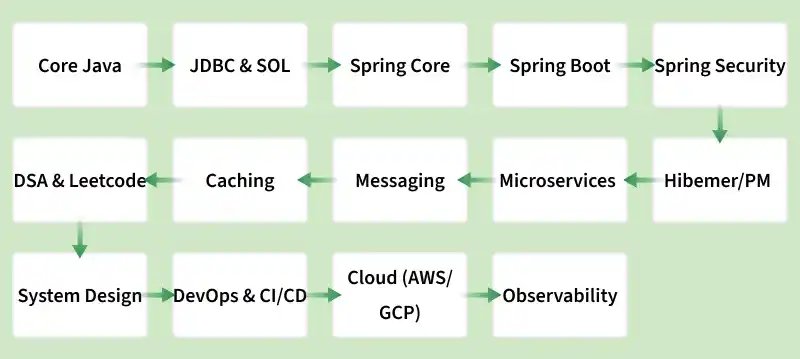
Below is a step-by-step roadmap that outlines the essential skills and technologies required to become a proficient Java Developer.
- Core Fundamentals: Learn Core Java concepts and practice DSA to build a strong programming foundation.
- Database & Backend Basics: Understand JDBC and SQL to connect Java applications with databases.
- Spring Ecosystem: Learn Spring Core, Spring Boot, and Spring Security for backend development.
- Intermediate Backend Skills: Explore caching and messaging systems for better performance and scalability.
- Microservices Architecture: Build scalable applications using microservices architecture with Spring Boot.
- System Design: Learn LLD and HLD concepts to design efficient and scalable systems.
- DevOps & CI/CD: Use tools like Git, Docker, and Jenkins for automation and deployment.
- Cloud Platforms: Deploy and manage applications using cloud services like AWS, GCP, or Azure.
- Observability & Monitoring: Implement logging, monitoring, and performance tracking using tools like Grafana and ELK.
Importance of the Profile
Java developers are in high demand across industries such as finance, healthcare, retail, and technology due to Java’s reliability and scalability. Its strong security, integration capabilities, and ability to handle large-scale data make it essential for modern enterprise applications.
- High demand across multiple industries
- Strong security and easy system integration
- Efficient handling of large-scale applications and data
Experience-wise Salary
Java developer salaries can vary based on experience, location, and the size of the company:
Experience Level | India (INR/Year) | United States (USD/Year) | United Kingdom (GBP/Year) |
|---|---|---|---|
Entry-Level (0-2 years) | ₹3,00,000 - ₹5,00,000 | $60,000 - $75,000 | £30,000 - £40,000 |
Mid-Level (3-5 years) | ₹6,00,000 - ₹10,00,000 | $80,000 - $100,000 | £45,000 - £60,000 |
Senior-Level (5-9 years) | ₹10,00,000 - ₹15,00,000 | $105,000 - $130,000 | £65,000 - £80,000 |
Expert-Level (10+ years) | ₹15,00,000 - ₹25,00,000 | $135,000 - $160,000 | £85,000 - £100,000 |
Opportunities for Java Developers
Java development offers various career opportunities across industries.
- Full-Stack Java Developer: Working on both front-end and back-end development using Java and web technologies.
- Android App Developer: Java is widely used in Android application development.
- Java Architect: Designing and overseeing the implementation of Java-based solutions in large organizations.
- Big Data Developer: Java is commonly used in big data technologies like Apache Hadoop.
- Cloud Developer: Many cloud platforms support Java, making it ideal for cloud computing applications.