
Active and Passive voice is a particularly essential grammatical structure used in the English language. Understanding the rules governing their usage is crucial for effective communication. In this article, we will delve into the fundamentals of the active and passive voice. we will also explore the usage, rules, and conversion of Active and Passive voices. The English Language is utterly essential for all competitive exams, and you must understand the significance of the Voice section if you are preparing for one.
Table of Content
Voice of a verb
The voice of a verb is the form of the verb that indicates whether the subject of the sentence is performing the action or the subject is receiving the action. In the English Language, verbs can be classified into two types of voices - Active voice and Passive voice.
There are Two Basic Kinds of Voice in English Grammar:
- Active Voice
- Passive Voice
What is Active Voice?
- When the subject of the sentence performs the action expressed by the verb then it is Active Voice.
- For Example: "Nisha ate the apple". Here "Nisha" is the subject performing the action"ate".
What is Passive Voice?
- When the subject of the sentence receives the action expressed by the verb or is acted upon then it is Passive Voice.
- For Example: "The apple was eaten by Nisha." Here, " The apple" is the subject receiving the action "was eaten".
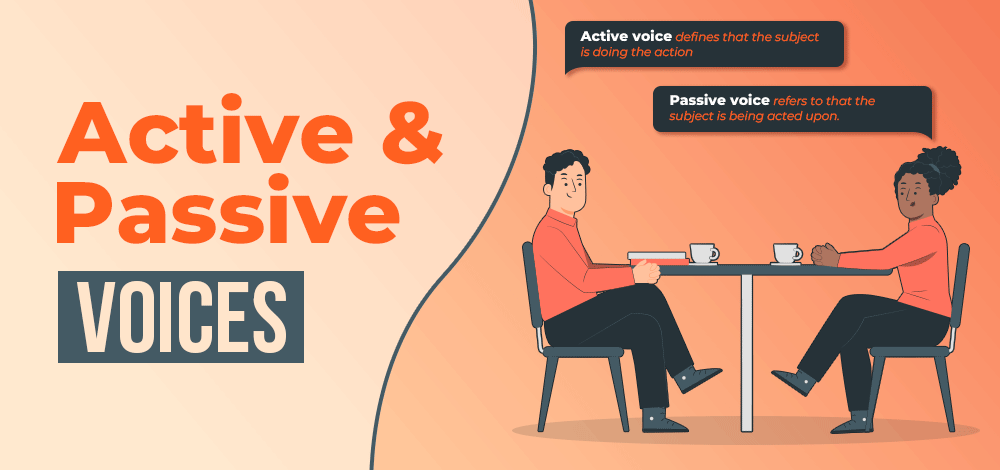
"Active voice defines that the subject is doing the action and the passive voice refers to that the subject is being acted upon."
Active and Passive Voice Rules Chart
| Tense | Active voice | Passive voice |
|---|---|---|
| Present Indefinite | Does/Do | Is/Are/Am |
| Present Continuous | Is/Am/Are | Is/Am/Are + Being |
| Present Perfect | Has / Have | Has been / Have been |
| Present Perfect Continuous | Has / Have been | Has / Have been + Being |
| Past Indefinite | Did | Was / Were |
| Past Continuous | was/were | was/ were + being |
| Past Perfect | had | had been |
| Past Perfect Continuous | had been | had been + being |
| Future Indefinite | Will | Will be |
| Future Continuous | Will be | Will be + Being |
| Future Perfect | Will have | Will have been |
| Future Perfect Continuous | Will have been | Will have been + being |
Active And Passive Voice Rules For Conversion :
- The object of the active verb becomes the subject of the passive verb.
- The active sentence's subject becomes the object of the passive sentence (or is dropped). The finite form of the verb is changed to past participle or V3 form.
- The preposition "by" is used before the passive object.
Active and Passive Voice Rules For All Tenses:
1. Simple Present/ Past/ Future Tense
- Active: Subject + V1/ V2/ will V1/ shall V1 + object…
- Passive: Object + Is/are/am/was/were/will be/shall be + verb (III forms) + by + subject…
2. Present/ Past Continuous Tense
- Active: Subject + Is/are/am/was/were + verb (ing) + object…
- Passive: Object + Is/are/am/was/were + being + verb (III from) + by + subject...
3. Present/ Past/ Future Perfect Tense
- Active: Subject + has/have/had/shall have/will have + verb (IIIrd form) + object...
- Passive: Object + has/have/had/shall have/will have + been + verb (IIIrd form) + by + subject...
NOTE: Generally, there is no voice change with Present Perfect Continuous, Past Perfect Continuous, Future Continuous, or Future Perfect Continuous.
4. Interrogative Sentences
Present and Past Tense:
- Structure 1:
Active: Do/does/did + subject + V1 + object....?
Passive: Is/are/am/was/were + object + V3 + by + subject....? - Structure 2:
Active: Is/are/a/was/were + subject + verb (ing) + object…?
Passive: Is/are/am/was/were + object + being + verb (III from) + by + subject…? - Structure 3:
Active: Has/have/had + subject + verb (IIIrd form) + object...
Passive: Has/have/had + object + been + verb (IIIrd form) + by + subject... - Structure 4:
Active: Who + verb (s or es)/verb (IInd form) + object...?
Passive: By whom + is/are/am/was/were + object + verb (IIIrd form)? - Structure 5:
Active: Wh-question word + do/does/did + subject + verb (I form) + object…?
Passive: Wh-question word + Is/are/am/was/were + object + verb (III from) + by + subject…?
Future Tense:
- Structure 1:
Active: Shall/ will + subject + verb (Ist form) + object....?
Passive: Is/are/am Shall/ will + object + be + verb (IIIrd form) + by + subject....? - Structure 2:
Active: Shall/ will + subject + have + verb (IIIrd form) + object...
Passive: Shall/ will + object + have + been + verb (IIIrd form) + by + subject... - Structure 3:
Active: Who + Shall/ will + V1 + object...?
Passive: By whom + Shall/ will + object + be + verb (IIIrd form)? - Structure 4:
Active: Wh-question word + Shall/ will + subject + verb (Ist form) + object…?
Passive: Wh-question word + Shall/ will + object + be + verb (IIIrd from) + by + subject…?
5. Imperative Sentences
- Positive
- Active: Verb + object
Passive: (i) Let + object + be + past participle
(ii) You are requested/ordered/suggested + to + verb (Ist form) + object - Negative
- Active: Do + not + Verb + Object
Passive: (i) Let + object + not + be + past participle
(ii) You are requested/ordered/suggested + not + to + verb (Ist form) + object
6. “To be” Sentences
- Active: Subject + Is/Are/Am/Was/Were/Has/Have/Had + To + Verb (Ist form) + Object..
- Passive: Object + Is/Are/Am/Was/Were/Has/Have/Had + To + Be + Verb (III form) + By + Subject.
7. Verb + Preposition + Object
- Active: Subject + verb + preposition + object...
- Passive: Object + to be + verb (III form) + preposition + by + subject...
NOTE: While converting such sentences into passive voices, the verb is always followed by the particular preposition.
8. Modal Verbs
- Active: Subject + modal verb + (V1) + object...
- Passive: Object + modal verb + be + V3 + by + subject...
9. Di-Transitive Verbs
- Some verbs take two objects, for example:
- Active: Samdish gave the beggar an old t-shirt.
Passive: (i) An old t-shirt was given to the beggar by Samdish.
(ii) The beggar was given an old t-shirt by Samdish.
10. Sentences with the Intransitive Verb:
Such sentences are known as Mid-voice or Quasi-Passive voice. They seem in active voice, but their meaning is in passive voice, and they have intransitive verbs, like without a direct object.
- Active: Honey tastes sweet.
- Passive: Honey is sweet when it is tasted.
TENSE | Active Voice | Passive Voice |
|---|---|---|
I write a letter. | A letter is written by me. | |
I am writing a letter. | A letter is being written by me. | |
I have written a letter. | A letter has been written by me. | |
I have been writing a letter. | A letter has been being written by me. | |
I wrote a letter. | A letter was written by me. | |
I was writing a letter. | A letter was being written by me. | |
I had written a letter. | A letter had been written by me. | |
I had been writing a letter. | A letter had been being written by me. | |
I will write a letter. | A letter will be written by me. | |
I will be writing a letter. | A letter will be being written by me. | |
I will have written a letter. | A letter will have been written by me. | |
I will have been writing a letter. | A letter will have been being written by me. |