
Communication is a process of building a connection or link between one point to another point for exchanging information. Different communication equipment including transmitter, receiver and communication channel assembled that form a communication system. It ensures that data such as voice, video and text is delivered efficiently, accurately and securely. The information being transmitted can be in either analog or digital form, depending on the type of communication system used.
Examples of the communication system are line telephony and line telegraphy, radio telephony and radiotelegraphy, radio broadcasting, point-to-point communication, mobile communication, computer communication, radar communication, television broadcasting, radio telemetry, radio aids to navigation and aircraft landing, etc.
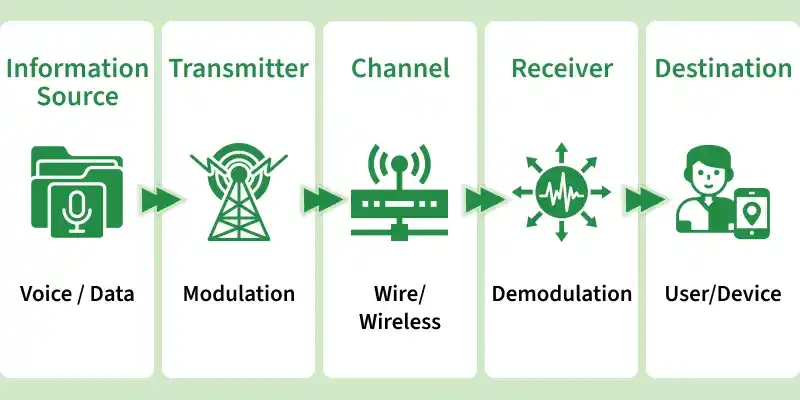
Block Diagram
Represents the basic structure of a communication system, showing how information is transmitted from the source to the destination through components like transmitter, channel, and receiver, while noise may affect the signal during transmission.
Basic Elements
- Information Source: Generates the message (voice, text, video).
- Transmitter: Changes the message into a signal that can be sent through the communication channel (Modulation).
- Channel: Medium through which the signal travels (wire, air, optical fiber).
- Noise: Unwanted disturbance that affects the signal during transmission.
- Receiver: Recovers the original message from the received signal (demodulation).
- Destination: Final user or device that receives the message.
Working
- The information source generates the message.
- The transmitter converts it into a signal.
- The signal travels through the channel.
- Noise may affect the signal during transmission.
- The receiver processes the signal and retrieves the message.
- The destination receives the final output.
Analog and Digital Communication
Describe the two main ways in which information is transmitted in a communication system.
Analog Communication
- Uses continuous signals
- More affected by noise
- Example: Radio broadcasting
Digital Communication
- Uses discrete signals (0s and 1s)
- Less affected by noise
- Example: Internet communication
Modes of Communication
Broadcasting: It involves the use of one powerful transmitter and many receivers that are relatively less expensive to build. Information-carrying signals flow only in one direction.
Example - Radio broadcasting (FM/AM radio), television broadcasting, and live satellite TV transmission.
Point-to-point communication: Communication process that takes place over a link between a single transmitter and a receiver can be referred to as "point-to-point communication". Usually a bidirectional flow of information-carrying signals, which requires the use of transmitter and receiver at each end of the link.
Example - Telephone calls, mobile communication, video conferencing, and direct computer-to-computer communication.
Need of Communication System
- To transmit information over short and long distances
- To enable fast and reliable communication
- To support real-time communication (calls, video conferencing)
- To connect devices and networks (internet, mobile systems)
- To improve efficiency and reduce manual effort
- To support modern technologies like satellite and wireless communication
Real-World Scenarios
- Making a phone call to talk to someone in another city
- Sending messages or chatting through mobile apps (WhatsApp, SMS)
- Watching live TV or listening to radio broadcasts
- Attending online classes or video meetings (Zoom, Google Meet)
- Using GPS for navigation and location tracking
- Browsing the internet and sending emails
- Communication in airplanes, ships, and military systems