
Table of Content
Red Black Tree:
A Red-Black tree is a balanced binary search tree where each node has an extra bit for denoting the color of the node, either Red or Black.
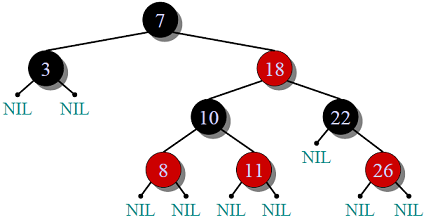
Properties:
- Color Property: Every node is either red or black.
- Root Property: The root is always black.
- Red Property: If a node is red, then both its children are black (no two reds in a row).
- Black Property: Every path from a node to any of its descendant NULL nodes has the same number of black nodes.
- Balance: The tree is "loosely" balanced. The longest path is no more than twice the length of the shortest path.
AVL(Adelson-Velskii and Landis) Tree
The AVL tree (named after inventors Adelson-Velskii and Landis) is a strictly balanced binary search tree.
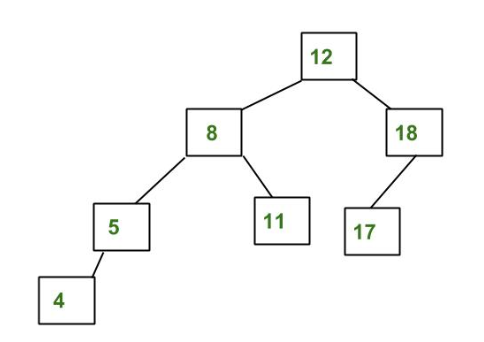
Properties:
- Balance Factor: For every node, the difference between the height of the left subtree and the right subtree (Balance Factor) must be -1, 0, or 1.
- Strict Balance: If at any time the heights differ by more than 1, rebalancing (rotations) is performed.
- Height: The height of an AVL tree is always O(log n), and it is generally flatter than a Red-Black tree.
Comparison Table: Red-Black Tree vs AVL Tree
| Basis of Comparison | Red-Black Tree | AVL Tree |
| Balancing | Relaxed balancing. No path is more than twice as long as any other. | Strict balancing. Height difference between subtrees <= 1. |
| Search (Lookups) | Slower than AVL because the tree can be taller. | Faster than Red-Black because the tree is more compact. |
| Insertion/Deletion | Faster. Requires fewer rotations to maintain balance. | Slower. Requires more frequent and complex rotations. |
| Storage | Lower overhead. Needs only 1 bit per node for color. | Higher overhead. Needs to store the height/balance factor (integer) per node. |
| Rotations | Max 2 rotations for insertion; Max 3 for deletion. | Can require up to O(log n) rotations in the worst case. |
Application
- Use AVL Trees when your application involves frequent lookups and infrequent insertions or deletions.
- Example: Database indexing, dictionary lookups.
- Use Red-Black Trees when your application involves frequent insertions and deletions along with lookups.
- Example: Language libraries like C++ STL (
map,set) and Java (TreeMap), or the Linux kernel's process scheduler.
- Example: Language libraries like C++ STL (
Summary
- AVL trees are more rigidly balanced, making them better for Search-intensive tasks.
- Red-Black trees are more flexible, making them better for General-purpose use cases where data changes frequently.