
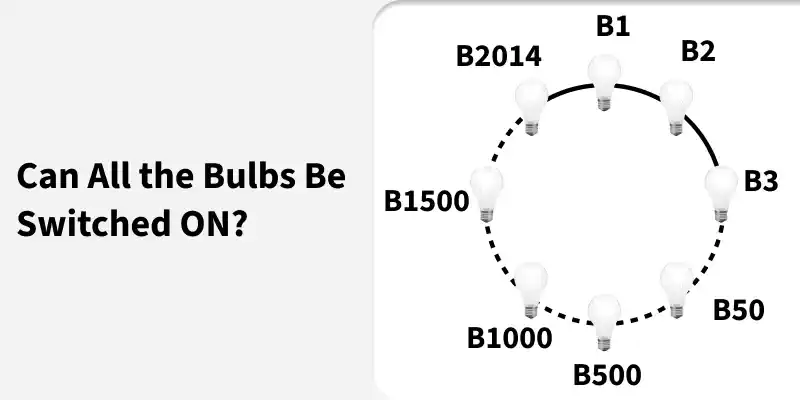
Consider a circle with 2014 light bulbs, and only 2 of them are on, and the rest are off. Anyone can choose any of the bulbs and change the state of the neighboring bulbs. The task is to switch all the 2014 light bulbs on.
Check if you were right - full answer with solution below.
Solution: Yes, it is possible to get all the light bulbs ON.
Step 1: Labeling the bulbs
Label the 2014 light bulbs as
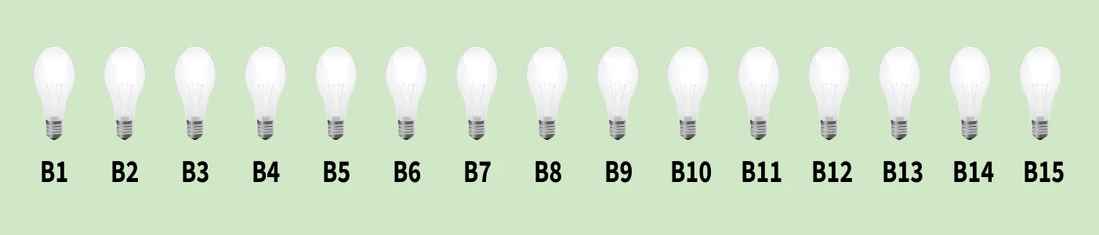
B1, B2, B3, …, B2014 arranged in a circle, so that:
- B1 and B2014 are adjacent bulbs.
Step 2: Possible initial positions of ON bulbs
The problem does not mention the positions of the two ON bulbs.
Therefore, we consider all possible arrangements using binary notation, where:
- 1 represents an ON bulb
- 0 represents an OFF bulb
Case 1: 1100 (or 0011)
- The two ON bulbs are adjacent.
- This creates the longest continuous block of OFF bulbs.
- Because the bulbs are circular,
1100and0011represent the same arrangement.
Case 2: 1001
- The two ON bulbs are separated by OFF bulbs on both sides.
- In one move, only the two neighboring bulbs of a chosen bulb change state.
- No move can make two separated ON bulbs become adjacent.
- Therefore, the required continuous ON segment can never be formed.
- This case is not solvable.
Case 3: 1010 (or 0101)
- The ON bulbs are alternating with OFF bulbs.
- Although each OFF bulb is next to an ON bulb, any move only shifts the ON bulbs.
- No operation can turn two neighboring OFF bulbs ON at the same time.
- Hence, adjacency between ON bulbs is never created.
- This case is also not solvable.
Step 3: Strategy to switch ON all bulbs
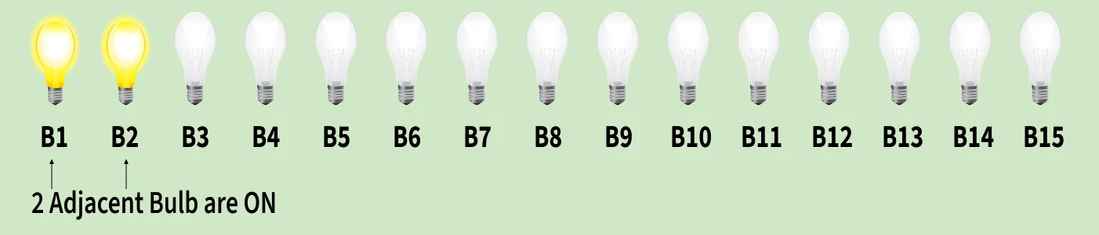
- After identifying that only configurations with two adjacent ON bulbs are solvable, we start with a pair of neighboring bulbs already ON.
- The remaining 2012 bulbs, which are all OFF, form one continuous block around the circle.
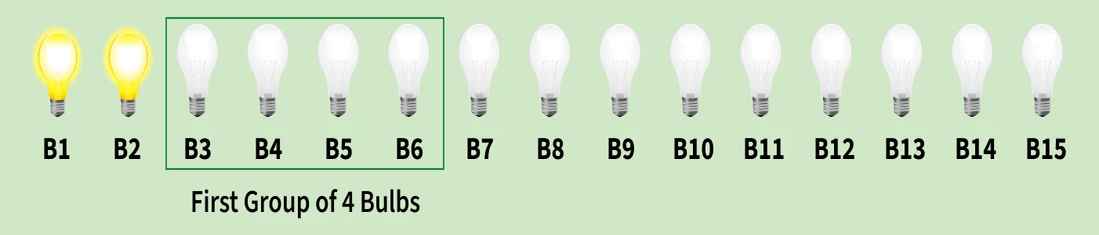
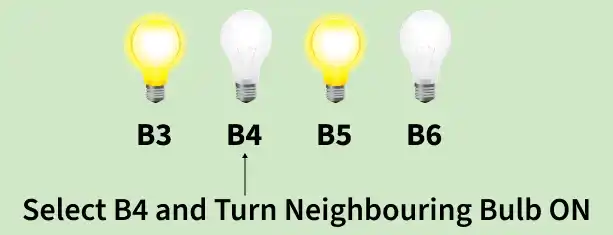
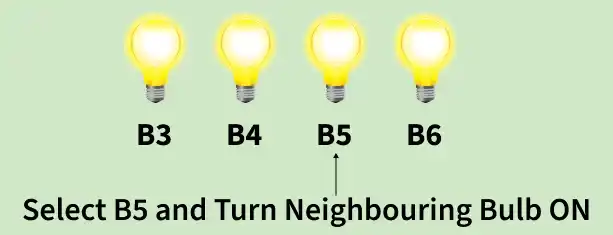
First group: B3,B4,B5,B6
- Select the second bulb of the group, B4: This changes the state of its neighboring bulbs B3 and B5 from OFF to ON.
- Next, select the third bulb of the group, B5: This changes the state of its neighboring bulbs B4 and B6 from OFF to ON.
As a result, all four bulbs in the group become ON.
Step 4: Repeating the process
- The same procedure is repeated for each group of 4 bulbs.
- Since, 2012÷4 = 503 so, there are 503 such groups.
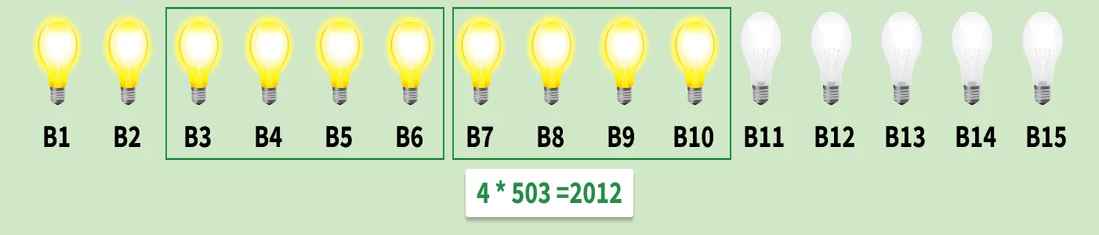
After completing this process for all groups, all 2014 bulbs are ON.
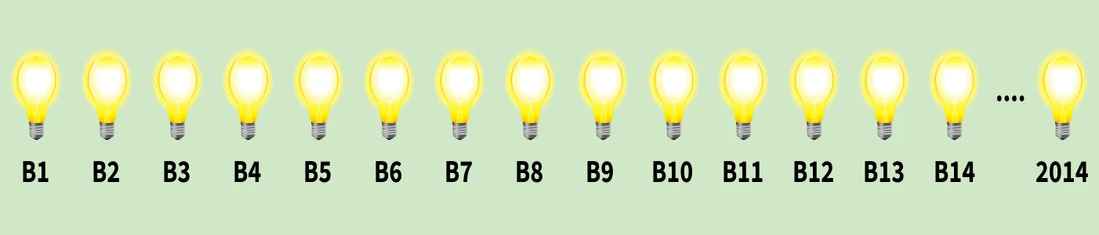
If the two initially ON bulbs are not adjacent, then it is not possible to switch ON all the bulbs.