
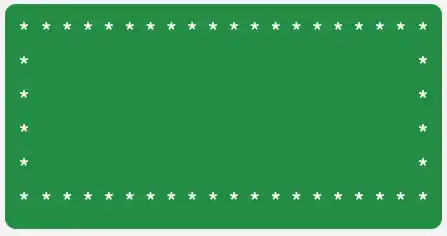
Given two integers n and m, print a hollow rectangle star pattern of the given n rows and m columns. In this pattern, stars (*) are printed on the boundary of the rectangle, while the inner area contains spaces.
Example:
Input: n = 6, m = 20
Output:Hollow Rectangle
Try It Yourself
Using Nested Loops – O(n*m) Time and O(1) Space
The pattern can be printed using two nested loops. The outer loop iterates through the rows, and the inner loop iterates through the columns. A star (*) is printed when the current position is on the first row, last row, first column, or last column; otherwise, a space is printed.
#include <iostream>
using namespace std;

void printHollowRect(int n, int m)
{
    int i, j;
    for (i = 1; i <= n; i++)
    {
        for (j = 1; j <= m; j++)
        {
            if (i == 1 || i == n ||
                j == 1 || j == m)
                cout << "*";
            else
                cout << " ";
        }
        cout << endl;
    }
}

int main() {
    int n = 6, m = 20;
    printHollowRect(n, m);
    return 0;
}
#include <stdio.h>

void printHollowRect(int n, int m)
{
    int i, j;
    for (i = 1; i <= n; i++)
    {
        for (j = 1; j <= m; j++)
        {
            if (i == 1 || i == n ||
                j == 1 || j == m)
                printf("*");
            else
                printf(" ");
        }
        printf("\n");
    }
}

int main() {
    int n = 6, m = 20;
    printHollowRect(n, m);
    return 0;
}
class GFG {
    public static void printHollowRect(int n, int m) {
        int i, j;
        for (i = 1; i <= n; i++) {
            for (j = 1; j <= m; j++) {
                if (i == 1 || i == n || j == 1 || j == m)
                    System.out.print("*");
                else
                    System.out.print(" ");
            }
            System.out.println();
        }
    }

    public static void main(String[] args) {
        int n = 6, m = 20;
        printHollowRect(n, m);
    }
}
def printHollowRect(n, m):
    i = 1
    while i <= n:
        j = 1
        while j <= m:
            if i == 1 or i == n or j == 1 or j == m:
                print("*", end="")
            else:
                print(" ", end="")
            j += 1
        print()
        i += 1

if __name__ == '__main__':
    n = 6
    m = 20
    printHollowRect(n, m)
using System;

class GFG {
    static void printHollowRect(int n, int m) {
        int i, j;
        for (i = 1; i <= n; i++)
        {
            for (j = 1; j <= m; j++)
            {
                if (i == 1 || i == n || j == 1 || j == m)
                    Console.Write("*");
                else
                    Console.Write(" ");
            }
            Console.WriteLine();
        }
    }

    public static void Main()
    {
        int n = 6, m = 20;
        printHollowRect(n, m);
    }
}
function printHollowRect(n, m) {
    let i, j;
    for (i = 1; i <= n; i++) {
        let line = "";
        for (j = 1; j <= m; j++) {
            if (i == 1 || i == n || j == 1 || j == m)
                line += "*";
            else
                line += " ";
        }
        console.log(line);
    }
}

// Driver code
const n = 6, m = 20;
printHollowRect(n, m);