
Given a 2d array mat[][] of order n * n, and an integer k. Your task is to find a submatrix of order k * k, such that sum of all the elements in the submatrix is maximum possible.
Note: Matrix mat[][] contains zero, positive and negative integers.
Examples:
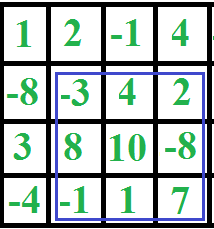
Input: k = 3
mat[][] = [ [ 1, 2, -1, 4 ]
[ -8, -3, 4, 2 ]
[ 3, 8, 10, -8 ]
[ -4, -1, 1, 7 ] ]
Output: 20
Explanation: The submatrix enclosed in blue boundary is the maximum sum submatrix of order 3 * 3.Input: k = 3
mat[][] = [ [ 1, 1, 1, 1, 1 ]
[ 2, 2, 2, 2, 2 ]
[ 3, 8, 6, 7, 3 ]
[ 4, 4, 4, 4, 4 ]
[ 5, 5, 5, 5, 5 ] ]
Output: 48
Explanation: The following submatrix of order k * k has sum 48, which is maximum possible:
[ [ 8, 6, 7 ]
[ 4, 4, 4 ]
[ 5, 5, 5 ] ]Input: k = 1
mat[][] = [ [ 4 ] ]
Output: 4
Explanation: The given matrix contains only a single element, thus the max possible sum is 4.

This problem is mainly an extension of Maximum Sum of a Subarray of Size k
[Naive Approach] - Generating All Submatrices - O(n ^ 2 * k ^ 2) Time and O(1) Space
The idea is to generate all possible submatrices of order k * k, and find sum of its elements. The maximum obtained sum is the answer.
We run two nested loops, where the outer loop runs from 0 to n - k, and marks the row, while the inner row runs from 0 to n - k and marks the current column. For each iteration of the inner loop, again run two nested loops, where the outer loop runs from i to i + k - 1, and inner loop runs from j to j + k - 1. For each iteration of innermost loop add the cell value to the sum. At last store the max of obtained sum and current answer.
#include <bits/stdc++.h>
using namespace std;

// Function to find the submatrix of
// order k * k with maximum sum of elements
int maximumSum(vector<vector<int>> &mat, int k) {
    int n = mat.size();

    // to store the answer
    int ans = INT_MIN;

    // generate all possible submatrix
    // of order k * k
    for(int i = 0; i <= n - k; i++) {
        for(int j = 0; j <= n - k; j++) {

            // compute sum of submatrix
            // of order k * k
            int sum = 0;
            for(int p = i; p < i + k; p++) {
                for(int q = j; q < j + k; q++) {
                    sum += mat[p][q];
                }
            }

            // update the maximum sum
            ans = max(ans, sum);
        }
    }
    return ans;
}

int main() {
    vector<vector<int>> mat = {
    { 1, 2, -1, 4 },
    { -8, -3, 4, 2 },
    { 3, 8, 10, -8 },
    { -4, -1, 1, 7 } };
    int k = 3;
    cout << maximumSum(mat, k);
    return 0;
}
// Function to find the submatrix of
// order k * k with maximum sum of elements
import java.util.*;

class GfG {

    // Function to find the submatrix of
    // order k * k with maximum sum of elements
    static int maximumSum(int[][] mat, int k) {
        int n = mat.length;

        // to store the answer
        int ans = Integer.MIN_VALUE;

        // generate all possible submatrix
        // of order k * k
        for (int i = 0; i <= n - k; i++) {
            for (int j = 0; j <= n - k; j++) {

                // compute sum of submatrix
                // of order k * k
                int sum = 0;
                for (int p = i; p < i + k; p++) {
                    for (int q = j; q < j + k; q++) {
                        sum += mat[p][q];
                    }
                }

                // update the maximum sum
                ans = Math.max(ans, sum);
            }
        }
        return ans;
    }

    public static void main(String[] args) {
        int[][] mat = {
            { 1, 2, -1, 4 },
            { -8, -3, 4, 2 },
            { 3, 8, 10, -8 },
            { -4, -1, 1, 7 }
        };
        int k = 3;
        System.out.println(maximumSum(mat, k));
    }
}
# Function to find the submatrix of
# order k * k with maximum sum of elements.
def maximumSum(mat, k):
    n = len(mat)

    # to store the answer
    ans = -float('inf')

    # generate all possible submatrix
    # of order k * k
    for i in range(0, len(mat) - k + 1):
        for j in range(0, len(mat) - k + 1):

            # compute sum of submatrix
            # of order k * k
            sum_val = 0
            for p in range(i, i + k):
                for q in range(j, j + k):
                    sum_val += mat[p][q]

            # update the maximum sum
            ans = max(ans, sum_val)
    return ans

if __name__ == "__main__":
    mat = [
        [ 1, 2, -1, 4 ],
        [ -8, -3, 4, 2 ],
        [ 3, 8, 10, -8 ],
        [ -4, -1, 1, 7 ]
    ]
    k = 3
    print(maximumSum(mat, k))
// Function to find the submatrix of
// order k * k with maximum sum of elements
using System;
using System.Collections.Generic;

class GfG {

    // Function to find the submatrix of
    // order k * k with maximum sum of elements
    static int maximumSum(List<List<int>> mat, int k) {
        int n = mat.Count;

        // to store the answer
        int ans = int.MinValue;

        // generate all possible submatrix
        // of order k * k
        for (int i = 0; i <= n - k; i++) {
            for (int j = 0; j <= n - k; j++) {

                // compute sum of submatrix
                // of order k * k
                int sum = 0;
                for (int p = i; p < i + k; p++) {
                    for (int q = j; q < j + k; q++) {
                        sum += mat[p][q];
                    }
                }

                // update the maximum sum
                ans = Math.Max(ans, sum);
            }
        }
        return ans;
    }

    static void Main() {
        List<List<int>> mat = new List<List<int>> {
            new List<int> { 1, 2, -1, 4 },
            new List<int> { -8, -3, 4, 2 },
            new List<int> { 3, 8, 10, -8 },
            new List<int> { -4, -1, 1, 7 }
        };
        int k = 3;
        Console.WriteLine(maximumSum(mat, k));
    }
}
// Function to find the submatrix of
// order k * k with maximum sum of elements.
function maximumSum(mat, k) {
    let n = mat.length;

    // to store the answer
    let ans = -Infinity;

    // generate all possible submatrix
    // of order k * k
    for (let i = 0; i <= n - k; i++) {
        for (let j = 0; j <= n - k; j++) {

            // compute sum of submatrix
            // of order k * k
            let sum = 0;
            for (let p = i; p < i + k; p++) {
                for (let q = j; q < j + k; q++) {
                    sum += mat[p][q];
                }
            }

            // update the maximum sum
            ans = Math.max(ans, sum);
        }
    }
    return ans;
}

let mat = [
    [ 1, 2, -1, 4 ],
    [ -8, -3, 4, 2 ],
    [ 3, 8, 10, -8 ],
    [ -4, -1, 1, 7 ]
];
let k = 3;
console.log(maximumSum(mat, k));
Output
20
[Expected Approach] - By Calculating Strips Sum - O(n ^ 2) Time and O(n ^ 2) Space
The idea is to preprocess the given square matrix. In the pre-processing step, calculate sum of all vertical strips of size k x 1 in a temporary square matrix stripSum[][]. Once we have sum of all vertical strips, we can calculate sum of first sub-square in a row as sum of first k strips in that row, and for remaining sub-squares, we can calculate sum in constant time by removing the leftmost strip of previous sub-square and adding the rightmost strip of new square.
#include <bits/stdc++.h>
using namespace std;

// Function to find the submatrix of
// order k * k with maximum sum of elements
int maximumSum(vector<vector<int>> &mat, int k) {
    int n = mat.size();

    // create 2d array to store strips sum
    vector<vector<int>> stripSum(n, vector<int>(n, 0));

    // calculate the sum column by column
    for(int j = 0; j < n; j++) {
        int sum = 0;

        // calculate sum of first k * 1 strip
        for(int i = 0; i < k; i++) {
            sum += mat[i][j];
        }
        stripSum[0][j] = sum;

        // calculate sum of remaining strips
        for(int i = 1; i <= n - k; i++) {
            sum += mat[i + k - 1][j] - mat[i - 1][j];
            stripSum[i][j] = sum;
        }
    }

    // to store the answer
    int ans = INT_MIN;

    // calculate the sum of k * k
    // submatrix using the sum of strips
    for(int i = 0; i <= n - k; i++) {
        int sum = 0;

        // calculate sum of first k strips
        for(int j = 0; j < k; j++) {
            sum += stripSum[i][j];
        }

        // update the maximum sum
        ans = max(ans, sum);

        // calculate sum of remaining strips
        for(int j = 1; j <= n - k; j++) {
            sum += stripSum[i][j + k - 1] - stripSum[i][j - 1];
            ans = max(ans, sum);
        }
    }

    return ans;
}

int main() {
    vector<vector<int>> mat = {
    { 1, 2, -1, 4 },
    { -8, -3, 4, 2 },
    { 3, 8, 10, -8 },
    { -4, -1, 1, 7 } };
    int k = 3;
    cout << maximumSum(mat, k);
    return 0;
}
// Function to find the submatrix of
// order k * k with maximum sum of elements
import java.util.*;

class GfG {

    // Function to find the submatrix of
    // order k * k with maximum sum of elements
    static int maximumSum(int[][] mat, int k) {
        int n = mat.length;

        // create 2d array to store strips sum
        int[][] stripSum = new int[n][n];

        // calculate the sum column by column
        for (int j = 0; j < n; j++) {
            int sum = 0;

            // calculate sum of first k * 1 strip
            for (int i = 0; i < k; i++) {
                sum += mat[i][j];
            }
            stripSum[0][j] = sum;

            // calculate sum of remaining strips
            for (int i = 1; i <= n - k; i++) {
                sum += mat[i + k - 1][j] - mat[i - 1][j];
                stripSum[i][j] = sum;
            }
        }

        // to store the answer
        int ans = Integer.MIN_VALUE;

        // calculate the sum of k * k
        // submatrix using the sum of strips
        for (int i = 0; i <= n - k; i++) {
            int sum = 0;

            // calculate sum of first k strips
            for (int j = 0; j < k; j++) {
                sum += stripSum[i][j];
            }

            // update the maximum sum
            ans = Math.max(ans, sum);

            // calculate sum of remaining strips
            for (int j = 1; j <= n - k; j++) {
                sum += stripSum[i][j + k - 1] - stripSum[i][j - 1];
                ans = Math.max(ans, sum);
            }
        }

        return ans;
    }

    public static void main(String[] args) {
        int[][] mat = {
            { 1, 2, -1, 4 },
            { -8, -3, 4, 2 },
            { 3, 8, 10, -8 },
            { -4, -1, 1, 7 }
        };
        int k = 3;
        System.out.println(maximumSum(mat, k));
    }
}
# Function to find the submatrix of
# order k * k with maximum sum of elements.
def maximumSum(mat, k):
    n = len(mat)

    # create 2d array to store strips sum
    stripSum = [[0 for _ in range(n)] for _ in range(n)]

    # calculate the sum column by column
    for j in range(n):
        sum_val = 0

        # calculate sum of first k * 1 strip
        for i in range(k):
            sum_val += mat[i][j]
        stripSum[0][j] = sum_val

        # calculate sum of remaining strips
        for i in range(1, n - k + 1):
            sum_val += mat[i + k - 1][j] - mat[i - 1][j]
            stripSum[i][j] = sum_val

    # to store the answer
    ans = -float('inf')

    # calculate the sum of k * k
    # submatrix using the sum of strips
    for i in range(0, n - k + 1):
        sum_val = 0

        # calculate sum of first k strips
        for j in range(k):
            sum_val += stripSum[i][j]
        ans = max(ans, sum_val)

        # calculate sum of remaining strips
        for j in range(1, n - k + 1):
            sum_val += stripSum[i][j + k - 1] - stripSum[i][j - 1]
            ans = max(ans, sum_val)

    return ans

if __name__ == "__main__":
    mat = [
        [ 1, 2, -1, 4 ],
        [ -8, -3, 4, 2 ],
        [ 3, 8, 10, -8 ],
        [ -4, -1, 1, 7 ]
    ]
    k = 3
    print(maximumSum(mat, k))
// Function to find the submatrix of
// order k * k with maximum sum of elements
using System;
using System.Collections.Generic;

class GfG {

    // Function to find the submatrix of
    // order k * k with maximum sum of elements
    static int maximumSum(List<List<int>> mat, int k) {
        int n = mat.Count;

        // create 2d array to store strips sum
        List<List<int>> stripSum = new List<List<int>>();
        for (int i = 0; i < n; i++) {
            List<int> row = new List<int>();
            for (int j = 0; j < n; j++) {
                row.Add(0);
            }
            stripSum.Add(row);
        }

        // calculate the sum column by column
        for (int j = 0; j < n; j++) {
            int sum = 0;

            // calculate sum of first k * 1 strip
            for (int i = 0; i < k; i++) {
                sum += mat[i][j];
            }
            stripSum[0][j] = sum;

            // calculate sum of remaining strips
            for (int i = 1; i <= n - k; i++) {
                sum += mat[i + k - 1][j] - mat[i - 1][j];
                stripSum[i][j] = sum;
            }
        }

        // to store the answer
        int ans = int.MinValue;

        // calculate the sum of k * k
        // submatrix using the sum of strips
        for (int i = 0; i <= n - k; i++) {
            int sum = 0;

            // calculate sum of first k strips
            for (int j = 0; j < k; j++) {
                sum += stripSum[i][j];
            }
            ans = Math.Max(ans, sum);

            // calculate sum of remaining strips
            for (int j = 1; j <= n - k; j++) {
                sum += stripSum[i][j + k - 1] - stripSum[i][j - 1];
                ans = Math.Max(ans, sum);
            }
        }

        return ans;
    }

    static void Main() {
        List<List<int>> mat = new List<List<int>> {
            new List<int> { 1, 2, -1, 4 },
            new List<int> { -8, -3, 4, 2 },
            new List<int> { 3, 8, 10, -8 },
            new List<int> { -4, -1, 1, 7 }
        };
        int k = 3;
        Console.WriteLine(maximumSum(mat, k));
    }
}
// Function to find the submatrix of
// order k * k with maximum sum of elements.
function maximumSum(mat, k) {
    let n = mat.length;

    // create 2d array to store strips sum
    let stripSum = new Array(n);
    for (let i = 0; i < n; i++) {
        stripSum[i] = new Array(n).fill(0);
    }

    // calculate the sum column by column
    for (let j = 0; j < n; j++) {
        let sum = 0;

        // calculate sum of first k * 1 strip
        for (let i = 0; i < k; i++) {
            sum += mat[i][j];
        }
        stripSum[0][j] = sum;

        // calculate sum of remaining strips
        for (let i = 1; i <= n - k; i++) {
            sum += mat[i + k - 1][j] - mat[i - 1][j];
            stripSum[i][j] = sum;
        }
    }

    // to store the answer
    let ans = -Infinity;

    // calculate the sum of k * k
    // submatrix using the sum of strips
    for (let i = 0; i <= n - k; i++) {
        let sum = 0;

        // calculate sum of first k strips
        for (let j = 0; j < k; j++) {
            sum += stripSum[i][j];
        }
        ans = Math.max(ans, sum);

        // calculate sum of remaining strips
        for (let j = 1; j <= n - k; j++) {
            sum += stripSum[i][j + k - 1] - stripSum[i][j - 1];
            ans = Math.max(ans, sum);
        }
    }

    return ans;
}

let mat = [
    [ 1, 2, -1, 4 ],
    [ -8, -3, 4, 2 ],
    [ 3, 8, 10, -8 ],
    [ -4, -1, 1, 7 ]
];
let k = 3;
console.log(maximumSum(mat, k));
Output
20
[Alternate Approach] - Using Dynamic Programming - O(n ^ 2) Time and O(n ^ 2) Space
The idea is to use Dynamic Programming to precompute the sum of all the sub-matrices having their top-left cell [0, 0] (Like prefix sum in 1 D array), and then use it to find the sums of submatrices of order k * k and pick the maximum possible. To do so, create a 2d array dp[][] of order n * n, where dp[i][j] stores the sum of all the elements of sub-matrix mat[0...i][0...j].
Follow the below given steps:
- Create a 2d array dp[][] of order n * n to store the sum of elements of all the submatrices
- To calculate the sum of elements of submatrix mat[0...i][0...j], i.e., dp[i][j], add dp[i-1][j], dp[i][j-1], and mat[i][j], and subtract dp[i-1][j-1], as this submatrix will get added twice while adding two other sub-matrices.
- Now, to calculate the sum of elements of sub-matrix having its right-bottom cell [i, j], subtract dp[i-k][j] and dp[i][j - k] from dp[i][j], and add dp[i - k][j - k], as this overlapping sub-matrix will get deleted twice.
- Do the same for all the cells of the matrix, and store the maximum value as the answer.
#include <bits/stdc++.h>
using namespace std;

// Function to find the submatrix of
// order k * k with maximum sum of elements
int maximumSum(vector<vector<int>> &mat, int k) {
    int n = mat.size();

    // create a 2d array to store sum
    // elements of submatrices
    vector<vector<int>> dp(n, vector<int>(n, 0));

    // calculate the sum of submatrices
    for(int i = 0; i < n; i++) {
        for(int j = 0; j < n; j++) {

            // add the current element
            dp[i][j] = mat[i][j];

            // add the submatrix ending at left
            if(j > 0) {
                dp[i][j] += dp[i][j - 1];
            }

            // add the submatrix ending at top
            if(i > 0) {
                dp[i][j] += dp[i - 1][j];
            }

            // remove the overlapping submatrix
            if(i > 0 && j > 0) {
                dp[i][j] -= dp[i - 1][j - 1];
            }
        }
    }

    // to store the answer
    int ans = INT_MIN;

    // generate all possible submatrices
    // of order k * k
    for(int i = k - 1; i < n; i++) {
        for(int j = k - 1; j < n; j++) {

            // compute sum of submatrix
            // of order k * k
            int sum = dp[i][j];

            // remove the submatrix ending at top
            if(i >= k) {
                sum -= dp[i - k][j];
            }

            // remove the submatrix ending at left
            if(j >= k) {
                sum -= dp[i][j - k];
            }

            // add the overlapping submatrix
            if(i >= k && j >= k) {
                sum += dp[i - k][j - k];
            }

            // update the maximum sum
            ans = max(ans, sum);
        }
    }

    return ans;
}

int main() {
    vector<vector<int>> mat = {
    { 1, 2, -1, 4 },
    { -8, -3, 4, 2 },
    { 3, 8, 10, -8 },
    { -4, -1, 1, 7 } };
    int k = 3;
    cout << maximumSum(mat, k);
    return 0;
}
// Function to find the submatrix of
// order k * k with maximum sum of elements
import java.util.*;

class GfG {

    // Function to find the submatrix of
    // order k * k with maximum sum of elements
    static int maximumSum(int[][] mat, int k) {
        int n = mat.length;

        // create 2d array to store sum
        // elements of submatrices
        int[][] dp = new int[n][n];

        // calculate the sum of submatrices
        for (int i = 0; i < n; i++) {
            for (int j = 0; j < n; j++) {

                // add the current element
                dp[i][j] = mat[i][j];

                // add the submatrix ending at left
                if (j > 0) {
                    dp[i][j] += dp[i][j - 1];
                }

                // add the submatrix ending at top
                if (i > 0) {
                    dp[i][j] += dp[i - 1][j];
                }

                // remove the overlapping submatrix
                if (i > 0 && j > 0) {
                    dp[i][j] -= dp[i - 1][j - 1];
                }
            }
        }

        // to store the answer
        int ans = Integer.MIN_VALUE;

        // generate all possible submatrices
        // of order k * k
        for (int i = k - 1; i < n; i++) {
            for (int j = k - 1; j < n; j++) {

                // compute sum of submatrix
                // of order k * k
                int sum = dp[i][j];

                // remove the submatrix ending at top
                if (i >= k) {
                    sum -= dp[i - k][j];
                }

                // remove the submatrix ending at left
                if (j >= k) {
                    sum -= dp[i][j - k];
                }

                // add the overlapping submatrix
                if (i >= k && j >= k) {
                    sum += dp[i - k][j - k];
                }

                // update the maximum sum
                ans = Math.max(ans, sum);
            }
        }

        return ans;
    }

    public static void main(String[] args) {
        int[][] mat = {
            { 1, 2, -1, 4 },
            { -8, -3, 4, 2 },
            { 3, 8, 10, -8 },
            { -4, -1, 1, 7 }
        };
        int k = 3;
        System.out.println(maximumSum(mat, k));
    }
}
# Function to find the submatrix of
# order k * k with maximum sum of elements.
def maximumSum(mat, k):
    n = len(mat)

    # create 2d array to store sum
    # elements of submatrices
    dp = [[0 for _ in range(n)] for _ in range(n)]

    # calculate the sum of submatrices
    for i in range(n):
        for j in range(n):
            # add the current element
            dp[i][j] = mat[i][j]

            # add the submatrix ending at left
            if j > 0:
                dp[i][j] += dp[i][j - 1]

            # add the submatrix ending at top
            if i > 0:
                dp[i][j] += dp[i - 1][j]

            # remove the overlapping submatrix
            if i > 0 and j > 0:
                dp[i][j] -= dp[i - 1][j - 1]

    # to store the answer
    ans = -float('inf')

    # generate all possible submatrices
    # of order k * k
    for i in range(k - 1, n):
        for j in range(k - 1, n):
            # compute sum of submatrix
            # of order k * k
            sum_val = dp[i][j]

            # remove the submatrix ending at top
            if i >= k:
                sum_val -= dp[i - k][j]

            # remove the submatrix ending at left
            if j >= k:
                sum_val -= dp[i][j - k]

            # add the overlapping submatrix
            if i >= k and j >= k:
                sum_val += dp[i - k][j - k]

            # update the maximum sum
            ans = max(ans, sum_val)

    return ans

if __name__ == "__main__":
    mat = [
        [ 1, 2, -1, 4 ],
        [ -8, -3, 4, 2 ],
        [ 3, 8, 10, -8 ],
        [ -4, -1, 1, 7 ]
    ]
    k = 3
    print(maximumSum(mat, k))
// Function to find the submatrix of
// order k * k with maximum sum of elements
using System;
using System.Collections.Generic;

class GfG {

    // Function to find the submatrix of
    // order k * k with maximum sum of elements
    static int maximumSum(List<List<int>> mat, int k) {
        int n = mat.Count;

        // create 2d array to store sum
        // elements of submatrices
        List<List<int>> dp = new List<List<int>>();
        for (int i = 0; i < n; i++) {
            List<int> row = new List<int>();
            for (int j = 0; j < n; j++) {
                row.Add(0);
            }
            dp.Add(row);
        }

        // calculate the sum of submatrices
        for (int i = 0; i < n; i++) {
            for (int j = 0; j < n; j++) {
                // add the current element
                dp[i][j] = mat[i][j];

                // add the submatrix ending at left
                if (j > 0) {
                    dp[i][j] += dp[i][j - 1];
                }

                // add the submatrix ending at top
                if (i > 0) {
                    dp[i][j] += dp[i - 1][j];
                }

                // remove the overlapping submatrix
                if (i > 0 && j > 0) {
                    dp[i][j] -= dp[i - 1][j - 1];
                }
            }
        }

        // to store the answer
        int ans = int.MinValue;

        // generate all possible submatrices
        // of order k * k
        for (int i = k - 1; i < n; i++) {
            for (int j = k - 1; j < n; j++) {
                // compute sum of submatrix
                // of order k * k
                int sum = dp[i][j];

                // remove the submatrix ending at top
                if (i >= k) {
                    sum -= dp[i - k][j];
                }

                // remove the submatrix ending at left
                if (j >= k) {
                    sum -= dp[i][j - k];
                }

                // add the overlapping submatrix
                if (i >= k && j >= k) {
                    sum += dp[i - k][j - k];
                }

                // update the maximum sum
                ans = Math.Max(ans, sum);
            }
        }

        return ans;
    }

    static void Main() {
        List<List<int>> mat = new List<List<int>> {
            new List<int> { 1, 2, -1, 4 },
            new List<int> { -8, -3, 4, 2 },
            new List<int> { 3, 8, 10, -8 },
            new List<int> { -4, -1, 1, 7 }
        };
        int k = 3;
        Console.WriteLine(maximumSum(mat, k));
    }
}
// Function to find the submatrix of
// order k * k with maximum sum of elements.
function maximumSum(mat, k) {
    let n = mat.length;

    // create 2d array to store sum
    // elements of submatrices
    let dp = new Array(n);
    for (let i = 0; i < n; i++) {
        dp[i] = new Array(n).fill(0);
    }

    // calculate the sum of submatrices
    for (let i = 0; i < n; i++) {
        for (let j = 0; j < n; j++) {
            // add the current element
            dp[i][j] = mat[i][j];

            // add the submatrix ending at left
            if (j > 0) {
                dp[i][j] += dp[i][j - 1];
            }

            // add the submatrix ending at top
            if (i > 0) {
                dp[i][j] += dp[i - 1][j];
            }

            // remove the overlapping submatrix
            if (i > 0 && j > 0) {
                dp[i][j] -= dp[i - 1][j - 1];
            }
        }
    }

    // to store the answer
    let ans = -Infinity;

    // generate all possible submatrices
    // of order k * k
    for (let i = k - 1; i < n; i++) {
        for (let j = k - 1; j < n; j++) {
            // compute sum of submatrix
            // of order k * k
            let sum = dp[i][j];

            // remove the submatrix ending at top
            if (i >= k) {
                sum -= dp[i - k][j];
            }

            // remove the submatrix ending at left
            if (j >= k) {
                sum -= dp[i][j - k];
            }

            // add the overlapping submatrix
            if (i >= k && j >= k) {
                sum += dp[i - k][j - k];
            }

            // update the maximum sum
            ans = Math.max(ans, sum);
        }
    }

    return ans;
}

let mat = [
    [ 1, 2, -1, 4 ],
    [ -8, -3, 4, 2 ],
    [ 3, 8, 10, -8 ],
    [ -4, -1, 1, 7 ]
];
let k = 3;
console.log(maximumSum(mat, k));
Output
20
Related Articles:
Given an n x n square matrix, find sum of all sub-squares of size k x k
Maximum sum rectangle in a 2D matrix