
The N Queen is the problem of placing N chess queens on an N×N chessboard so that no two queens attack each other.
For example, the following is a solution for 8 Queen problem.
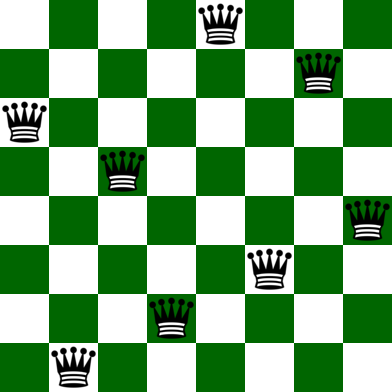
Input: N = 4
Output:
0 1 0 0
0 0 0 1
1 0 0 0
0 0 1 0
Explanation:
The Position of queens are:
1 - {1, 2}
2 - {2, 4}
3 - {3, 1}
4 - {4, 3}
As we can see that we have placed all 4 queens
in a way that no two queens are attacking each other.
So, the output is correct
Input: N = 8
Output:
0 0 0 0 0 0 1 0
0 1 0 0 0 0 0 0
0 0 0 0 0 1 0 0
0 0 1 0 0 0 0 0
1 0 0 0 0 0 0 0
0 0 0 1 0 0 0 0
0 0 0 0 0 0 0 1
0 0 0 0 1 0 0 0
Approach: The idea is to use Hill Climbing Algorithm.
- While there are algorithms like Backtracking to solve N Queen problem, let's take an AI approach in solving the problem.
- It’s obvious that AI does not guarantee a globally correct solution all the time but it has quite a good success rate of about 97% which is not bad.
- A description of the notions of all terminologies used in the problem will be given and are as follows:-
- Notion of a State - A state here in this context is any configuration of the N queens on the N X N board. Also, in order to reduce the search space let’s add an additional constraint that there can only be a single queen in a particular column. A state in the program is implemented using an array of length N, such that if state[i]=j then there is a queen at column index i and row index j.
- Notion of Neighbours - Neighbours of a state are other states with board configuration that differ from the current state’s board configuration with respect to the position of only a single queen. This queen that differs a state from its neighbour may be displaced anywhere in the same column.
- Optimisation function or Objective function - We know that local search is an optimization algorithm that searches the local space to optimize a function that takes the state as input and gives some value as an output. The value of the objective function of a state here in this context is the number of pairs of queens attacking each other. Our goal here is to find a state with the minimum objective value. This function has a maximum value of NC2 and a minimum value of 0.
Algorithm:
- Start with a random state(i.e, a random configuration of the board).
- Scan through all possible neighbours of the current state and jump to the neighbour with the highest objective value, if found any. If there does not exist, a neighbour, with objective strictly higher than the current state but there exists one with equal then jump to any random neighbour(escaping shoulder and/or local optimum).
- Repeat step 2, until a state whose objective is strictly higher than all it's neighbour's objectives, is found and then go to step 4.
- The state thus found after the local search is either the local optimum or the global optimum. There is no way of escaping local optima but adding a random neighbour or a random restart each time a local optimum is encountered increases the chances of achieving global optimum(the solution to our problem).
- Output the state and return.
- It is easily visible that the global optimum in our case is 0 since it is the minimum number of pairs of queens that can attack each other. Also, the random restart has a higher chance of achieving global optimum but we still use random neighbour because our problem of N queens does not has a high number of local optima and random neighbour is faster than random restart.
- Conclusion:
- Random Neighbour escapes shoulders but only has a little chance of escaping local optima.
- Random Restart both escapes shoulders and has a high chance of escaping local optima.
Below is the implementation of the Hill-Climbing algorithm:
// C++ implementation of the
// above approach
#include <iostream>
#include <math.h>

#define N 8
using namespace std;

// A utility function that configures
// the 2D array "board" and
// array "state" randomly to provide
// a starting point for the algorithm.
void configureRandomly(int board[][N],
                       int* state)
{

    // Seed for the random function
    srand(time(0));

    // Iterating through the
    // column indices
    for (int i = 0; i < N; i++) {

        // Getting a random row index
        state[i] = rand() % N;

        // Placing a queen on the
        // obtained place in
        // chessboard.
        board[state[i]][i] = 1;
    }
}

// A utility function that prints
// the 2D array "board".
void printBoard(int board[][N])
{

    for (int i = 0; i < N; i++) {
        cout << " ";
        for (int j = 0; j < N; j++) {
            cout << board[i][j] << " ";
        }
        cout << "\n";
    }
}

// A utility function that prints
// the array "state".
void printState(int* state)
{

    for (int i = 0; i < N; i++) {
        cout << " " << state[i] << " ";
    }
    cout << endl;
}

// A utility function that compares
// two arrays, state1 and state2 and
// returns true if equal
// and false otherwise.
bool compareStates(int* state1,
                   int* state2)
{

    for (int i = 0; i < N; i++) {
        if (state1[i] != state2[i]) {
            return false;
        }
    }
    return true;
}

// A utility function that fills
// the 2D array "board" with
// values "value"
void fill(int board[][N], int value)
{
    for (int i = 0; i < N; i++) {
        for (int j = 0; j < N; j++) {
            board[i][j] = value;
        }
    }
}

// This function calculates the
// objective value of the
// state(queens attacking each other)
// using the board by the
// following logic.
int calculateObjective(int board[][N],
                       int* state)
{

    // For each queen in a column, we check
    // for other queens falling in the line
    // of our current queen and if found,
    // any, then we increment the variable
    // attacking count.

    // Number of queens attacking each other,
    // initially zero.
    int attacking = 0;

    // Variables to index a particular
    // row and column on board.
    int row, col;

    for (int i = 0; i < N; i++) {

        // At each column 'i', the queen is
        // placed at row 'state[i]', by the
        // definition of our state.

        // To the left of same row
        // (row remains constant
        // and col decreases)
        row = state[i], col = i - 1;
        while (col >= 0
               && board[row][col] != 1) {
            col--;
        }
        if (col >= 0
            && board[row][col] == 1) {
            attacking++;
        }

        // To the right of same row
        // (row remains constant
        // and col increases)
        row = state[i], col = i + 1;
        while (col < N
               && board[row][col] != 1) {
            col++;
        }
        if (col < N
            && board[row][col] == 1) {
            attacking++;
        }

        // Diagonally to the left up
        // (row and col simultaneously
        // decrease)
        row = state[i] - 1, col = i - 1;
        while (col >= 0 && row >= 0
               && board[row][col] != 1) {
            col--;
            row--;
        }
        if (col >= 0 && row >= 0
            && board[row][col] == 1) {
            attacking++;
        }

        // Diagonally to the right down
        // (row and col simultaneously
        // increase)
        row = state[i] + 1, col = i + 1;
        while (col < N && row < N
               && board[row][col] != 1) {
            col++;
            row++;
        }
        if (col < N && row < N
            && board[row][col] == 1) {
            attacking++;
        }

        // Diagonally to the left down
        // (col decreases and row
        // increases)
        row = state[i] + 1, col = i - 1;
        while (col >= 0 && row < N
               && board[row][col] != 1) {
            col--;
            row++;
        }
        if (col >= 0 && row < N
            && board[row][col] == 1) {
            attacking++;
        }

        // Diagonally to the right up
        // (col increases and row
        // decreases)
        row = state[i] - 1, col = i + 1;
        while (col < N && row >= 0
               && board[row][col] != 1) {
            col++;
            row--;
        }
        if (col < N && row >= 0
            && board[row][col] == 1) {
            attacking++;
        }
    }

    // Return pairs.
    return (int)(attacking / 2);
}

// A utility function that
// generates a board configuration
// given the state.
void generateBoard(int board[][N],
                   int* state)
{

    fill(board, 0);
    for (int i = 0; i < N; i++) {
        board[state[i]][i] = 1;
    }
}

// A utility function that copies
// contents of state2 to state1.
void copyState(int* state1, int* state2)
{

    for (int i = 0; i < N; i++) {
        state1[i] = state2[i];
    }
}

// This function gets the neighbour
// of the current state having
// the least objective value
// amongst all neighbours as
// well as the current state.
void getNeighbour(int board[][N],
                  int* state)
{
    // Declaring and initializing the
    // optimal board and state with
    // the current board and the state
    // as the starting point.

    int opBoard[N][N];
    int opState[N];

    copyState(opState,
              state);
    generateBoard(opBoard,
                  opState);

    // Initializing the optimal
    // objective value

    int opObjective
        = calculateObjective(opBoard,
                             opState);

    // Declaring and initializing
    // the temporary board and
    // state for the purpose
    // of computation.

    int NeighbourBoard[N][N];
    int NeighbourState[N];

    copyState(NeighbourState,
              state);
    generateBoard(NeighbourBoard,
                  NeighbourState);

    // Iterating through all
    // possible neighbours
    // of the board.

    for (int i = 0; i < N; i++) {
        for (int j = 0; j < N; j++) {

            // Condition for skipping the
            // current state

            if (j != state[i]) {

                // Initializing temporary
                // neighbour with the
                // current neighbour.

                NeighbourState[i] = j;
                NeighbourBoard[NeighbourState[i]][i]
                    = 1;
                NeighbourBoard[state[i]][i]
                    = 0;

                // Calculating the objective
                // value of the neighbour.

                int temp
                    = calculateObjective(
                        NeighbourBoard,
                        NeighbourState);

                // Comparing temporary and optimal
                // neighbour objectives and if
                // temporary is less than optimal
                // then updating accordingly.

                if (temp <= opObjective) {
                    opObjective = temp;
                    copyState(opState,
                              NeighbourState);
                    generateBoard(opBoard,
                                  opState);
                }

                // Going back to the original
                // configuration for the next
                // iteration.

                NeighbourBoard[NeighbourState[i]][i]
                    = 0;
                NeighbourState[i] = state[i];
                NeighbourBoard[state[i]][i] = 1;
            }
        }
    }

    // Copying the optimal board and
    // state thus found to the current
    // board and, state since c++ doesn't
    // allow returning multiple values.

    copyState(state, opState);
    fill(board, 0);
    generateBoard(board, state);
}

void hillClimbing(int board[][N],
                  int* state)
{

    // Declaring  and initializing the
    // neighbour board and state with
    // the current board and the state
    // as the starting point.

    int neighbourBoard[N][N] = {};
    int neighbourState[N];

    copyState(neighbourState, state);
    generateBoard(neighbourBoard,
                  neighbourState);

    do {

        // Copying the neighbour board and
        // state to the current board and
        // state, since a neighbour
        // becomes current after the jump.

        copyState(state, neighbourState);
        generateBoard(board, state);

        // Getting the optimal neighbour

        getNeighbour(neighbourBoard,
                     neighbourState);

        if (compareStates(state,
                          neighbourState)) {

            // If neighbour and current are
            // equal then no optimal neighbour
            // exists and therefore output the
            // result and break the loop.

            printBoard(board);
            break;
        }
        else if (calculateObjective(board,
                                    state)
                 == calculateObjective(
                        neighbourBoard,
                        neighbourState)) {

            // If neighbour and current are
            // not equal but their objectives
            // are equal then we are either
            // approaching a shoulder or a
            // local optimum, in any case,
            // jump to a random neighbour
            // to escape it.

            // Random neighbour
            neighbourState[rand() % N]
                = rand() % N;
            generateBoard(neighbourBoard,
                          neighbourState);
        }

    } while (true);
}

// Driver code
int main()
{

    int state[N] = {};
    int board[N][N] = {};

    // Getting a starting point by
    // randomly configuring the board
    configureRandomly(board, state);

    // Do hill climbing on the
    // board obtained
    hillClimbing(board, state);

    return 0;
}
import java.util.Arrays;
import java.util.Random;

public class NQueensHillClimbing {
    static final int N = 8;

    public static void main(String[] args) {
        int[] state = new int[N];
        int[][] board = new int[N][N];

        configureRandomly(board, state);
        hillClimbing(board, state);
    }

    static void configureRandomly(int[][] board, int[] state) {
        Random rand = new Random();

        for (int i = 0; i < N; i++) {
            state[i] = rand.nextInt(N);
            board[state[i]][i] = 1;
        }
    }

    static void printBoard(int[][] board) {
        for (int i = 0; i < N; i++) {
            for (int j = 0; j < N; j++) {
                System.out.print(" " + board[i][j] + " ");
            }
            System.out.println();
        }
    }

    static void printState(int[] state) {
        System.out.println(" " + Arrays.toString(state) + " ");
    }

    static boolean compareStates(int[] state1, int[] state2) {
        return Arrays.equals(state1, state2);
    }

    static void fill(int[][] board, int value) {
        for (int i = 0; i < N; i++) {
            for (int j = 0; j < N; j++) {
                board[i][j] = value;
            }
        }
    }

    static int calculateObjective(int[][] board, int[] state) {
        int attacking = 0;

        for (int i = 0; i < N; i++) {
            int row, col;
            row = state[i];
            col = i - 1;

            while (col >= 0 && board[row][col] != 1) {
                col--;
            }
            if (col >= 0 && board[row][col] == 1) {
                attacking++;
            }

            row = state[i];
            col = i + 1;
            while (col < N && board[row][col] != 1) {
                col++;
            }
            if (col < N && board[row][col] == 1) {
                attacking++;
            }

            row = state[i] - 1;
            col = i - 1;
            while (col >= 0 && row >= 0 && board[row][col] != 1) {
                col--;
                row--;
            }
            if (col >= 0 && row >= 0 && board[row][col] == 1) {
                attacking++;
            }

            row = state[i] + 1;
            col = i + 1;
            while (col < N && row < N && board[row][col] != 1) {
                col++;
                row++;
            }
            if (col < N && row < N && board[row][col] == 1) {
                attacking++;
            }

            row = state[i] + 1;
            col = i - 1;
            while (col >= 0 && row < N && board[row][col] != 1) {
                col--;
                row++;
            }
            if (col >= 0 && row < N && board[row][col] == 1) {
                attacking++;
            }

            row = state[i] - 1;
            col = i + 1;
            while (col < N && row >= 0 && board[row][col] != 1) {
                col++;
                row--;
            }
            if (col < N && row >= 0 && board[row][col] == 1) {
                attacking++;
            }
        }
        return attacking / 2;
    }

    static void generateBoard(int[][] board, int[] state) {
        fill(board, 0);
        for (int i = 0; i < N; i++) {
            board[state[i]][i] = 1;
        }
    }

    static void copyState(int[] state1, int[] state2) {
        System.arraycopy(state2, 0, state1, 0, N);
    }

    static void getNeighbour(int[][] board, int[] state) {
        int[][] opBoard = new int[N][N];
        int[] opState = new int[N];
        copyState(opState, state);
        generateBoard(opBoard, opState);

        int opObjective = calculateObjective(opBoard, opState);

        int[][] neighbourBoard = new int[N][N];
        int[] neighbourState = new int[N];
        copyState(neighbourState, state);
        generateBoard(neighbourBoard, neighbourState);

        for (int i = 0; i < N; i++) {
            for (int j = 0; j < N; j++) {
                if (j != state[i]) {
                    neighbourState[i] = j;
                    neighbourBoard[neighbourState[i]][i] = 1;
                    neighbourBoard[state[i]][i] = 0;

                    int temp = calculateObjective(neighbourBoard, neighbourState);

                    if (temp <= opObjective) {
                        opObjective = temp;
                        copyState(opState, neighbourState);
                        generateBoard(opBoard, opState);
                    }

                    neighbourBoard[neighbourState[i]][i] = 0;
                    neighbourState[i] = state[i];
                    neighbourBoard[state[i]][i] = 1;
                }
            }
        }

        copyState(state, opState);
        fill(board, 0);
        generateBoard(board, state);
    }

    static void hillClimbing(int[][] board, int[] state) {
        int[][] neighbourBoard = new int[N][N];
        int[] neighbourState = new int[N];
        generateBoard(neighbourBoard, neighbourState);

        do {
            copyState(state, neighbourState);
            generateBoard(board, state);
            getNeighbour(neighbourBoard, neighbourState);

            if (compareStates(state, neighbourState)) {
                printBoard(board);
                break;
            } else if (calculateObjective(board, state) == calculateObjective(neighbourBoard,
                                                                              neighbourState)) {
                neighbourState[(int) (Math.random() * N)] = (int) (Math.random() * N);
                generateBoard(neighbourBoard, neighbourState);
            }
        } while (true);
    }
}
# Python3 implementation of the
# above approach
from random import randint

N = 8

# A utility function that configures
# the 2D array "board" and
# array "state" randomly to provide
# a starting point for the algorithm.
def configureRandomly(board, state):

    # Iterating through the
    # column indices
    for i in range(N):

        # Getting a random row index
        state[i] = randint(0, 100000) % N;

        # Placing a queen on the
        # obtained place in
        # chessboard.
        board[state[i]][i] = 1;

# A utility function that prints
# the 2D array "board".
def printBoard(board):

    for i in range(N):
        print(*board[i])

# A utility function that prints
# the array "state".
def printState( state):
    print(*state)

# A utility function that compares
# two arrays, state1 and state2 and
# returns True if equal
# and False otherwise.
def compareStates(state1, state2):


    for i in range(N):
        if (state1[i] != state2[i]):
            return False;

    return True;

# A utility function that fills
# the 2D array "board" with
# values "value"
def fill(board, value):

    for i in range(N):
        for j in range(N):
            board[i][j] = value;

# This function calculates the
# objective value of the
# state(queens attacking each other)
# using the board by the
# following logic.
def calculateObjective( board, state):

    # For each queen in a column, we check
    # for other queens falling in the line
    # of our current queen and if found,
    # any, then we increment the variable
    # attacking count.

    # Number of queens attacking each other,
    # initially zero.
    attacking = 0;

    # Variables to index a particular
    # row and column on board.
    for i in range(N):

        # At each column 'i', the queen is
        # placed at row 'state[i]', by the
        # definition of our state.

        # To the left of same row
        # (row remains constant
        # and col decreases)
        row = state[i]
        col = i - 1;
        while (col >= 0 and board[row][col] != 1) :
            col -= 1

        if (col >= 0 and board[row][col] == 1) :
            attacking += 1;

        # To the right of same row
        # (row remains constant
        # and col increases)
        row = state[i]
        col = i + 1;
        while (col < N and board[row][col] != 1):
            col += 1;

        if (col < N and board[row][col] == 1) :
            attacking += 1;

        # Diagonally to the left up
        # (row and col simultaneously
        # decrease)
        row = state[i] - 1
        col = i - 1;
        while (col >= 0 and row >= 0 and board[row][col] != 1) :
            col-= 1;
            row-= 1;

        if (col >= 0 and row >= 0  and board[row][col] == 1) :
            attacking+= 1;

        # Diagonally to the right down
        # (row and col simultaneously
        # increase)
        row = state[i] + 1
        col = i + 1;
        while (col < N and row < N  and board[row][col] != 1) :
            col+= 1;
            row+= 1;

        if (col < N and row < N and board[row][col] == 1) :
            attacking += 1;

        # Diagonally to the left down
        # (col decreases and row
        # increases)
        row = state[i] + 1
        col = i - 1;
        while (col >= 0 and row < N  and board[row][col] != 1) :
            col -= 1;
            row += 1;

        if (col >= 0 and row < N and board[row][col] == 1) :
            attacking += 1;

        # Diagonally to the right up
        # (col increases and row
        # decreases)
        row = state[i] - 1
        col = i + 1;
        while (col < N and row >= 0  and board[row][col] != 1) :
            col += 1;
            row -= 1;

        if (col < N and row >= 0 and board[row][col] == 1) :
            attacking += 1;

    # Return pairs.
    return int(attacking / 2);

# A utility function that
# generates a board configuration
# given the state.
def generateBoard( board, state):
    fill(board, 0);
    for i in range(N):
        board[state[i]][i] = 1;

# A utility function that copies
# contents of state2 to state1.
def copyState( state1, state2):

    for i in range(N):
        state1[i] = state2[i];

# This function gets the neighbour
# of the current state having
# the least objective value
# amongst all neighbours as
# well as the current state.
def getNeighbour(board, state):

    # Declaring and initializing the
    # optimal board and state with
    # the current board and the state
    # as the starting point.
    opBoard = [[0 for _ in range(N)] for _ in range(N)]
    opState = [0 for _ in range(N)]

    copyState(opState, state);
    generateBoard(opBoard, opState);

    # Initializing the optimal
    # objective value
    opObjective  = calculateObjective(opBoard, opState);

    # Declaring and initializing
    # the temporary board and
    # state for the purpose
    # of computation.
    NeighbourBoard = [[0 for _ in range(N)] for _ in range(N)]

    NeighbourState = [0 for _ in range(N)]
    copyState(NeighbourState, state);
    generateBoard(NeighbourBoard, NeighbourState);

    # Iterating through all
    # possible neighbours
    # of the board.
    for i in range(N):
        for j in range(N):

            # Condition for skipping the
            # current state
            if (j != state[i]) :

                # Initializing temporary
                # neighbour with the
                # current neighbour.
                NeighbourState[i] = j;
                NeighbourBoard[NeighbourState[i]][i] = 1;
                NeighbourBoard[state[i]][i] = 0;

                # Calculating the objective
                # value of the neighbour.
                temp = calculateObjective( NeighbourBoard, NeighbourState);

                # Comparing temporary and optimal
                # neighbour objectives and if
                # temporary is less than optimal
                # then updating accordingly.

                if (temp <= opObjective) :
                    opObjective = temp;
                    copyState(opState, NeighbourState);
                    generateBoard(opBoard, opState);

                # Going back to the original
                # configuration for the next
                # iteration.
                NeighbourBoard[NeighbourState[i]][i] = 0;
                NeighbourState[i] = state[i];
                NeighbourBoard[state[i]][i] = 1;

    # Copying the optimal board and
    # state thus found to the current
    # board and, state since c+= 1 doesn't
    # allow returning multiple values.
    copyState(state, opState);
    fill(board, 0);
    generateBoard(board, state);

def hillClimbing(board, state):

    # Declaring  and initializing the
    # neighbour board and state with
    # the current board and the state
    # as the starting point.

    neighbourBoard = [[0 for _ in range(N)] for _ in range(N)
    neighbourState = [0 for _ in range(N)]

    copyState(neighbourState, state);
    generateBoard(neighbourBoard, neighbourState);

    while True:

        # Copying the neighbour board and
        # state to the current board and
        # state, since a neighbour
        # becomes current after the jump.

        copyState(state, neighbourState);
        generateBoard(board, state);

        # Getting the optimal neighbour

        getNeighbour(neighbourBoard, neighbourState);

        if (compareStates(state, neighbourState)) :

            # If neighbour and current are
            # equal then no optimal neighbour
            # exists and therefore output the
            # result and break the loop.

            printBoard(board);
            break;

        elif (calculateObjective(board, state) == calculateObjective( neighbourBoard,neighbourState)):

            # If neighbour and current are
            # not equal but their objectives
            # are equal then we are either
            # approaching a shoulder or a
            # local optimum, in any case,
            # jump to a random neighbour
            # to escape it.

            # Random neighbour
            neighbourState[randint(0, 100000) % N]  = randint(0, 100000) % N;
            generateBoard(neighbourBoard, neighbourState);

# Driver code
state = [0] * N
board = [[0 for _ in range(N)] for _ in range(N)]

# Getting a starting point by
# randomly configuring the board
configureRandomly(board, state);

# Do hill climbing on the
# board obtained
hillClimbing(board, state);

# This code is contributed by phasing17.
using System;

class Program
{
    const int N = 8;

    static void ConfigureRandomly(int[,] board, int[] state)
    {
        Random rand = new Random();

        for (int i = 0; i < N; i++)
        {
            state[i] = rand.Next(N);
            board[state[i], i] = 1;
        }
    }

    static void PrintBoard(int[,] board)
    {
        for (int i = 0; i < N; i++)
        {
            Console.Write(" ");
            for (int j = 0; j < N; j++)
            {
                Console.Write(board[i, j] + " ");
            }
            Console.WriteLine();
        }
    }

    static void PrintState(int[] state)
    {
        for (int i = 0; i < N; i++)
        {
            Console.Write(" " + state[i] + " ");
        }
        Console.WriteLine();
    }

    static bool CompareStates(int[] state1, int[] state2)
    {
        for (int i = 0; i < N; i++)
        {
            if (state1[i] != state2[i])
            {
                return false;
            }
        }
        return true;
    }

    static void Fill(int[,] board, int value)
    {
        for (int i = 0; i < N; i++)
        {
            for (int j = 0; j < N; j++)
            {
                board[i, j] = value;
            }
        }
    }

    static int CalculateObjective(int[,] board, int[] state)
    {
        int attacking = 0;
        int row, col;

        for (int i = 0; i < N; i++)
        {
            row = state[i];
            col = i - 1;
            while (col >= 0 && board[row, col] != 1)
            {
                col--;
            }
            if (col >= 0 && board[row, col] == 1)
            {
                attacking++;
            }

            row = state[i];
            col = i + 1;
            while (col < N && board[row, col] != 1)
            {
                col++;
            }
            if (col < N && board[row, col] == 1)
            {
                attacking++;
            }

            row = state[i] - 1;
            col = i - 1;
            while (col >= 0 && row >= 0 && board[row, col] != 1)
            {
                col--;
                row--;
            }
            if (col >= 0 && row >= 0 && board[row, col] == 1)
            {
                attacking++;
            }

            row = state[i] + 1;
            col = i + 1;
            while (col < N && row < N && board[row, col] != 1)
            {
                col++;
                row++;
            }
            if (col < N && row < N && board[row, col] == 1)
            {
                attacking++;
            }

            row = state[i] + 1;
            col = i - 1;
            while (col >= 0 && row < N && board[row, col] != 1)
            {
                col--;
                row++;
            }
            if (col >= 0 && row < N && board[row, col] == 1)
            {
                attacking++;
            }

            row = state[i] - 1;
            col = i + 1;
            while (col < N && row >= 0 && board[row, col] != 1)
            {
                col++;
                row--;
            }
            if (col < N && row >= 0 && board[row, col] == 1)
            {
                attacking++;
            }
        }

        return attacking / 2;
    }

    static void GenerateBoard(int[,] board, int[] state)
    {
        Fill(board, 0);
        for (int i = 0; i < N; i++)
        {
            board[state[i], i] = 1;
        }
    }

    static void CopyState(int[] state1, int[] state2)
    {
        Array.Copy(state2, state1, N);
    }

    static void GetNeighbour(int[,] board, int[] state)
    {
        int[,] opBoard = new int[N, N];
        int[] opState = new int[N];
        CopyState(opState, state);
        GenerateBoard(opBoard, opState);
        int opObjective = CalculateObjective(opBoard, opState);

        int[,] neighbourBoard = new int[N, N];
        int[] neighbourState = new int[N];
        CopyState(neighbourState, state);
        GenerateBoard(neighbourBoard, neighbourState);

        for (int i = 0; i < N; i++)
        {
            for (int j = 0; j < N; j++)
            {
                if (j != state[i])
                {
                    neighbourState[i] = j;
                    neighbourBoard[neighbourState[i], i] = 1;
                    neighbourBoard[state[i], i] = 0;
                    int temp = CalculateObjective(neighbourBoard, neighbourState);

                    if (temp <= opObjective)
                    {
                        opObjective = temp;
                        CopyState(opState, neighbourState);
                        GenerateBoard(opBoard, opState);
                    }

                    neighbourBoard[neighbourState[i], i] = 0;
                    neighbourState[i] = state[i];
                    neighbourBoard[state[i], i] = 1;
                }
            }
        }

        CopyState(state, opState);
        Fill(board, 0);
        GenerateBoard(board, state);
    }

    static void HillClimbing(int[,] board, int[] state)
    {
        int[,] neighbourBoard = new int[N, N];
        int[] neighbourState = new int[N];

        CopyState(neighbourState, state);
        GenerateBoard(neighbourBoard, neighbourState);

        do
        {
            CopyState(state, neighbourState);
            GenerateBoard(board, state);
            GetNeighbour(neighbourBoard, neighbourState);

            if (CompareStates(state, neighbourState))
            {
                PrintBoard(board);
                break;
            }
            else if (CalculateObjective(board, state) == CalculateObjective(neighbourBoard, neighbourState))
            {
                neighbourState[new Random().Next(N)] = new Random().Next(N);
                GenerateBoard(neighbourBoard, neighbourState);
            }

        } while (true);
    }

    static void Main(string[] args)
    {
        int[] state = new int[N];
        int[,] board = new int[N, N];

        ConfigureRandomly(board, state);
        HillClimbing(board, state);
    }
}
// JS implementation of the
// above approach
let  N = 8

// A utility function that configures
// the 2D array "board" and
// array "state" randomly to provide
// a starting point for the algorithm.
function configureRandomly(board, state)
{

    // Iterating through the
    // column indices
    for (var i = 0; i < N; i++) {

        // Getting a random row index
        state[i] = Math.floor(Math.random() * 100000) % N;

        // Placing a queen on the
        // obtained place in
        // chessboard.
        board[state[i]][i] = 1;
    }
}

// A utility function that prints
// the 2D array "board".
function printBoard(board)
{

    for (var i = 0; i < N; i++) {
        process.stdout.write(" ");
        for (var j = 0; j < N; j++) {
            process.stdout.write(board[i][j] + " ");
        }
        process.stdout.write("\n");
    }
}

// A utility function that prints
// the array "state".
function printState( state)
{

    for (var i = 0; i < N; i++) {
       process.stdout.write(" " + state[i] + " ");
    }
    process.stdout.write("\n");
}

// A utility function that compares
// two arrays, state1 and state2 and
// returns true if equal
// and false otherwise.
function compareStates(state1,
                   state2)
{

    for (var i = 0; i < N; i++) {
        if (state1[i] != state2[i]) {
            return false;
        }
    }
    return true;
}

// A utility function that fills
// the 2D array "board" with
// values "value"
function fill(board, value)
{
    for (var i = 0; i < N; i++) {
        for (var j = 0; j < N; j++) {
            board[i][j] = value;
        }
    }
}

// This function calculates the
// objective value of the
// state(queens attacking each other)
// using the board by the
// following logic.
function calculateObjective( board,
                        state)
{

    // For each queen in a column, we check
    // for other queens falling in the line
    // of our current queen and if found,
    // any, then we increment the variable
    // attacking count.

    // Number of queens attacking each other,
    // initially zero.
    var attacking = 0;

    // Variables to index a particular
    // row and column on board.
    var row, col;

    for (var i = 0; i < N; i++) {

        // At each column 'i', the queen is
        // placed at row 'state[i]', by the
        // definition of our state.

        // To the left of same row
        // (row remains constant
        // and col decreases)
        row = state[i], col = i - 1;
        while (col >= 0
               && board[row][col] != 1) {
            col--;
        }
        if (col >= 0
            && board[row][col] == 1) {
            attacking++;
        }

        // To the right of same row
        // (row remains constant
        // and col increases)
        row = state[i], col = i + 1;
        while (col < N
               && board[row][col] != 1) {
            col++;
        }
        if (col < N
            && board[row][col] == 1) {
            attacking++;
        }

        // Diagonally to the left up
        // (row and col simultaneously
        // decrease)
        row = state[i] - 1, col = i - 1;
        while (col >= 0 && row >= 0
               && board[row][col] != 1) {
            col--;
            row--;
        }
        if (col >= 0 && row >= 0
            && board[row][col] == 1) {
            attacking++;
        }

        // Diagonally to the right down
        // (row and col simultaneously
        // increase)
        row = state[i] + 1, col = i + 1;
        while (col < N && row < N
               && board[row][col] != 1) {
            col++;
            row++;
        }
        if (col < N && row < N
            && board[row][col] == 1) {
            attacking++;
        }

        // Diagonally to the left down
        // (col decreases and row
        // increases)
        row = state[i] + 1, col = i - 1;
        while (col >= 0 && row < N
               && board[row][col] != 1) {
            col--;
            row++;
        }
        if (col >= 0 && row < N
            && board[row][col] == 1) {
            attacking++;
        }

        // Diagonally to the right up
        // (col increases and row
        // decreases)
        row = state[i] - 1, col = i + 1;
        while (col < N && row >= 0
               && board[row][col] != 1) {
            col++;
            row--;
        }
        if (col < N && row >= 0
            && board[row][col] == 1) {
            attacking++;
        }
    }

    // Return pairs.
    return Math.floor(attacking / 2);
}

// A utility function that
// generates a board configuration
// given the state.
function generateBoard( board,
                   state)
{

    fill(board, 0);
    for (var i = 0; i < N; i++) {
        board[state[i]][i] = 1;
    }
}

// A utility function that copies
// contents of state2 to state1.
function copyState( state1, state2)
{

    for (var i = 0; i < N; i++) {
        state1[i] = state2[i];
    }
}

// This function gets the neighbour
// of the current state having
// the least objective value
// amongst all neighbours as
// well as the current state.
function getNeighbour(board,
                  state)
{
    // Declaring and initializing the
    // optimal board and state with
    // the current board and the state
    // as the starting point.

    var opBoard = new Array(N);
    for (var i = 0; i < N; i++)
        opBoard[i] = new Array(N).fill(0);
    var opState = new Array(N).fill(0);

    copyState(opState,
              state);
    generateBoard(opBoard,
                  opState);

    // Initializing the optimal
    // objective value

    var opObjective  = calculateObjective(opBoard,
                             opState);

    // Declaring and initializing
    // the temporary board and
    // state for the purpose
    // of computation.

    var NeighbourBoard = new Array(N).fill(new Array(N).fill(0));
    var NeighbourState = new Array(N).fill(0);
    copyState(NeighbourState,
              state);
    generateBoard(NeighbourBoard,
                  NeighbourState);

    // Iterating through all
    // possible neighbours
    // of the board.

    for (var i = 0; i < N; i++) {
        for (var j = 0; j < N; j++) {

            // Condition for skipping the
            // current state

            if (j != state[i]) {

                // Initializing temporary
                // neighbour with the
                // current neighbour.

                NeighbourState[i] = j;
                NeighbourBoard[NeighbourState[i]][i]
                    = 1;
                NeighbourBoard[state[i]][i]
                    = 0;

                // Calculating the objective
                // value of the neighbour.

                var temp
                    = calculateObjective(
                        NeighbourBoard,
                        NeighbourState);

                // Comparing temporary and optimal
                // neighbour objectives and if
                // temporary is less than optimal
                // then updating accordingly.

                if (temp <= opObjective) {
                    opObjective = temp;
                    copyState(opState,
                              NeighbourState);
                    generateBoard(opBoard,
                                  opState);
                }

                // Going back to the original
                // configuration for the next
                // iteration.

                NeighbourBoard[NeighbourState[i]][i]
                    = 0;
                NeighbourState[i] = state[i];
                NeighbourBoard[state[i]][i] = 1;
            }
        }
    }

    // Copying the optimal board and
    // state thus found to the current
    // board and, state since c++ doesn't
    // allow returning multiple values.

    copyState(state, opState);
    fill(board, 0);
    generateBoard(board, state);
}

function hillClimbing(board, state)
{

    // Declaring  and initializing the
    // neighbour board and state with
    // the current board and the state
    // as the starting point.

    var neighbourBoard = new Array(N);
    for (var i = 0; i < N; i++)
        neighbourBoard[i] = new Array(N).fill(0);
    var neighbourState = new Array(N).fill(0)

    copyState(neighbourState, state);
    generateBoard(neighbourBoard,
                  neighbourState);

    do {

        // Copying the neighbour board and
        // state to the current board and
        // state, since a neighbour
        // becomes current after the jump.

        copyState(state, neighbourState);
        generateBoard(board, state);

        // Getting the optimal neighbour

        getNeighbour(neighbourBoard,
                     neighbourState);

        if (compareStates(state,
                          neighbourState)) {

            // If neighbour and current are
            // equal then no optimal neighbour
            // exists and therefore output the
            // result and break the loop.

            printBoard(board);
            break;
        }
        else if (calculateObjective(board,
                                    state)
                 == calculateObjective(
                        neighbourBoard,
                        neighbourState)) {

            // If neighbour and current are
            // not equal but their objectives
            // are equal then we are either
            // approaching a shoulder or a
            // local optimum, in any case,
            // jump to a random neighbour
            // to escape it.

            // Random neighbour
            neighbourState[(Math.floor(Math.random() * 100000) % N)]
                = Math.floor(Math.random() * 100000) % N;
            generateBoard(neighbourBoard,
                          neighbourState);
        }

    } while (true);
}

// Driver code
var state = new Array(N).fill(0);
var board =  new Array(N);
for (var i = 0; i < N; i++)
        board[i] = new Array(N).fill(0);

    // Getting a starting point by
    // randomly configuring the board
    configureRandomly(board, state);

    // Do hill climbing on the
    // board obtained
    hillClimbing(board, state);

// This code is contributed by phasing17.
Output
 0 0 1 0 0 0 0 0
 0 0 0 0 0 1 0 0
 0 0 0 0 0 0 0 1
 1 0 0 0 0 0 0 0
 0 0 0 1 0 0 0 0
 0 0 0 0 0 0 1 0
 0 0 0 0 1 0 0 0
 0 1 0 0 0 0 0 0
Complexity Analysis
- The time complexity for this algorithm can be divided into three parts:
- Calculating Objective - The calculation of objective involves iterating through all queens on board and checking the no. of attacking queens, which is done by our calculateObjective function in O(N2) time.
- Neighbour Selection and Number of neighbours - The description of neighbours in our problem gives a total of N(N-1) neighbours for the current state. The selection procedure is best fit and therefore requires iterating through all neighbours, which is again O(N2).
- Search Space - Search space of our problem consists of a total of NN states, corresponding to all possible configurations of the N Queens on board. Note that this is after taking into account the additional constraint of one queen per column.
- Calculating Objective - The calculation of objective involves iterating through all queens on board and checking the no. of attacking queens, which is done by our calculateObjective function in O(N2) time.
- Therefore, the worst-case time complexity of our algorithm is O(NN). But, this worst-case occurs rarely in practice and thus we can safely consider it to be as good as any other algorithm there is for the N Queen problem. Hence, the effective time complexity consists of only calculating the objective for all neighbours up to a certain depth(no of jumps the search makes), which does not depend on N. Therefore, if the depth of search is d then the time complexity is O(N2 * N2 * d), which is O(d*N4).