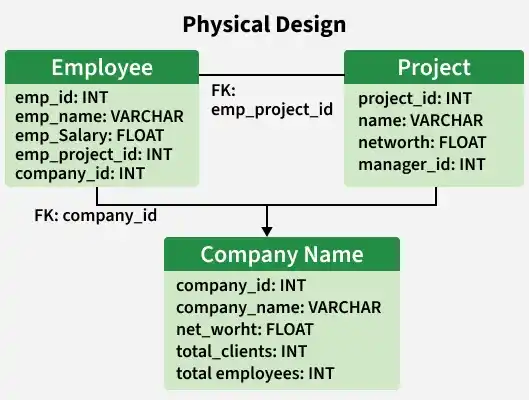
Database design is a systematic process that involves a set of procedures and tasks to implement a database effectively. It focuses on organizing and structuring data in a way that ensures efficiency, accuracy, and usability.
- Maintain data consistency and integrity
- Ensure low redundancy to avoid unnecessary duplication of data
- Enable faster searching through the proper use of indexes
- Implement security measures by enforcing integrity constraints
Primary Terminologies Used in Database Design
- Redundancy – Duplication of data in a database system; should be minimized to prevent inconsistency and storage wastage.
- Schema – The logical structure of a database that defines tables, columns, data types, and relationships.
- Record / Tuple – A single row in a table that stores related data values.
- Indexing – A data structure technique used to improve the speed of data retrieval operations.
- Data Integrity – Accuracy, validity, and reliability of stored data in a database.
- Consistency – Ensures data remains correct, uniform, and logically valid across the database.
- Data Model – A structured visual representation of data and relationships (e.g., Hierarchical, Network, Relational, Object-Oriented).
- Normalization – Systematic process of organizing data into smaller tables to reduce redundancy and dependency.
- Functional Dependency – A relationship where one attribute uniquely determines another attribute (A → B).
- Transaction – A single logical unit of work in a database system that follows ACID/BASE properties.
- Schedule – The defined sequence or order in which transactions are executed.
- Concurrency – Allowing multiple transactions to execute simultaneously without causing conflicts.
- Constraints – Defined rules such as NOT NULL, UNIQUE, PRIMARY KEY, and FOREIGN KEY used to maintain data integrity and accuracy.
Database Design Lifecycle

1. Requirement Analysis
It's very Important to understand the requirements of our application so that you can think in productive terms. And imply appropriate integrity constraints to maintain the data integrity and consistency.
2. Logical & Physical Design
This phase involves the actual design of the database and is divided into two stages:
- Logical Data Model Design: This phase creates a high-level structure of the database based on requirements. It identifies entities, attributes, keys, relationships, and constraints without considering physical storage. Techniques like ER modeling and normalization are used to organize data and remove redundancy.
- Physical Data Model Design: This phase implements the logical design in a DBMS. Tables are created, relationships and constraints are defined, and storage details are set to generate the actual working database.
3. Data Insertion and testing for various integrity Constraints
Finally, after implementing the physical design of the database, we're ready to input the data & test our integrity. This phase involves testing our database for its integrity to see if something got left out or, if anything new to add & then integrating it with the desired application.
Logical Data Model Design
The logical data model design defines the structure of data and what relationship exists among those data. The following are the major components of the logical design:
1. Data Models: Data modeling is a visual technique used to represent the structure of a database. It helps in understanding requirements through diagrammatic representation.
Examples: Hierarchical Model, Network Model, Relational Model, Object-Oriented Data Model.
2. Entity: An Entities is a real-world object that has attributes (properties).
- Strong Entity: Has a primary key and can be uniquely identified.
- Weak Entity: Does not have a primary key and depends on a strong entity for identification. It has total participation in a relationship.
Example: A Loan depends on a Customer and is identified using the customer’s ID.
3. Relationships: A relationship defines how entities are logically connected.
Types:
- Unary: Relationship within the same entity. Example: An employee manages another employee.
- Binary: Relationship between two entities. Example: A student enrolls in a course.
- Ternary: Relationship among three entities. Example: An employee works on a project for a client.
4. Attributes: Attributes are properties that describe an entity.
Example: Employee → ID, Name, Age, Salary, Department.
5. Normalization: Normalization is the process of organizing data to eliminate redundancy and prevent anomalies such as insertion, update, and deletion anomalies.
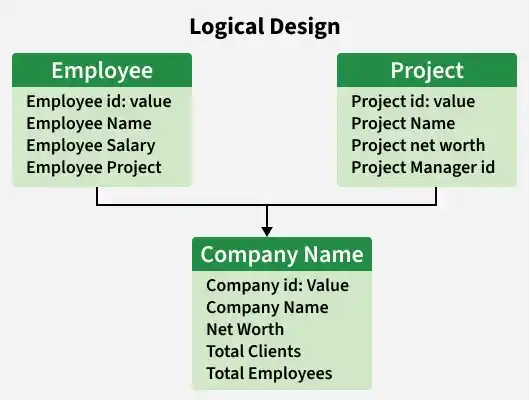
Physical Design
The main purpose of the physical design is to actually implement the logical design that is, show the structure of the database along with all the columns & their data types, rows, relations, relationships among data & clearly define how relations are related to each other.
Steps Taken in Physical Design
- Entities are converted into tables or relations that consist of their properties (attributes)
- Apply integrity constraints: establish foreign key, unique key, and composite key relationships among the data. And apply various constraints.
- Entity names are converted into table names, property names are translated into attribute names, and so on.
- Apply normalization & modify as per the requirements.
- Final Schemes are defined based on the entities & attributes derived in logical design.