
Cascading rollback is formed using two different words, which are cascade and Rollback. The word cascade means “waterfall” and rollback means “ an act of making an action to change back to what it was before”. Due to the failure of a single transaction, a cascade of transaction rollbacks occurs.
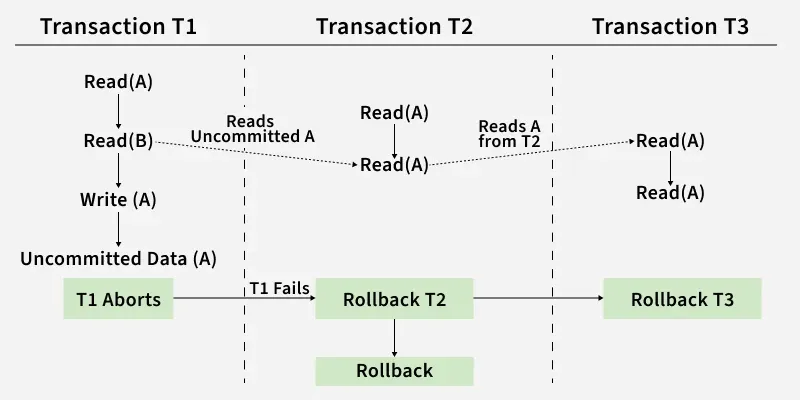
Explanation:
- T1 writes value of A
- T2 reads A (before T1 commits)
- T3 reads A (value coming from T2)
- T1 aborts
- Since T2 and T3 used uncommitted data, both must roll back
Therefore, failure of T1 causes rollback of T2 and T3, resulting in cascading rollback.
Key Characteristics
- Occurs due to dirty reads (reading uncommitted data).
- Common in non-strict schedules.
- One transaction failure can affect multiple dependent transactions.
- Rollbacks propagate in a chain-like manner.
- Mainly seen in systems that allow read before commit.
How Cascading Rollback Occurs
- A transaction T1 writes a data item.
- Another transaction T2 reads that data item before T1 commits.
- If T1 aborts, the value read by T2 becomes invalid.
- T2 must also roll back.
- If a third transaction T3 depends on T2, it must also roll back.
- This creates a cascade of rollbacks.
Conditions Required for Cascading Rollback (Explanation)
- Transactions execute concurrently: Multiple transactions run at the same time, allowing them to access and modify shared data items.
- A transaction reads data written by another uncommitted transaction: One transaction uses a value that has been updated but not yet committed by another transaction (dirty read).
- The writing transaction aborts or fails: When the original transaction fails, its uncommitted changes are undone, making any dependent reads invalid.
- No strict locking: The DBMS allows reading data before the writing transaction commits, enabling cascading dependencies.
Problems Caused by Cascading Rollback
1. Wastes CPU Time and System Resources: Cascading rollback requires undoing the operations of multiple dependent transactions. This consumes extra CPU time, memory, and disk I/O, leading to inefficient use of system resources.
2. Increases Transaction Delay: Transactions that depend on failed transactions must be rolled back and re-executed. This increases their completion time and causes delays in overall transaction processing.
3. Reduces System Performance: Frequent rollbacks and re-execution shift system focus from normal processing to recovery tasks. As a result, database throughput decreases and performance is degraded.
4. Complicates Recovery Process: The system must identify and track all transactions that read uncommitted data. Rolling them back in the correct order makes the recovery process complex and error-prone.
How to Prevent Cascading Rollback
Cascading rollback can be avoided by using strict scheduling techniques:
- Processes only use committed data – No process reads data from another process until it is fully committed.
- Careful dependency management – Avoid unnecessary dependencies between processes.
- Checkpointing – Save process states periodically to limit rollback to the last safe point.
- Transaction protocols (like 2PC) – Ensure all nodes agree before committing updates.
- Message logging – Keep logs of communications to recover without rolling back dependent processes.