
Sampling is the process of selecting a small group from a larger population to gather information and make conclusions about the whole group. It's a practical and cost-effective way to collect data, especially when studying when it is not possible.
Example:- A man wants to buy mangoes but doesn't inspect each one individually. Instead, he picks 2 to 3 mangoes at random from the pile, checks their quality, and decides that the entire batch is good based on his quick inspection.
There are two types of Sampling Methods: Probability sampling methods and Non-probability sampling methods.
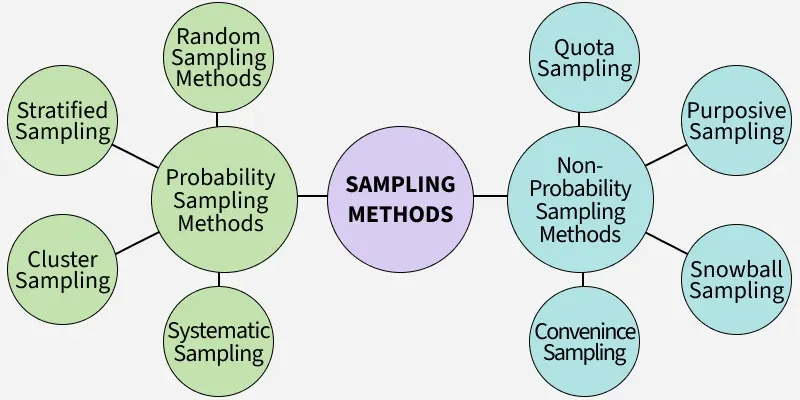
Probability Sampling Methods
Every element has a known, non-zero chance of selection. Here we will discuss in detail three probability sampling methods, such as
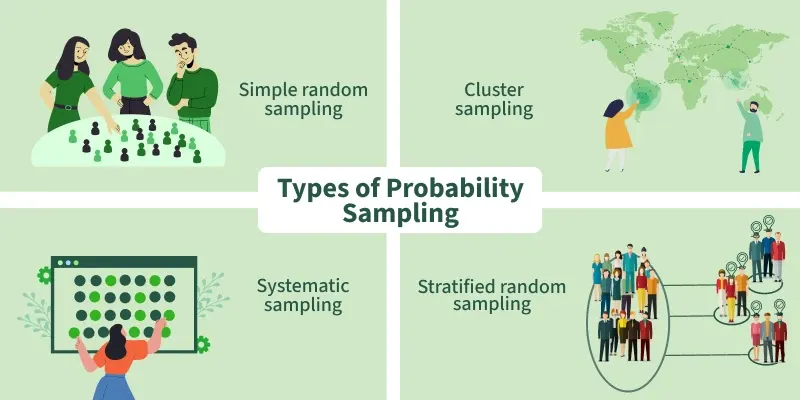
Random Sampling Method
Random Sampling is a method where every item or individual in a group has an equal chance of being selected. It's like drawing names from a hat—each name has the same probability of being chosen.
Example: You have a class of 30 students, and you want to randomly select 5 students for a group project. You write each student’s name on a separate piece of paper, put them all in a hat, and draw 5 names. Each student has an equal chance of being selected.
Lottery Method: In the Lottery Method, the investigator prepares paper slips for each of the items of the universe and shuffles these slips in a box. After that, some slips are impartially drawn from the box to obtain a sample.
Table of Random Numbers: Use pre-generated tables of random numbers to select items.
Random Sampling and Haphazard Sampling: Random sampling follows a systematic approach based on rules of sampling, whereas haphazard sampling does not follow any systematic rules or methodology. Additionally, in random sampling, each item has an equal chance of being selected. In contrast, haphazard sampling does not ensure equal chances for each item to be selected.
Stratified or Mixed Sampling
Stratified or Mixed Sampling is a method used when a population has different groups with unique characteristics. In this method, the population is divided into smaller groups, called strata, based on these differences. Then, some items are chosen from each group to represent the whole population.
Example:- Surveying 300 customers from an e-commerce site: Split customers into strata (e.g., age groups: 18–30, 31–50, 51+). Randomly sample 100 from each group.
Stratified Sampling Method is also known as Mixed Sampling because it combines both Purposive and Random Sampling methods. The population is divided into different strata purposefully, but the items are selected randomly from each stratum.
Systematic Sampling
Systematic Sampling is a method where the population is arranged in a specific order, such as by number or alphabet. Every nth item or person is then selected for the sample. This method is usually easier than randomly picking each item and helps reduce bias.
Example: Quality testing in a factory: Take every 20th smartphone off the assembly line. Test it for defects.
Cluster Sampling
Cluster sampling is a research method where you split a large population into natural groups (like neighborhoods or schools), randomly pick a few of these groups, and study everyone in the chosen groups.
Example: To study student lunch habits in a city: Divide all students into clusters by school. Randomly select 5 schools out of 50. Survey every student in those 5 schools.
Non-Probability Sampling Methods
Selection not random; generalizability limited. Here we are explaining three types in Non-probability Sampling:
Quota Sampling
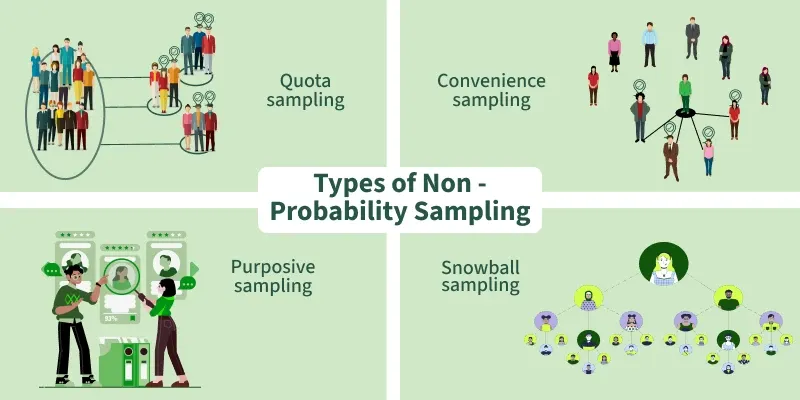
Quota Sampling is a method where the population is divided into groups based on certain characteristics, like age, gender, or income. The researcher then picks a fixed number of items from each group to form a sample. This way, the sample represents different parts of the population.
Example:- Study the opinions of 100 people about a new product, divide them into groups based on gender and age, such as 50 men and 50 women. Then, collect responses from 20 people in each age group.
Convenience Sampling
As the name suggests, Convenience Sampling is a method of collecting data where the investigator selects items from the population based on convenience.
Example:- An investigator who wants to collect data on the average number of females using induction cooktops in the kitchen goes to a shopping mall and collects information from the females visiting that mall. By doing so, the investigator neglects females who were not present in the mall that day or who did not visit the mall. This reduces the reliability of the result, as some females may have induction cooktops in the kitchen but were not present in the mall at that time.
Purposive or Deliberate Sampling
Purposive Sampling, also known as Judgmental or Deliberate Sampling, is a non-random sampling method where the researcher intentionally selects individuals or items that are most relevant to the research objectives. This approach is used when specific characteristics or expertise are needed to address particular research questions.
Example:- if an investigation is about FMCG companies, then the inclusion of companies like Nestle, Hindustan Unilever Ltd., etc., is essential in the sample. However, the chances of personal biases in this method of sampling are higher, which reduces its credibility.
Snowball Sampling
Snowball sampling is a research method where existing participants recruit new participants from their own network of contacts. This sampling starts with few people and relies on referrals. Sampling size grows like chain reaction. This is used in studying hard-to-reach or hidden population.
Example:- A researcher studying homelessness starts by interviewing one person living on the streets. That person refers the researcher to two friends who are also homeless. Those two friends each refer two more people. The sample "snowballs" from 1 person → 3 people → 7 people, growing through participant referrals.
Summary of Sampling Methods
A table summarizing the sampling methods, along with their definitions and examples.
| Method of Sampling | Definition | Example |
|---|---|---|
| Random Sampling | A sampling method where every item of the population has an equal chance of being selected. It is impartial and does not involve investigator control. | Drawing names from a lottery to select participants. |
| Stratified Sampling | The population is divided into subgroups (strata) based on distinct characteristics, and samples are selected proportionally from each subgroup. | Dividing students into Arts, Commerce, and Science groups to study academic performance. |
| Systematic Sampling | The population is arranged in order, and every nth item is selected to form the sample. | Selecting every 10th person from a list of 200 for a survey. |
Cluster Sampling | Split large population into small groups and pick few groups and study samples from chosen group. | Selecting some schools from clusters of schools. |
| Quota Sampling | The population is divided into groups based on certain characteristics, and fixed numbers are selected from each group to ensure diversity in the sample. | Surveying a set percentage of people from different age groups. |
| Convenience Sampling | The investigator selects items based on convenience, often using readily accessible individuals or items. | Interviewing people at a local mall for a survey about cooking habits. |
Purposive Sampling | The investigator deliberately selects a sample based on their judgment, focusing on items that are deemed most relevant to the study. | Selecting top FMCG companies like Nestle and Hindustan Unilever for a market study. |
Snowball Sampling | A research method where sample is increased when existing subjects recruit by referrals. | Study about Homelessness, where a person refer to two homeless and those people then refer to more homeless people. |
Solved Problem Based on Data Sampling
Question 1. What is the purpose of data sampling?
Answer :- The main purposes of data sampling are Efficient Data Collection, Cost-Effective, and Statistical Inference.
Question 2. In a factory with 600 employees, you want to select 100 employees for a survey. You choose every 6th person from a list, starting with the 4th person. The selection process is systematic, ensuring that every 6th person is chosen. What type of sampling is being used?
Answer :- In Systematic Sampling, you select every 6th person from the list, starting at a randomly chosen point (the 4th person). This method ensures a consistent, systematic approach to selecting participants
Question 3. In which sampling method is group formation important?
Answer :- Group formation is important in stratified sampling because the population is divided into distinct subgroups (strata), and a sample is taken from each group.
Question 4. Which sampling method can generate bias?
Answer :- Convenience Sampling can generate bias because it relies on selecting easily accessible participants, which may not accurately represent the entire population.
Practice Problem based on Data Sampling
Question 1. Which sampling method is used when specific individuals are chosen based on their knowledge or expertise?
Question 2. Which sampling method involves selecting a fixed number of participants from each subgroup in proportion to their occurrence in the population?
Question 3. Which sampling method selects participants based on predetermined characteristics or criteria?
Question 4.What type of sampling ensures that each member of the population has an equal chance of being selected?
Answer :-
1. Purposive Sampling 2. Quota Sampling 3. Purposive Sampling 4. Random Sampling