
Comparing the human brain and computers is a way to understand how both handle information. The human brain is a natural organ made of neurons that help us learn, remember, and make decisions. Computers, on the other hand, are machines created by humans that use circuits and programs to process data, store information, and follow instructions.
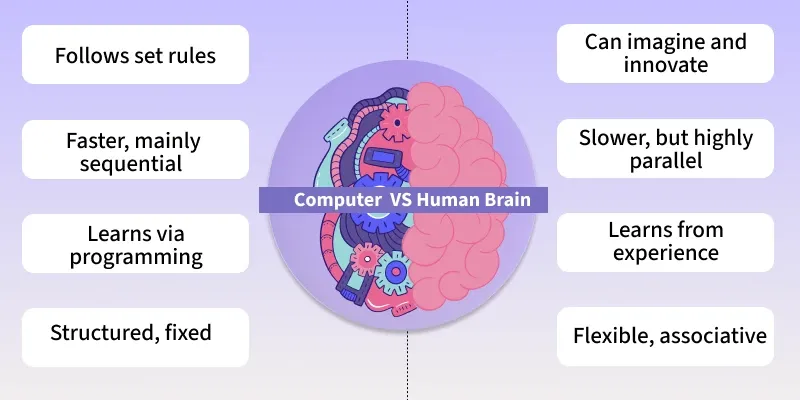
- Both are powerful at handling tasks, but they do it in different ways. By looking at how they work in areas like processing speed, memory, and problem-solving, we can see what makes each one special.
Human Brain
Your brain packs about 86 billion neurons and 100 trillion synaptic connections into just three pounds of tissue. That's more connections than there are stars in the Milky Way, all working together to keep you breathing, thinking, feeling, and creating.
What makes the brain special?
It rewires itself constantly. Every time you learn something new or practice a skill, your brain physically changes its structure. Scientists call this neuroplasticity, and it's something no computer can match.
Processes Information
- Your brain doesn't work like a computer processor that handles one task at a time. Instead, millions of neurons fire simultaneously, processing everything from the feeling of your shirt against your skin to memories of yesterday's lunch. This parallel processing lets you walk down the street while having a conversation and spotting a friend across the road - all at once.
- The brain also weaves emotion and context into every decision. When you see a dog, you don't just identify "canine" - you might remember your childhood pet, feel happy, or instinctively step back if you're afraid of dogs.
Memory: Dynamic and Ever-Changing
- Your memories aren't stored like files on a hard drive. They exist as patterns of connections between neurons, constantly shifting and evolving. Each time you recall a memory, you actually change it slightly. Your brain can hold an estimated 2.5 petabytes of information - roughly equivalent to streaming Netflix for 3 million hours straight.
- Unlike computer memory, your brain's storage grows stronger with use. The more you practice piano or think about your best friend's face, the stronger those neural pathways become.
Problem-Solving Through Experience
- Your brain excels at making leaps of intuition. You can look at a half-finished jigsaw puzzle and immediately know where a piece goes, or hear just a few notes and recognize your favourite song. This happens because your brain draws on years of experience, finding patterns and making connections that aren't immediately obvious.
➣Point to know: The brain processes visual information 60,000 times faster than text, which is why we can recognise a familiar face in a crowd almost instantly!
Computer
A computer operates through electronic circuits, transistors, and carefully programmed instructions. Unlike your brain, which evolved over millions of years, computers were designed by humans for specific purposes: calculating, storing data, and following commands with perfect accuracy.
- Modern computers can execute billions of instructions per second, far outpacing what any human could accomplish with pure calculation. But here's the catch - they only do exactly what they're told to do.
Processing Power
- Today's computers, especially those with multiple processing cores or graphics cards, can crunch numbers at incredible speeds. A high-end gaming computer might perform trillions of calculations while rendering a single frame of a video game.
- However, most computer processing happens sequentially - one instruction after another. Even with multiple cores working simultaneously, computers can't match the brain's ability to process thousands of different types of information at once.
Memory: Precise but Static
- Computer memory comes in fixed sizes - 8GB of RAM, 1TB hard drive, 256GB SSD. This memory stores information as electrical states representing 1s and 0s. Unlike your brain, computer memory doesn't change or strengthen with use. A file saved ten years ago looks exactly the same as when you created it.
- Need more storage? You'll need to physically install additional memory chips or drives.
Problem-Solving: Following the Rules
- Computers excel at tasks with clear rules and defined parameters. They can sort through millions of database records, calculate taxes with perfect accuracy, or render movie-quality special effects. But ask a computer to understand sarcasm or appreciate art, and you'll hit a wall.
- Even the most sophisticated AI systems work by following complex mathematical formulas, not by truly understanding concepts the way humans do.
- The world's most powerful supercomputers can perform over 1 quintillion calculations per second, yet they consume enough electricity to power a small city. Your brain accomplishes its remarkable feats using just 20 watts - about the same as a dim light bulb.
➣Point to know: The world’s fastest supercomputer, Icon, can perform over 1 quintillion (10^18) calculations per second, yet it consumes enough power to run a small town!
Human Brain vs Computer
The human brain and computers process and store information differently. The brain is adaptable, efficient, and processes in parallel, while computers excel in speed, structure, and require external maintenance.
| Aspect | Human Brain | Computer |
|---|---|---|
| Construction | 86 billion neurons connected by synapses | Silicon chips, transistors, electronic circuits |
| Memory Growth | Forms new neural connections naturally | Requires hardware upgrades |
| Power Usage | 20 watts (like a light bulb) | Hundreds to thousands of watts |
| Information Storage | Electrochemical patterns across neural networks | Binary code (1s and 0s) in electronic memory |
| Processing Style | Massively parallel - millions of simultaneous operations | Mostly sequential, limited parallel processing |
| Learning Ability | Continuous adaptation and self-improvement | Programmed responses; AI requires extensive training |
| Self-Repair | Automatically adapts and heals from damage | Needs external maintenance and updates |
| Input Methods | Five senses provide rich, contextual information | Keyboard, mouse, touchscreen, sensors |
| Decision Making | Influenced by emotions, experience, context | Logic-based algorithms and programmed rules |
| Flexibility | Highly creative, adapts to new situations easily | Limited to programmed capabilities |
Why This Matters Today
Understanding the similarities and differences between the brain and computers is important in AI, neuroscience, and technology.
- Brain-inspired computing is leading to new computer architectures that mimic neural networks. These systems are behind the voice recognition in your smartphone and the recommendation algorithms on streaming services.
- Medical breakthroughs come from studying how the brain processes information, leading to better treatments for conditions like Alzheimer's, depression, and paralysis.
- Artificial intelligence advances by borrowing concepts from neuroscience, while brain research benefits from powerful computer simulations of neural activity.
- Robotics combines both approaches - using computer precision for calculations while trying to replicate the brain's adaptability for navigation and decision-making.
➣Point to know: The ENIAC computer from 1945 weighed 30 tons and filled an entire room, yet your smartphone today is millions of times more powerful while fitting in your pocket. Meanwhile, your brain achieves its incredible capabilities in the same compact space humans have had for thousands of years.