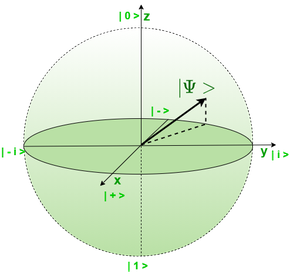
Similar to a bit in classical computing, a qubit is a basic building block of Quantum Computers. It represents the superposition of states 0 and 1. What we mean by superposition is that the given state is in a linear combination of state 0 and state 1.
It is a common misconception that qubit is in one state 0 or 1, we just don't know until we measure it. However, qubit always exists in a state between 0 and 1 (inclusive), the act of measuring brings it to either of the states.
Matrix Representation :
A qubit is represented as a complex vector of size 2. Generally represented as :
\begin{bmatrix}\alpha\\\beta\end{bmatrix}
where
\alpha, \beta
are amplitudes of states 0 and 1 respectively or we can say the probability to be in state 0 and 1 respectively. This vector is normalized i.e.
| \alpha | ^2 +| \beta |^2 = 1
State 0 is represented as :
\begin{bmatrix}1\\0\end{bmatrix}
State 1 is represented as:
\begin{bmatrix}0\\1\end{bmatrix}
Quantum states |0> and |1> form orthogonal basis also called computational basis or canonical basis.
Dirac's Notation :
It is a shorthand notation for a qubit. A vector is represented using a ket.
|0\rangle\ \ =\begin{bmatrix} 1 \\ 0 \end{bmatrix} and \ \ |1\rangle\ \ =\begin{bmatrix} 0 \\ 1 \end{bmatrix}
|+> and |-> are called Hadamard's basis. These are also orthogonal to each other.
|i\rangle\ \ = \frac{1}{\sqrt2}(|0\rangle+i|1\rangle) \ \ and \ \ |-i\rangle\ \ = \frac{1}{\sqrt2}(|0\rangle-i|1\rangle) Bloch's Representation :
Bloch's sphere is a geometric representation of quantum states where different points in the surface of the unit radius sphere represent various quantum states. A qubit can be represented in a 3D space as a vector of unit length connecting points in the surface of the Bloch's sphere and it's center.
Bloch's Qubit Representation