
Network segmentation divides a computer network into smaller, isolated segments to control and restrict communication. It enhances security by limiting unauthorized access and containing potential threats within defined boundaries.
- Reduces attack surface by isolating critical systems
- Limits lateral movement during cyberattacks
- Improves traffic control and network performance
- Enforces access restrictions using firewalls, routers, or VLANs
- Helps contain breaches and protect sensitive data
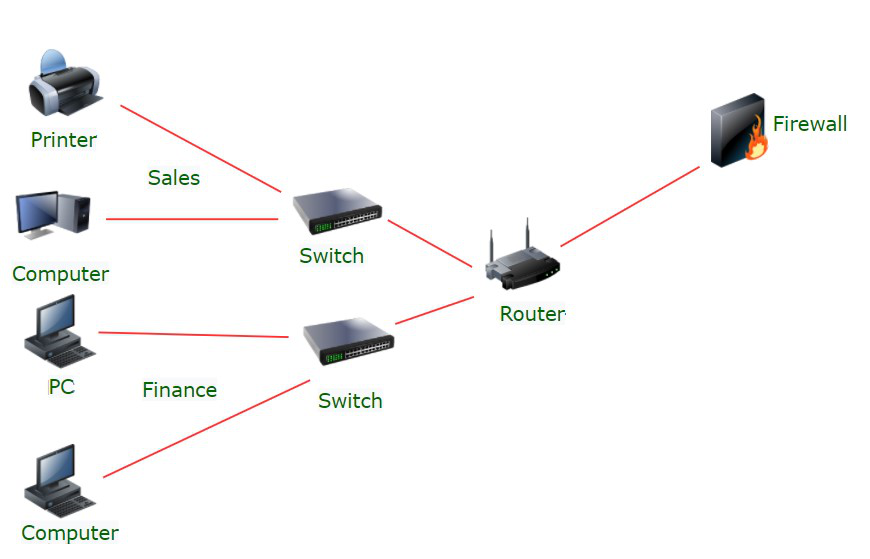
Example: In an organization with separate networks for Sales and Finance, users from one network cannot directly access resources on the other. If access is required, traffic must traverse a switch, router, and firewall enforcing security policies.
Purpose of Network Segmentation
Network segmentation is used to:
- Enhance security by reducing the attack surface.
- Improve performance by limiting broadcast traffic and reducing congestion.
- Enforce access control by controlling which devices can communicate.
- Simplify management and troubleshooting by isolating issues to specific segments.
- Support compliance with data protection and industry regulations.
- Enable scalability by allowing easy addition of new segments as the organization grows.
Working of Network Segmentation
There are several basic steps involved in how network segmentation works.
1. Identify and Group Assets: Classify devices, systems, and applications based on their function, sensitivity, or access requirements (e.g., HR, Finance, Guest).
2. Create Segments: Divide the network into logical or physical segments using subnets or VLANs, assigning distinct IP ranges.
3. Deploy Firewalls and Layer 3 Devices: Use routers and firewalls between segments to enforce security boundaries and control traffic based on policies.
4. Configure VLANs and ACLs: Use VLANs to logically group devices on the same physical network. Set Access Control Lists (ACLs) to permit or block traffic between segments.
5. Monitor Inter-Segment Traffic: Utilize Intrusion Detection/Prevention Systems (IDS/IPS) to detect malicious activity between segments.
6. Apply Least Privilege: Deny all non-essential inter-segment traffic by default. Permit only what's necessary for business operations.
7. Review and Update Policies: Regularly reassess firewall rules, ACLs, and segmentation strategies to reflect organizational and threat landscape changes.
Types of Network Segmentation
Network segmentation involves dividing a computer network into smaller parts to improve performance, security, and management. Here are the main types of network segmentation:
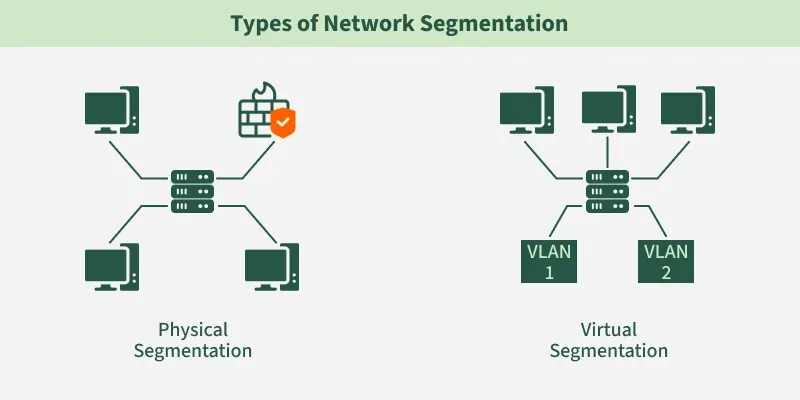
1. Physical Segmentation
- Physical Segmentation (or perimeter-based segmentation) separates device groups using dedicated switches, wiring, firewalls, and sometimes individual internet connections.
- While it offers strong isolation, it's costly, difficult to scale, and complex to manage. Internal networks often remain flat, so if an attacker bypasses the firewall, they can move laterally with little resistance.
2. Virtual Segmentation
- Virtual Segmentation, or logical segmentation, divides a single physical network into multiple isolated virtual segments.
- Each segment can have its own security and communication policies. This is commonly implemented using technologies like VLANs (Virtual Local Area Networks).
Technologies Used for Network Segmentation
Segmentation is enforced using:
- Firewalls & Routers: With ACLs to control access.
- Switches & VLANs: For logical isolation.
- Next Gen Firewalls (NGFW) & IPS: For deep inspection and threat prevention.
- Software-Defined Networking (SDN): Enables centralized, dynamic control of segmentation.
- Zero Trust Architecture (ZTA): Enforces least privilege and verifies every connection.
Steps to Implement Network Segmentation
Implementing network segmentation involves strategic planning and the use of technologies like VLANs, subnets, firewalls, and access control policies.
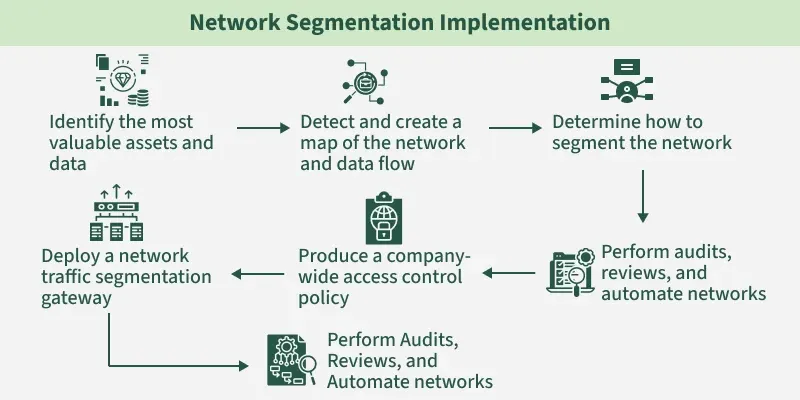
1.Identify the most valuable assets and data: Determine which systems, applications, and information need the highest protection.
2. Detect and create a map of the network and data flow: Visualize how devices communicate and where data travels across the network.
3. Determine how to segment the network: Decide the segmentation strategy (e.g., VLANs, subnets, firewalls, zones).
4. Perform audits, reviews, and automate networks: Assess current configurations, identify gaps, and use automation for consistency.
5. Produce a company-wide access control policy: Define who can access what, ensuring least-privilege enforcement.
6. Deploy a network traffic segmentation gateway: Implement firewalls, ACLs, and gateways to enforce segmentation rules.
7. Perform ongoing audits, reviews, and automation: Continuously monitor, update, and optimize segmentation as the network evolves.
Network Segmentation vs Micro Segmentation
| Network Segmentation | Micro Segmentation |
|---|---|
| Divides a network into smaller subnetworks | Further divides segments into granular security zones |
| Controls north-south traffic | Controls east-west traffic |
| Implemented using VLANs, ACLs, and firewalls | Implemented using SDN and virtualization |
| Provides isolation between major segments | Provides fine-grained isolation within segments |