
The expansion of users in the Internet and the devices connecting to it, the Internet Protocol version 4 (IPv4) having 32-bit address is running out of capacity. To overcome this problem, the Internet Protocol version 6 (IPv6) is introduced having 128-bit addresses and therefore allows trillions of unique IPs through which many devices can connect easily.
The transition from IPv4 to IPv6 not only solves the issue of limitation of addresses but also brings improvements in network efficiency, security, and performance. In this article, we will look into what are the different methods through which we can transition or switch from IPv4 to IPv6.
How Transition Happens From IPv4 to IPv6?
Various organizations are currently working with IPv4 technology and in a very short time, we can not switch directly from IPv4 to IPv6. Instead of only using IPv6, we use a combination of both and transition means not replacing IPv4 but co-existing of both.
When we want to send a request from an IPv4 address to an IPv6 address, it is not possible because IPv4 and IPv6 transition is not compatible. For a solution to this problem, we use some technologies that help in an easy transition from IPv4 to IPv6. These technologies are mentioned below:
- Dual Stack Routers
- Tunneling
- NAT Protocol Translation
Dual-Stack Routers
A dual-stack router is a network device that can support both IPv4 and IPv6 protocols simultaneously. It allows communication between devices using any of the protocol, making it a key component during the transition from IPv4 to IPv6. In dual-stack router, A router's interface is attached with IPv4 and IPv6 addresses configured are used in order to transition from IPv4 to IPv6.

In this above diagram, A given server with both IPv4 and IPv6 addresses configured can communicate with all hosts of IPv4 and IPv6 via dual-stack router (DSR). The dual stack router (DSR) gives the path for all the hosts to communicate with the server without changing their IP addresses.
Tunneling
Tunneling is a technique used to enable communication between IPv4 and IPv6 networks during the transition from IPv4 to IPv6. Tunneling encapsulates IPv6 packets within IPv4 packets (or vice versa). Tunneling is used as a medium to communicate the transit network with the different IP versions.

In this above diagram, the different IP versions such as IPv4 and IPv6 are present. The IPv4 networks can communicate with the transit or intermediate network on IPv6 with the help of the Tunnel. It's also possible that the IPv6 network can also communicate with IPv4 networks with the help of a Tunnel.
NAT Protocol Translation
NAT (Network Address Translation) Protocol Translation (NAT-PT), is a technique used to enable communication between IPv4 and IPv6 networks by translating one protocol to the other. With the help of the NAT Protocol Translation technique, the IPv4 and IPv6 networks can also communicate with each other without understanding the address of different IP version.
Generally, an IP version doesn't understand the address of different IP version, for the solution of this problem we use NAT-PT device which removes the header of first (sender) IP version address and add the second (receiver) IP version address so that the Receiver IP version address understand that the request is sent by the same IP version, and its vice-versa is also possible.
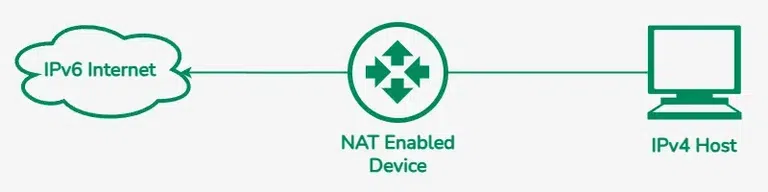
In the above diagram, an IPv4 address communicates with the IPv6 address via a NAT-PT device to communicate easily. In this situation, the IPv6 address understands that the request is sent by the same IP version (IPv6) and it responds.
Conclusion
In conclusion, the transition from IPv4 to IPv6 is important to support the increasing number of devices connected to the internet. Range of IPv4 Address is limited and therefore it creates a challenges like full utilization of IP Addresses. This results in IPv6, with increase in address range. Ipv6 not only solves the problem of address limitation, IPv6 also bring improvements in network performance, network security, and scalability of networks. With different solutions like dual-stack, tunneling, and NAT, these technologies helps in the transition from IPv4 to IPv6 can be used in parallel until IPv6 is fully adopted.