
Quality of Service (QoS) improvement techniques are network methods that control how traffic is handled so time-critical applications get the performance they need, even when the network is busy.
- Needed because networks carry mixed traffic (voice, video and data) on the same links
- Helps real-time applications by reducing delay, jitter, and packet loss
- Assigns priority to important traffic when congestion happens
- Controls bandwidth usage so one flow doesn’t dominate others
Techniques for QoS
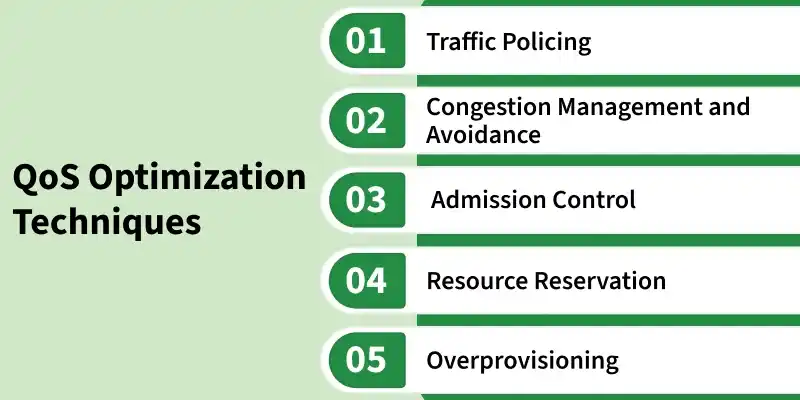
1. Traffic Policing
Checks traffic speed against a set limit and immediately drops or lowers the priority of packets that exceed it.
- Measures traffic against a predefined rate or policy
- Operates without buffering excess packets
- Prevents a single user or application from overusing bandwidth
- Commonly implemented at network ingress points to control incoming traffic
2. Congestion Management and Avoidance
Regulate packet queues and proactively respond to rising traffic levels to maintain stable network performance.
- Congestion management controls queue buildup and ensures orderly packet transmission
- Congestion avoidance identifies early congestion signals before buffers overflow
- Early action helps minimize delay and prevents large-scale retransmissions
- Random Early Detection (RED): drops packets selectively to notify senders about congestion
- Weighted RED (WRED): varies drop probability based on traffic priority to safeguard critical flows
3. Admission Control
Allows new traffic flows only when the network has enough resources to support them without harming the performance of existing services.
- Checks availability of bandwidth, delay margin, and buffer capacity
- Admits a new flow only if current QoS levels can still be maintained
- Helps avoid overload and uncontrolled congestion
- Supports predictable performance for real-time and high-priority traffic
- Common in mission-critical and guaranteed-service network environments
4. Resource Reservation
It dedicates specific network capacity to selected traffic flows to ensure stable and predictable performance.
- Allocates bandwidth and necessary resources before transmission starts
- Provides assured service for delay-sensitive applications
- Minimizes competition with best-effort traffic
- Suitable for environments requiring strict performance guarantees
- RSVP (Resource Reservation Protocol) conceptually signals and establishes reservations across the path
5. Overprovisioning
Network design approach that adds extra capacity so normal traffic spikes are less likely to cause congestion and performance issues.
- Increases link bandwidth/resources to absorb peak loads
- Lowers congestion chances without relying heavily on QoS controls
- Works best when the network is lightly to moderately loaded
- Cannot ensure predictable service during severe or unpredictable congestion
- Expensive and inefficient at scale due to unused reserved capacity
QoS Requirements for Different Applications
| Application | Reliability | Delay | Jitter | Bandwidth |
|---|---|---|---|---|
| High | Low | Low | Low | |
| File Transfer | High | Low | Low | Medium |
| Web Access | High | Medium | Low | Medium |
| Remote Login | High | Medium | Medium | Low |
| Audio on Demand | Medium | Low | High | Medium |
| Video on Demand | Medium | Low | High | High |
| Telephony (VoIP) | Medium | High | High | Low |
| Video Conferencing | Medium | High | High | High |
Traffic Classification and Marking
Process of identifying different types of network traffic and labelling packets so the network can apply appropriate QoS policies to them.
- Traffic classification groups packets based on parameters like application type, protocol, port number, or source/destination address (e.g., voice, video, best-effort data).
- Packet marking assigns a priority value to classified packets (such as DSCP or priority bits) to indicate how network devices should treat them.
- Marked packets allow routers and switches to differentiate traffic and apply mechanisms like priority queuing, shaping, or policing effectively.
- Without classification and marking, all traffic is treated equally, making QoS enforcement ineffective.