
Link Access Procedure (LAP) is a family of ITU-standardized Data Link Layer protocols derived from IBM’s SDLC and based on HDLC, designed for reliable data communication.
- Operates at the Data Link Layer (DLL)
- Derived from SDLC and considered subsets of HDLC
- Provides framing, synchronization, and error control
- Each LAP variant is optimized for specific technologies
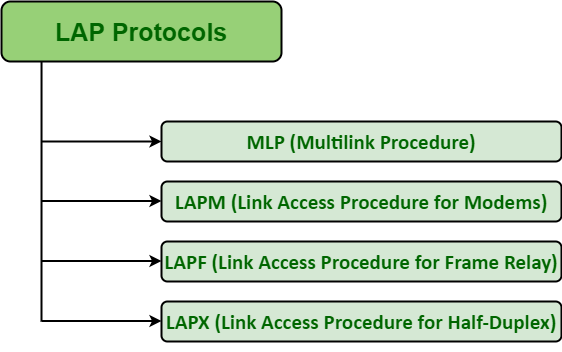
Note: Each LAP protocol is tailored for specific communication technologies and applications, providing reliable data transfer, framing, synchronization and error control.
Types of LAP Protocols
1. Multilink Procedure (MLP)
Purpose: Supports multilink operations for improved throughput.
Functionality:
- Operates as an upper sublayer of the Data Link Layer.
- Functions between the Packet Layer and multiple Single Link Protocols (SLPs).
- Extends LAPB (Link Access Procedure, Balanced) to allow multiple physical links to be combined into a single logical connection.
- Advantage: Provides higher bandwidth and better efficiency by distributing traffic across multiple links.
2. Link Access Procedure for Modems (LAPM)
Purpose: Designed for error correction in modems, especially V.32 and V.42 modems.
Functionality:
- Uses bit-oriented synchronous framing even though computers send data asynchronously to the modem.
- Performs asynchronous-to-synchronous conversion.
- Supports Selective Reject (SREJ) for retransmitting only corrupted frames, speeding up error recovery.
- Ensures data reliability using: CRC (Cyclic Redundancy Check) -> Detects transmission errors & ARQ (Automatic Repeat Request) -> Retransmits erroneous or lost frames.
- Advantage: Provides reliable transmission with error detection, correction and retransmission, enhancing modem efficiency.
3. Link Access Procedure for Frame Relay (LAPF)
Purpose: Provides the data link layer protocol for Frame Relay networks.
Functionality:
- A simplified version of ISDN’s LAPD (Link Access Procedure for the D-channel).
- Focuses only on data transport without DLL-level flow or error control.
- Ensures frame sequencing and checks whether frames are error-free.
- Does not use the Command/Response (C/R) bit, though higher-layer protocols may use it for application-specific needs.
- Advantage: Reduces overhead, making it lightweight and efficient for high-speed Frame Relay services.
4. Link Access Procedure for Half-Duplex (LAPX)
Purpose: Supports half-duplex communication, commonly used in ship-to-shore transmission.
Functionality:
- Adapts HDLC principles for half-duplex links.
- Suitable for environments where only one direction of communication can occur at a time.
- Each LAP protocol is tailored for specific communication technologies and applications, providing reliable data transfer, framing, synchronization and error control. Together, they form an essential part of early and modern digital communication systems.
- Advantage: Reliable protocol for constrained communication channels like maritime links.
Key Features of LAP Protocols
- Based on HDLC principles such as framing, addressing and error detection.
- Application-specific tailoring: Each LAP variant focuses on specific technologies (e.g., modems, Frame Relay, ISDN).
- Reliability mechanisms: Most versions use CRC, ARQ or sequencing to ensure accuracy.
- Flexibility: Supports both synchronous and asynchronous data environments.