
Digital evidence in cyber forensics refers to electronic data collected and analyzed to investigate cybercrimes and legal cases. It helps forensic experts identify, preserve, and present digital information from computers and other electronic devices.
- The growth of personal computers increased the use of technology in daily life.
- The rise in technology has also led to an increase in computer-related crimes.
- Digital forensics emerged to investigate such crimes.
- Forensic experts analyze digital artifacts to identify criminal activities.
Electronic Evidence
This includes any digital information that can be used to support an investigation or legal proceeding related to cybercrime.
- Includes files such as emails, images, documents or chat records.
- May also include system logs, metadata and network activity records
- Evidence can be collected from computers, mobile devices or servers.
- Helps identify unauthorized access or illegal activity.
Process Involved in Digital Evidence Collection
It is a systematic process used to identify, examine, analyze, and document electronic data so that it can be used in cybercrime investigations and legal proceedings.
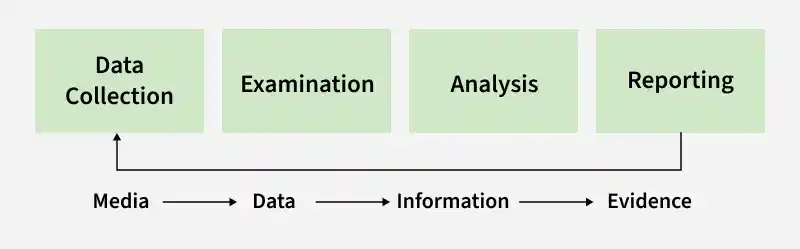
1. Data Collection
- Identify sources of digital evidence.
- Collect data from devices such as computers, mobiles, servers, or storage media.
- Ensure original data is not modified during collection.
- Use forensic tools to create copies of evidence.
2. Examination
- Carefully inspect the collected data.
- Filter relevant information related to the investigation.
- Detect hidden, deleted, or encrypted files.
- Organize data for further analysis.
3. Analysis
- Use forensic techniques to interpret evidence.
- Identify patterns, relationships, or suspicious activities.
- Reconstruct events using collected data.
- Extract useful information that supports the investigation.
4. Reporting
- Document all findings clearly and accurately.
- Present evidence in structured format.
- Include details of tools and methods used.
- Prepare report for legal authorities or organizations.
Types of Collectible Data
Collectible data refers to the digital information that investigators search for in seized devices during a computer forensic investigation.
- Investigators must identify what type of digital evidence may exist.
- Investigators use specialized forensic tools and techniques to recover data safely.
- Proper methods help maintain integrity of the original evidence.
- Correct identification of data helps structure the investigation process.
1. Persistent Data
This is the information stored on non-volatile storage devices that remains available even when the computer system is turned off.
- Stored permanently until manually deleted.
- Can be recovered even after system shutdown.
- Examples of storage devices Hard Disk Drive (HDD), Solid State Drive (SSD) or external storage devices
- Common examples of persistent data are documents, images, videos and emails
2. Volatile Data
Volatile data is temporary information stored in memory that is lost when the system is turned off or loses power.
- Exists only while the system is running.
- Must be collected quickly during investigation.
- Examples include RAM data, running processes, cache memory and active network connections
- Important for understanding current system activity
Types of Evidence
Collecting the shreds of evidence is important in any investigation to support the claims in court. Below are some major types of evidence.
- Real Evidence: These pieces of evidence involve physical or tangible evidence such as flash drives, hard drives, and documents, an eyewitness can also be considered as a shred of tangible evidence.
- Hearsay Evidence: These pieces of evidence are referred to as out-of-court statements. These are made in courts to prove the truth of the matter.
- Original Evidence: These are the pieces of evidence of a statement that is made by a person who is not a testifying witness. It is to prove that the statement was made rather than to prove its truth.
- Testimony: Testimony is when a witness takes oath in a court of law and gives their statement in court. The shreds of evidence presented should be authentic, accurate, reliable, and admissible as they can be challenged in court.
Advantages
- It is vital to keep computer systems and other digital devices safe.
- Evidence can be produced when needed in a court of law for the authorities to pass judgment.
- In case the systems & networks are compromised within an organization, this can be used for capturing sensitive details.
- This collection helps in tracing cybercriminals in all parts of the world quickly.
- Take out, analyze, and explain the evidence in a law court to show one is criminal behavior.
Disadvantages
- Volatile data may be lost when system power is turned off.
- Difficulty in maintaining evidence integrity as ensuring the integrity of evidence is challenging.
- Evidence must not be altered during the collection process.
- Legal issues may arise when data is stored in different countries.
- Investigators must follow legal regulations and standards.