
Management refers to the process of planning, organizing, directing, and controlling business activities to achieve the goals of an organization efficiently and effectively.
Definitions of management differ according to context. Earlier, the traditional view of management was unclear because it did not specify the functions a manager performs. It also appeared manipulative, as it focused only on getting work done through others and ignored workers’ needs.
Modern Concept of Management
Management is a process through which an organization designs and maintains an environment in which individuals work together with the motive of achieving organisational goals effectively and efficiently. The three essential elements that come under the modern concept of Management are as follows:
Management is a Process
Management is not a single activity; it is a series of interrelated and continuous functions such as planning, organising, staffing, directing, and controlling. Managers perform these functions in a coordinated way to ensure smooth operations and the achievement of goals.
Focus on Effectiveness
Effectiveness refers to achieving the desired goals within the planned time. It focuses on the end result. For example, completing a project or meeting a sales target on time indicates that the organisation is effective in its performance.
Need for Efficiency
Efficiency means performing tasks correctly, with minimum cost and maximum output. It emphasizes optimum use of resources—such as time, money, and manpower—so that there is less wastage and the organisation can operate more economically.
Characteristics of Management
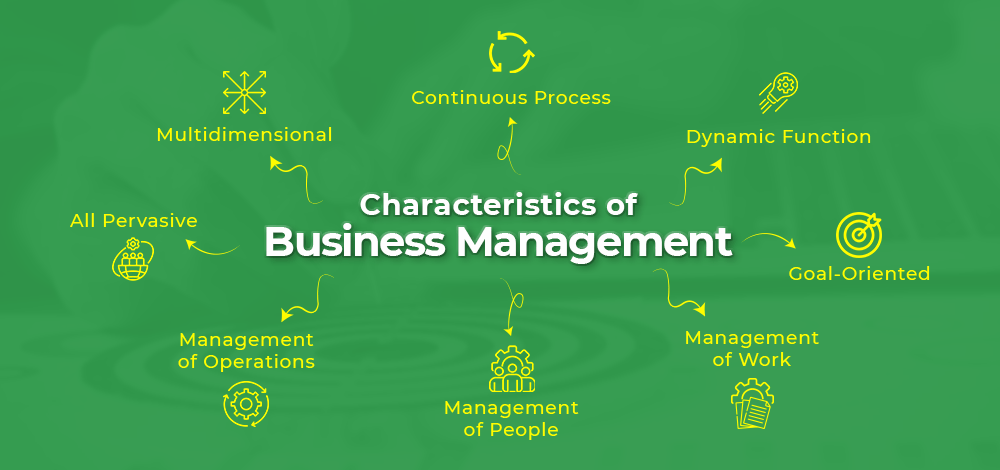
Continuous Process
Management is a continuous process. It means that the process of business management goes on until the company exists, as it helps in achieving the organisational goals. Every manager of an organisation has to perform the different functions of management in a series (planning, organising, staffing, directing, and controlling).
Goal-oriented
Every organisation has a set of predetermined goals or objectives that it aims to accomplish during its existence. Every organisation has different goals. Hence, management helps these organisations in fulfilling their goals by utilising the given limited resources in the best optimum manner. For example, If the objective of Airtel is to add a billion Airtel Xtreme customers in a year, then all of its managerial activities will be directed toward the achievement of this objective.
All Pervasive
The process of business management is universal in nature. Every organisation, whether small scale, large scale, economic, social, etc., uses the process of management at every level or stage. Besides, the activities involved in the management of an organisation are common for all whether it is a social, political, or economic enterprise.
Multidimensional
Management is a multidimensional process as it does not involve only one activity. The three main activities involved in management are Management of Work, Management of People, and Management of Operations.
Dynamic Function
There are different internal and external factors that affect the working of an organisation. An organisation has to change and adapt itself on the basis of changing environment to accomplish the organisational goals and objectives. Hence, management is a dynamic function.
Management is a Group Activity
Management involves a group of people performing managerial activities. The functions of management can be executed only when every individual performs his/her role their respective status and department. And as the result of management affects every individual and every department of an organisation, it always refers to a group effort.
Management is an Intangible Force
Management is a function that cannot be physically seen but its presence can be felt by watching the orderliness and coordination in work environment and happy faces of the employees when the task is completed.
Objectives of Management
Social Objectives
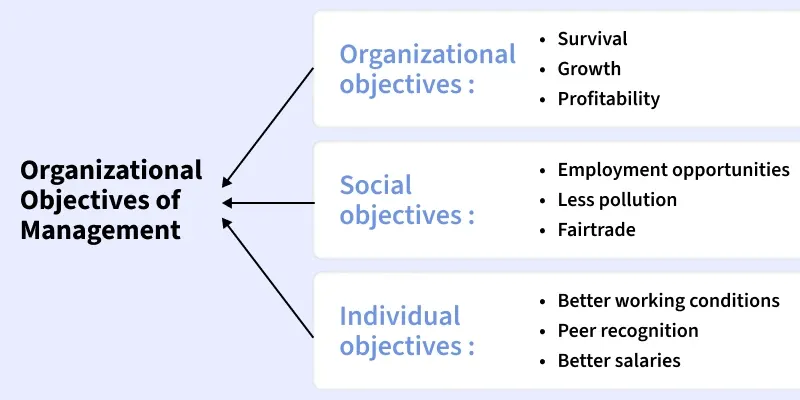
These refer to the objectives which are desired to be achieved for the benefit of society. Every organisation has a social responsibility to fulfill during its existence. Some of the social obligations of an organisation include implementing environment friendly practices in the production process, providing basic amenities to employees such as healthcare, education, etc., and providing the unprivileged sections of society with employment opportunities.
Organisational Objectives
With the help of management, every organisation sets and achieves organisational goals. The three major organisational objectives are survival, profit, and growth.
- Survival: One of the basic objectives of every organisation is survival.
- Profit: Survival is not enough for an organisation; it has to earn profits to grow and expand in the future.
- Growth: Besides earning a profit, an organisation has to grow in order to remain in the industry.
Personal or Individual Objectives
As discussed earlier, people are the main asset of an organisation having different goals, backgrounds and personalities. It is the duty of the managers to ensure that the personnel objectives are aligned with the organisational objectives. Individual or Personal Objectives of an organisation consist of satisfying needs like Social Needs, Financial Needs, Good and Healthy Working Conditions, and Higher Level Needs.
Importance of Management
Increases Efficiency
The management process of an organisation increases its efficiency by reducing cost and increasing productivity by utilisation of the available resources in the best possible and optimum way.
Helps in Achieving Group Goals
Effective management process creates teamwork and builds coordination among the members of an organisation. The managers provide a common path or direction to their employees for the accomplishment of the overall objectives of the organisation.
Creates a Dynamic Organisation
Every organisation works in a changing environment. The managers of an organisation have to help their members adapt to the changing environment, which ultimately helps them ensure the survival and growth of the organisation. Besides, the management convinces the employees that the changes brought in the organisation will benefit their future prospects.
Development of Society
Every organisation has various objectives toward different groups of society. Along with the development of the organisation, its management has to develop the society too. To do so, the management helps the organisation produce good quality products, adopt new technologies, and provide employment opportunities to the weaker sections of society.
Helps in Achieving Personal Objectives
Every individual or employee of an organisation has different objectives or goals they wish to accomplish while doing their jobs. Management helps these employees in fulfilling their personal objectives along with the organisational objectives.
Levels of Management
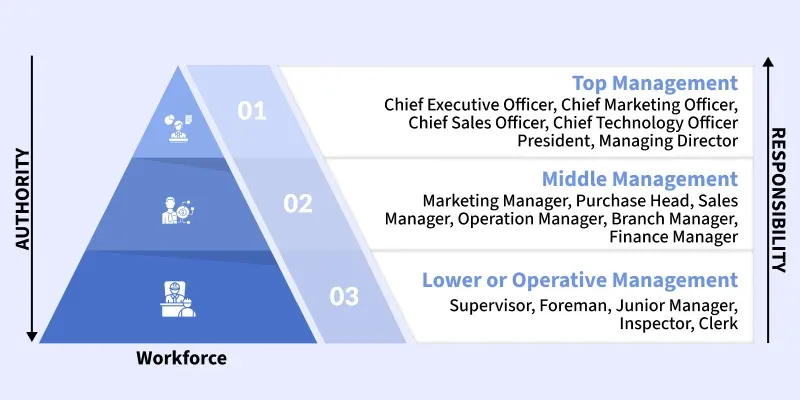
In every organisation, work is divided among different levels to ensure smooth functioning. These levels define authority, responsibility, and the role each manager performs. Management is generally classified into three levels:
Top level management
Top level management includes positions such as the Board of Directors, Chief Executive Officer and Managing Director. This level is responsible for framing the overall objectives, policies and strategies of the organisation. It takes major decisions, approves important plans and ensures that the organisation maintains good relations with the external environment. Top management also coordinates the activities of all departments and evaluates the overall performance of the organisation.
Middle level management
Middle level management consists of departmental heads such as the Production Manager, Marketing Manager, Finance Manager and other divisional or branch managers. This level acts as a link between the top and operational levels. It interprets the policies and plans made by top management and converts them into departmental plans. Middle managers assign duties to their subordinates, ensure coordination between different departments and look after the discipline and welfare of employees within their respective departments.
Operational or supervisory level management
Operational or supervisory level management consists of supervisors and foremen who directly oversee the work of workers. This level ensures that the daily tasks are carried out according to the plans made by the higher levels. Supervisors maintain the quality of output, guide workers, solve work-related problems and ensure proper use of tools, materials and machinery. They also report the performance of workers to the middle level and maintain close contact with the workforce.
Functions of Management
Management performs several essential functions to ensure that the activities of an organisation are carried out in a coordinated and efficient manner. The major functions of management are explained below.
Planning
Planning involves deciding in advance what the organisation aims to achieve and the methods it will use to reach those goals. It includes setting objectives, developing strategies, and determining the resources and actions required. Through planning, managers reduce uncertainty, prepare for future challenges and ensure that all activities move in a coordinated direction. It provides a clear sense of purpose and guides the organisation towards efficient and effective results.
Organising
Organising consists of arranging people, tasks and resources in a structured way so that work can be carried out smoothly. It involves identifying activities, grouping them into departments, assigning responsibilities and establishing authority–responsibility relationships. By creating a clear organisational structure, organising helps individuals understand their roles, promotes coordination among different units and ensures proper utilisation of resources.
Staffing
Staffing is concerned with ensuring that the organisation has the right number of qualified people in the right positions. It includes recruitment, selection, training, development and evaluation of employees. Through effective staffing, the organisation builds a competent workforce capable of achieving its goals. It also ensures that employees are placed in roles that match their abilities, leading to higher efficiency and better performance.
Directing
Directing involves guiding, supervising and motivating employees so that they work willingly and efficiently towards organisational objectives. It includes communication, leadership and motivation, which help managers influence the behaviour and performance of individuals. Directing ensures that employees understand what is expected of them, feel encouraged to give their best and maintain harmony in the workplace.
Controlling
Controlling consists of measuring actual performance, comparing it with planned targets and taking corrective action whenever required. It helps managers identify deviations, analyse their causes and ensure that activities are carried out as intended. Controlling maintains discipline, improves efficiency and enables the organisation to achieve its objectives in a consistent and reliable manner.
Coordination: The Essence of Management
Coordination is considered the essence of management because it runs through every managerial function and binds all activities together. Whether a manager is planning, organising, staffing, directing or controlling, each function requires the harmonious blending of efforts from individuals and departments. Since an organisation consists of people with different roles, abilities and interests, coordination ensures that their actions are unified and directed towards common goals. It removes duplication of work, resolves conflicts, and maintains a smooth flow of activities across all levels. In this way, coordination becomes a continuous and pervasive force that integrates all functions of management and ensures the effective and efficient achievement of organisational objectives.