
What does a Product Manager do? is the question that came to our mind, before getting into their course. In this article, we are going to learn just that, and so many things.
A Product Manager is a key role in product development and management within a company. The responsibilities of a Product Manager can vary based on the organization's structure, industry, and specific product offerings, but generally, they play a central role in guiding a product from ideation to market launch and ongoing improvement.

Table of Content
- What does a Product manager do?
- Daily Responsibilities of a Product Manager:
- Key Result Areas (KRAs) of a Product Manager
- The Business Impact of a Product Manager's Work:
- Product Manager Career Path
- Parts of the Product Manager Role
- Why Pursue a Career in Product Management?
- What is the Average Salary for a Product Manager?
What does a Product manager do?
A Product Manager is a key role in product development and management within a company. The responsibilities of a Product Manager can vary based on the organization's structure, industry, and specific product offerings, but generally, they play a central role in guiding a product from ideation to market launch and ongoing improvement. Here are the core responsibilities of a Product Manager:
Daily Responsibilities of a Product Manager
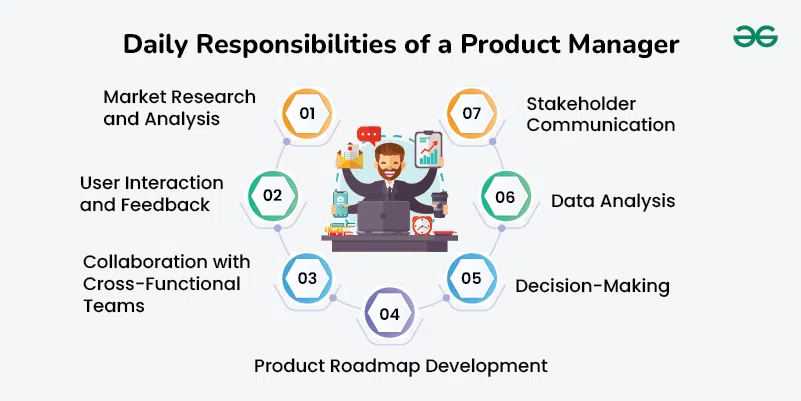
1. Market Research and Analysis
- Daily Activity: Keeping a finger on the market pulse, analyzing trends, and staying updated on competitors.
- Importance: Informs product strategy, ensuring the product remains competitive and aligned with market demands.
2. User Interaction and Feedback
- Daily Activity: Engaging with users through feedback channels, surveys, and user testing.
- Importance: Gathers insights for continuous improvement, shaping features based on user needs.
3. Collaboration with Cross-Functional Teams
- Daily Activity: Working closely with development, design, marketing, and sales teams.
- Importance: Ensures everyone is on the same page, aligning efforts to achieve product goals.
4. Product Roadmap Development
- Daily Activity: Planning and refining the product roadmap, prioritizing features.
- Importance: Guides the team, providing a clear path for development aligned with business objectives.
5. Decision-Making
- Daily Activity: Making decisions on feature priorities, trade-offs, and addressing challenges.
- Importance: Drives the product forward, adapting to changes and ensuring timely delivery.
6. Data Analysis
- Daily Activity: Reviewing product metrics, analyzing user behavior, and interpreting data.
- Importance: Informs decision-making, allowing for data-driven improvements and optimizations.
7. Stakeholder Communication
- Daily Activity: Updating stakeholders on progress, discussing strategies, and managing expectations.
- Importance: Builds trust, ensures transparency, and aligns everyone with the product vision.
Key Result Areas (KRAs) of a Product Manager
-of-a-Product-Manager.webp)
1. Product Success
- KRA: Meeting or exceeding product success metrics.
- Importance: Indicates the effectiveness of the Product Manager in delivering a successful product.
2. User Satisfaction
- KRA: High levels of user satisfaction and positive feedback.
- Importance: Reflects the product's alignment with user needs and expectations.
3. Timely Delivery
- KRA: Meeting development timelines and release schedules.
- Importance: Ensures products are delivered promptly, maximizing market opportunities.
4. Cross-Functional Collaboration
- KRA: Effective collaboration and communication with cross-functional teams.
- Importance: A cohesive team effort leads to successful product outcomes.
5. Innovation and Adaptability
- KRA: Introducing innovative features and adapting to market changes.
- Importance: Positions the product as a leader in the industry.
The Business Impact of a Product Manager's Work
A Product Manager's role is integral to the success of a business, with far-reaching impacts across various aspects:
1. Strategic Alignment with Business Goals
A Product Manager's daily tasks align with the overarching business strategy. Their ability to set a clear product vision and roadmap ensures that the product contributes directly to the achievement of company goals.
2. Market Responsiveness and Competitiveness
By staying attuned to market trends, a Product Manager positions the product to respond promptly to changes. This adaptability enhances the product's competitiveness and helps the business maintain relevance in a dynamic market.
3. Customer-Centric Approach
The daily focus on user satisfaction and continuous improvement directly impacts customer loyalty. A satisfied customer base contributes to repeat business, positive word-of-mouth, and long-term success.
4. Efficient Resource Utilization
Effective prioritization and decision-making by Product Managers lead to efficient resource utilization. This, in turn, positively impacts the company's bottom line by optimizing costs and maximizing returns.
5. Agile Innovation for Market Leadership
Product Managers who embrace Agile methodologies foster a culture of innovation. This commitment to continuous improvement positions the business as a market leader, driving growth and setting industry standards.
Product Manager Career Path
The Product Manager career path begins as Associate Product Manager, progressing to a Product Manager role, and then to Senior Product Manager in Product Management. Advancement may lead to leadership positions like Group Product Manager or Director of Production Management.
.webp)
List of Product Management Roles
- Associate Product Manager
- Product Manager
- Senior Product Manager
- Director of Product
- VP of Product
- Chief Product Officer
Parts of the Product Manager Role
Product Management encompasses various roles, each contributing to the success of a product. Here are some key roles within Product Management:
- Product Manager (PM)
- Technical Product Manager
- UX/UI Designer
- Data Analyst/Scientist
- Product Marketing Manager
- Product Owner (Scrum)
- Product Operations Manager
- Business Analyst
Why Pursue a Career in Product Management?
Here are the following Reasons for which we can pursue a career in product management:
- To make a difference in the world: Product managers are able to work on products that have the potential to significantly improve people’s lives. A product manager in the healthcare industry, for example, would be tasked with creating a piece of novel medical equipment that has the potential to save lives. Alternatively, a product manager of a firm that provides education may be involved in creating a fresh platform that would help in improving student performance.
- To be creative and innovative: Product managers never run out of ideas for new features and products. They are able to use their imaginations and think creatively. They also get to see their concepts realized and have an impact on the world.
- To solve problems: Problem-solving for users is the responsibility of product managers. They must be able to recognise and understand the demands of their consumers in order to create features and products that satisfy those needs.
- To work with a variety of people: Product managers must collaborate with engineers, designers, marketers, and sales teams, among other stakeholders. They must be able to establish relationships and speak clearly with a variety of people.
- To have a high-paying job: Product management is a high-paying job. The average salary for a product manager in the United States can lie between $70,000-$150,000.
What is the Average Salary for a Product Manager?
The Average Salary of Product Manager ranges from 13 lakhs to 30 lakhs per year, dependent on experience and skills, product managers in India earn an average of about Rs. 16,60,000 yearly. The starting salaries are sizable at 5-8 lakhs per year, profit-sharing benefits can increase starting earnings by 50,000 to 1 lakh. The compensation depends on various variables, including geography, industry, background, and firm size.
Here is a table showing the average salary for a Product Manager in rupees (INR) for the top 10 product-based companies:
| Company | Average Salary (INR) |
|---|---|
| ₹3,000,000 | |
| Amazon | ₹2,800,000 |
| Microsoft | ₹2,500,000 |
| Apple | ₹2,700,000 |
| ₹2,900,000 | |
| Adobe | ₹2,600,000 |
| Cisco | ₹2,400,000 |
| Oracle | ₹2,200,000 |
| Salesforce | ₹2,500,000 |
| IBM | ₹2,000,000 |
Note: The salaries mentioned above are approximate values and may vary based on experience, location, and other factors.
For more details Please refer this article : Product Manager Salary in India 2024