
Techniques of control are vital for effective management and achieving organisational goals. These techniques include financial control, quality control, inventory control, process control, strategic control, and personnel control.
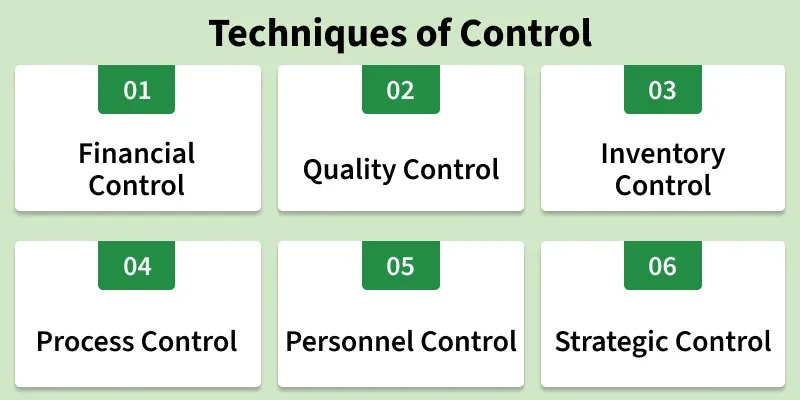
They involve managing financial resources, ensuring product/service quality, optimizing inventory levels, enhancing operational efficiency, aligning with strategic goals, and evaluating employee performance. By employing these control techniques, businesses can maintain quality, efficiency, and profitability for long-term success.
Network Techniques
Network techniques such as PERT and CPM are widely used tools in management planning and control. They assist managers in planning, scheduling, and monitoring complex projects by breaking them into smaller activities and arranging them in a logical sequence. By defining the order of tasks and setting time limits for each activity, these techniques ensure better coordination, efficient resource use, and timely completion of projects.
Characteristics of Network Techniques
- The project is divided into smaller, manageable activities to simplify planning and control.
- Activities are arranged in a logical sequence based on their interdependence.
- A network diagram is prepared to visually represent the relationships among activities.
- Careful analysis of each project component is required to ensure optimum timing.
- Activities are represented by arrows, showing the operations to be performed.
- Events are shown by circles, indicating the start or completion of activities.
Programme Evaluation and Review Technique (PERT )
Programme Evaluation and Review Technique (PERT) is an effective visual network method specifically designed for planning, monitoring, and controlling complex and unique projects. PERT offers a systematic approach that ensures project success by breaking down the entire project into smaller, manageable activities and establishing their interdependencies within a network diagram.
The process of developing a PERT involves several key steps:
Activity Breakdown: The entire project is divided into smaller and clearly defined activities. This detailed breakdown allows managers to study each task individually, understand its scope, and arrange activities in a logical sequence for better planning and control.
Interdependency Identification: The interrelationships and dependencies among various activities are carefully analysed. These relationships are then represented in the form of a network diagram, which provides a clear and complete picture of how activities are connected and how the project flows from start to finish.
Time Estimation: For each activity, three time estimates are determined: optimistic, pessimistic, and most likely time. Using these estimates helps in accounting for uncertainty and provides a more realistic and balanced estimation of activity durations.
Critical Path Determination: The critical path, which is the longest time path in the network, is identified. It represents the sequence of activities that must be completed on time for the project to finish as scheduled. Any delay in these activities directly delays the entire project.
Plan Refinement: After identifying the critical path, the project plan is reviewed and refined. Necessary adjustments are made to improve efficiency, control time, and reduce the chances of delay, ensuring smooth and timely completion of the project.
Critical Path Method (CPM)
Critical Path Method (CPM) is a project management technique that shares similarities with Programme Evaluation and Review Technique (PERT), but it also has some distinguishing characteristics:
Simplified Activity Duration: Unlike PERT, CPM assumes that the duration of each activity is fixed and known with certainty. As a result, only a single time estimate is assigned to every activity. This simplifies project planning and scheduling, as managers do not have to deal with probabilistic time estimates or uncertainty in activity completion.
Emphasis on Cost: CPM gives significant importance to cost control along with time management. It helps project managers analyse the relationship between time and cost, identify cost intensive activities, and allocate resources in an economical manner. Through techniques like cost optimisation and crashing, CPM supports achieving project objectives at the minimum possible cost.
Well-Known Activity Durations: CPM is most suitable for projects where activity durations can be accurately estimated in advance. It works effectively in situations where sufficient historical data, standardised processes, or prior project experience is available. This makes CPM ideal for routine, repetitive, or construction based projects with predictable activities.
Applications of PERT/CPM
PERT/CPM is a highly versatile and widely used tool in project management, offering numerous applications across various industries. Some of the key areas where this technique proves beneficial are:
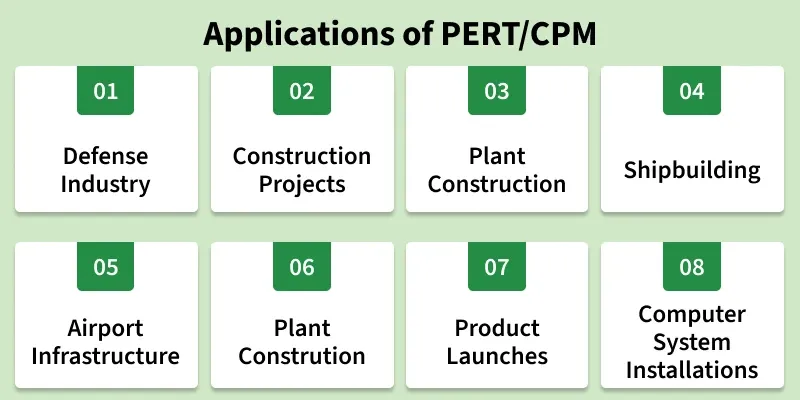
Défense Industry: PERT/CPM plays a crucial role in managing large-scale projects related to the development and production of complex weapon systems. It aids in the meticulous planning, scheduling, and coordination of activities, ensuring efficient project execution.
Construction Projects: The construction industry widely uses PERT/CPM for projects of all sizes. It helps in resource allocation, scheduling, monitoring progress, and ensuring timely completion.
Shipbuilding: PERT/CPM is applied in shipbuilding to plan and control activities like hull construction, equipment installation, and testing. It ensures smooth workflow and timely delivery.
Airport Infrastructure: It is used in airport projects for managing tasks such as terminal construction, runway development, and system installations. It improves coordination and project completion.
Plant Construction: PERT/CPM helps in planning and controlling the construction of new plants by sequencing activities, coordinating contractors, and ensuring timely project completion.
Product Launches: In new product launches, PERT/CPM supports effective planning and coordination of development, production, marketing, and distribution activities to meet deadlines.
Computer System Installations: PERT/CPM is used to manage hardware, software, and testing activities. It ensures organized execution and timely installation of systems.
Advantages of PERT/CPM
The following are the advantages of PERT/CPM:
Thorough Analysis: PERT/CPM helps managers analyse all factors affecting project completion. It identifies obstacles, uncertainties, and inefficiencies for better planning and fewer surprises.
Predictive Capability: It acts as a forecasting tool to assess the impact of schedule changes. Managers can detect potential issues early and take preventive actions to reduce risks
Focus on Critical Activities: PERT/CPM highlights critical tasks that directly affect project timelines. This helps managers prioritize resources and speed up important activities.
Enhanced Collaboration and Communication: It improves coordination between departments by clearly showing task relationships. This leads to better communication, teamwork, and overall project efficiency.
Limitations of PERT/CPM
The following are the limitations of PERT/CPM:
Estimation Challenges: One of the limitations of PERT/CPM is the inherent difficulty in accurately estimating the time and cost involved in various project activities. Estimation errors can introduce unpredictability and make the PERT chart less reliable as a control tool for effective project management.
Time-Centric Focus: PERT/CPM is primarily suited for projects where time plays a critical role. It shines in managing and controlling time-sensitive projects, but its applicability may be constrained when other factors, such as cost or quality hold greater significance in project outcomes.
Limited Applicability to Simple Projects: PERT/CPM may have limited utility in handling straightforward, routine, and repetitive projects. Its strength lies in tackling complex and unique projects that require intricate analysis and involve multiple interdependent activities. In cases of continuous processes or projects with a streamlined and predictable flow, PERT/CPM may not provide substantial advantages.