
A social audit is a systematic evaluation of an organisation’s social performance and its impact on society, assessing how well it meets its responsibilities toward stakeholders such as employees, customers, communities, and the environment. Unlike financial audits that focus on monetary outcomes, a social audit examines ethical practices, social welfare, and sustainable development. Its main purpose is to determine whether organisational activities align with social values, legal requirements, and ethical standards, while also identifying strengths, weaknesses, and areas for improvement in social responsibility. By promoting transparency and accountability, a social audit supports responsible decision-making and strengthens an organisation’s credibility and long-term sustainability.

Features of Social Audit
Social audits are comprehensive evaluations that assess an organisation's adherence to its social responsibilities, encompassing crucial aspects like environmental sustainability, ethical business conduct, and community engagement. These audits play a pivotal role in fostering responsible business practices and ensuring accountability for an organisation's societal impact. Some features of social audit are:
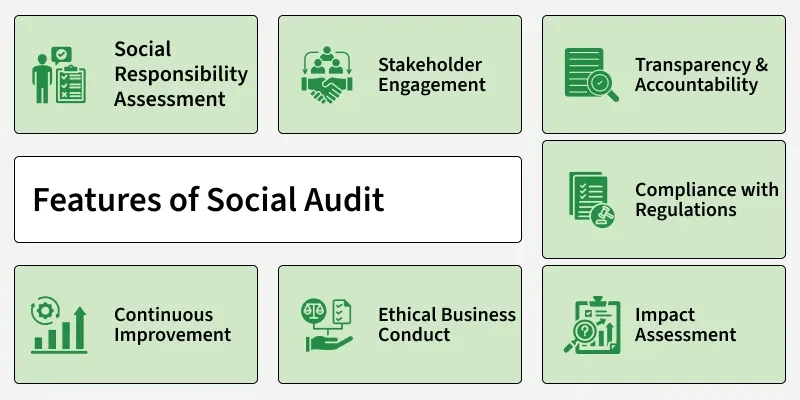
Social Responsibility Assessment: Social audits meticulously evaluate an organisation's fulfilment of its social responsibilities. This includes a thorough examination of environmental sustainability initiatives, ethical business practices, and the extent of community engagement.
Stakeholder Engagement: An integral component of social audits involves engaging various stakeholders, such as employees, customers, local communities, and non-governmental organisations (NGOs). Gathering diverse perspectives helps in comprehensively understanding the organisation's social impact.
Transparency and Accountability: Social audits prioritize transparency, requiring organisations to openly communicate about their social performance. This transparency extends to acknowledging and taking responsibility for any negative impacts resulting from their operations.
Compliance with Regulations: A critical facet of social audits is the assessment of an organisation's compliance with relevant laws, regulations, and industry standards pertaining to social and ethical practices.
Impact Assessment: Social audits aim to quantify the actual social impact of an organisation's activities. This includes evaluating both positive and negative consequences on stakeholders and the broader community.
Ethical Business Conduct: Evaluation of ethical business practices is a key focus, encompassing fair treatment of employees, ethical sourcing, and responsible marketing strategies.
Continuous Improvement: Social audits serve as a dynamic tool for organisations to identify areas for improvement in their social responsibility practices. They facilitate the implementation of changes over time, ensuring a commitment to continuous enhancement.
Benefits of Social Audit
Improved Social Responsibility: Social audits serve as a proactive tool for organisations to enhance their commitment to social responsibility. By identifying strengths and areas for improvement, companies can refine their practices and contribute positively to the well-being of society.
Enhanced Stakeholder Relations: Engaging stakeholders in the social audit process fosters a sense of inclusivity and demonstrates a commitment to transparency. This, in turn, strengthens relationships with employees, customers, communities, and other stakeholders, building trust and loyalty.
Risk Mitigation: Social audits help organisations identify and address potential risks associated with social and ethical practices. By proactively managing these risks, companies can avoid negative impacts on their reputation and financial performance.
Regulatory Compliance: Ensuring compliance with social and ethical regulations is a key benefit of social audits. Organisations can avoid legal complications, penalties, and damage to their reputation by regularly assessing and aligning their practices with relevant laws and standards.
Competitive Advantage: A positive social audit outcome can be leveraged as a competitive advantage. Consumers and investors increasingly favor businesses that demonstrate a commitment to social responsibility, making a favorable social audit an asset in a competitive market.
Items Examined in a Social Audit
A social audit evaluates an organisation’s social responsibility by focusing on the following important areas. A social audit assesses how responsibly an organisation operates by examining key social, ethical, and environmental aspects of its activities. The major items examined are as follows:
Environmental Sustainability: This includes evaluation of the organisation’s impact on the environment, such as resource usage, waste management, pollution control, and efforts to reduce carbon emissions. The audit checks whether sustainable practices are followed to minimise environmental harm.
Ethical Business Conduct: The audit examines the fairness and integrity of business practices. It focuses on ethical treatment of employees, equal opportunity policies, fair wages, supply chain ethics, and measures taken to prevent corruption and unethical behaviour.
Employee Welfare: Employee welfare covers assessment of compensation, benefits, workplace safety, and overall working conditions. The audit also considers employee satisfaction, health and safety measures, and initiatives for diversity and inclusion.
Community Engagement: This area evaluates the organisation’s relationship with the community. It includes review of community development programmes, social initiatives, philanthropic activities, and the organisation’s contribution to local economic growth.
Compliance with Laws and Regulations: The audit verifies whether the organisation complies with labour laws, environmental regulations, and industry standards. It also examines the effectiveness of systems in place to ensure legal and ethical compliance.