
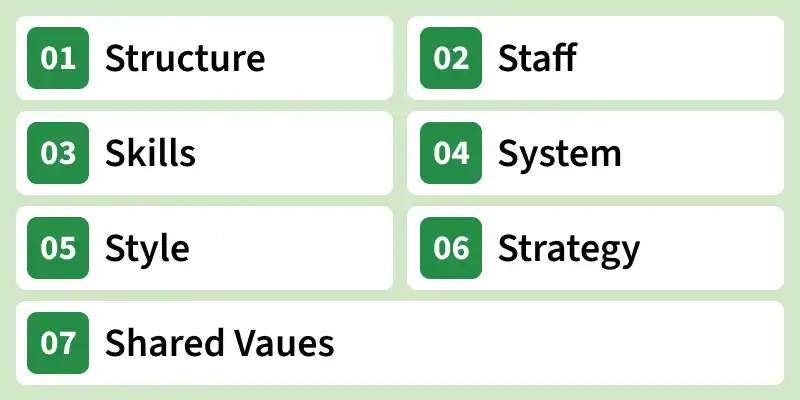
McKinsey & Company’s 7S Framework is a widely used strategic management model that helps organizations analyse internal alignment and improve overall effectiveness. The framework explains that organizational performance depends on the alignment of seven interrelated elements: strategy, structure, systems, shared values, skills, style, and staff. It emphasizes that focusing only on formal aspects like strategy and structure is not enough, as cultural and people-oriented factors are equally important for achieving organizational goals. The model was developed by consultants at McKinsey & Company, a leading global consulting firm known for advising governments, multinational corporations, and non-profit organizations on strategy, organizational design, and performance improvement. Based on its extensive consulting experience, the company created the 7S Framework to help managers understand how different internal elements must work together for successful strategy implementation and long-term organizational success.
McKinsey’s 7S Model
Shared Values
Shared values represent the core beliefs and aspirations that go beyond formal corporate objectives. They embody the mission of the organisation and are determined by the values of leaders, market demands, and competitive actions. Shared values serve as the fundamental principles around which the organisation is built.
Strategy
Strategy refers to the long-term plan adopted by an organisation after analysing its internal and external environment. It aims to improve the organisation's competitive position and can include approaches such as low-cost production, superior quality and service, or technological dominance. Continuous strategic planning and management enable organisations to adapt to environmental changes effectively.
Structure
Organisational structure defines the formal relationships and divisions of tasks within the organisation. It outlines the roles and responsibilities of different positions and establishes communication channels. Changes in strategy often require adjustments in the organisational structure. For example, a company expanding into multiple product lines may shift from a functional structure to a decentralized product structure.
Systems
Systems encompass the formal and informal rules, procedures, and processes that support the organisational structure. These can include production and planning systems, financial systems, training and development programs, and performance evaluation processes. Changes in strategy or structure often necessitate corresponding adjustments in management systems to align with the new direction.
Style
Each organisation has its own unique way of working. The style of an organisation is influenced by how top managers act over time and how people report to each other. Employees often follow the style of their leaders. According to the McKinsey model, style is not just about top management behaviour, but also about the culture of the organisation. Some organisations are friendly and open, while others are more aggressive and secretive. When companies merge, their different cultures can cause problems. Family-run businesses tend to be innovative and centralized, while professionally managed companies are more decentralized and organized. Successful organizations have clear communication, openness, a strong drive, trust in delegation, a focus on achievements, and support for new ideas. These factors contribute to the overall success of the organisation.
Staff
Staffing refers to the process of selecting individuals for specific positions within an organisation and developing their competence for effective performance. According to Waterman, it involves how organisations integrate new recruits into their activities and manage their career growth. The McKinsey study highlights that excellent companies place significant emphasis on nurturing young employees to become future leaders. These high-performing organisations value and manage their human resources in a way that instils a sense of belief among employees that they are the true contributors to the organisation's success. They attract, develop, and retain top talent by providing opportunities for career advancement, personal growth, and self-actualization.
Skills
High-performing organisations possess distinct capabilities or skills that contribute to their success. For example, Tata Engineering and Locomotive Company and Larsen and Toubro are known for their engineering skills, while Hindustan Unilever is recognized for its marketing skills. The dominant skills or distinctive competencies of an organisation play a significant role in determining its achievements. However, skills alone are not sufficient for success. What matters is the organisation's ability to effectively identify and utilize these skills to achieve its goals.
Application
Although McKinsey’s 7S Framework is not a rigid process, it is often applied in a systematic, step wise manner for analysing organisations and managing change. The following steps explain how the framework is practically used.
Step 1: Identify the Current Situation: The first step is to analyse the organisation’s existing position by examining all seven elements of the 7S Framework. Managers assess how strategy, structure, systems, shared values, skills, style, and staff currently operate and interact with one another. This helps in understanding the overall internal environment of the organisation.
Step 2: Identify Misalignments: After assessing the current situation, managers identify areas where the seven elements are not aligned. For example, the organisational structure may not support the strategy, or employee skills may not match organisational goals. Identifying such gaps is essential for diagnosing performance and coordination problems.
Step 3: Define the Desired Future State: In this step, managers determine how the organisation should ideally look in order to achieve its objectives. This involves defining the desired alignment among all seven elements, keeping long term goals and external conditions in mind. Top management usually plays a key role in deciding this optimal organisational design.
Step 4: Decide Necessary Changes: Once the desired state is defined, managers decide which elements need to be modified. Changes may involve restructuring departments, improving systems, developing employee skills, altering leadership style, or strengthening shared values. The focus is on ensuring consistency across all elements.
Step 5: Implement and Monitor Changes: The final step involves implementing the planned changes and continuously monitoring their impact. Managers ensure that adjustments in one element are supported by changes in other elements. Regular evaluation helps maintain alignment and allows timely corrective actions.