
Paul Hersey and Kenneth Blanchard developed the Life Cycle Theory of Leadership, also called the Maturity–Immaturity Theory, which explains that no single leadership style is effective in every situation. The theory states that leaders should adjust their task behaviour (guidance and direction) and relationship behaviour (support and communication) according to the maturity, ability, and confidence of their followers. They identified four leadership styles suited to different levels of follower readiness, emphasizing that effective leadership depends on matching leadership style with the needs of subordinates.
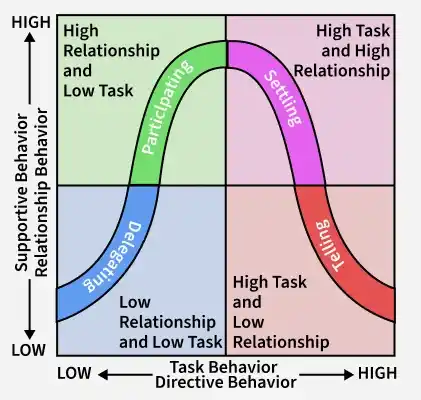
The maturity of followers refers to their readiness and ability to take responsibility for their behaviour. The theory suggests that as followers become more mature, less task behaviour and support from the leader are required. To match different levels of follower maturity, Hersey and Blanchard propose four leadership styles: Telling (S1), Selling (S2), Participating (S3), and Delegating (S4).
Telling (S1): In the Telling style (S1), leaders provide clear instructions and specific guidance when subordinates lack both the ability and willingness to take responsibility. This style suits low-maturity situations where followers require explicit direction due to their limited competence and confidence.
Selling (S2): The Selling style (S2) is appropriate when subordinates are willing but unable to assume responsibility. Leaders combine directive behaviour with support, explaining decisions and persuading followers to accept them. This approach aims to bolster willingness and enthusiasm among followers who may lack the necessary skills.
Participating (S3): When subordinates possess the ability but are unwilling (M) to carry out tasks, the Participating style (S3) is recommended. Leaders adopt a supportive and non-directive approach, fostering active listening and encouraging participation. They share decision-making responsibilities and motivate to encourage followers to overcome their reluctance.
Delegating (S4): In situations where subordinates are both able and willing (M), the Delegating style (S4) is suitable. Leaders offer minimal guidance and support, empowering subordinates to make decisions and take ownership of task execution. This style is most effective when followers are capable and motivated to assume responsibility.
The Life Cycle Theory emphasizes that the appropriate leadership style depends on the maturity level of followers. Telling style is effective for low-maturity situations, Selling style for low to moderate maturity, Participating style for moderate to high maturity, and Delegating style for high maturity. It acknowledges that there is no universal approach to influencing people, and leaders must adapt their style to align with the maturity level of their followers. The theory recognizes that the four leadership styles are not rigidly separated but rather blend into one another as the mix of task and relationship behaviours evolves. It offers valuable insights for managers, helping them determine suitable actions based on the given situation. Furthermore, the theory highlights the importance of fostering follower maturity through training and development initiatives. Many prominent companies, such as Bank of America, IBM, Carter Pillar, Mobil Oil, and Xerox, have embraced this theory as a component of their training programs, reflecting its intuitive appeal and practical application.
Advantages of Life Cycle Theory of Leadership
The Life Cycle Theory of Leadership emphasizes employee development and flexible leadership. It explains how effective leadership can help employees grow psychologically and contribute more meaningfully to organisational success.
Encourages Employee Development: The theory recognises that employees naturally progress from immaturity to maturity as they gain experience and confidence. Leaders are encouraged to provide opportunities, responsibilities, and supportive conditions that facilitate this growth.
Promotes Participative Leadership: As employees become more mature, the theory supports involving them in decision making. Participation increases motivation, commitment, and accountability, leading to better quality decisions and stronger teamwork.
Improves Job Satisfaction and Morale: By reducing excessive control and allowing autonomy, employees feel trusted and valued. This sense of independence improves job satisfaction, morale, and long term attachment to the organisation.
Enhances Organisational Performance: Mature employees are more self directed and goal oriented. When leadership aligns with employee maturity, productivity improves and organisational goals are achieved more efficiently.
Human Centric Management Approach: Proposed by Chris Argyris, the theory views employees as dynamic individuals with evolving needs. This human oriented approach supports empowerment, innovation, and sustainable organisational development.
Limitations of Life Cycle Theory (Maturity-Immaturity Theory)
Lack of empirical support: The model has not undergone rigorous scientific analysis and lacks substantial empirical evidence to validate its claims. The absence of extensive testing and refinement hinders its credibility and generalizability.
Assumption of accurate assessment: The theory assumes that leaders can accurately assess the maturity level of their subordinates. However, in reality, accurately judging the exact level of maturity can be challenging. Differences in perception and understanding between leaders and subordinates can lead to discrepancies in assessing maturity levels.
Style flexibility: The theory assumes that leaders possess sufficient flexibility to transition from high-task behaviour to high relationship behaviour as the maturity level of subordinates changes. However, in practice, leaders may encounter difficulties in adapting their leadership style effectively, particularly when conflicts or situational constraints arise.