
Lean manufacturing is a production method that improves efficiency by reducing waste and focusing only on activities that create customer value. It includes ideas like Just-in-Time (JIT), continuous improvement (Kaizen), and production leveling (Heijunka) to improve flow, reduce costs, and shorten production time. Its goal is to deliver high-quality products at lower cost and with less delay. The approach developed over time, from early efficiency ideas to Henry Ford’s production system and the Toyota Production System (TPS) created by Kiichiro Toyoda and Taiichi Ohno. It became widely known after James P. Womack popularized the term “lean” in 1991, and today it is used across many industries worldwide.
Wastes of Lean Manufacturing
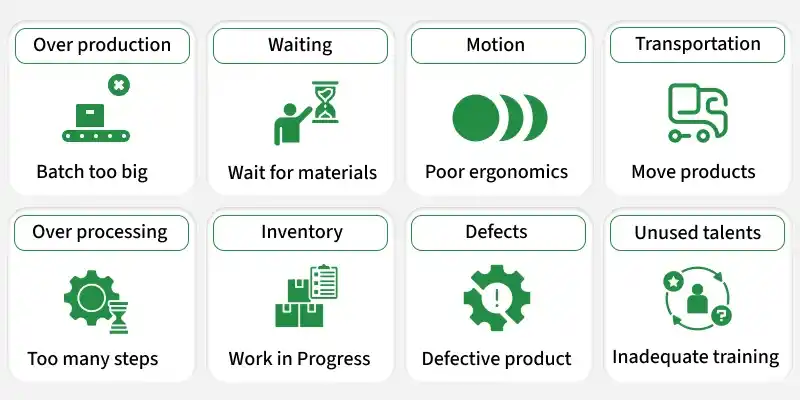
- Defects: Products with errors or poor quality that lead to rework, extra cost, and customer dissatisfaction.
- Overproduction: Producing more than required, which leads to excess stock and wasted resources.
- Transportation: Unnecessary movement of materials between locations, causing delays and added cost.
- Inventory: Excess stock that increases storage costs and may become outdated or unused.
- Motion: Unnecessary movement of workers or equipment due to poor layout or organization.
- Waiting: Idle time when people, materials, or machines are not being used efficiently.
- Over-processing: Doing extra work that is not needed to meet customer requirements, wasting time and effort.
- Unused Talent: Not using employees’ skills and ideas properly, leading to lost efficiency and innovation
Importance of Lean Manufacturing
1. Eliminating Waste: Waste in production, whether in the form of idle time, inefficient processes, or unused materials, serves as a detrimental factor for costs, deadlines, and resource utilization. The central tenet of lean manufacturing is to systematically detect and eliminate such waste, as it adds no value to the final products or services. By implementing techniques such as value stream mapping and continuous improvement processes, organizations can target and eliminate non-value-adding activities, ultimately enhancing efficiency and productivity.
2. Improving Quality: The pivotal purpose of lean manufacturing is to offer improved quality. Beyond merely eliminating defects, this principle involves designing processes that align with evolving customer expectations and desires. By incorporating customer feedback and adapting to market changes, firms can not only meet but exceed customer satisfaction. Prioritizing quality improvement not only enhances customer loyalty but also ensures a sustained competitive edge over rivals in a dynamic market where customer preferences are continually evolving.
3. Reducing Costs: Overproduction and surplus materials lead to increased storage costs, impacting the overall financial health of a manufacturing operation. Lean manufacturing addresses this issue by optimizing processes and material management, thereby limiting excess and reducing overall costs. Just-in-time manufacturing, a core element of lean philosophy, enables firms to produce goods only as needed, preventing excess inventory and associated costs. By aligning production with demand, firms can achieve significant cost savings and boost their overall financial performance.
4. Reducing Time: Inefficient working practices translate to wasted time and, consequently, wasted money. Lean Manufacturing focuses on the implementation of more efficient practices to shorten lead times. It involves streamlining processes, limiting setup times, and optimizing workflows. As a result, firms can not only save costs but also enhance their agility and responsiveness. Shorter lead times help in the swift delivery of goods and services, meeting customer expectations for faster turnaround times and positioning the firm as a reliable and efficient provider in the market.
How does Lean Manufacturing Work?
The fundamental principle of lean manufacturing is eradicating waste to perpetually enhance processes. This methodology focuses on consistently delivering value to customers by limiting waste and driving ongoing improvements. Waste encompasses processes, activities, products, or services that demand time, money, or skills without contributing tangible value to the end customer. Such waste may manifest in underutilized talent, surplus inventories, or inefficient processes and procedures. The strategic elimination of these inefficiencies aims to streamline services, cut costs, and ultimately generate savings throughout the supply chain, culminating in an enhanced and cost-effective delivery of specific products or services to customers.
Lean Manufacturing Examples
Toyota
The pioneer of lean manufacturing, Toyota, has introduced the Toyota Production System. TPS focuses on waste elimination in the manufacturing process and has become a fundamental methodology in lean manufacturing. Toyota also employs the Jidoka Methodology to limit faulty products and Kaizen for continuous improvement. Automation plays a crucial role in avoiding human error and ensuring product quality. Additionally, Toyota adopts the JIT model, producing items only when there is demand, thereby controlling inventory levels and preventing overproduction.
Harley-Davidson
Harley-Davidson's lean manufacturing strategy revolves around Total Productive Maintenance, the 5S System, and standard work to stabilize their techniques. Complementing these foundations, the firm incorporates additional lean tools, such as Kaizen and Six Sigma, to enhance operations and address challenges. Adopting just-in-time inventory management and value stream mapping permits Harley-Davidson to maintain optimal inventory levels at the right times, avoiding waste and delivering value to customers.
Nike
With nearly 800 contracted factories in its manufacturing network, Nike prioritizes consistency and waste reduction through continuous enhancement practices. In 2011, the firm introduced the Manufacturing Index, a comprehensive framework with key benchmarks and performance indicators. This initiative aims to limit miscommunications, waste, and inconsistencies across manufacturers. The index incorporates lean elements such as Just-in-Time (JIT) Production, aligning with Toyota Production System (TPS) principles.
Advantages
Waste Minimization: Lean Manufacturing stands as an effective strategy for limiting waste within production facilities, resulting in cost reduction and heightened operational efficiency. By detecting and eliminating non-value-adding activities, organizations can streamline processes, optimize resource utilization, and enhance their overall productivity.
Enhanced Customer Relationships: Lean Manufacturing emphasizes operational efficiency and proves to be a beneficial approach to customer relationships. By aligning production with the scheduled or predictable needs of loyal customers, lean manufacturing contributes to limited waste and heightened customer satisfaction. This customer-centric focus ensures that products are delivered promptly, meeting the precise demands of the consumer.
Improved Quality and Reduced Costs: A fundamental outcome of lean manufacturing is the optimization of production processes, leading to a reduction in waste and, consequently, an improvement in product quality. This simultaneous focus on quality enhancement and waste reduction contributes to an overall reduction in production costs, permitting firms to deliver high-quality products at a competitive price point.
Streamlined Design and Reduced Lead Times: Lean Manufacturing places a strategic emphasis on establishing streamlined designs and limiting lead times for finished products. Firms can attain greater efficiency in their production processes by eliminating unnecessary steps and optimizing workflows. The result is a more agile and responsive manufacturing system that can quickly adapt to changing market demands.
Disadvantages
Unique Challenges for each Organization: The drawbacks associated with lean manufacturing are inherently unique to each organization, necessitating a meticulous evaluation before implementation. The tailored nature of these challenges underscores the importance of considering individual organizational structures, processes, and goals when contemplating the adoption of lean practices.
Potential Inventory Issues: Lean Manufacturing, especially when transitioning from traditional inventory systems, can introduce challenges related to inventory management. The shift towards a just-in-time approach may necessitate adjustments in handling inventory levels and supply chain dynamics. Firms must carefully navigate potential disruptions and fluctuations in demand to avoid issues associated with understocking or overstocking.
Worker Impact: While lean manufacturing aims to streamline processes and construct a more efficient workflow, it may have implications for the workforce. The efficiency gains attained through lean practices might lead to a leaner workforce, potentially necessitating workforce reductions. This impact on personnel requires thoughtful consideration and strategic planning to limit negative effects on employees and maintain a positive organizational culture.
Implementation Challenges: The implementation of lean manufacturing is not a one-size-fits-all solution and demands a thorough analysis of both its cons and pros. Firms must weigh the potential perks against the challenges specific to their context. It's essential to recognize that lean manufacturing might not be the optimal choice for every product design or manufacturing process. Careful consideration and evaluation are crucial to ensure the implementation aligns with the firm's goals and operational requirements.
Lean Manufacturing V/S Six Sigma
Lean Manufacturing and Six Sigma are two recognized improvement methodologies used to enhance process efficiency and product quality in manufacturing and service industries. Both aim to improve business performance, but they take different approaches. Lean Manufacturing focuses on eliminating waste and improving workflow to increase speed and reduce cost, while Six Sigma revolves around reducing defects and variation through data driven and statistical problem solving.
Lean emphasizes continuous improvement by removing non value adding activities, shortening production cycles, and improving process flow to deliver greater value to the customer. Six Sigma applies structured problem solving models like DMAIC (Define, Measure, Analyse, Improve, Control) and DMADV (Define, Measure, Analyse, Design, Verify) to achieve consistent quality and near zero defect performance through measurement systems, statistical tools, and root cause analysis.
| Basis of Difference | Lean Manufacturing | Six Sigma |
|---|---|---|
| Primary Purpose | Eliminate waste and improve process flow | Reduce defects and process variation |
| Measurement Focus | Speed, flow, and waste removal | Statistical accuracy and quality measurement |
| Approach | Continuous improvement through simplification | Data driven, analytical, and systematic problem solving |
| Tools Used | 5S, Kaizen, JIT, Kanban, Value Stream Mapping | DMAIC, Root Cause Analysis, Control Charts, FMEA |
| Philosophy | Focuses on what adds customer value | Focuses on achieving near zero defects |
| Time Frame | Improvements often visible quickly | Improvements usually long term and project based |
| Skill Structure | Does not require belt-based certification | Uses belt system: Yellow, Green, Black, Master |
| Suitable For | Reducing cost, inventory, and lead time | Improving precision and reducing errors |