
The thyroid gland is a butterfly-shaped endocrine gland located in the neck, just below the larynx and in front of the trachea. It plays a vital role in regulating the body’s metabolism, growth, and development by secreting the hormones thyroxine (T₄) and triiodothyronine (T₃). These hormones control various physiological processes such as energy production, body temperature, heart rate, and overall growth and development. Therefore, the thyroid gland is essential for maintaining normal body functions and overall health.
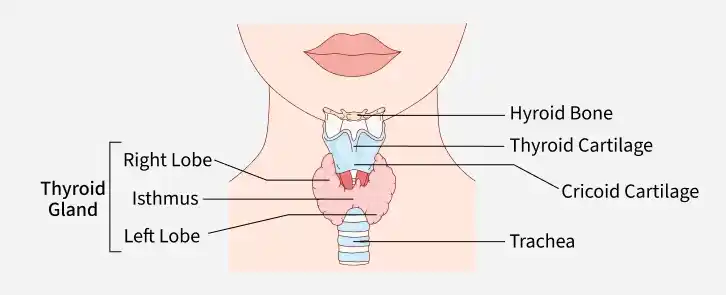
Characteristics of the Thyroid Gland
- It is the largest endocrine gland in the body.
- It is highly vascular, ensuring quick hormone transport.
- It stores hormones in the form of colloid.
- It requires iodine for hormone synthesis.
- It influences almost all tissues of the body.
Structure of the Thyroid Gland
- The thyroid gland is located in the neck, just below the larynx (voice box) and in front of the trachea.
- It is a butterfly-shaped gland consisting of two lobes connected by a thin band of tissue called the isthmus.
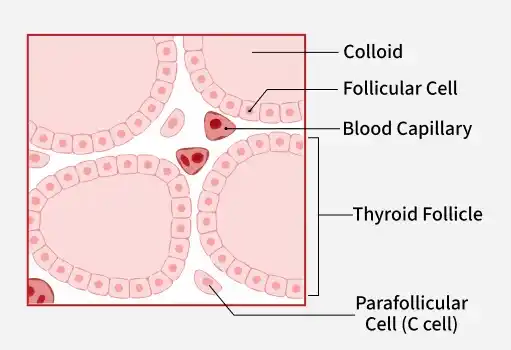
- The thyroid gland is composed of follicles and stromal tissues.
- Each thyroid follicle is composed of follicular cells, enclosing a cavity.
- The follicular cells line these follicles and are responsible for hormone production.
Hormones of the Thyroid Gland
1. Thyroxine (T₄) and Triiodothyronine (T₃)
- Regulation of the basal metabolic rate.
- Support the process of red blood cell formation.
- Control the metabolism of carbohydrates, proteins and fats.
- Maintenance of water and electrolyte balance.
2. Calcitonin
- Helps in calcium metabolism.
- Lowers blood calcium levels by promoting deposition of calcium in bones.
- Also secretes a protein hormone called thyrocalcitonin (TCT), which regulates the blood calcium levels.
Functions of the Thyroid Gland
- Regulates basal metabolic rate (BMR).
- Controls growth and development, especially of the brain.
- Maintains body temperature.
- Influences heart rate and blood pressure.
- Plays a role in calcium balance.
Disorders of the Thyroid Gland
Hypothyroidism
- Deficiency of iodine in our diet results in hypothyroidism and enlargement of the thyroid gland, commonly called goitre.
- Hypothyroidism during pregnancy causes defective development and maturation of the growing baby, leading to stunted growth (cretinism), mental retardation, low intelligence quotient, abnormal skin, deaf-mutism, etc.
Hyperthyroidism
- Due to cancer of the thyroid gland or due to the development of nodules of the thyroid gland.
- The rate of synthesis and secretion of the thyroid hormones is increased to abnormally high levels, leading to a condition called hyperthyroidism, which adversely affects the body's physiology.
Goitre
- Exophthalmic goitre is a form of hyperthyroidism.
- It is characterised by enlargement of the thyroid gland, protrusion of the eyeballs, increased basal metabolic rate, and weight loss.
- It is also called Graves’ disease.
Cretinism
- Hypothyroidism in children.
- In children, hypothyroidism causes stunted growth and intellectual disability.
Myxoedema
- Severe hypothyroidism in adults.
- In adult women, hypothyroidism may cause the menstrual cycle to become irregular.