
Reptilia is a class of cold-blooded vertebrates that includes snakes, lizards, turtles, and crocodiles. They are characterized by dry, scaly skin, respiration through lungs, and the laying of shelled eggs. Reptiles occupy a wide range of habitats, from deserts to rainforests. Many species are predators and use adaptations such as venom or strong jaws to capture their prey.
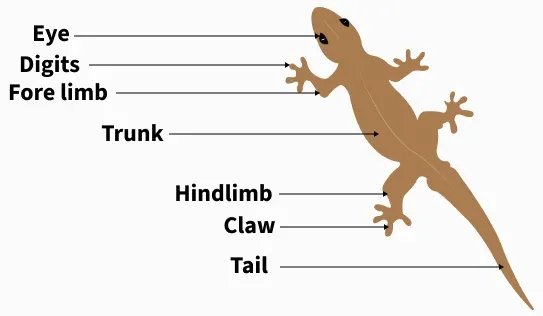
The Mesozoic Era was the “Golden Age of Reptiles.” The study of snakes is known as Serpentology or Ophiology. They are mostly terrestrial and tetrapods. Reptilia is divided into Squamata, Rhynchocephalia, Crocodilia, and Testudines. Reptilia has both ecological and economic importance.
Characteristics of Class Reptilia
The following points describe the characteristics of Reptilia:
- Reptiles are ectothermic (cold-blooded) vertebrates that obtain heat from the environment.
- Most possess a three-chambered heart, while crocodiles have a four-chambered heart.
- They are oviparous with direct development; eggs are yolk-rich and usually leathery or soft-shelled.
- Fertilization is internal.
- They have 12 pairs of cranial nerves in their nervous system.
- External ear openings are absent.
- They are uricotelic, excreting nitrogenous waste mainly as uric acid.
- The body is covered with scales containing beta keratin, and some species periodically shed these scales.
- Their skin is dry, rough, and lacks glands.
- Respiration occurs through lungs.
- The body is divided into head, neck, trunk, and tail.
- Most reptiles are terrestrial and often burrowing, and they are commonly found in warm regions of the world.
- They are tetrapods, possessing four limbs or their derivatives.
Examples: turtles, lizards, snakes, and crocodiles.
Classification of Class Reptilia
Reptiles belong to Phylum Chordata and Class Reptilia. They are cold-blooded (ectothermic), mostly terrestrial vertebrates with dry, scaly skin. Reptiles are classified into the following orders based on their body structure and habits:
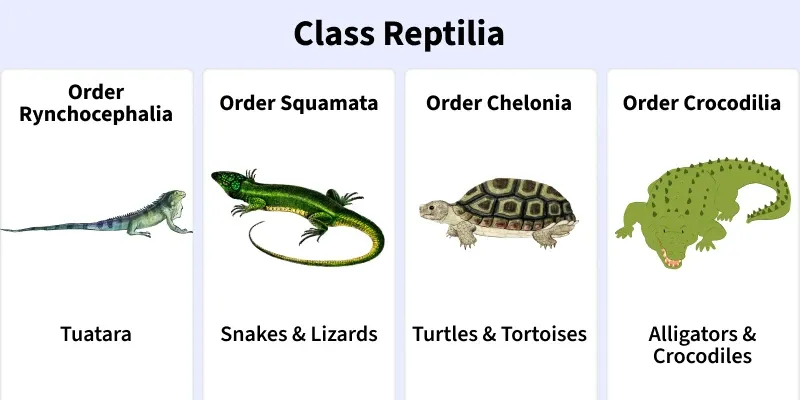
There are four major orders:
1. Squamata
- It is the largest order of reptiles
- Its body is covered with overlapping scales
- Examples: lizards and snakes
2. Rhynchocephalia
- Primitive reptiles
- It has a lizard-like body
- This order is rare and limited in distribution
- Example: Tuatara
3. Crocodilia
- This order is large and includes aquatic reptiles
- It has a four-chambered heart
- This order contains strong jaws with sharp teeth
- Examples: Crocodile, Alligator
4. Testudines
- This order has a body enclosed in a hard shell
- Teeth absent, and jaws form a beak
- Mostly aquatic or semi-aquatic
- Examples: Turtle, Tortoise
Extinct Groups of Class Reptilia
Class Reptilia once included many groups that are now extinct, as outlined below:
- Ichthyopterygia: Ichthyopterygia is an extinct order of marine reptiles that lived during the Mesozoic era. An example is dolphins.
- Archosauria: Archosauria were also known as ruling reptiles. They were the major group of diapsids. They are represented today only by crocodilians and birds
- Lepidosauria: Lepidosauria are ancestors of Squamata and the extant rhynchocephalian. The common features are overlapping scales and are also characterised by their scaly skin.
- Synapsida: Synapsids were the largest terrestrial vertebrates in the Permian period. A subclass of reptiles that includes the Pelycosauria and Therapsida.
Importance of Class Reptilia
- Lizards help in pest control by consuming insects from houses, gardens and other areas.
- Snake controls the population of Rodents.
- They help in biological research programs. Snake venom is used for the development of pain management drugs.
- Reptile skin is used in the leather industry.
- Alligators and crocodiles prevent the overpopulation of fish species.
Ecological Significance of Class Reptilia
- It plays a crucial role in maintaining ecological balance and biodiversity.
- They also help to regulate prey species and prevent unchecked population growth.
- Many reptiles also act as keystone species.
Amphibia VS Reptilia
The difference between Amphibia and Reptilia is as follows:
Amphibia | Reptilia |
|---|---|
Skin is permeable to gases and water. Skin is moist. | Skin is dry and covered in scales. |
Webbed or unwebbed feet. | Well-developed limbs are present. |
Eggs have a gel-like covering and are laid in water. | The eggs are hard and laid on nests or on land. |
They undergo metamorphosis in the larval stage. | No metamorphosis. |
They live in aquatic and terrestrial environments. | They are primarily terrestrial, but some species are adapted to other habitats as well. |
Example: Frogs and Salamanders. | Example: Lizards, turtles, snakes and crocodiles. |
Examples of Class Reptilia
Some well-known reptiles include:
- Snakes
- Lizards
- Turtles
- Crocodiles
- Alligators
- Chameleons
- Komodo dragons
- Geckos
- Iguanas
- Tuatara
Conservation Challenges for Class Reptiles
Reptiles have many ecological importance, but still face many conservation challenges:
- Habitat loss due to development.
- Climate change.
- Poaching and hunting.
- Illegal pet trade.