
Phylum Cnidaria, also known as Coelenterata, consists of simple multicellular aquatic animals that exhibit a tissue-level organisation. They are among the earliest animals to possess true tissues and a primitive nervous system. The phylum is characterised by the presence of specialised stinging cells called cnidocytes or cnidoblasts, which are used for defence and capturing prey. Most cnidarians are marine, while a few, such as Hydra, live in freshwater.
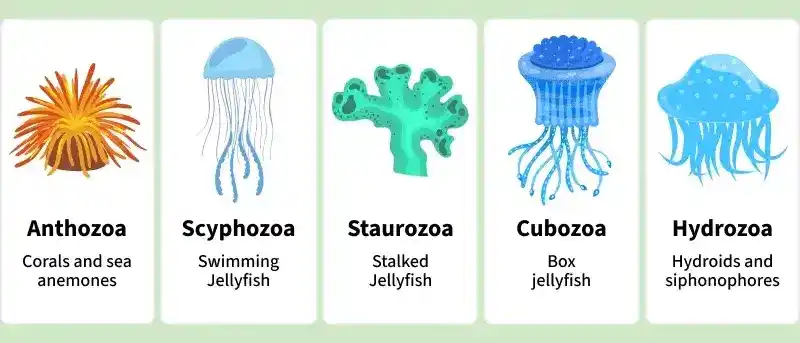
General Characteristics of Phylum Cnidaria
The members of Phylum Cnidaria possess several distinctive features that differentiate them from other animal groups.
- They are multicellular, eukaryotic, and heterotrophic animals.
- They are predominantly marine, although some freshwater forms, such as Hydra, also occur.
- They exhibit tissue-level organisation, making them the first animals to possess true tissues.
- They are diploblastic, having two embryonic germ layers, namely ectoderm and endoderm.
- A non-cellular gelatinous layer called mesoglea is present between the two germ layers.
- They show radial symmetry, allowing the body to be divided into similar halves through multiple planes passing through the central axis.
- The body cavity is called the coelenteron or gastrovascular cavity.
- They possess only one opening, which functions both as the mouth and anus.
- Digestion is both extracellular and intracellular.
- Specialised stinging cells called cnidoblasts are present on the tentacles and body wall.
- Respiration and excretion occur through simple diffusion.
- They possess a primitive nervous system consisting of a diffuse nerve net.
- Reproduction occurs by both sexual and asexual methods.
- Many cnidarians exhibit polymorphism and metagenesis.
- Some species possess a calcareous exoskeleton.
Habitat of Cnidarians
- Cnidarians are primarily aquatic organisms and are found in oceans and seas throughout the world. Most species inhabit marine environments ranging from shallow coastal waters to deep oceanic regions.
- Coral reefs, rocky shores, and open ocean waters support a large variety of cnidarian species.
- A few members, such as Hydra, are freshwater organisms and are commonly found in ponds, lakes, ditches, and slow-moving streams.
- Depending upon the species, cnidarians may be sessile, attached permanently to a substratum, or free-swimming in the water.
Tissue Level of Organisation
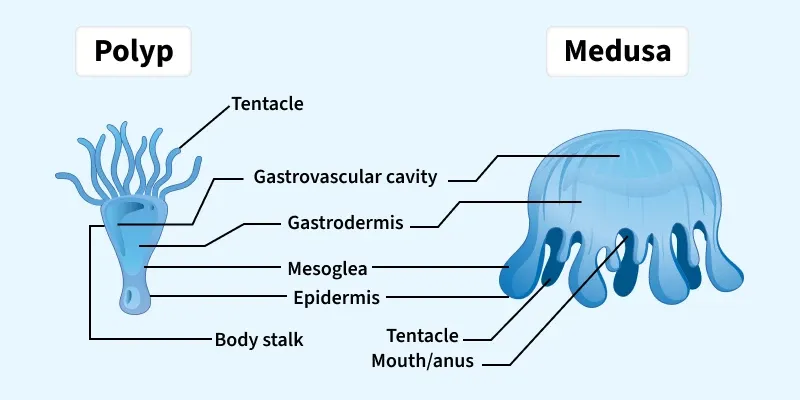
Cnidarians represent the first group of animals in which cells become organised into tissues. Unlike sponges, which possess only a cellular level of organisation, cnidarians have specialised tissues that perform particular functions. The body wall consists of two layers:
- Epidermis (Ectoderm): The outer layer of the body wall is called the epidermis. It contains protective cells, sensory cells, nerve cells, muscle cells, and stinging cells.
- Gastrodermis (Endoderm): The inner layer lining the gastrovascular cavity is called the gastrodermis. It is responsible for the digestion and absorption of food.
- Mesoglea: Between the epidermis and gastrodermis lies a gelatinous non-cellular layer known as mesoglea. It provides support and elasticity to the body.
Body Forms in Cnidaria
Cnidarians generally occur in two basic body forms.
- Polyp: The polyp is a cylindrical, sessile form attached to a substratum by its basal end. The mouth and tentacles are directed upwards.
- Medusa: The medusa is a free-swimming, umbrella-shaped form. The mouth and tentacles are directed downwards. Some cnidarians possess only one body form, whereas others exhibit both forms during their life cycle.
Cnidoblasts: The Characteristic Feature
The most distinctive feature of cnidarians is the presence of specialised stinging cells called cnidoblasts or cnidocytes. These cells contain a capsule called a nematocyst, which encloses a coiled thread containing toxins. The presence of cnidoblasts is a unique characteristic of the Phylum Cnidaria and serves as the basis for its scientific name.
Digestion in Cnidarians
Cnidarians possess an incomplete digestive system because there is only one opening that functions both as the mouth and anus. Food is captured by tentacles and brought into the gastrovascular cavity.
Types of Digestion:
- Extracellular Digestion: Digestive enzymes are secreted into the gastrovascular cavity, where food is partially digested.
- Intracellular Digestion: Partially digested food particles are engulfed by gastrodermal cells and digested within food vacuoles.
Thus, digestion in cnidarians is both extracellular and intracellular.
Respiration and Excretion
Cnidarians lack specialised respiratory and excretory organs.
- Respiration: Oxygen diffuses directly through the body surface into cells, while carbon dioxide diffuses out.
- Excretion: Nitrogenous wastes, mainly ammonia, are removed by diffusion through the body surface.
Nervous System
Cnidarians possess the first primitive nervous system in the animal kingdom. The nervous system consists of a diffuse network of interconnected nerve cells known as a nerve net. Since no brain or central nervous system is present, impulses can travel in different directions. This arrangement enables the animal to respond to external stimuli such as touch, light, and chemicals.
Reproduction in Cnidaria
Cnidarians reproduce by both asexual and sexual methods.
- Asexual Reproduction: Asexual reproduction usually occurs through budding. In budding, a small outgrowth develops on the parent body, gradually grows, and eventually separates to form a new individual.
- Sexual Reproduction: Sexual reproduction involves the formation and fusion of gametes. Male and female gametes may be produced by the same individual or by separate individuals. Fertilisation leads to the formation of a zygote, which develops into a free-swimming larval stage called the planula larva.
Metagenesis in Cnidaria
Metagenesis refers to the alternation between an asexual polyp generation and a sexual medusa generation during the life cycle. This phenomenon is known as alternation of generations or metagenesis.
Example: Obelia
- Polyp stage reproduces asexually.
- Medusa stage reproduces sexually.
- The two generations alternate regularly.
Economic and Ecological Importance of Cnidarians
Cnidarians play a significant role in aquatic ecosystems.
Beneficial Importance
- Corals form coral reefs that support marine biodiversity.
- Coral reefs protect coastlines from erosion.
- Some species are used in scientific research.
- They serve as food for many marine organisms.
- Reef ecosystems support fisheries and tourism industries.
Harmful Importance
- Stings from jellyfish and Physalia can be painful and dangerous.
- Coral bleaching affects marine ecosystems.
- Some species may cause injuries to swimmers and fishermen.