
Reproductive health refers to a state of complete physical, mental, emotional, and social well-being in all aspects of reproduction. It does not merely mean the absence of disease but includes the proper functioning of reproductive organs and a healthy approach toward sex and reproduction. According to the World Health Organisation, reproductive health ensures that individuals have a safe and satisfying reproductive life and the ability to reproduce if they choose.
According to the World Health Organisation (WHO), “reproductive health means a total well-being in all aspects of reproduction, i.e., physical, emotional, behavioural, and social”.
Contraceptive Methods
The following are the different contraceptive methods:

Temporary Methods
These are the methods that help in postponing the pregnancy till they are used regularly.
1. Natural methods
Methods that work by ensuring sperm does not meet the ovum by natural means, i.e. without using any external substance.
- Periodic abstinence: It is also called the Rhythm method. In this method, the male and female avoid coitus from day 10 to day 17 of the menstrual cycle, as this period is considered the fertile period where the chances of ovulation are high.
- Coitus interruptus: It is also called the withdrawal method. In this method, the male withdraws his penis from the female’s vagina just before ejaculation to prevent insemination.
- Lactational amenorrhea: During a 6-month lactation period after birth, prolactin levels are high in a female, which prevents ovulation; Chances of conception are low during this period.
2. Barrier methods
Methods in which an external barrier is used to prevent the meeting of sperm with the ovum.
- Condoms: It is a rubber or latex-based cover for the penis during coitus that blocks the entry of sperm into the female’s reproductive tract. Nirodh is a popular brand of condoms in India.
- Femidoms: It is the female alternative to a condom made of rubber or latex that covers the vagina and cervix in females.
- Diaphragms, cervical caps, and vaults: Cover the female’s cervix to prevent the entry of sperm. Made of rubber and reusable.
3. Chemical methods
Usually, spermicidal chemical substances are used along with or without barriers like diaphragms, cervical caps, and vaults. They can only be used if the user is non-allergic to the substance.
- Spermicidal creams, jellies, and foams: Used along with reusable barriers to increase their contraceptive capability. Consists of spermicides like lactic acid, citric acid, potassium permanganate, etc.
- Sponge: A soft foam device containing spermicide (e.g., nonoxynol) inserted into the vagina.
4. Intra-Uterine Contraceptive Devices (IUCDs)
These are plastic or metal objects that make the uterus unsuitable for implantation or the cervix hostile to sperm. They need to be inserted into the female’s genital tract by an expert medical practitioner.
- Non-medicated IUCDs: S-shaped plastic wire that increases phagocytosis of sperm by immune cells. E.g. Lippes’ loop.
- Hormone-releasing IUCDs: Contain hormones that alter the hormonal balance of the female’s body, making the uterus unsuitable for implantation and the uterus hostile for sperms. E.g. Progestasert, LNG-20.
- Copper-releasing IUCDs: These IUCDs release Cu ions that suppress sperm motility and fertilisation capacity. E.g. CuT, Cu7, Multiload 375, etc.
5. Oral contraceptive pills
These are made of small doses of either progestogens or progestogen–estrogen combinations. They are used in the form of tablets and hence are popularly called pills.
- Combined pills: Consists of synthetic progesterone and estrogen that prevent ovulation. These pills are to be taken daily for 21 days, starting preferably from the first 5 days of the menstrual cycle and then after a gap of 7 days, the same patterns are to be repeated till the desired period. E.g. Mala D and Mala N.
- Mini pills: These are mainly pills that contain progestin only and are to be taken daily.
- Saheli is a non-steroidal oral contraceptive pill, taken once a week (after initial doses).
6. Hormonal injections and subcutaneous implants
These are either injections or implants under the skin that contain either progestogens or a progestogen-estrogen combination. Their mode of action is similar to that of pills, and their effective periods are much longer.
Permanent Methods
The surgical or sterilisation methods are considered terminal methods to prevent any further pregnancy by blocking the pathway of the gamete. These methods are performed only by specialised surgeons and these methods are generally safe but may involve surgical risks such as infection, pain, or complications. There are two methods:
- Vasectomy: The surgical method in which a small section of a male’s vas deferens is cut and tied to block the pathway of sperm.
- Tubectomy: The surgical method in which a small section of a female’s fallopian tube is cut and tied to prevent the movement of the egg.

Medical Termination of Pregnancy (MTP)
The voluntary termination of pregnancy before its full term is called MTP or induced abortion. In a year, almost 45 to 50 million MTPs are performed worldwide, which is almost around 1/5th of total pregnancies in a year worldwide. In India, MTP was legalised in 1971 with strict rules to avoid misuse. The process is considered relatively safe during the first trimester, i.e., up to 12 weeks of pregnancy. Second-trimester abortions are much more risky. MTP is beneficial in conditions like:
- To avoid unwanted pregnancy due to rapes, casual relationships, unprotected sex, etc.
- When a continuous pregnancy could be harmful or even fatal to either the mother or the foetus or both.
- MTP is primarily used for medical and personal reasons, not as a population control method.
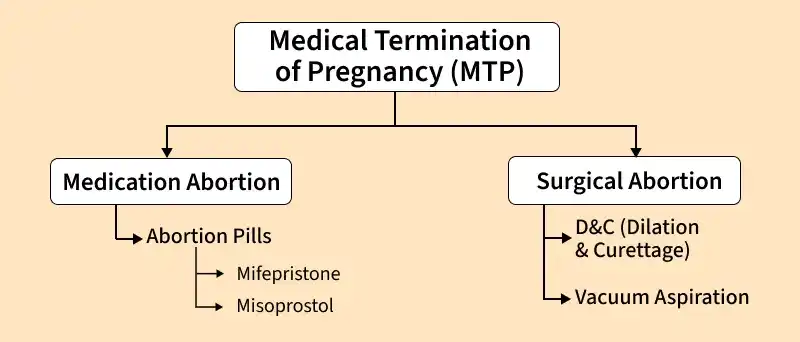
There are certain issues with MTP, these are:
- The majority of the MTPs are performed illegally by non-professional quacks, making it risky.
- Misuse causing female foeticide.
Sexually Transmitted Diseases (STDs)
These are the diseases that are transmitted through sexual intercourse. These diseases are also called venereal diseases (VD) or reproductive tract infections (RTI). Hepatitis B and HIV are also transmitted by sharing of injection needles and surgical instruments during the transfusion of blood and from the infected mother to the foetus. Some of the common STDs are:
| STD | Pathogen | Symptoms and Consequences |
|---|---|---|
| Gonorrhoea | Neisseria gonorrhoeae | Painful urination, discharge from genital organs, may cause sterility and pelvic inflammatory disease |
| Syphilis | Treponema pallidum | Sores on mouth/genitals, later affects heart and brain; can cause paralysis, miscarriage, birth defects |
| Chlamydia | Chlamydia trachomatis | Painful urination, abnormal discharge; may lead to pelvic inflammatory disease and infertility |
| Genital warts | Human papillomavirus infection | Warts on genital areas; some strains may lead to cervical cancer |
| Trichomoniasis | Trichomonas vaginalis | Itching, irritation, vaginal discharge in females; males often asymptomatic |
| Genital herpes | Herpes simplex virus | Painful blisters/sores, itching, discomfort in genital region |
| Hepatitis B | Hepatitis B virus | Liver infection, fatigue, abdominal pain, jaundice |
| AIDS | HIV/AIDS | Weak immune system, infections, weight loss, may become life-threatening if untreated |
Prevention of STDs can be achieved by:
- Always avoid sex with unknown or multiple partners.
- Always use condoms during coitus.
- In case of doubt, one should go to a qualified doctor for early detection and get complete treatment.
Infertility
The lack of ability to produce children after unprotected sexual contact for at least two years of sexual cohabitation is called infertility. The reason behind this can be physical, congenital, diseases, drugs, immunological or psychological. Specialised healthcare units called infertility clinics could help in the diagnosis and corrective treatment of some of these disorders, and if that’s not possible, then with the help of assisted reproductive technologies (ART), they can have children.
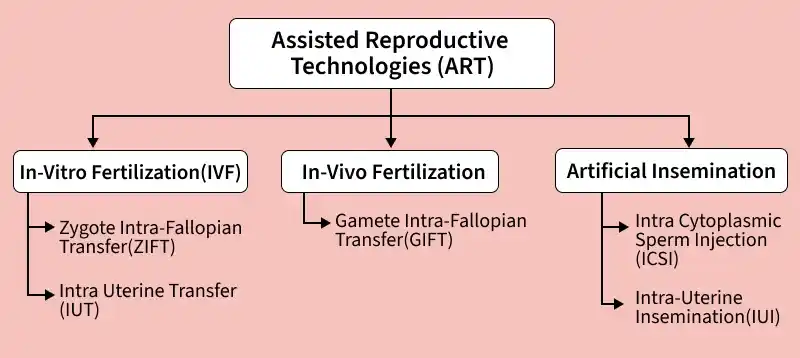
1. In vitro fertilisation (IVF)
It is the process of in-vitro fertilisation (IVF) where the male and female gametes are fertilised outside the body in a laboratory setup to form an embryo. Then embryo transfer (ET) is done in the uterus of the parental female or another surrogate female, either in two ways;
- Zygote Intra Fallopian Transfer (ZIFT): Where the embryo of 8 blastomeres stage is transferred inside the fallopian tube.
- Intra Uterine Transfer (IUT): When the embryo of more than 8 blastomeres is transferred inside the uterus.
2. In Vivo fertilisation
In vivo fertilisation refers to the process in which the fusion of male and female gametes (sperm and ovum) occurs inside the female body, specifically in the fallopian tube, under natural physiological conditions.
- Gamete Intrafallopian Transfer (GIFT): In this method, an ovum taken from a donor female is transferred to the fallopian tube of another recipient woman who is incapable of producing a functional gamete but can provide a suitable environment for fertilisation and further development.
3. Artificial Insemination (AI)
In this method, sperm collected from a husband (having low sperm count) or a healthy donor is injected into the uterus (Intra Uterine Insemination, IUI) of the female.
- Intra Cytoplasmic Sperm Injection (ICSI): In this method, the sperm is directly injected into the cytoplasm of the ovum for successful fertilisation. Then the embryo is transferred to the female either by ET or IUT.
- IUI (Intra-uterine insemination): In this method, semen is collected from a man or a healthy donor. It is finally introduced artificially into the uterus if the woman can support the compatibility for the movement of sperm into the uterus.