The Kingdom Monera comprises unicellular, prokaryotic organisms that lack a true nucleus. They are considered the oldest forms of life on Earth, and many scientists believe that more complex organisms evolved from them. In the five-kingdom classification system, living organisms are divided into Monera, Protista, Fungi, Plantae, and Animalia. Kingdom Monera includes three main groups: Archaebacteria, Eubacteria, and Cyanobacteria.
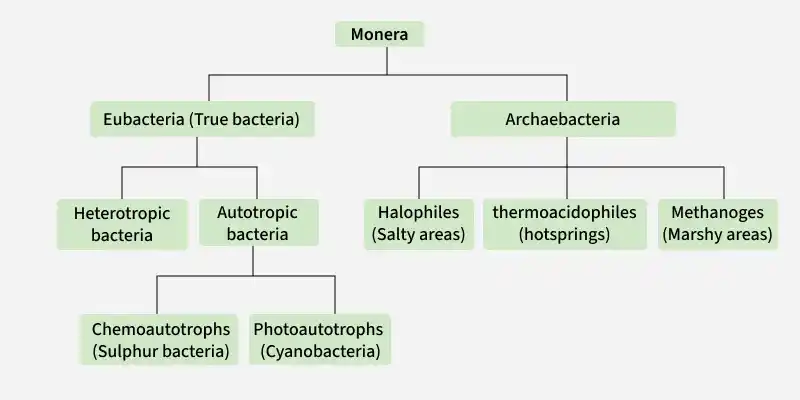
Classification of Kingdom Monera
Kingdom Monera is divided into three main groups based on structure and characteristics:
1. Archaebacteria
- It is considered an ancient prokaryote.
- Found in extreme environments: Methanogens (marshy areas), Thermophiles (hot springs), and Halophiles (high salt conditions).
- Cell wall structure differs from that of eubacteria.
- Have unique rRNA and tRNA sequences.
- Some are autotrophic, others are heterotrophic.
- Important in processes like biogas production (methanogens).
Examples: Methanobacterium, Halobacterium
2. Eubacteria (True Bacteria)
- Most common and well-known bacteria.
- Cell wall made of peptidoglycan.
- Classified as Gram-positive or Gram-negative.
- Can be autotrophic or heterotrophic.
- Exist as free-living, parasitic, or decomposers.
- Can survive in aerobic or anaerobic conditions.
Examples: Rhizobium, Pseudomonas
3. Cyanobacteria (Blue-Green Algae)
- Photosynthetic prokaryotes.
- Contain chlorophyll and perform oxygenic photosynthesis.
- Found in aquatic and moist environments.
- Some can fix atmospheric nitrogen.
Examples: Nostoc, Anabaena, Spirulina
Characteristics of Kingdom Monera
- Monerans are unicellular organisms.
- They possess 70S ribosomes.
- DNA is not enclosed by a nuclear membrane and exists as a nucleoid.
- Membrane-bound organelles (mitochondria, Golgi bodies, lysosomes, plastids, etc.) are absent.
- Reproduction mainly occurs asexually by binary fission (budding is rare).
- Most have a cell wall made of peptidoglycan (absent in Mycoplasma).
- Some possess flagella for movement.
- Exhibit diverse modes of nutrition: autotrophic, heterotrophic, saprophytic, or parasitic.
Shapes of Bacteria
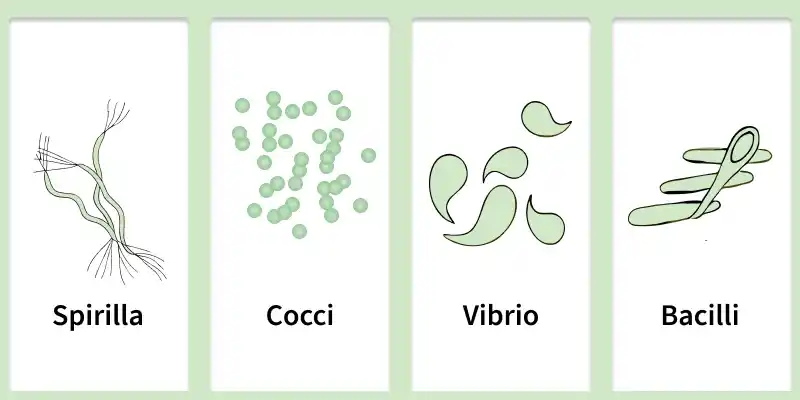
Bacteria are classified based on their shape:
- Cocci (Spherical): It is generally round-shaped and occurs singly, in pairs, chains, or clusters. Examples include Streptococcus and Staphylococcus.
- Bacilli (Rod-shaped): It is Rod-like structure bacteria and may occur singly or in chains. Examples include Escherichia coli and Bacillus are examples..
- Spirilla (Spiral-shaped): It is helical and rigid, and it moves using flagella. Examples include Spirillum.
- Vibrio (Comma-shaped): It is a curved rod-like structure that is common in aquatic environments. Examples include Vibrio cholerae.
Structure of Bacteria
Bacteria are simple prokaryotic cells with the following components:
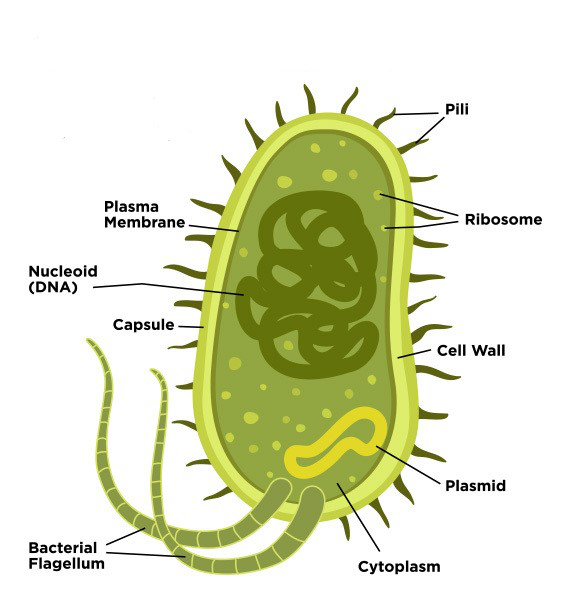
- Capsule: It is an outer protective layer that is made of polysaccharides, which prevents desiccation and phagocytosis and contributes to virulence in some bacteria.
- Cell Envelope: It is composed of three layers that are the Glycocalyx (outer layer), the Cell wall, and the Plasma membrane.
- Cell Wall: It is made up of peptidoglycan and provides shape and protection to the cell.
- Cytoplasm: It is a gel-like matrix containing enzymes, nutrients, ribosomes, and DNA Site of metabolic activities.
- Plasma Membrane: A semipermeable membrane that controls the movement of substances in and out of the cell.
- Nucleoid: It is a region containing circular DNA, not enclosed by a membrane.
- Plasmids: It is a small, circular, extrachromosomal DNA which carry genes for antibiotic resistance and other traits. It is important in genetic engineering.
- Ribosomes: 70S ribosomes made of RNA and proteins, and it is a site of protein synthesis.
- Flagella: It is a hair-like structures for movement.
- Pili and Fimbriae: Both are hair-like projections that help in attachment and conjugation (DNA transfer).