
Purines and pyrimidines are the two types of nitrogenous bases that make up the building blocks of DNA and RNA. These bases are responsible for encoding genetic information. Learning the differences between purines and pyrimidines is crucial in understanding the structure and function of DNA and RNA. In this article, we will compare and discuss the similarities and differences between purines and pyrimidines.
Table of Content
What are Purines?
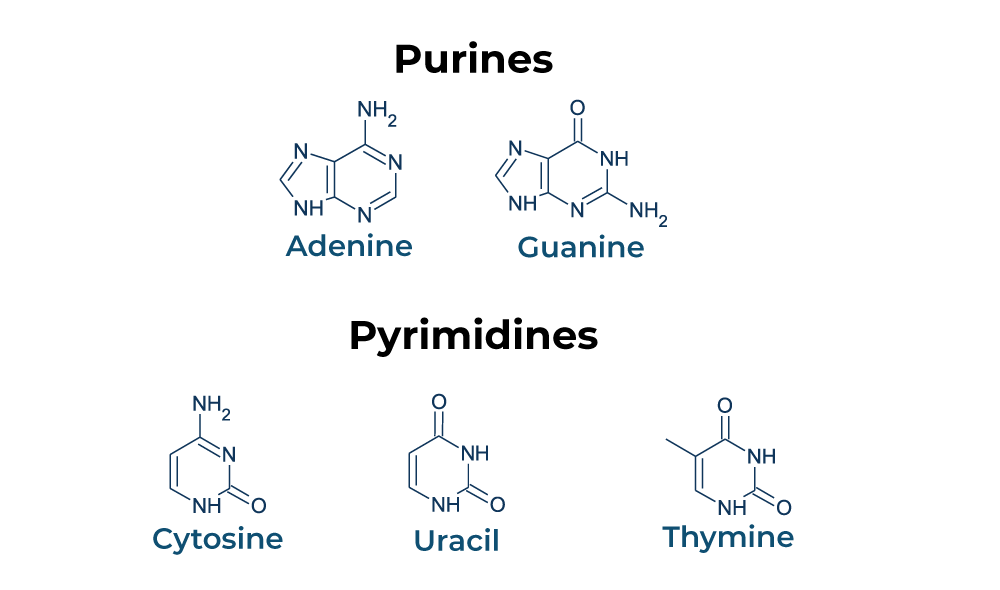
Purines are one of the two types of nitrogenous bases found in DNA and RNA. They have a double-ring structure consisting of a six-membered ring fused to a five-membered ring. The two purines found in DNA and RNA are adenine (A) and guanine (G). These nitrogenous bases are essential for the formation of hydrogen bonds between complementary base pairs, which help stabilize the double helix structure of DNA.
What are Pyrimidines?
Pyrimidines are the other type of nitrogenous base found in DNA and RNA. They have a single-ring structure consisting of a six-membered ring. The three pyrimidines found in DNA and RNA are cytosine (C), thymine (T), and uracil (U). Cytosine and thymine are found in DNA, while cytosine and uracil are found in RNA. The nitrogenous base pairing rules dictate that adenine pairs with thymine (or uracil in RNA) and cytosine pairs with guanine.
Difference between Purines and Pyrimidines
Difference between Purines and Pyrimidines class 12 are as follows:
| Characteristics | Purines | Pyrimidines |
|---|---|---|
| Structure | Contain two carbon-nitrogen rings fused together | Contain a single carbon-nitrogen ring |
| Nitrogenous Bases in DNA | Adenine (A) and Guanine (G) | Cytosine (C), Thymine (T), and Uracil (U) |
| Nitrogenous Bases in RNA | Adenine (A) and Guanine (G) | Cytosine (C), Uracil (U) |
| Base Pairing | A pairs with T (DNA) or U (RNA) and G pairs with C | C pairs with G and T (DNA) or U (RNA) pairs with A |
| Number of Nitrogen Atoms | Contain four nitrogen atoms in their structure | Contain two nitrogen atoms in their structure |
| Function in DNA/RNA | Serve as the building blocks for genetic material | Serve as the building blocks for genetic material |
| Hydrogen Bonding | Can form hydrogen bonds with pyrimidines | Can form hydrogen bonds with purines |
Similarities of Purines and Pyrimidines
Table comparing the similarities between purines and pyrimidines is given below:
| Features | Purines | Pyrimidines |
|---|---|---|
| Nitrogenous Bases in DNA | Adenine (A) and Guanine (G) | Cytosine (C), Thymine (T), and Uracil (U) |
| Chemical Composition | Contain two carbon-nitrogen rings fused together | Contain a single carbon-nitrogen ring |
| Nitrogenous Bases in RNA | Adenine (A) and Guanine (G) | Cytosine (C), Uracil (U) |
| Hydrogen Bonding | Can form hydrogen bonds with pyrimidines | Can form hydrogen bonds with purines |
| Function in DNA/RNA | Serve as the building blocks for genetic material | Serve as the building blocks for genetic material |
| Number of Nitrogen Atoms | Contain four nitrogen atoms in their structure | Contain two nitrogen atoms in their structure |
Conclusion - Difference Between Purines And Pyrimidines
Purines and pyrimidines are the two types of nitrogenous bases found in DNA and RNA. Purines have a double-ring structure and consist of adenine and guanine, while pyrimidines have a single-ring structure and consist of cytosine, thymine, and uracil. Learinng the difference between purines and pyrimidines is crucial in understanding the structure and function of DNA and RNA. The base pairing rules between purines and pyrimidines are essential for the replication and transcription of genetic material.
Also Read: