
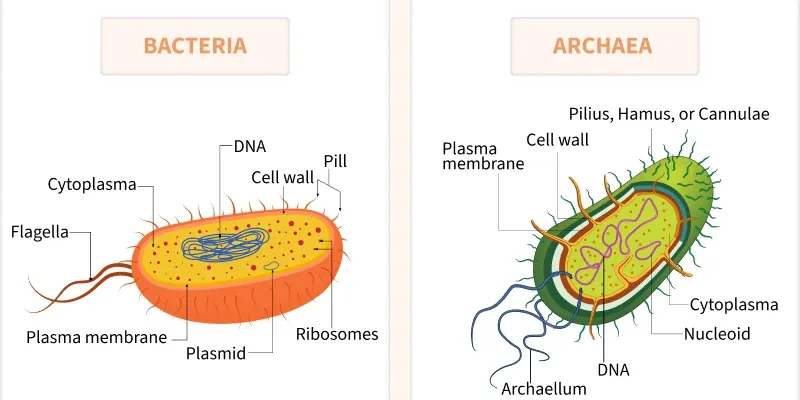
Archaea and bacteria are both single-celled microorganisms, but they differ in genetic makeup, membrane structure, and habitat. Archaea often thrive in extreme environments like hot springs and acidic conditions, while bacteria can be found in diverse habitats, including soil, water, and human bodies.
Archaea
Archaea are single-celled microorganisms. They possess a structure similar to bacteria but are evolutionarily different from bacteria.
Characteristics of Archaea
- Archaea is derived from the Greek word archaios, which means primitive or ancient.
- Many archaea are found in extreme habitats, such as high pressure and salt conditions. Thus, some archaea are also known as extremophiles.
- Archaea sometimes live in association with eukaryotes.
- Some archaea are in symbiotic relationships with sponges, and methanogenic archaea are found in the digestive system of some animals.
- A few examples of archaea are Lokiarchaeota and Methanobrevibacter smithii.
Also Read: Archaebacteria
Role of Archaea
The role of archaea is:
- They help in digestion.
- They help in ammonia fixation.
- They remove hydrogen in the carbon cycle.
- They help with global nutrient cycling.
Also Read: Difference between Bacteria and Amoeba
Bacterium
Bacteria are single-celled organisms that can be found in various environments. They can be both beneficial and harmful.
Characteristics of Bacteria
- Bacteria also play crucial roles in processes like digestion and decomposition, and cause diseases.
- The cell wall of bacteria is made up of peptidoglycan.
- Bacteria can survive in extreme conditions as well.
- Bacteria are classified into 4 groups depending on their shapes, i.e. spherical (Cocci), Spiral (Spirilla), Rod (Bacilli), and Comma (Vibrio).
- A few examples of bacteria are Campylobacter, E. Coli, Norovirus and Salmonella, and a few of the useful bacteria are Lactobacillus, Actinobacteria and Escherichia Coli.
Also Read: Eubacteria
Role of Bacteria
The role of bacteria is:
- It helps to degrade food or act as a decomposer.
- It helps to neutralise toxins.
- It enhances soil fertility.
- It helps in industrial production.
Also Read: Difference Between Aerobic And Anaerobic Bacteria
Archaea VS Bacteria
The differences between Archaea and Bacteria are stated below:
Characteristics | Archaea | Bacteria |
|---|---|---|
Types |
|
|
Metabolism Activity | Glycolysis and Citric Acid Cycle (Modified form) | Glycolysis and Citric Acid Cycle |
Cell Wall | Pseudopeptidoglycan | Peptidoglycan/ Lipopolysaccharide |
Thriving Habitat | They can thrive in extreme environmental conditions such as deep-sea vents, the guts of humans, hot springs and marshlands. | They are found in hot springs, radioactive wastes, soil, organic matter and the earth's crust. |
Cell Membrane | Ether-linked lipids | Ester linked lipids |
Method of Reproduction | Archaea reproduce asexually by the processes of fragmentation, budding and binary fission. | Bacteria produce spores |
Number of RNA present | Three RNA | Single RNA |
Presence on Introns | Introns are present in the chromosomes of archaea | Introns are absent in the chromosomes of bacteria |
Presence of Thymine | Thymine is present in tRNA | |
Photosynthesis | Archaea don't perform photosynthesis | Many bacteria perform photosynthesis |
Pathogenicity | Archaea are not pathogenic | Bacteria are pathogenic |
Similarities Between Archaea and Bacteria
Although there are differences between Archaea and Bacteria, they have some similarities too:
- Both of them are the same in shape and size.
- Both of them lack a well-defined nucleus.
- Both of them are unicellular.
- They look morphologically similar.