
Calvin Cycle is the biochemical pathway in the plants responsible for synthesizing glucose using carbon dioxide and the energy obtained from sunlight. The Calvin cycle steps include carbon fixation, reduction, and regeneration. The final Calvin Cycle product is glyceraldehyde-3-phosphate (G3P) molecules. The cycle helps plants store energy and form sugar, supporting their growth and survival. This article covers the Calvin Cycle explained - definition, steps, diagram, and products.
Table of Content
What is the Calvin Cycle?
Calvin Cycle Definition: Calvin cycle or C3 cycle is defined as the series of chemical reactions performed by the plants to reduce carbon dioxide and hydrogen-carrying compounds into glucose.
The Calvin Cycle is also known as the Calvin-Benson Cycle or the C3 cycle. It is a metabolic pathway that occurs in the chloroplasts of plants and certain types of bacteria during the process of photosynthesis. It is also known as a light-independent or dark reaction. The Calvin Cycle is found in all photosynthetic eukaryotes as well as numerous photosynthetic bacteria. The Calvin cycle location is in the stroma of the chloroplasts in plant cells.
The Calvin Cycle was discovered by Melvin Calvin and was named after him. The Calvin cycle uses ATP and NADPH to convert carbon dioxide and water into organic compoundsthat can be used by the organism. Although it is called a dark reaction it does not take place in the dark or the night. It is called so because it requires NADPH, which is short-lived and comes from light-dependent reactions.
Products (ATP and NADPH) of light-dependent reactions are taken by the cycle for further chemical processes. Therefore, the Calvin cycle occurs in the light, independent of the kind of photosynthesis (C3 carbon fixation, C4 carbon fixation, and CAM). This reaction is also called carbon fixation reaction. The enzyme that plays the key role is known as RuBisCO.
Calvin Cycle Diagram
Different stages of C3 cycle are shown below in the diagram; including carbon fixation, reduction, and regeneration.
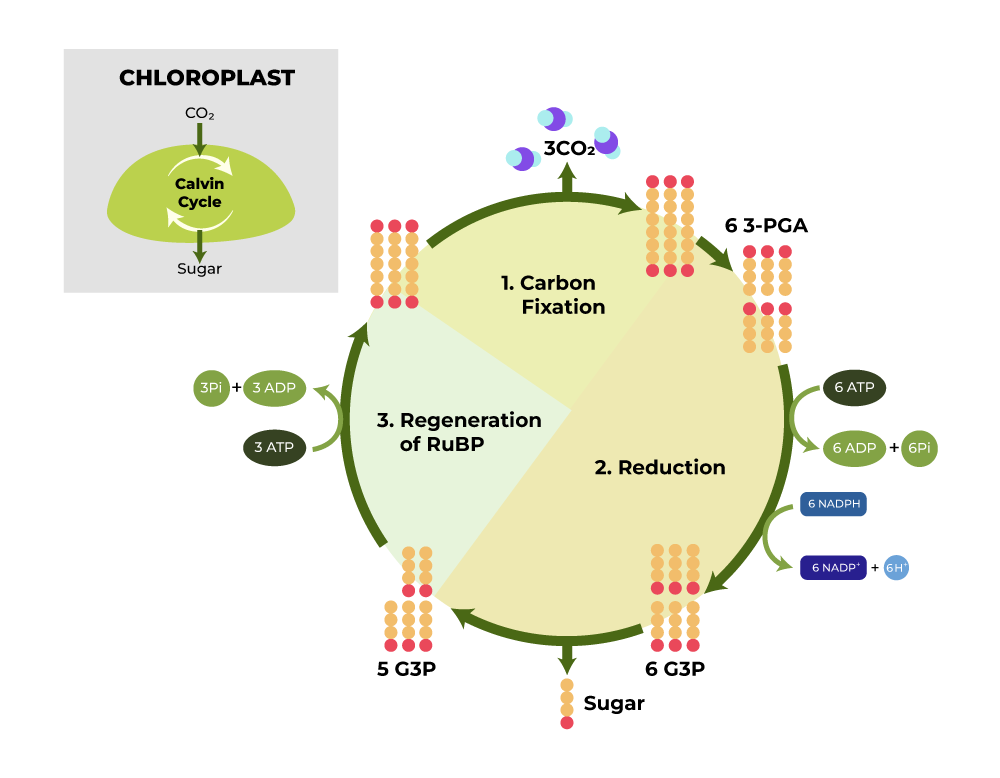
Steps of Calvin Cycle
The Calvin Cycle that takes place in the stroma of chloroplasts during photosynthesis. It converts carbon dioxide and energy from light-dependent reactions into glucose and other sugars. The Calvin cycle steps are as follows:
Stage 1: Carbon Fixation
- Carbon dioxide (CO2) from the atmosphere is combined with ribulose-1,5-bisphosphate (RuBP) which is a five-carbon compound.
- The enzyme ribulose-1,5-bisphosphate carboxylase/oxygenase (RuBisCO) catalyzes this reaction.
- The six-carbon compound splits into two three-carbon molecules, 3-phosphoglycerate (3-PGA).
Stage 2: Reduction
- ATP and NADPH generated in the light-dependent reactions provide energy and electrons.
- A series of chemical reactions convert each molecule of 3-PGA into another three-carbon molecule, glyceraldehyde-3-phosphate (G3P).
- This step involves phosphorylation and reduction processes.
Stage 3: Regeneration of RuBP
- Some of the G3P molecules produced in the previous step are used to regenerate RuBP, the starting molecule of the cycle, and some of the G3P molecules are used to produce glucose.
- This is important to keep the cycle running and continue carbon fixation.
Calvin Cycle Equation
6 CO2 + 18 ATP + 12 NADPH + 12 H2O → C6H12O6 (glucose) + 18 ADP + 18 Pi+ 12NADP+ + 6 H2O
Calvin Cycle Products
The products of C3 cycle are important molecules that serve as energy compounds for the plant's growth and survival. The primary end product of the Calvin Cycle is glyceraldehyde-3-phosphate (G3P), a three-carbon sugar molecule. The products of Calvin cycle are as follows:
- One turn of the Calvin cycle produces one molecule of carbon dioxide.
- A glucose molecule is formed by combining two molecules of glyceraldehyde-3 phosphate.
- Three turns of the Calvin cycle produce one molecule of glyceraldehyde-3 phosphate.
- In the reduction of 3-phosphoglyceric acid to glyceraldehyde-3 phosphate and the regeneration of RuBP, 3 ATP and 2 NADPH molecules are used.
- In the production of 1 glucose molecule, 18 ATP and 12 NADPH are consumed.
Regulation of Calvin Cycle
The regulation of the Calvin Cycle takes place in the following way:
- The Calvin Cycle reactions do not occur at night or in the dark. The cycle's enzymes are regulated by light, especially because the third step requires NADPH.
- Two regulatory systems control when the cycle starts or stops: the thioredoxin/ferredoxin system activates some enzymes, and the RuBisCo enzyme has its activation process involving an activase.
- The thioredoxin/ferredoxin system activates important enzymes in the cycle like glyceraldehyde-3-P dehydrogenase, fructose-1,6-bisphosphatase, and others. This occurs when light is present and ferredoxin, a protein, gets reduced in the thylakoid electron chain
- In the RuBisCo enzyme, a specific lysine amino acid needs to be carbamylated for activation. RuBisCo activase helps this process by enabling the binding of carbon dioxide. Magnesium ion, necessary for RuBisCo's function, is released from the thylakoid lumen due to proton pumping from the electron flow.
- RuBisCo activase is activated by high ATP concentrations caused by phosphorylation in the stroma.
Functions of Calvin Cycle
The Calvin Cycle performs important functions within the process of photosynthesis, contributing to the overall energy production and growth of plants. Some of the functions of the Calvin Cycle are as follows:
- The primary function of the Calvin Cycle is to fix carbon dioxide from the atmosphere which through a series of chemical reactions is converted to organic molecules like glucose.
- The Calvin Cycle produces glyceraldehyde-3-phosphate (G3P), which can be used to synthesize glucose and other sugars. Glucose is a key source of energy and serves as a storage molecule for later use by the plant.
- The Calvin Cycle is regulated by light-dependent reactions and functions when ATP and NADPH are available. This allows plants to optimize carbon fixation based on the availability of energy from sunlight.
- Organic molecules from the cycle contribute to the synthesis of amino acids, lipids, and other organic molecules required for growth and repair.
- The regeneration of ribulose-1,5-bisphosphate (RuBP) is required for the initial step of carbon fixation, ensuring that the cycle can continue functioning.
Importance of Calvin Cycle
Some of the importance of the Calvin Cycle is as follows:
- Converts carbon dioxide and energy into glucose, which is a fundamental energy source for plants.
- As it is regulated by light-dependent reactions, it optimizes carbon fixation based on sunlight availability.
- It forms the base of the food web or chain by providing energy for plant-eating organisms and higher trophic levels.
- It generates organic molecules that are precursors for amino acids, lipids, and other organic molecules vital for growth and development.
- Stores energy in the form of sugars, providing resources for growth, reproduction, and metabolic processes.
Conclusion: Calvin Cycle
Calvin cycle is also known as C3 cycle. In this cycle, carbon from carbon cycle is fixed into sugars. Calvin cycle steps include: Carbon Fixation, Reduction and Regeneration of RuBP. The Calvin cycle end product is glyceraldehyde-3-phosphate (G3P), a three-carbon sugar molecule. This serve as energy compounds useful in plant growth. The Calvin Cycle diagram is useful in understanding the complex cycle.
Also Read: