
The Kingdom Animalia was one of the five kingdoms in the classification system proposed by R.H. Whittaker. The animal kingdom is a diverse and vast biological kingdom consisting of multicellular, eukaryotic organisms. The classification of animals is based on various criteria, including the arrangement of cells, body symmetry, the nature of the coelom, and patterns of digestive, circulatory, or reproductive systems.
.png)
The animal kingdom is primarily classified into two main groups vertebrates (animals with a backbone) and invertebrates (animals without a backbone), with further subdivisions into various phyla based on anatomical and genetic traits.
Characteristics of the Animal Kingdom
Characteristics of the Animal Kingdom are:
- The basic fundamental features, such as level of organisation, symmetry, cell organisation, coelom, segmentation, notochord, etc., have enabled us to broadly classify the animal kingdom.
- The animal kingdom contains all the animals from the simplest to the most complex.
- Animals are multicellular organisms that are capable of movement, either actively or passively.
- They are heterotrophic, i.e., they obtain their energy by consuming other organisms or organic matter.
- The animal kingdom is divided into many phyla, each with its unique characteristics and adaptations.
- Some of the most well-known phyla include the arthropods, which include insects, spiders, and crustaceans, and the chordates, which include vertebrates like fish, amphibians, reptiles, birds, and mammals.
Classification of the Animal Kingdom
Animals included in the animal kingdom are eukaryotic organisms. Animals have been categorised into two primary categories in the animal kingdom based on the presence or absence of a backbone or spinal column, as Chordates and Non-Chordates.
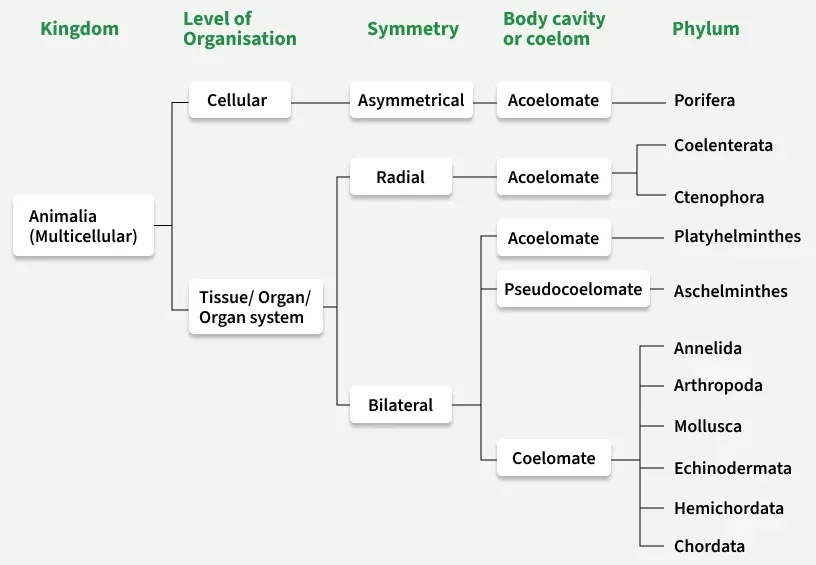
The animals are further classified into various phyla depending on their characteristics:
1. Phylum Porifera
Phylum Porifera consists of the simplest multicellular animals. The name Porifera means “pore-bearing,” indicating that organisms of this phylum possess numerous pores on their body surface called ostia. These organisms are simple, aquatic animals commonly known as sponges. Phylum Porifera includes more than 5,000 species.

The characteristics of the organism are as follows:
- These are the first multicellular organism that has pores on their body.
- They lack true tissues and organs
- The poriferans have loosely organised cells.
- Mostly found in marine water.
- In ancient times, these were recognised as plants because of their green colour and their relation to algae. Later on, after the discovery of their life cycle and feeding habits, they were put under the animal kingdom.
- Poriferans don’t have any organs in their body.
- Examples are Sycon, Hylonema, Spongilla, and Euplectella.
2. Phylum Coelenterata
The simplest form of tissue organisation is found in the Phylum Coelenterata, which has only two layers of cells with radial symmetry.
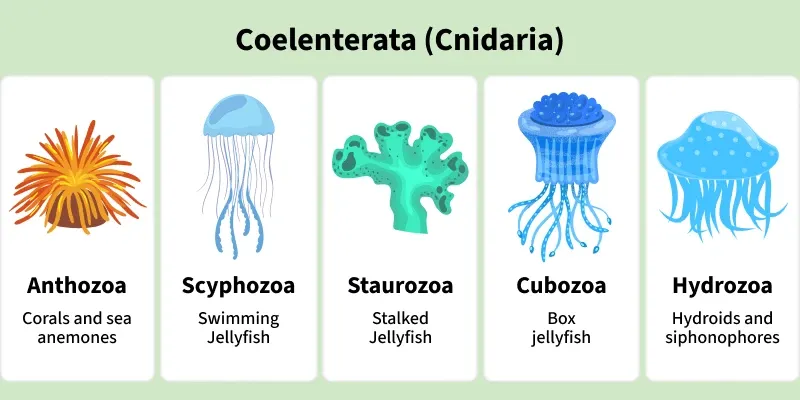
They have the following characteristics:
- They do not have an organised circulatory system. Circulation happens through diffusion between the layers of the tissues.
- They exhibit radial symmetry and possess specialised stinging cells called cnidocytes.
- They have a central gastrovascular cavity with a single opening serving as both the mouth and anus.
- These are mostly found in marine water.
- Most coelenterates have tentacles that are armed with cnidocytes to capture and immobilise prey.
- Coelenterates have both modes of digestion, i.e., intracellular and extracellular.
- Respiration and excretion are done by simple diffusion.
- Reproduction can be asexual through budding or fragmentation, and sexual reproduction occurs in some species through the release of gametes.
- They can regenerate lost body parts, making them resilient to physical damage.
- Examples are Moon jelly, Lion’s mane jellyfish, Barrel jellyfish, and Portuguese man-of-war.
3. Phylum Ctenophora
Ctenophora are the largest animals that swim using cilia. They exhibit radial symmetry, with body parts arranged around a central axis in a circular or comb-like pattern.
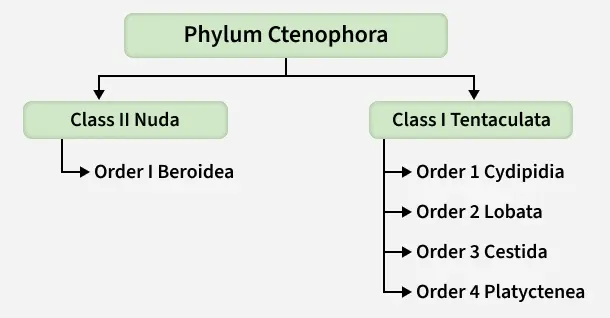
They show the following characteristics:
- These organisms have two layers of cells, which are thicker at the outer part, and their bodies consist of a jelly mass.
- Many ctenophores are bioluminescent, producing light to attract prey or deter predators.
- Different types of body forms are found in this phylum, like egg-shaped cydippids with retractable tentacles, flat, large-mouthed beroids, etc.
- They have a simple digestive system with a mouth and an anal pore, and some species have a branched, tree-like digestive system.
- Ctenophores are carnivorous and feed on zooplankton, small fish, and other small aquatic organisms.
- They possess a simple nerve net that allows for basic coordination and responses to stimuli.
- The distinguishing feature of ctenophores is that they have colloblasts, i.e., sticky and adhere to the prey, but some species lack these colloblasts.
- They reproduce through external fertilisation, releasing gametes into the water.
- They are diploblastic. But according to some, they are known as triploblastic because they have complex muscles that arise from the middle cell layers.
- Examples are Nuda, Tentaculata, Bathocyroe, Dryodoridae, etc.
4. Phylum Platyhelminthes
The Phylum Platyhelminthes organism shows bilateral symmetry. They are soft-bodied invertebrates and are known as flatworms. They are primarily parasitic or free-living and thrive in aquatic or moist environments.
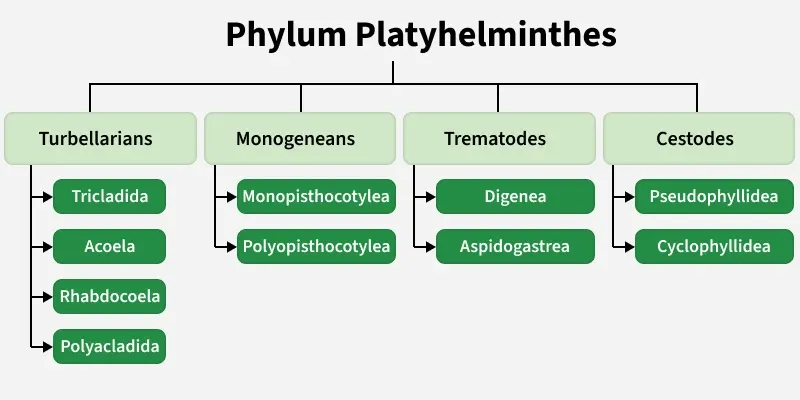
They show the following characteristics:
- They have a flat, ribbon-like body shape, which gives them their common name, "flatworms."
- Flatworms lack a coelom (body cavity), and they don’t have any specialised organs for respiration and circulation.
- They possess a branched, sac-like gut with a single opening that serves as both the mouth and anus.
- Mostly, Platyhelminthes are free-living or parasitic in nature.
- Flatworms have a ladder-like nervous system with paired longitudinal nerve cords and ganglia (clusters of nerve cells) that allow for basic sensory perception and coordination.
- They are triploblastic and don’t have cilia for movement.
- Both male and female organs are present in the same body, so are hermaphrodites. They can reproduce asexually as well as sexually. Sexual reproduction is done by the fusion of gametes, and asexually, it is done by fission and regeneration.
- For excretion, they have flame cells. Flame cells are also helpful in osmoregulation. They have a ladder-like nervous system.
- Flatworms have a remarkable ability to regenerate lost body parts, and in some cases, a complete individual can regrow from a small fragment.
- Examples are Tapeworms, Turbellaria, Flukes, Monogenea, etc.
5. Phylum Aschelminthes
Phylum Aschelminthes shows many similarities with the Platyhelminthes. This phylum has the characteristic of having a pseudocoelom.
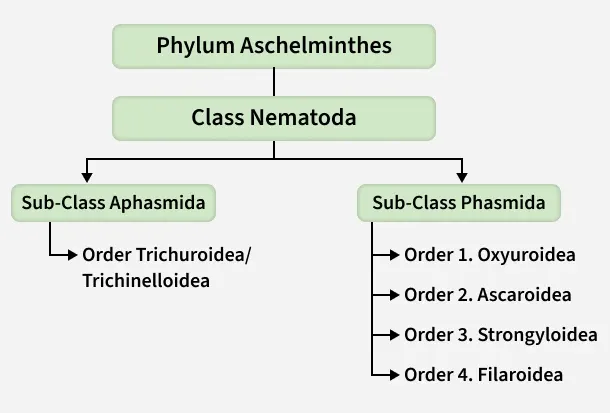
They possess the following characteristics:
- Usually, Aschelminthes are free-living organisms. In the human intestine, Ascaris lives as an endoparasite.
- They have a fluid-filled body cavity called a pseudocoelom that surrounds their internal organs.
- They are triploblastic, bilaterally symmetrical, unsegmented, slender, long, and taper at the end.
- They have a mouth and a separate anus, with a complete digestive system.
- Aschelminthes does not have metameric segmentation.
- They have a simple nervous system with a nerve ring around the pharynx and longitudinal nerve cords.
- They have an organ-system level of organisation.
- The reproduction mode is sexual, and the fertilisation is internal. Development can be direct or indirect through the larval stage.
- Examples are Human pinworm, Heartworm, Threadworm, Human whipworm, etc.
6. Phylum Annelida
Phylum Annelida organisms are usually known as segmented worms or ringed worms. Annelids have a segmented body, with each segment typically being repeated along the length of the animal. These are triploblastic and coelomates.
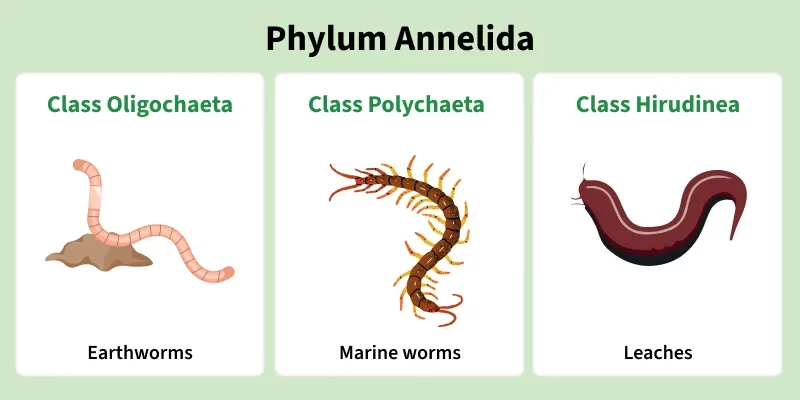
They show the following characteristics:
- Annelids have a true coelom, a fluid-filled body cavity surrounded by mesodermal tissue.
- Respiration is done through the body surface, and for excretion, they have nephridia as excretory organs.
- Annelids have a closed circulatory system, with blood contained within vessels.
- They possess a complete digestive system with a mouth and an anus, allowing for efficient food processing.
- A common process in annelids is regeneration.
- Most annelids have setae, which are bristle-like structures on their body segments. These aid in locomotion and anchor the worms.
- Annelids can reproduce both sexually and asexually. Some reproduce by budding or fragmentation.
- They have haemoglobin, due to which they have a red colour.
- Examples are Earthworms, leeches, Bobbit worms, and Polychaete.
7. Phylum Arthropoda
Phylum Arthropoda is the largest and most diverse phylum in the animal kingdom, containing a wide variety of invertebrate animals. Their name itself represents jointed appendages.
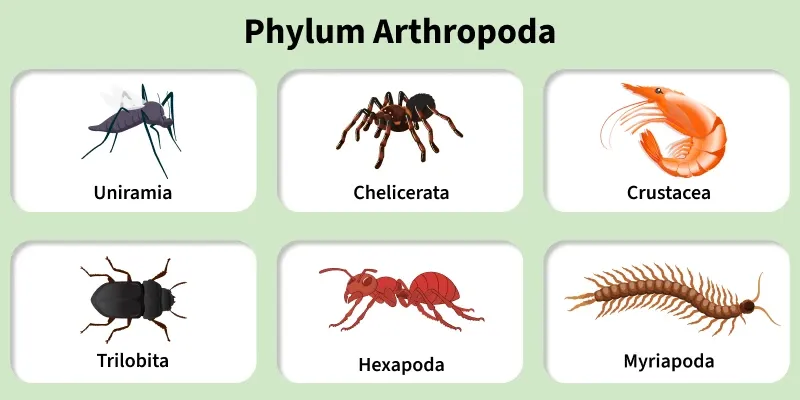
They show the following characteristics:
- Arthropods have an external skeleton made of a tough, flexible material called chitin, which provides protection and support. They have a segmented body.
- Arthropods have jointed appendages, including legs and antennae, that enable them to move and interact with their environment.
- They are bilaterally symmetrical.
- Arthropods have a true coelom (body cavity) surrounded by mesoderm.
- Arthropods have various respiratory structures, including gills, tracheae, book lungs, and cutaneous respiration, depending on the group.
- Arthropods undergo moulting (shedding their old exoskeleton to have a new one) to keep growing.
- They have approx. 10 million species.
- Examples are Spider, Scorpion, crustaceans, Arachnid, etc.
8. Phylum Mollusca
Phylum Mollusca is the second-largest phylum in the animal kingdom. It has approx. 85000 species in this phylum. Molluscs are characterised by soft, unsegmented bodies that are often protected by a hard shell made of calcium carbonate.
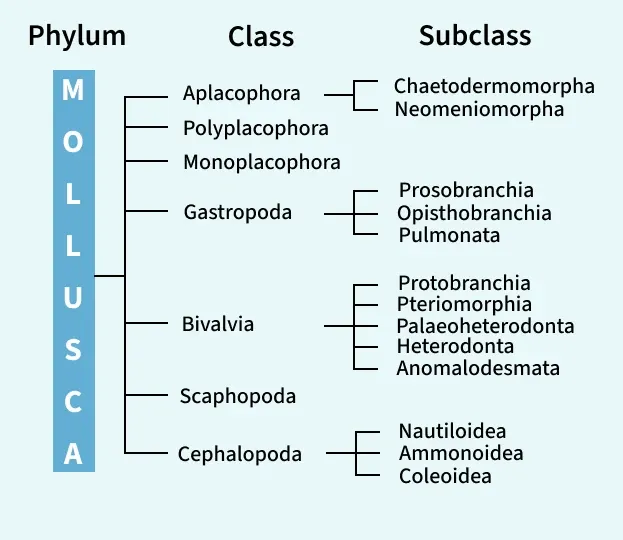
The organisms exhibit the following characteristics:
- They have three main body parts: a muscular foot for locomotion, a visceral mass containing internal organs, and a head with sensory organs.
- Molluscs respire using gills (aquatic species) or lungs (terrestrial species), and some rely on cutaneous respiration.
- Molluscs reproduce sexually, with separate sexes, and fertilisation can be external or internal.
- Molluscs are coelomate, and the main cavity is a hemocoel through which blood circulates as it has an open circulatory system.
- For excretion, they have kidney-like organs. In ancient times, it was a good source of food for humans, and it was a good source of luxurious goods like pearls, sea silk, Tyrian purple dye, etc.
- Examples are Octopus, Scallops, Bivalvia, Gastropods, etc.
9. Phylum Echinodermata
Phylum Echinodermata includes species like starfish, brittle stars, sea cucumbers, sand dollars, etc. They consist of marine animals with spiny, often calcareous endoskeletons.
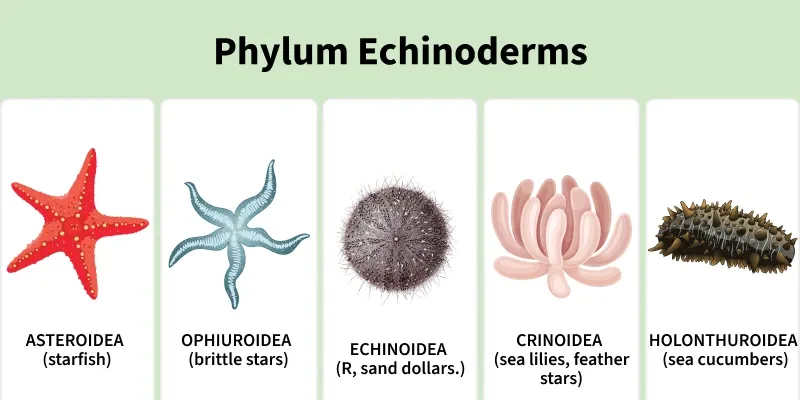
These organisms show the following characteristics:
- They are radially symmetrical.
- Echinoderms are usually found at the bottom of the sea.
- They possess a unique water vascular system, a network of water-filled canals and tube feet that are used for locomotion, respiration, and feeding.
- Reproduction is done asexually, and they regenerate tissues and organs. Some exceptions are there where they regenerate from a single limb.
- This phylum has valuable species due to its ossified skeleton, which is the main contributor to limestone formations.
- They are multicellular organisms, colored with unique shapes.
- Echinoderms respire through their tube feet, exchanging gases with seawater.
- Echinoderms are diverse in their feeding habits, with some species being predators, while others are detritivores (feeding on decaying matter) or filter feeders.
- Echinoderms are triploblastic and coelomates.
- Examples are Starfish, Sea cucumber, Sea urchins, Brittle stars, Cystoidea, etc.
10. Phylum Protochordata
Protochordates are a group of simple, primitive chordate animals that show some basic chordate characteristics but lack a well-developed backbone. They act as a connecting link between invertebrates and vertebrates, helping us understand the evolution of higher animals.
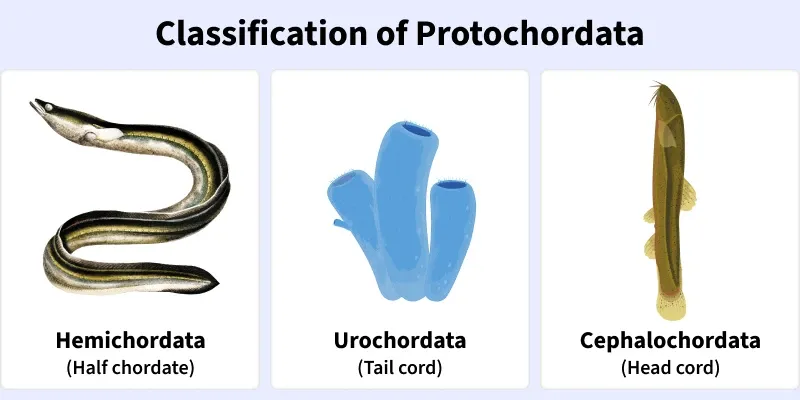
These organisms show the following characteristics:
- Protochordates are all aquatic, mostly marine creatures.
- The bodies of protochordata organisms are bilaterally symmetrical, which means that they can be divided into two halves when a plane is passed longitudinally.
- Organisms are triploblastic, which means they have ectoderm on the outside, endoderm on the inside, and mesoderm in the middle.
- Coelomates are organisms. Coelomate refers to the presence of a true coelom surrounded by mesoderm.
- Organisms in this phylum have an organ-system level of organisms.
- The body of organisms at one point in time consists of a long, rod-like structure that provides support known as the notochord.