
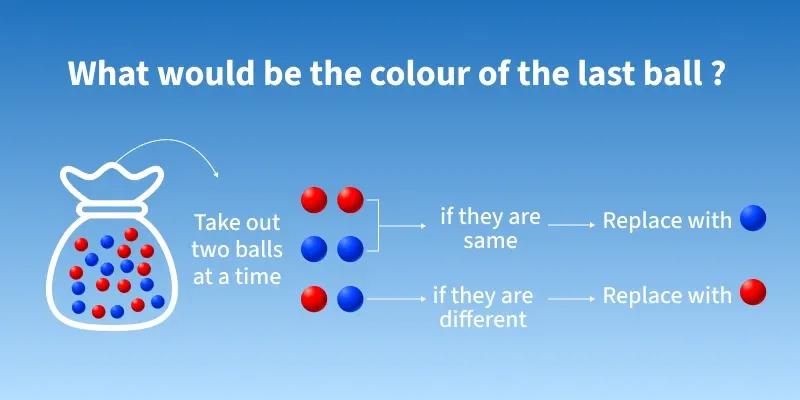
A bag contains 20 Red balls and 16 Blue balls.
You repeatedly perform the following operation:
- Remove any two balls from the bag.
- If the two balls are the same color, add one Blue ball to the bag.
- If the two balls are of different colors, add one Red ball to the bag.
Each operation removes two balls and adds one ball back to the bag, and the process continues until only one ball remains.
What will be the color of the last remaining ball?
Check if you were right - full answer with solution below.
Step 1: Check the number of Red balls
Initially:
- 20 Red balls
- 16 Blue balls
20 is an even number.
Step 2: What happens to Red balls?
When two balls are removed:
- Red + Red → Red decreases by 2
- Blue + Blue → Red unchanged
- Red + Blue → Red unchanged
So the number of Red balls either decreases by 2 or stays the same.
This means the number of Red balls always remains even.
Step 3: The last ball
At the end, only one ball remains.
If it were Red, then the number of Red balls would be 1 (odd).
But we have already shown that the number of Red balls always remains even.
Since this is not possible, the last ball cannot be Red.
So, the only possibility is that the last remaining ball is Blue.
Core Insight
For this set of replacement rules:
- If the initial number of Red balls is odd, the last ball is Red.
- If it is even, the last ball is Blue.